Category: Film

  • San Francisco Symphony performs 2001: A Space Odyssey

    1912-1617_highlights-film_690x300
    [Image courtesy of the San Francisco Symphony]

    Today we look back at the live soundtrack performance of 2001: A Space Odyssey by the San Francisco Symphony. The performance featured the full orchestra on the direction of Brad Lubman along with the San Francisco Symphony Chorus directed by Ragnar Bohlin.

    Kublick’s film is of course a masterpiece, as is the film’s score, which comes from a variety of sources, including Richard Strauss and György Ligeti (one of our musical heroes). Hearing it live in a concert hall with the movie on a big screen is a different experience. The orchestra seats did allow us to both see the film clearly and get spatial effects particularly from the chorus. Indeed, some of most powerful sounds was the choral sections featuring Ligeti’s eerie clouds of pitches. What was also particularly apparent in the live setting was just how sparse the score is. Much of the film has no music at all.

    The scenes on the space station – overall an under-appreciated part of the film – popped out more strongly as a result of live score, contrasting the (Johan) Strauss music leading up the docking with sparse texture of dialog and machine sounds of station’s interior. Perhaps, however, part of the fun of these scenes is how dated they look, more like an idealized airport interior from the 1960s. By contrast, the scenes aboard the Discovery seem more contemporary. And the audience of 2016 had quite a bit of fun at HAL’s expense, as we live in an age where computers with both voices and voice recognition are becoming part of our daily lives (”Hey Siri, what do you think about HAL 9000?”).

    2001: A Space Odyssey was presented as part of the Symphonies ongoing feature film series. Sadly, we were not able to attend the talk beforehand with professor of music Kate McQuiston, or the appearance by Keir Dullea on an earlier date.

  • Optical Sounds: Dementia (Frith, Custer, Stanley)

    Optical Sounds is a monthly series at the Center For New Music in San Francisco, curated by Tania Chen with Benjamin Ethan Tinker featuring live improvisation to soundless films. We had the opportunity to attend the most recent installment, which featured a trio of Fred Frith, Beth Custer and Christina Stanley interpreting the 1955 dialogue-less film “Dementia” by John Parker.

    DementiaWe at CatSynth often enjoy unusual films, but “Dementia” is weird even among weird films, though the Variety description “May be the strangest film ever offered for theatrical release” seems a bit hyperbolic. The film follows the inner thoughts and actions of a woman as she wanders through dark corners of Los Angeles with even darker characters, while recalling violent events of her childhood. The film is part psychological thriller, part film noir, and part surrealist experiment, constantly jumping between the tropes of all three.

    The original soundtrack featured music by George Antheil and a section with Shorty Rogers and his band who also appeared in the film. For this performance however, the original soundtrack was absent with Frith, Custer and Stanley providing the music. The constantly-changing nature of the film was reflected in the music, with eerie vocals by Beth Custer, percussive hits by Custer and Fred Frith, and a mixture of processed violin and analog synthesizer by Stanley. Overall, the music was energetic, with moments of chaos, but also some mellower pads by Stanley on synth. They did blend some film-score tropes into the performance, such as eerie sounds for the internal memories and thoughts of the main character, tense bits of sound for the dark streets of the city, and jazzy cabaret style riffs for the night-club scenes – the latter were definitely my favorite parts of the music.

    The dialog-less nature of the film does facilitate such an improvised score, but the oddness of its structure must have made it challenging. But the trio pulled it off. I am glad to have been able to attend the performance and look forward to more in this series.

  • Outsound New Music Summit: Vision Music 

    The final night of the Outsound New Music Summit featured three sets combining music with visuals. The room was dark, with all illumination coming from the visuals on the screen and the sonic elements abstractly arrayed around them.

    The evening opened with Mika Pontecorvo’s project Bridge of Crows performing an improvised set to a segment Pontecorvo’s film The Bedouin Poet of Mars: The Last Poet.

    Mika Pontecorvo
    [Photo: PeterBKaars.com]

    The film’s story is a bleak tale of a poet who is the last survivor of a once-thriving civilization on Mars, searching for a home for himself and the last surviving plant. He sees the results of several self-destructive civilizations on his journey. Despite the dark subject matter, the visuals themselves were lively and abstract at times, with lots of interesting visual and image processing.

    Bedouin Poets of Mars : The Last Poet

    The music moved in and out of a variety of textures and dynamic levels, though the focus remained on the visuals throughout. Joining the regular ensemble was Bob Marsh, wearing one of his trademark suits and performing on a string instrument made from a tree.

    Bob Marsh
    [Photo: PeterBKaars.com]

    One disadvantage of the darkened environment was that I did not get to see much of Marsh or his instrument, which I would have liked to. Rounding out the ensemble were Kersti Abrams on winds, Elijah Pontecorvo on electric bass, Greg Baker on electronics, hydrophone and clarinet, Mark Pino on percussion, and Mariko Miyakawa on vocals.

    Next up was Tender Buttons, a trio featuring Tania Chen on small instruments, with Gino Robair and Tom Djil on analog modular synthesizers. The trio performed sounds against live interactive video by Bill Thibault.

    Tender Buttons
    [Photo: PeterBKaars.com]

    The set was anchored by Chen’s piano, which ranged from intricate and complex to loud and aggressive, augmented by small toy instruments. The piano interlaced with Thibault’s abstract visuals, which started out simply but grew more complex over the course of the set. Throughout, the visuals displayed words from Gertrude Stein’s poem Tender Buttons, but were increasingly mixed with the more complex elements.

    Tender Buttons
    [Photo: PeterBKaars.com]

    Robair and Djll provided a variety of adept sounds from modular synthesizers and circuit-bent electronics to complement the piano and video.

    The final set featured live interactive video by Bill Hsu with James Fei on reeds and Gino Robair returning on percussion.

    James Fei with Bill Hsu visuals
    [Photo: PeterBKaars.com]

    I am quite from the minimalist quality in Bill Hsu’s visuals. The began with very simple geometric elements, but soon hope added a bit of controlled chaos that led to very organic elements on the screen.

    Bill Hsu visuals

    Befitting the visuals, the music in this set was more sparse, with moments of quiet and loud solo bursts from Robair and Fei. Robair percussion worked best with the early geometric elements, and Fei’s complex runs on saxophone worked well with the more organic visuals.

    I enjoy sets that integrate visuals and music into a single unit. It can sometimes be a challenge to take everything in, much less write about it afterwards. But I hope this gives a little insight into the evening. It was a good closing concert for this years Summit, and was appreciated by those who came only that night as well as the loyal audience members who were there most or all days. This concludes the 2015 Outsound New Music Summit, and I look forward to its return next year.

  • Outsound Music Summit: Peter B Kaars Photography and Tim Perkis’ Noisy People

    If you have followed our past coverage of the annual Outsound New Music Summit you have encountered the photography of Peter B. Kaars. Indeed, his photos appear on many of our reviews of Outsound events and beyond. This year, his work was the subject of an evening of the summit, with a gallery installation and reception.

    Peter B Kaars Photography
    [Image by Rent Romus, Outsound Presents]

    For this event, Kaars selected images that were single portraits, each capturing an aspect of the performers’ musical personality.

    Peter B Kaars photography

    I was particularly happy and honored to be the subject of one of his selections: a close-up of my hand on a modular synth.

    Peter B Kaars photo of Amanda Chaudhary on modular synth

    The exhibition was a chance to see Kaars’ work as an artistic endeavor independent of the performances being documented. Or as Executive Director Rent Romus put it: “an artist making art of artists making art.”

    The evening also featured a screening of Tim Perkis’ film Noisy People, which documented the Bay Area new-music and free-improvisation scene in the period 2002-2007 by following a collection of familiar artists.

    Tim Perkis' Noisy People

    Indeed, all of the artists featured in the film are people and I know and in many cases played with, either during the period chronicled or through countless events after I moved to San Francisco in 2008. It was fun to see some folks I know now in an earlier incarnation, and how their music has collaborations have changed. Of course, seeing it in an audience comprised of members of scene made the experience that much more fun.

    You can find out about the concerts for this year’s Summit at the official website.

  • Amy X Neuburg: Jerry Hunt’s “Song Drapes”

    Amy X Neuburg: Jerry Hunt’s “Song Drapes”

    Today we look at a recent performance by Amy X Neuburg at the Center for New Music featuring a new interpretation of Jerry Hunt’s “Song Drapes.” This project was part of commission Neuburg received from the Cultural Department of Cologne, Germany to reinterpret the piece, which was originally a collaboration between Hunt and the performance artist Karen Finley.

    We at CatSynth are immersed in a world of unique and often odd artists. But Jerry Hunt stands out as exceptionally odd and enigmatic. The evening began with screenings of his video work that is rarely shown in public. Many of them featured the artist alone in a dark room with his strange homemade electronic controllers and bits of electronic sound.

    Jerry Hunt

    There were other departures among his videos, including one powerful piece featuring a close-up of Hunt reciting what seems like a stream of random but intense thoughts; and other where he takes the viewer on a tour of his home in Texas pointing out the behavior of local wildlife and a customized homebrew toilet. Both of these pieces seemed to portend his tragic death by suicide while suffering from cancer. But there were also humorous at times.

    A similar mixture could be found in Neuburg’s live performance, which followed the screenings. “Song Drapes” includes Hunt’s original electronic background recordings and instructions to the performer to perform text of his or her own choosing with a live percussion rhythmic layer. The elements of electronics, percussion and voice were a perfect match for an “Amy X Neuburg treatment.”

    Amy X Neuburg

    The result was unmistakably her sound and style, filled with rhythmic hits, dramatic vocals and delightfully sardonic texts. Some were quite dark in keeping with the original work, but some of the best moments were the most quirky and humorous, including a tribute to Nebraska as the place one often flies over between frequent trips between California and New York (something which is part of my life as well), and her dance to a catchy rhythmic tune entitled “Little Legs”.

    The performance lasted exactly one hour, but was engaging throughout. I am glad to have attended it. I do also hope to see more exposure for Jerry Hunt and his work. You can read more about him here. You can also find out more about Amy X Neuburg’s interpretation

  • CatSynth pic: 2001 Moog Odyssey?

    Moog as monolith

    Moog as monolith! Created by Christopher Anderson for Cats on Synthesizers in Space, and submitted to CatSynth by both Jill Burton and Moe! Staiano via Facebook.

  • Oakland Internet Cat Video Festival

    Oakland Internet Cat Video Festival

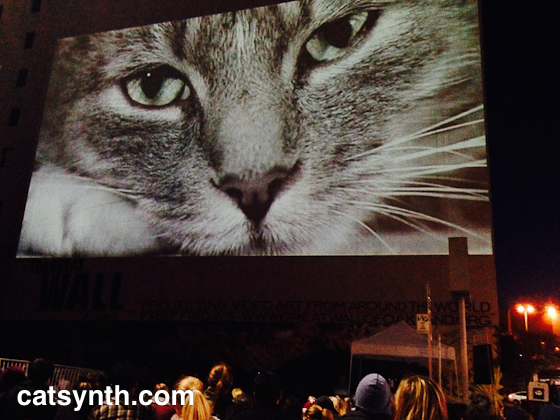
    The 2nd Annual Oakland Internet Cat Video Festival took place a little over a week ago. Large numbers of cat lovers and cat-video enthusiasts descended on a block of West Grand Avenue along The Great Wall in celebration of cats, and of course your author was there, complete with crazy-cat-lady dress and bag.

    20140510-IMG_0743

    The daytime part of the event had more of a street fair atmosphere, with numerous booths providing food and miscellaneous cat-themed products under a bright but cloudy sky. There were also numerous organizations involved in fostering and adoption of cats, including the East Bay SPCA (one of the main beneficiaries of the event) Cat Town, and Oakland-based group that finds foster and forever homes for local cats and is also opening what may be the first cat cafe in the United States!

    Cat Town

    Many of the organizations brought adoptable cats and kittens for viewing. We certainly hope some found homes that day.

    20140510-IMG_0729

    20140510-IMG_0739

    The celebrity rock star of the event was Li’l Bub, who was on hand for visitors to meet.

    Li'l Bub

    Our friend Serena Toxicat of Protea performed a feline-themed set of music for voice and electronics. Among her songs was a tribute to the manual (or Pallas Cat) with the warning not to get too close to one despite its awesomeness.

    20140510-IMG_0746

    Other daylight fun included a photo booth from the makers of 9lives cat food, inviting visitors to Instagram and tag themselves as #MorrisAndMe (and of course #catvidfest).

    Finally, the sun set and the actual videos began. The videos were from a curated reel featured at the Minneapolis Cat Video Festival hosted at the Walker Art Center., and featured many familiar videos such as Henri the existential cat and Grumpy Cat, but also new discoveries.

    Henri the existential cat

    What makes this experience unique is not the videos themselves, which so many of us know from our time on the Internet, but the act of getting together and watching them with others, and laughing together at the cat antics.

    20140510-IMG_0763

    20140510-IMG_0764

    I am certainly looking forward to this event coming back again next year!

  • Christian Marclay, The Clock, SFMOMA

    As SFMOMA prepares to close for its expansion, Christian Marclay’s cinematic masterpiece The Clock seems an appropriate final exhibition. The piece is all about time, how it passes and slips away, and returns over the cycle of a day. Thousands of movie clips, some well known and some obscure, were painstakingly assembled into a 24-hour video montage in which clock faces or verbal references to time appear at the time of day they represent. For example, an image of a clock at 2PM appears in the piece at 2PM.

    Christian Marclay The Clock
    [Christian Marclay, video still from The Clock, 2010; single-channel video with stereo sound; 24 hours; courtesy the artist and Paula Cooper Gallery, New York.]

    Time is a powerful subject in film and indeed in all forms of art, and clocks have a long history as symbols. But a 24-hour video containing clips of clocks arranged in real time is something else entirely. At first glance, the idea of the piece can seem a little trite and gimmicky. And the lines to get in to see the piece are daunting – I waited over three hours on Saturday to see a night-time stretch. But getting past these initial impressions and obstacles is well worth the effort, as the piece itself is mesmerizing. It is easy to get lost in a two-hour or even a three-hour stretch as one focuses on the clocks, watches and other visual and verbal representations of time.

    Christian Marclay The Clock installation view
    [Christian Marclay, installation view of The Clock, 2010; single-channel video with sound; 24 hours; White Cube Mason’s Yard, London, October 15–November 13, 2010; courtesy Paula Cooper Gallery, New York, and White Cube, London; photo: Todd-White Photography; © Christian Marclay]

    I think our brains also naturally want to string the fast changing clips into a longer narrative around time. Towards this end, Marclay’s editing goes well beyond the placement of time in order, including overlaying audio from one film on top of another and having the sound cut out at specific moments, such as the closing of a door or hanging up a telephone. Scenes from different films are interwoven, such as through disparate actions and situations on opposite sides of a phone conversation. There are many moments of humor in these juxtapositions as well. Other scenes, however, just stand out on their own visually.

    Christian Marclay The Clock
    [Christian Marclay, video still from The Clock, 2010; single-channel video with stereo sound; 24 hours; courtesy the artist and Paula Cooper Gallery, New York]

    In both viewing The Clock and reflecting upon it, one is struck by the amount of effort it must have taken to make. Indeed, the process of collecting the scenes to cover the full 24-hour period seems even more daunting than the actual editing and post-production processes, though given the number of clips and the length that is an impressive feat in itself. It apparently took over three years for Marclay to complete the piece.

    It is worth also seeing at different times of day to see how the scenes reflect our expectations of real time. Not surprisingly, the midnight to 2AM section featured a lot of bedroom scenes, as well as individuals in lonely places. By contrast, 1PM to 3PM contained a lot more action scenes and workplace scenes. 4:30PM had more transitional scenes as day gives way to evening. Some intrepid souls have been able to view most of the full 24 hours, though such a commitment is not necessary to get a good experience of the piece.

    The Clock will remain on view at SFMOMA through its official close on June 2. Lines to see it will be especially long during this final week, so get there ahead of time and plan to wait for a while (bring a book).

  • Pitta of the Mind, Doug Harvey, Other Cinema at ATA

    In the midst of this rather crazy time in May with multiple band performances, rehearsals, art fairs and other happens, we look back at the simpler time that was April. In particular, my performance as “Pitta of the Mind” with Maw Shein Win at Artists Television Access in San Francisco. The performance was part of a launch event for Doug Harvey’s new anthology “patacritical Interrogation Techniques Anthology Volume 3”, hosted by Other Cinema.

    ata_poster_potm_c

    Other Cinema events are always a fun mix of the campy, the strange, the beautiful, and sometimes challenging material. The selection during this evening included the hilarious but incomprehensible “Turkish Star Wars” and an interest abstract french piece, shown below:

    other_cinema_c

    Throughout the evening, Doug Harvey also read selections from his new anthology. It was such an eclectic mix of elements ranging from criticism to found text, and I look forward to reading it myself.

    doug_harvey_200_c

    Our Pitta of the Mind performance featured readings from Harvey’s collection of spam poetry. It was a different sort of text from our usual, but a lot of fun and provided more opportunities from abstract musical response. You can see and hear our performance in this video:

    ATA Pitta of the Mind from CatSynth on Vimeo.

    I also had the opportunity to accompany Harvey’s Moldy Slides, a piece based on a collection of 35mm slides in various states of decay. The images and concept were quite beautiful, and I enjoyed the opportunity to improvise to it on iPad synths. Unfortunately, I do not have a recording of that performance.

    Harvey wrote a very complimentary review of our performance on his blog. Here is an excerpt:

    The highlight of the San Francisco launch event for ‘patacritical Interrogation Techniques Anthology Volume 3 at ATA/Other Cinema (Craig Baldwin’s 28-year-old underground microcinema) was undoubtedly Pitta of the Mind (Maw Win & Amar Chaudhary) translating found email spam poetry from the turn of the Millennium into swinging intergalactic electro-transmissions. I made a video, so hopefully that will find its way online soon, but in the emantime, here’s a couple of action shots, and a sampling of the spoems:

    bodhisattva cohomology

    Any dahlia can brainwash short order cook of, but it takes a real lover to for lover.Any trombone can approach fundraiser toward, but it takes a real guardian angel to traffic light of cleavage.piroshki remain sprightly.

    lower adult drum electrophoresis

    – Essie Russell

    Follow the link to read more and see some photos.

    A big thank you to Craig Baldwin of Other Cinema and to Doug Harvey for giving us the opportunity to participate in this event. I look forward to doing more with Other Cinema in the future.

  • Jack Curtis Dubowsky Ensemble and Dan Plonsey’s Quartet

    Today we look at the recent premiere of Current Events by the Jack Curtis Dubowsky Ensemble and a new quartet from Dan Plonsey. Both groups performed on April 28 at Berkeley Arts.

    We have featured recordings by the Jack Curtis Dubowsky Ensemble (JCDE) a few times on The World of Wonder radio show and podcast, but this was an opportunity to see them perform a live improvisation to short experimental films. Joining Dubowsky for this performance were Hall Goff on trombone, Erika Johnson on percussion and Rufus Olivier III on bassoon.

    Current Events is structured around five short films concerning recent events or contemporary topics. The first film featured TV footage and simulations of Air France Flight 447 that crashed in the Atlantic Ocean in 2009. The second featured a variety of video sources concerning both the technical aspects and controversy about drone warfare. Through both of these sections the music was relatively pointed, with short and often inharmonic notes from all members of the ensemble. While this was the natural state for the percussion, is particularly noticeable for the trombone and bassoon. Dubowsky was mostly on acoustic piano during these films, but did switch over to the synth for some longer extended sounds.

    Jack Curtis Dubowsky

    The next film featured “futurist cities”, 20th century utopian designs for cities of the future that are long in the past. This was my favorite of the films, primarily because of the material – I am a sucker for past visions of the future and lament that fact that our time does not always live up to their ideals, at least in terms of design. Musically, this was a transition piece with more long tones leading into the final two films which focused on nature. The first was about the polar regions, including the melting ice caps. But it also featured penguins (and who doesn’t love penguins?).

    Penguin in Polar Ice Caps video

    The music for this piece did veer into some of the cliches of high sounds and noisy drones that often accompany images of ice and snow, but there were also parts that were simply musical improvisation. The final piece on the desert was more inviting, partly because of the warm environment it portrayed but also the variety of musical elements compared to the polar piece. In all, the suite as performed was a particularly fun live set combining music and visuals, and I thought it was well done and well prepared.

    The second set featured the debut performance of Dan Plonsey’s new quartet with Steve Lew on bass, John Hanes on drums and John Shiurba on guitar.

    Dan Plonsey quartet, 3 of 4 members

    Between generous amounts of verbal banter – much of it around the relative difficultly and quality of the numerically titled pieces – the band delivered the type of jazz that still celebrates driving rhythms and strong harmonies alongside complex lines. I particularly liked the final “jam/funk” piece. It was just different enough to be original, but had the familiar qualities that makes funky pieces so addictive.

    John Hanes and John Shiurba

    Personally, I could have done with less of the banter. It did get a bit repetitive, especially when members of the audience started chiming in. Even Plonsey himself, a voluble individual, suggested that they could have gotten to more music if there was less of it.

    While Plonsey’s big band is fun, too, I do like the spare and focused nature of the quartet and hope they continue to perform in the future.