
By J.B. 🙂

Kearny Street Workshop’s APAture 2015 festival continued this past weekend with more showcases in multiple fields. I was able to attends parts of two of them, and share these brief notes.
The Music Showcase took place last Friday at Bindlestiff Studio in the SOMA neighborhood of San Francisco (it’s our home neighborhood at CatSynth). There was a wide range of musical styles present.
The evening opened with reggie-infused sounds and rhythms from Iridium.

Next up was ebolabuddha, an intense metal band that featured reading of books in addition to the playing of instruments (quite loudly).

The band featured some familiar faces, including Eli Pontecorvo on bass/vocals and Mark Pino on drums with Steve Jong on guitar and vocals.

Combination of the forceful and physically driving music with the book readings (in addition to guest performers, everyone was invited to come up and read) was quite fun.
The tone and energy changed abruptly with MC a.K.aye (aka Ahmed Kap Animo), whose words with both playful and at times featured strong messages that resonated with many in the audience.

Next was The Vibrant Things featuring Amy Dabalos on vocals. Dabalos had a fantastic and inspiring voice that worked well the group’s mixture of jazz, R&B and cabaret sounds. I also always enjoy seeing other groups with Nord keyboards.

One of the more unique showcases of APAture is the Comics and Illustration showcase, which took place on Saturday at the main branch of the San Francisco Public Library.

At first glance, the event has a nerdy vibe and many familiar styles and tropes of popular Asian comics. But many of the artists also featured strong messages in their work. Artist Bo explores queer and transgender identities in his comics. Pixelated follows the experience of a biological female passing as a male and suddenly being assumed to have strong technical skills, poking fun at gender stereotypes around technology.
Featured artist Thi Bui presented meticulously drawn art including her graphic novel The Best We Could Do, an “immigration epic” about her family. She also made drawings of visitors to the event as a fundraiser for Kearny Street Workshop.

[© Kearny Street Workshop/ Shuntaro Ogata]
I particularly enjoyed Cecilia Wong’s colorful illustrations, many of which featured cats. I of course had to purchase a copy of one. I look forward to seeing more of her work in the future.

Wong also gave a presentation of color, with tips on both theory and practice. It gave me a few thoughts for color in future graphic designs to complement my usual black&white styles.
Also present at the event was the Comic Book Legal Defense Fund, a “non-profit organization dedicated to the protection of the First Amendment rights of the comics art form and its community of retailers, creators, publishers, librarians, and readers.” I was not familiar with them, but on reflection I’m not surprised that many comics artist may need such defense, especially when the challenge traditional norms and authority (something that we at CatSynth wholeheartedly support).
Optical Sounds is a monthly series at the Center For New Music in San Francisco, curated by Tania Chen with Benjamin Ethan Tinker featuring live improvisation to soundless films. We had the opportunity to attend the most recent installment, which featured a trio of Fred Frith, Beth Custer and Christina Stanley interpreting the 1955 dialogue-less film “Dementia” by John Parker.
 We at CatSynth often enjoy unusual films, but “Dementia” is weird even among weird films, though the Variety description “May be the strangest film ever offered for theatrical release” seems a bit hyperbolic. The film follows the inner thoughts and actions of a woman as she wanders through dark corners of Los Angeles with even darker characters, while recalling violent events of her childhood. The film is part psychological thriller, part film noir, and part surrealist experiment, constantly jumping between the tropes of all three.
The original soundtrack featured music by George Antheil and a section with Shorty Rogers and his band who also appeared in the film. For this performance however, the original soundtrack was absent with Frith, Custer and Stanley providing the music. The constantly-changing nature of the film was reflected in the music, with eerie vocals by Beth Custer, percussive hits by Custer and Fred Frith, and a mixture of processed violin and analog synthesizer by Stanley. Overall, the music was energetic, with moments of chaos, but also some mellower pads by Stanley on synth. They did blend some film-score tropes into the performance, such as eerie sounds for the internal memories and thoughts of the main character, tense bits of sound for the dark streets of the city, and jazzy cabaret style riffs for the night-club scenes – the latter were definitely my favorite parts of the music.
The dialog-less nature of the film does facilitate such an improvised score, but the oddness of its structure must have made it challenging. But the trio pulled it off. I am glad to have been able to attend the performance and look forward to more in this series.
Today we look back at the final concert of the 2015 San Francisco Electronic Music Festival. The program featured artists – some familiar, some new – exploring different aspects of electronic music, both aurally and visually.
The evening opened with AQULAQUTAQU, a “fractal alien operetta” by Kevin Blechdom (aka Kristin Grace Erickson) in collaboration with Madison Heying, Matthew Galvin and David Kant.

[Photo: peterbkaars.com]
The operetta, complete with visuals, costumes, and dance, follows the story of two scientists on the planet AQULAQUTAQU, whose discoveries run afoul of the theocratic rulers of the planet (at a level Earth’s contemporary theocrats could only dream of) and end up feeling the planet for Earth. During the story, one of the scientists presents the story of Ladle Rat Rotten Hut, a corruption of Little Red Riding Hood complete with images of vague homophones to the words of the story, and a larger-than-life wolf costume. The journey to Earth sets a very different tone from the sections on the homeworld, and the finale in which the arrivals on Earth have a dance party (with the wolf joining in) was fun and reminded me of 1960’s tropes where everyone comes out and dances in the middle or end of a show.
The next set was a solo performance by Doug Lynner on his original Serge modular synthesizer along with a Cyndustries Zeroscillator.

We have frequently chronicled Doug Lynner and his virtuosic performances here on CatSynth, and they are always impressive, sometimes quite subtle and intricate before breaking out into louder noisier sections. This one was a bit different, focusing more on beats and harmonies that approached traditional Western music, perhaps even a bit towards electronica. Of course it was all done with the same instrumentation as his more abstract performances – the Serge modulars tend to have simple functions like slopes that are combined into more complex signals, so it likely takes a bit to assemble something as rhythmic and harmonic as this performance was.
The final set featured a piece by Olivia Block titled Aberration of Light. Originally composed for a live cinema piece, it was presented here as a four-channel realization in a darkened hall. The one minimalist visual element was a single cone of light striking fog (emitted from a machine offstage).

[Photo: peterbkaars.com]
The piece and the visual was meditative. One could focus on just the sounds and the interaction with the room, which forms another instrument of the piece, but I did find myself focused on the light cone as I am often drawn to minimalist visual elements. It also gave the performance a more mysterious quality than would have been present if the room was entirely dark.
Overall it was a solid show and thought Block’s piece was a great ending to the festival. Because of many circumstances beyond the scope of this article, this final show of SFEMF was the only one I was able to attend the year. I am glad I was able to make it, and looking forward to next year’s festival.
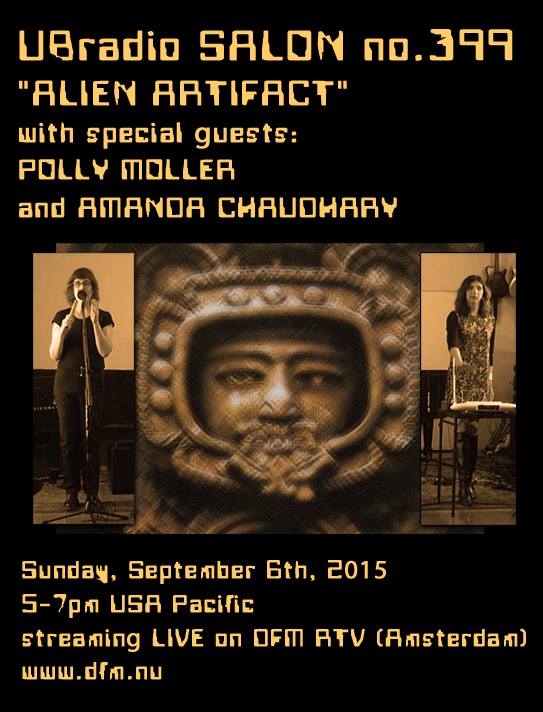

Last weekend Polly Moller and I joined the hosts at UBRadio Salon for two hours of live experimental electronic improvisation. UBRadio Salon is a project by the folks who brought us Big City Orchestra UBIUBI and we excited to have the opportunity to play on their 399th consecutive weekly show.

We began with a version of our improv piece Ode to Steengo, with Polly on voice, bass flute and guitar, and I performed on modular synth and Moog Theremini. It became a quartet with electronics, and DIY sonic objects. Overall it was one of the best versions of this piece we have done! We immediately sequed into an extended coda with abstract improvisation. The second set was open improvisation as well, with Polly providing vocals and narratives throughout. In between were clips from National Lampoon radio broadcasts as well as bits of the original Stainless Steel Rats series, on which the spam text of Ode to Steengo is based.
You can hear the show in its entirely via this archive.
Thanks to our hosts Ninah Pixie and DAs for having us on the show. I look forward to their upcoming 400th episode, and we certainly hope to come back and play again.

Comic by J.B.. You can find out more about Steve Lacy here and here.
This story intersects with Ornette Coleman, whom we wrote about at the time of his death earlier this year. And the desire to “play some interesting music and get paid for it” resonates with us at CatSynth.
The final night of the Outsound New Music Summit featured three sets combining music with visuals. The room was dark, with all illumination coming from the visuals on the screen and the sonic elements abstractly arrayed around them.
The evening opened with Mika Pontecorvo’s project Bridge of Crows performing an improvised set to a segment Pontecorvo’s film The Bedouin Poet of Mars: The Last Poet.

[Photo: PeterBKaars.com]
The film’s story is a bleak tale of a poet who is the last survivor of a once-thriving civilization on Mars, searching for a home for himself and the last surviving plant. He sees the results of several self-destructive civilizations on his journey. Despite the dark subject matter, the visuals themselves were lively and abstract at times, with lots of interesting visual and image processing.

The music moved in and out of a variety of textures and dynamic levels, though the focus remained on the visuals throughout. Joining the regular ensemble was Bob Marsh, wearing one of his trademark suits and performing on a string instrument made from a tree.

[Photo: PeterBKaars.com]
One disadvantage of the darkened environment was that I did not get to see much of Marsh or his instrument, which I would have liked to. Rounding out the ensemble were Kersti Abrams on winds, Elijah Pontecorvo on electric bass, Greg Baker on electronics, hydrophone and clarinet, Mark Pino on percussion, and Mariko Miyakawa on vocals.
Next up was Tender Buttons, a trio featuring Tania Chen on small instruments, with Gino Robair and Tom Djil on analog modular synthesizers. The trio performed sounds against live interactive video by Bill Thibault.

[Photo: PeterBKaars.com]
The set was anchored by Chen’s piano, which ranged from intricate and complex to loud and aggressive, augmented by small toy instruments. The piano interlaced with Thibault’s abstract visuals, which started out simply but grew more complex over the course of the set. Throughout, the visuals displayed words from Gertrude Stein’s poem Tender Buttons, but were increasingly mixed with the more complex elements.

[Photo: PeterBKaars.com]
Robair and Djll provided a variety of adept sounds from modular synthesizers and circuit-bent electronics to complement the piano and video.
The final set featured live interactive video by Bill Hsu with James Fei on reeds and Gino Robair returning on percussion.

[Photo: PeterBKaars.com]
I am quite from the minimalist quality in Bill Hsu’s visuals. The began with very simple geometric elements, but soon hope added a bit of controlled chaos that led to very organic elements on the screen.

Befitting the visuals, the music in this set was more sparse, with moments of quiet and loud solo bursts from Robair and Fei. Robair percussion worked best with the early geometric elements, and Fei’s complex runs on saxophone worked well with the more organic visuals.
I enjoy sets that integrate visuals and music into a single unit. It can sometimes be a challenge to take everything in, much less write about it afterwards. But I hope this gives a little insight into the evening. It was a good closing concert for this years Summit, and was appreciated by those who came only that night as well as the loyal audience members who were there most or all days. This concludes the 2015 Outsound New Music Summit, and I look forward to its return next year.
The third night of the Outsound New Music Summit featured three sets that spanned a wide range of electronic music history, from analog modular synthesizers to digital laptops and an eclectic mix of technologies in between.
First up was a “power trio” on Serge Modular synthesizers featuring LX Rudis, Doug Lynner and Dmitri SFC.

[Photo PeterBKaars.com.]
I have heard all three perform of Serge synthesizers before, but never together in this way. The result combined their very different performance styles, with intricate and meticulous musical details from Doug Lynner and driving beats from Dmitri SFC. There were also a variety of drones, noise hits and other sonic elements throughout the performance, which consisted of a single 40-minute improvisation.
Next up Instagon with edition 684 of Lob’s long-running project. This all-electronic mixer set featured Andrew Wayne, Tim White, Thomas Dimuzio, Marc Schneider, Mark Pino and Jack Hertz.

[Photo PeterBKaars.com.]
As with most Instagon mixer sets, each of the performed improvised freely in his instruments, with Lob conducting and sculpting the performance in real time on a mixer. The result is at times chaotic and cacophonic, but appropriately so and mixed with sparser moments where the details of a particular playing were brought out. One of the unifying elements was recorded text that appeared at various times before being obscured beneath the noise.
The final set was a digital laptop trio featuring Thea Farhadian, Aaron Oppenheim and Tim Perkis. This was an ensemble formed specifically for this concert.

[Photo PeterBKaars.com.]
For a while it was rather common to see musicians performing solo or in ensembles exclusively with laptops and digital-processing software. It seems to be less common at the moment with the resurgence of hardware synthesizers, and it is becoming more common to see electronic musicians including analog synthesizers like the classic Serge modulars from the first set. This transition is something I have myself participated in as a performing electronic musician. But the trio on this night reminded me of some of the unique sounds that digital systems can create, with access to samples, jumps, and signal processing that takes advantage of artifacts and computation, such as FM and granular synthesis. There was also more subtlety in the music for this set, with some very quiet moments. Unlike the previous sets, this one was broken up into a few distinct compositions.
Overall, it was interesting to hear the different strains of disciplines within electronic music juxtaposed as they were on this evening. Perhaps an interesting follow up would be to pair a modular synth performer with a digital laptop performer in a future concert.
While the first night of the 2015 Outsound New Music Summit was billed as “Quiet Noise”, the second night was something altogether different. The concert features three exuberant but very different bands spanning a wide variety of musical techniques and styles.
First up was Cabbages, Captain and King, a trio featuring Eli Wallace on piano, Karl Evangelista on guitar, and Jon Arkin on drums.

[Cabbages, Captain and King. Photo: peterbkaars.com.]
I have become quite a fan of Eli Wallace’s piano playing, which is virtuosic and energetic. Combined with Evangelista’s intense and varied guitar performance and Arkin’s drums, the trio packed quite a punch. The speed and energy rarely let up throughout the 45-minute set. The music had an unsettled quality, always moving forward and never quite reaching a groove or tonal center. There were occasional quiet moments when the overall intensity of the performance let up, and the final notes with prepared piano were a nice touch.

[Eli Wallace. Photo: peterbkaars.com.]
Next up was Liza Mezzacapa’s Bait & Switch performing her project avantNoir. The pieces in this project were all inspired by noir fiction. The first half was based on “hard-boiled” stories by Dashiell Hammett set in 1920s San Francisco – with many familiar places and streets references – and the second half was based on “soft boiled” stories by Paul Auster set in 1980s New York (also a familiar setting).

[Lisa Mezzacappa’s avantNOIR with Bait & Switch. Photo: peterbkaars.com.]
The music fit into the punctuated jazz style I have heard many times from Mezzacapa and her bands. But there was a distinctly 1970s crime show vibe to many of the pieces that contrasted with the times and places of the original stories’ settings. The interplay of bass, guitar with wah wah and drums, along with some of the electronic sounds from guest performer Tim Perkis led to this 1970s feel. The project itself suggests film scores for the stories, and I liked the idea of changing listeners’ expectations, especially if they have seen Hollywood versions of these stories. In addition to Mezzacapa and Perkis, the set featured Aaron Bennett on tenor saxophone, Jordon Glenn on drums, John Finkbeiner on guitar and special guest William Winant on vibraphone and sound-effects percussion. I found Winant’s seltzer bottle and tiny door particularly amusing.

[Aaron Bennett and William Winant. Photo: peterbkaars.com.]
Then it was time for Vacuum Tree Head to take the stage.

[Vacuum Tree Head. Photo: peterbkaars.com.]
Led by Jason Berry who was conducting this evening, led us through fast-paced set of short pieces that ranged from classic jazz to deep funk to something approaching metal rock. Above the fray were vocals by Amy X Neuburg, who brought her theatrical and operatic voicings to the rather challenging music along with her very distinctive performance personality.


[Amy X Neuburg and Jason Berry. Photos: peterbkaars.com.]
Many of the pieces, which were composed primarily by Berry and Michael de La Cuesta who together formed the band in 1989(!), were premiers. The band made the most of the variety of music, with an extended fusion keyboard solo by Amanda Chaudhary in DL DS, deep funk from the whole band behind Rich Corney’s guitar in EMS, a blindingly short jazz tune inspired by the Akhnaton dynasty of ancient Egypt, and a loud metal tune that may have been a first for an Outsound New Music Summit.

[Amanda Chaudhary et al. Photo: peterbkaars.com.]
Rich Lesnick (also a band-mate of mine in Reconnaissance Fly) brought solid saxophone and bass clarinet, including an extended moody bass-clarinet solo in Cushion Fortress; and Michael de la Cuesta featured in many songs on analog synthesizer, guitar and glockenspiel. Justin Markovits held things together with his drumming, assisted in the rhythm section by Tom Ferguson on bass. There was even a bit of abstract electronics from Amy X Neuburg on Blippo Box and Amanda Chaudhary on modular synth.


[Michael de la Cuesta and Justin Markovits. Photo: peterbkaars.com.]
The set was very well received by audience, some of whom were longtime fans of the band and some hearing us for the first time. And personally, it was quite a privilege to be part of the band for this event.
Overall, it was a strong evening for the summit, one that stood out as quite contrasting among the sets as well as with the other concerts.
The opening concert of the 2015 Outsound New Music Summit open with a very elemental program based on music from wood, stone, earth and metal.
First up was Cheryl Leonard performing compositions for natural objects, including shells, stones, wood, and water. Each of the pieces was accompanied by a video created from other artists.
Water and extreme weather were major themes of her set. The first piece was based on field recordings of melting ice on lakes in Yosemite National Park. As an ominous sign for the chronic drought we are facing here in California and climate change worldwide, the ice was thawing an crackling without a snow cover in mid January. Nonetheless, the music Leonard created from this was beautiful, the thumps and crackles formed a surprisingly strong rhythm with changing meter. Another piece focused on a storm while in open waters of the Arctic ocean as seen through the porthole of a ship, with video by artist Genevieve Swift. This piece was more turbulent compared to the more mesmerizing nature of the melting ice.

Leonard also employs quite a variety of musical techniques for her natural objects, not simply percussive techniques. In the photo above, we see her playing dried kelp as a wind instrument.
Next up was Machine Shop, a duo featuring Karen Stockpole on gongs and Drew Webster on electronics. The dominant element in this set was metal, but not simply metal as found objects, but forged into strong and beautiful instruments.
Gongs can of course be loud and chaotic, but the rich harmonics and interplay among them can be brought out for subtle musical phrasing with a master artist like Karen Stockpole. The sounds ranged from loud booming drones to individual nearly pure tones and beats among harmonics from different instruments. There were also more abrupt staccato notes that she played with a mobile gong while walking around the stage. The overall effect was hypnotic, but nonetheless very musical with phrasing and a subtle form of rhythm.
It was often difficult to tell where the acoustic sounds of the gongs ended and where the electronic processing began, which is not a bad thing, as I think electro-acoustic ensembles should often blend these elements. In the last two pieces, however, Webster’s electronics were more apparent, and one could here the processing as well as his synthesizer contributions to the sound which complemented the amplified gongs.

Overall, it was a strong start to this years summit. Both sets were very well received by the full house in attendance; and it was refreshing to see that the artists received support for their recordings for sale (at least one of the new releases is now in the CatSynth collection).
Most photographs for this article are from Peter B. Kaars, who was featured earlier in the week with an exhibit and reception. You can read our report from that event here.


