Category: Music

  • room: GLASS NOODLE (Pamela Z and Carl Stone)

    On March 16 I attended the latest installment of Pamela Z’s ::ROOM:: series at the Royce Gallery in San Francisco. This concert, entitled room: GLASS NOODLE, featured Pamela Z and Carl Stone in solo performances, and then together as the duo.

    The performance opened with a series of solo works by Pamela Z. I had heard several of these before, at the San Francisco Electronic Music Festival and earlier ::ROOM:: performances. As in previous performances, she began with a piece that featured live looping of melodic singing turned in harmonies, along with extended vocal techniques, “street textures” against sung lines, and bubble wrap. This was followed by a humorous piece the features the sounds and gestures of a manual typewriter, both key clicks and the carriage return – the narrative at the beginning of the piece is that the performer is writing to her penpal on a typewriter because her MacBook is broken. In the background, the video features transformations on old QWERTY typewriter keys. The round mechanical keys lent themselves to playful rolling animations. Over time, the music shifted to short voice loops and sample glitches, and gradually became darker. One piece that featured the experience of going through airport security (including an operating singing of the familiar “did you pack your own bags” inquiry) seemed familiar from SFEMF, although in that performance I recall a longer section in which people spoke about their contents of their suitcases. Pamela Z concluded her solo performances with sketches from new pieces. There were eerie loops of pure tones, whispers, stop motion video of the artist on a wooded path – bits of sound that resembled prepared piano were followed by several voices talking about memory.

    Carl Stone’s performance was an electro-acoustic tour de force. His continuously changing samples and other electronic sounds weaved together a complex structure with both energy and sense of direction. It started off subtly, with a build-up of granular synthesis and complex harmonics that quickly became enveloping. Some of the sonic elements evoked a sense of relaxation, even as they were metallic and machine-like. A section of rhythmic percussive sounds and plucked strings seemed to suggest a rock influence, which gradually morphed into something more South Asian featuring tabla and other drums. As the sounds further transitioned from percussion to vocals with rolling watery lines, it seems we were traveling further east towards Southeast Asia. The music settled into an undulating six-eight rhythm, that every so often would pause abruptly and resume. String instruments provided both the harmonies and the rhythm, the vocals grew more tonally complex. Bell sounds emerged into the mix, at first part of the overall Asian sound but then becoming a more abstract element. It seemed that the bells were growing, with a soundscape of large metallic sounds, and constant harmonies against an ethereal background. The overall sound grew in intensity and sounded “choral”. After a period of time in this pattern, the Asian-influenced percussion and voice fragments re-emerged, although at times the voice seemed to be in a more classical Western style. Towards the end of the continuously evolving piece, there was at least one false ending where the sound disappeared, before returning, until it drew to a true close.


    After a brief intermission, Carl Stone and Pamela Z returned to perform as a duo called Glass Noodle. The set started out very quietly with low granular sounds and low pitches that seemed like machinery winding down. Slowly, the sounds became a little higher and faster. Videos of glass noodles were projected on the background as Pamela Z began reciting noodle recipes. (For anyone reading this article who is not familiar with glass noodles, they are quite tasty and I highly recommend trying them.) The short vocal samples, which were looped and granulated, built up and became more complex over time, and were eventually joined by percussion and melodic bell-like sounds. As the voice and electronic sounds again became more subdued, the video became more glitchy, and I heard a recipe for fish source thrown in amongst the noodles, as well as vocal sound effects that evoked “deliciousness”. Minor harmonies emerged against the recipe recitations, along with references to red chili peppers and pickled garlic. If I had not already eaten before this performance, I am sure I would have been quite hungry (glass noodles and the other foods described are all quite tasty). The order and complex counterpoint of the music eventually decayed into a series of asynchronous loops.

    The next section began with classical piano and granular sounds, sparse vocals and bird calls. The loops, pitch bends and other effects were quite playful, and evoked the sound experiments of the late 1960s (think “Revolution 9”). The sounds of the birds and voice gave way to strange percussive sound effects, squeaking and rubbing, before the voice returned in the distance. Over time the texture became more complex, with short hits of metal and glass sounds and a glitchy voice loop. The noodles being projected at this point seemed more brittle than the sinuous textures from the earlier part of the set – then all of a sudden they “melted” as the sounds grew more extended. As the sound once again grew glitchier and noisier, the piece drew to a close.

  • John Butcher, Bill Hsu and Gino Robair at Artist Television Access

    live visuals by Bill Hsu

    Two Sundays ago, I attended a performance at Artist Television Access featuring electro-acoustic audio-visual improvisations with John Butcher, Bill Hsu and Gino Robair. Bill Hsu provided the visual elements of the performance using the visualization environment Processing. (I have been interested in Processing for a while, and used it in the abstract graphics in my video piece featuring Luna.) Gino Robair had an array of electronic devices, including a Blippo Box and an Alesis effects unit, and acoustic percussion for a variety of sounds. John Butcher provided the low-tech counterpoint on saxophone.

    I arrived late to an already pitch-black room as the first piece was concluding. (I was late because I was looking for a parking spot, which in the Mission is usually an ordeal. and I rarely drive there, but I had to on this night because of other obligations.) The next piece began in darkness, with small colored dots and a very sparse musical texture. The sound primarily consisted of electronic drones and long saxophone tones. As the the dots began to expand, so did the music. It became more active and featured more percussive sounds from Robair. As the graphics grew more complex, with swells and streaks, the music veered from discrete sounds to outright skronking with long runs of fast notes from both performers.

    The next piece featured graphics that reminded me a bit of finite-element simulations with large numbers of particles forming in and out of patters. At first the particles seemed to form glyphs or characters of a written language, but then dissolved into smoke. This was set against sparse music, featuring bowed metal. (It was too dark to see, but I am pretty sure this was Gino Robair’s signature cracked cymbal.) The graphics shifted gradually over time, sometimes it seemed more like water, sometimes more like sand. Towards the end, the music (both saxophones and percussion) moved towards rather piercing high tones.

    After a brief intermission, the performance resumed with the now familiar sound of the Blippo Box. It is interesting how despite having chaotic processes, this instrument has a very distinctive set of timbres and contours that are quickly recognizable. I did find out after the performance that the Blippo Box was being used in conjunction with an Alesis effects unit, which added more dimensions to the sound without changing its inherent character. Butcher attempted to match the sound on his saxophone, coming into unisons on the steady-state pitches, but then moving in chaotic runs of fast notes are growling timbres during the more turbulent output from synthesizer. The graphics during this piece focused on two closed elements, one yellow and one purple. They were mostly round shapes that curved in on themselves, but they occasionally coalesced into representational objects, such as a complex cross shape with sub-bars on the end (a bit like an Eastern Orthodox crucifix), and vague outlines of human figures.

    The next piece was a sharp contrast musically, with drum samples and live percussion set against percussive saxophone effects, such as key clicks and tonguing. The graphics featured a red star with a roiling plasma surface that expanded over time.

    The graphics in the final piece connected most strongly with my own visual aesthetics. It featured patterns of vertical bars overlaid periodically with large dots. The patterns started out simple, focusing on just a few elements on colors, but got more complex and richly colored over time. The music set against these visuals again featured the Blippo Box and its constantly changing but distinctive sound palette. But rather than attempting to match it, Butcher’s saxophone provided a counterpoint. He wove together active lines and melodies that on occasion were distinctively jazz-like, and then moving back and forth between long runs and series of loud inharmonic tones.

  • Pi Day, 2011 (with Music)

    Every year, we at CatSynth join numerous other mathematics enthusiasts, geeks and otherwise eccentric characters in celebrating Pi Day on March 14.

    March 14 is notated in the U.S. and some other countries as “3-14”, which evokes the opening digits of π (pi). Although the date representation is a very arbitrary connection to the number, we also recognize that the representation of π in decimal digits is arbitrary, an accident of human beings having ten fingers. So this year we are exploring the representations in binary and other related bases.

    To represent an integer in binary, one of course presents it as a sum of powers of two, e.g., 11 = 8 + 2 + 1 or 1011 in binary. But one can also represent fractional numbers in binary. Digits to the right of the decimal point represents powers of one-half. So the binary number 0.11 is 1/2 + 1/4, or 3/4. Fractions like 1/3 can be represented with repeating digits as 0.010101…, much like in base ten. And this concept can be extended to irrational numbers like π.

    The author of this website has calculated 32768 digits of pi in binary. We reprint the first 258 below:

    11.
    00100100 00111111 01101010 10001000 10000101 10100011 00001000 11010011 
    00010011 00011001 10001010 00101110 00000011 01110000 01110011 01000100 
    10100100 00001001 00111000 00100010 00101001 10011111 00110001 11010000  
    00001000 00101110 11111010 10011000 11101100 01001110 01101100 10001001 
    

    The initial “11” represents the 3 in π, and the remaining digits begin the non-integral portion. Like in the decimal representation, the binary representation continues forever with no particular pattern. While not as iconic or memorable as the decimal representation 3.14159…, there is something about the binary representation that makes it seem more universal, i.e., based on fundamental mathematical truths rather than a quirk of human anatomy. For me, the binary representation also lends itself to musical ideas. And for the occasion, I have created a couple of short synthesized pieces representing the 32768 binary digits of pi. In the first example, each binary digit represents a sample. The “1” represents full amplitude and the zero represents no amplitude (silence). The result, which at 44.1kHz sample rate is less than one second long, can be heard below.

    The random configuration of digits sounds like noise, and more specifically like white noise, suggesting something approaching uniform randomness at least to human hearing. I also made an example slowed down to a level whether the individual samples became musical events. I find this one quite interesting.

    With some additional refinement (and may some more digits to extend the length), it could certainly stand alone as a composition.

    One interesting counterpoint to the notion that digits of pi form white noise is a conjecture related to its representation in hexadecimal (base 16), which as a power of two is “closer” to binary and seemingly less arbitrary than decimal. From Wolfram MathWorld, we find the following “remarkable recursive formula conjectured to give the nth hexadecimal digit of π – 3 is given by where is the floor function:

    The formula is attributed to (Borwein and Bailey 2003, Ch. 4; Bailey et al. 2007, pp. 22-23). If true, it would add some sense of order to the digits, and thus additional musical possibilities.

  • Music in Motion at the Luggage Store Gallery

    I will be attending and participating in this performance tonight at the Luggage Store Gallery. The evening will unfold as an interaction among Laurie Amat, the Cornelius Cardew Choir and the Free Reed Vibrating Society. The two ensembles will trade off pieces, with Laurie Amat performing a solo in between.

    In between performances by the Cardew Choir I may be live tweeting @catsynth. As long as it doesn’t seem too tacky.


    The Luggage Store Gallery
    1007 Market Street @ 6th
    San Francisco, CA

    Music in Motion focuses on the ongoing dialogue between space and sound. The sound helps define the space. The space helps define the sound.

    Space/Sound investigators are:
    Laurie Amat – solo voice and movement

    Cornelius Cardew Choir
    Tom Bickley – director and co-founder
    Eric Theise, Sarah Rose Stiles, Dean Santomieri
    Nathan Rosquist, Kalonica McQuesten, Marianne McDonald
    Bob Marsh (co-founder), Cathryn Hrudicka, Ryk Groetchen
    Tom Duff, Amar Chaudhary, Diane Caudillo, Nancy Beckman
    Anne O’Rourke

    Free Reed Vibrating Society
    Bob Marsh – president, melodica
    Sandra Yolles – melodica
    Rent Romus – accordion
    CJ Borosque – melodica
    Melissa Margolis – accordion
    David Slusser – accordion
    Diane Caudillo – melodica
    Juliayn Coleman – harmonica
    Suki O’Kane – accordion, melodica
    Michael Zelner – harmonica
    Tom Bickley – melodica
    Jim Ryan – melodica

  • Preparing for March 4 Concert, Part 2

    On Tuesday, I went to the Center for New Music and Audio Technologies (CNMAT) in order to continue preparing for the Regent’s Lecture concert on March 4.  I brought most of the setup with me, at least the electronic gear:

    Several pieces are going to feature the iPad (yes, the old pre-March 2 version) running TouchOSC controlling Open Sound World on the Macbook.  I worked on several new control configurations after trying out some of the sound elements I will be working with.  Of course, I have the monome as well, mostly to control sample-looping sections of various pieces.

    One of the main reasons for spending time on site is to work directly with the sound system, which features an 8-channel surround speaker configuration.  Below are five of the eight speakers.


    One of the new pieces is designed specifically for this space – and to also utilize a 12-channel dodecahedron speaker developed at CNMAT.  I will also be adapting older pieces and performance elements for the space, including a multichannel version of  Charmer:Firmament.  In addition to the multichannel, I made changes to the iPad control based on the experience from last Saturday’s performance at Rooz Cafe in Oakland.  It now is far more expressive and closer to the original.

    I also broke out the newly acquired Wicks Looper on the sound system.  It sounded great!

    The performance information (yet again) is below.


    Friday, March 4, 8PM
    Center For New Music and Audio Technologies (CNMAT)
    1750 Arch St., Berkeley, CA

    CNMAT and the UC Berkeley Regents’ Lecturer program present and evening of music by Amar Chaudhary.

    The concert will feature a variety of new and existing pieces based on Amar’s deep experience and dual identity in technology and the arts. He draws upon diverse sources as jazz standards, Indian music, film scores and his past research work, notably the Open Sound World environment for real-time music applications. The program includes performances with instruments on laptop, iPhone and iPad, acoustic grand piano, do-it-yourself analog electronics and Indian and Chinese folk instruments. He will also premier a new piece that utilizes CNMAT’s unique sound spatialization resources.

    The concert will include a guest appearance by my friend and frequent collaborator Polly Moller. We will be doing a duo with Polly on flutes and myself on Smule Ocarina and other wind-inspired software instruments – I call it “Real Flutes Versus Fake Flutes.”

    The Regents’ Lecturer series features several research and technical talks in addition to this concert. Visit http://www.cnmat.berkeley.edu for more information.

  • Some preparation for March 4 concert

    A late evening preparing for the upcoming Regents’ Lecture concert, with an assist from Luna:

    Here Luna poses with TouchOSC on the iPad, which is becoming one of the main control surfaces I will be using to control Open Sound World.  Last night I was building the synthesis infrastructure for the new piece, a combination of drum sampling and spatialized additive synthesis – at least four separate additive synthesis models that are algorithmically generated based on input from the iPad.  Against this will be electronic drum sounds and an Afro-Cuban rhythm detail.  I really won’t know the exact shape of this piece until I work with CNMAT’s speaker array.

    I also learned from the Saturday’s performance in Oakland that I will need to refine the control on TouchOSC for the new implementation of my piece Charmer:Firmament.  It was very well received, with descriptions like “beautiful” and “meditative”, but it was difficult to control compared to the Wacom graphics tablet.  I will try a different mix of controls on the iPad to see if it works better.

  • Preparing for tonight’s performance

    I will be performing tonight in Oakland at Rooz Cafe (1918 Park Blvd, Oakland, CA) at 7PM tonight. Details below:

    A rescheduling of a an old date, remade in Rooz-y glory:

    -Zeina Nasr
    Emphatic, ethereal vocalisms

    -Amar Chaudhary
    (www.amarchaudhary.com/)
    Complex, articulate solo work with an electronic aesthetic

    -Karl Evangelista/Shaun Lowecki/Sean Peterson Trio
    (www.karlevangelista.com)
    (www.shaunlowecki.com)
    -Animated, explosive inside/outside music

    I have been busily preparing today with a small setup, similar to one I had planned for January 17:

    Once again, I will have the monome controlling the MacBook, primarily for live sampling and looping today. I will be using the dotara, an Indian folk string instrument, as one of the live sample sources. I will also bring a bell and the prayer bowl as live sources. The iPad will be running Curtis, which gets more an more advanced with each upgrade and is becoming a true musical instrument. I will also be using TouchOSC to control Open Sound World, including a brand new implementation of my piece Charmer:Firmament for iPad, replacing the retired Wacom graphics tablet. This is a dry run for the big concert next Friday (March 4), so we’ll see out it goes.

    I had been hoping a new contact mic would arrive today – I am considering that for March 4 as well – but of course FedEx showed up just while I was out at an important art-related meeting, so I missed it and they are the one courier that won’t leave things. So I will be using an ordinary mic once again for the live sampling/looping – maybe it’s for the best.

    Update: Just as I finished posting this article, a package arrived.  Not the contact microphone, but it was an exciting new toy, the Wicks Looper.

    You see previous CatSynth pics and videos with this and related devices via this link (the cat in most of these is also named Luna). I have been considering getting one these for a while, and the current run of performances provided the impetus.  Although I have not yet played it, I am seriously tempted to try it out for tonight’s set.  After all, what’s the worst that could happen?

  • UC Berkeley Regents’ Lecturer Concert at CNMAT, March 4

    The next event in my UC Berkeley Regents’ Lecturer appointment is coming up soon! This time it is a full concert of my compositions, including at least one new one that I have promised to write.

    Look for at least one “Preparing for upcoming performance” post over the next couple of weeks. If I plan ahead properly it won’t have to be a “Preparing for tonight’s performance”.


    Friday, March 4, 8PM
    Center For New Music and Audio Technologies (CNMAT)
    1750 Arch St., Berkeley, CA

    CNMAT and the UC Berkeley Regents’ Lecturer program present and evening of music by Amar Chaudhary.

    The concert will feature a variety of new and existing pieces based on Amar’s deep experience and dual identity in technology and the arts. He draws upon diverse sources as jazz standards, Indian music, film scores and his past research work, notably the Open Sound World environment for real-time music applications. The program includes performances with instruments on laptop, iPhone and iPad, acoustic grand piano, do-it-yourself analog electronics and Indian and Chinese folk instruments. He will also premier a new piece that utilizes CNMAT’s unique sound spatialization resources.

    The Regents’ Lecturer series features several research and technical talks in addition to this concert. Visit http://www.cnmat.berkeley.edu for more information.


    There is another performance coming up earlier than that, at Rooz Cafe in Oakaland on February 26. My upcoming performance schedule is always available here.

  • Zimoun and Jim Haynes at Swissnex

    In mid-January, I had the opportunity to see a performance by Swiss artist and instrument-maker Zimoun and local artist Jim Haynes at Swissnex here in San Francisco.

    Swissnex is tucked away on quiet block in a “neutral zone” between the FInancial District, Chinatown and North Beach (an area I enjoy passing through on some of my long walks). The space is very minimal and stark white, with bits of the structural architecture and industrial quality of the building present. Within this space, a large array of music-making machinery was set up. One one side was Zimoun’s very minimal instrumentation, and on the other the chaotic array of gear and elements that would make up Haynes’ performance.

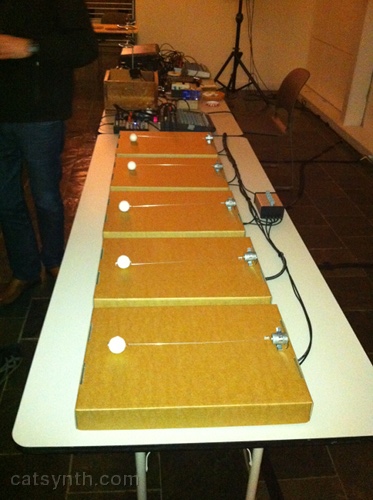
    Zimoun’s instrument was incredibly simple, a series of cardboard boxes on top of which were mounted ping-pong balls on motorized arms. The boxes served as resonant chambers for the excitation of the ping-ping balls.


    [Click to enlarge.]

    The performance unfolded as simply as the instrument itself. First, one of the five units began to vibrate, producing a low rumbling sound. Gradually the other ball+motor+box elements entered the mix, producing an odd harmony of machine noises. Out of this combination, I heard a higher-pitched metallic sound. I am not sure if this came directly from the machinery of the instrument, or was an acoustic artifact from the interaction of the different sounds. That is one of the interesting things about having such a minimal concept behind a piece, it allows one to focus on the output and explore minute details that would often be lost in a more complex performance. The piece continued as continuous sound, without much in the way of change or development, for about twenty minutes. The combination of the sound and visual environment allowed for a few minutes of peaceful detachment and I was able to experience it purely as signal and image processing without social context.

    Jim Haynes’ performance was a sharp contrast to Zimoun, both aurally and visually. His table was covered with a diverse array of audio devices and lab equipment.

    [Click to enlarge.]

    At first, I took the metal column and rings to be a custom-made theremin of sorts before realizing that it was the rings and tower familiar from countless science classes.

    After an initial burst of loud noise and feedback (which reassuringly let us all know that “yes, this thing is on”), the sound unfolded as an exploration of traditional elements, notably fire, air and earth. He opened with fire, specifically from the flame of a lit candle. He latter added sand, which poured from a bottle he placed on the metallic rings so that the sand could gradually fall out onto a contact microphone. While Zimoun’s performance invited detachment, Haynes’ required close attention. Many of the sounds that emerged seem closely related to the elemental sources: from the fire a series of crackling sounds and wind sounds from the excited air, and from the sand a sea of granular noises that could at times seem like liquid. But there were other sounds as well, the sound of ambient radio static, something akin to vinyl noise, a high-pitched shaking sound, and metallic rattling. Whether these were directly from the fire and sand or from the BOSS Dr. Sample and associated effects boxes is unclear.

    This performance was in many ways a preview for Zimoun’s exhibition at the Gray Area Foundation for the Arts (GAFFTA) which opened a few days later. That exhibition is still ongoing and will close on on February 22nd. Follow the link for more details.

  • Paul Cowan, Cameron Soren, Amy Yao, Jancar Jones Gallery

    A couple of weeks ago I stopped by Jancar Jones Gallery to see the current exhibition featuring works by Paul Cowan, Cameron Soren and Amy Yao. One the things I like about visiting is the gallery itself, a small but inviting room tucked away on a rather idiosyncratic block of Mission Street in SOMA. Despite being such a small space, the exhibitions are always sparse and calming. (You can see previous reviews of exhibits at Jancar Jones via this link.)

    [Installation View: Paul Cowan, Cameron Soren, Amy Yao. Image courtesy of Jancar Jones Gallery.]

    Perhaps the pieces that most caught my interest were Paul Cowan’s two paintings featuring musical notes, both with the label Untitled, 2010. Each features a single quarter note on five-line staff without a clef. Assuming an implicit treble clef (which is admittedly a big assumption), the notes would be A and G, respectively. The “A” is on a very sparse canvas with red lines, similar to something I might have had to draw out myself during early years of studying music. The “G”, by contrast is filled in with vibrant color fields, though once again red is the most prominent color.

    [Paul Cowan: Untitled, 2010, oil on canvas, 20 x 16 inches; and Untitled, 2010, oil on canvas, 18×14 inches.  Images courtesy of Jancar Jones Gallery.]

    The other piece that caught my attention was Amy Yao’s Dealing Don’t Cry, which featured three small bits of newspaper fastened to a horizontal wooden dowel. The bits of text on two of the paper bits feature the text “Dealing” and “Don’t Cry” – I am always interested in the use of text, especially when the context is missing. My understanding in this work is the title is derived from the material, rather than text being found to fit the title.

    [Amy Yao, Dealing Don’t Cry, 2010, wood dowel, newspaper.  Image courtesy of Jancar Jones Gallery.]

    Rounding out the exhibition was Cameron Soren’s untitled video installation depicting the gallery on the opening on January 7, 6-9PM.

    This is the final weekend for the exhibition – it closes on February 12 – so stop by if you happen to be nearby.