
Category: San Francisco
-
Art of Illusion, Driftwood Salon
On April 1, I attended the opening for the Art of Illusion exhibition at Driftwood Salon. The exhibition took it’s title from the date of the opening and its reference to illusion and trickery. “As artists, we strive to create aesthetically pleasing works of art, but sometimes we like to use that ability to trick the mind, and play with shapes, images and dept of field by pushing boundaries and defying gravity.”
Beyond that initial statement, the works in this show were quite diverse in terms of style and subject matter.

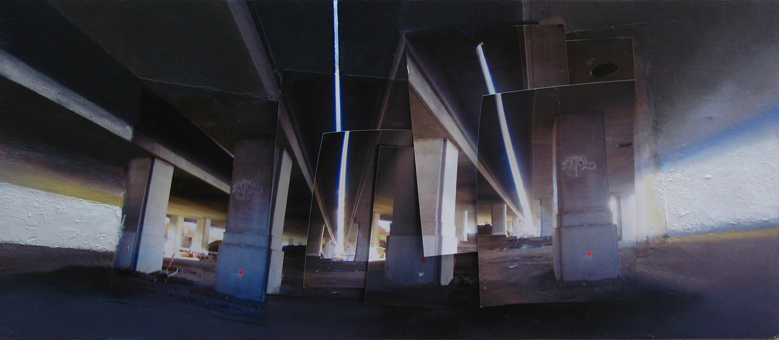
Along the wall, second from the left, is a piece by Rebecca Kerlin. I have seen (and reviewed) Rebecca Kerlin’s work before at Open Studios. Her work often involves highways, a frequent subject here at CatSynth, as well as other elements of the urban landscape and infrastructure. She takes familiar scenes, such as the freeway overpass near 4th Street and Bryant Street in San Francisco, and distorts the image through collage.

[Rebecca Kerlin, Underpass Under Construction In Blue #1.
Image courtesy of the artist. Click to enlarge.]One on hand, we see the whole image of the overpass and intersection, but at the same it is a series of separate images that are adjacent, overlapping or slightly out of alignment. Similar processes can be seen at work in Blossom Hill Road, San Jose, CA #2. It took me a moment to recognize the highway 85 freeway entrance sign.

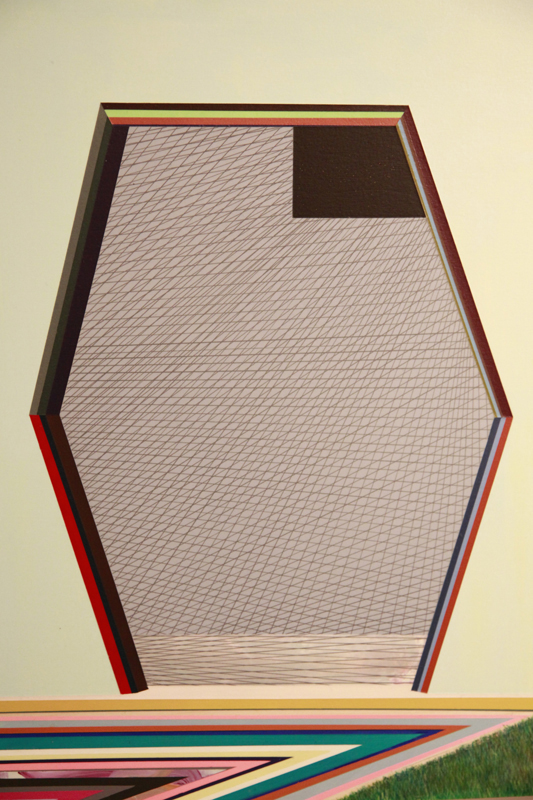
Closeup of Untitled by Evan Nesbit. Image courtesy of Driftwood Salon. Click to enlarge. While Kerlin’s pieces begin with familiar elements such as highways, Evan Nesbit’s contributions seemed based on pure abstract geometry, and primarily on straight lines and angles. In his large piece “the god effect”, lines are arranged in crossing diagonal patterns that lead to the illusion of curvature. This was an effect I learned myself as a young adult and repeated many times in images. In “Untitled”, the crisscrossing lines are used to mark out areas of solid color, which in turn form geometric shapes such as the central hexagon of the piece. However, these geometric elements can be seen to represent a door leading inside from a patio or walkway, an illusion heightened by the grass in the lower corner. Without the grass, one might not see the other shapes as a house at all.
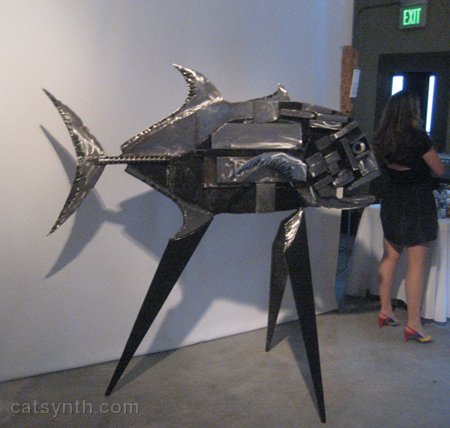
Among the other work that caught my attention was Jose Daniel Rojales’ Ulua.

[Jose Daniel Rojales, Ulua. Click to enlarge.]
It is on one level a representation in metal of an ulua, a popular Hawai’ian game fish. But the metal rectangles and geometric elements are quite distinct, particularly around the head, and in some ways stand out by themselves.
You can see more images from the show at the gallery website. The show will remain on display until May 2.
-
Moldover, Celeste Lear and Nonagon at Control Freq
Last Wednesday I attended Control Freq at the Hotel Utah here in San Francisco. Of course, that is a fantastic name for a show, being a play on words for electronic music controllers, audio signal processing, and the tendency of many of us to be in fact “control freaks.” The overall theme among the three groups who performed was use of Ableton Live! with various controllers.
The evening opened with Celeste Lear (guitar, vocals, electronics) and her band, including Adam Willis (drums) and Ian Montgomery (bass).

Lear has quite a pedigree in music and audio, and her music and band is quite technologically sophisticated (I did see the iPhone as a controller on the bassist’s strap). Nonetheless, they manage to combine technology with popular music idioms. I heard various funk, house, and reggae influences in her music – I had a soft spot for the final song which sounded like a classic house/disco track in a minor key. Though most of the music was very rhythmic, there were some free-form moments as well with guitar effects, etc. For much of the set, they were joined by trumpeter John Gibbons.
Celeste Lear was followed by Nonagon [along with guests]. The group had an impressive array of gear, arranged as multiple stations with laptops and controllers, including offerings from Akai and Albeton+Novation and of course a Monome. There were also two glowing globes in between the performers that emitted an ever changing color of light. Musically, the set began with complex ambient sounds, quite different of the Celeste Lear Band. Gradually, beats and recognizable chords emerged, with the beats eventually becoming quite strong and pronounced. Over the course of the set, they seamlessly moved through various beat-based soundscapes, with various resonances, vocal pads, pianos and other sounds filling in.
Moldover concluded the evening with a very impressive, high-paced and virtuosic performance with his Mojo controller, guitar and voice. We had last seem Moldover at LoveTech.

His performance on the controller was strong and rhythmically tight and fun to watch. He played the various buttons and sliders as if he was playing guitar or drums. Even though the Mojo was being used to bring in out various loops, recordings and processed sounds, the end result were new rhythms, chords and even melodies. This can be best seen in a video clip rather than in words:
-
SoundSpeak, Luggage Store Gallery
Last Thursday’s performances at the Luggage Store Gallery were all about poetry and spoken word.
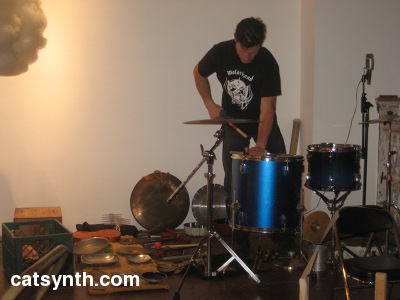
The first performance was a duo Polly Moller (vocals) and Moe! Staiano (percussion) interpreting a recent form of spoetry. Spoetry is spam that in its effort to evade filters rises to the level of high art. Our current set of songs in Reconnaissance Fly is based on spoetry, but the performance this evening featured a new and different form where words were grouped into disjoint sequences of two or three words, and in one case the words were themselves decomposed into individual sounds and reordered.


[Click on images to enlarge.]
The performance began with coarse drums and cymbals set against dramatic recitation of the first spoem. Although I wasn’t fully aware of the structure of the spoem at the time, one could definitely sense that the words were quite disjoint from one another. There were multiple languages, which allowed Polly the opportunity to play with different accents, pitches and timbres within the text. The drums at times were “prepared” with various objects on the heads. At one point, the drums got very soft, then gave way to scraping sounds on the cymbals set against longer drawn-out words, and then both the voice and percussion suddenly became very staccato and active.
The third piece focused more on Moe!’s percussive gadgets, including a back massager that was used to set a steady pulse for the piece, and set of old intercoms that were used to remotely set of loud squeaks from the edges of the room. This was the most rhythmic of the pieces, with a steady pulse that one could even sway to a bit. Moe! expertly threw and struck various objects in a way that kept the beat going, complete with accents.
In the final piece, the sounds of the words were decomposed into even smaller units that further blurred any sense of meaning. I did recall the phrases “Isis kitsch”, however. The main percussion instruments in this piece were a set of rubber balls attached to sticks that created a powerful sound when rubbed along the walls or on the heads of the drums.
The second set featured poet Robert Anbian with Rent Romus on saxophones and Bob Marsh on cello. This was more of a “traditional” poetry performance, with Anbian reciting long-form poetry against improvised music, and quite a contrast to Polly and Moe!’s more experimental set.
The first piece began with long cello harmonics that were matched by tones on the saxophone. The poem had memorable phrases such as “square root of suffering” and “posey for your supper.”
The second piece started with an animated run of fast saxophone notes and pizzicato on the cello. Then the poetry entered, with imagery and words related to fire and memorable phrases such as “The post war blues you are feeling is perfectly normal.” The music became noisier and sparser, then moved towards more of a jazz idiom (i.e., with the cello sounding a bit like a bass) then back to more noise and free improvisation. This was quite a long poem, and towards the end I think we in the audience began applauding before it was actually done. Anbian took this in stride and simply said “the audience has spoken.”
The last piece, My Country Loves Peace Remix began with cello and electronics (delays, etc.) set against a moaning saxophone. After a while the music moved to bowed cello and sax harmonics, then back to more electronically processed cello. The poem was about the perpetual state of war we seem to find ourselves in, despite leaders proclaiming their desire for piece. War was used broadly and included not only guns and bombs, but the taking of resources and cultural assets from others, sometimes by force, yet still proclaiming peace. “When will the war end?” A section of the music featured harmonics on the cello matching long tones on the sax with tremolo on both instruments. At one point, the pitches stablized on a major third before “falling apart” as a series of glissandi. The poem ended with the question repeated “When will the war end…Barack?”
-
Storm Moon Concert
A little over a week ago, I attend the lastest in the Full Moon Concert series, the Storm Moon, at the Luggage Store Gallery. The Storm Moon concert was all about electric guitars, and featured two very different guitarists with their own interpretations of “gathering and releasing the storm.”
The first set featured guitarist Joshua Churchill in collaboration with filmmaker Paul Clipson. The music began with recorded samples, with changes in pitch and speed. The music in these samples formed a drone of minor chords, against which Churchill sprinkled metallic tones from the edge of the guitar. The overall effect was quite ethereal. With this sound as a backdrop, Clipson’s film began. The film was actually a Super 8mm film (i.e., not a video), which brings with it a certain image quality and style of editing that was does not often see in contemporary live music+visual performances. It started with simple geometric patters of light and shapes, notably rectangles and parallelograms that suggested office windows or overhead lighting. Against these emerging patterns, the music moved to guitar loops and longer tones set against the earlier metallic sounds. This gradually gave way to full chords and drones. Both the movie and the music become more intense, but the building blocks of guitar tones and shapes and light remained.

At one point, the film became entirely patterns of red and green, as the music continued to grow in intensity and fullness. There were sounds reminiscent of wave motion and some trills, but there remained overall a droning quality and a minor tonality. This gave way to beating patterns and a “loud wall of sound.” As the film progressed, I began to notice more familiar objects and patterns, such as looking through a chain-link fence. As distinct images of urban lights and street scenes emerged, the music became louder, faster and nosier. I was then able to recognize familiar images from New York, the Chrysler Building and some of the bridges. At this point the music came to a loud and noisy climax after which the softer harmonies re-emerged and both the music and movie gradually came to a close.
This interplay of sound, light and image was followed by a solo performance by Peter Kolovos. We had heard his very dextrous and energetic style of performance during his set at last year’s Outsound Music Summit; he brought the same energy and technique to channel the peak of the storm moon’s energies on this particular evening. He began with short blips, scrapes and squeaks. The overall effect was staccato and percussive – quite the opposite of the previous set – and it was quite loud. Even as the notes grew longer, they remained percussive. Kolovos not only moved fast on the guitar itself, but also with his effects, quickly switching between effects such as heavy delays and distortions even within single notes. Gradually, the texture began to include sounds with longer duration, such as feedback and overdriven delay patterns. There were even some harmonic chords in there, though I quite liked his inharmonic sounds on the guitar, with or without effects. As the tones grew longer, the music felt even louder, feeling it more in my entire body than as sound. Then all of sudden, it became software, with percussion and a tone that reminded me more of analog synthesizers. Gradually things became louder again – in one section I heard what seemed like a standard rock chord progression – and then drew to a quick and decisive close.
-
In Tandem with Max Mathews, Aaron Koblin, and Daniel Massey
Last Friday I attended a talk featuring Max Matthews and a new conceptual work by local artists as the Gray Area Foundation for the Arts (GAFFTA). GAFFTA is an intriguing new organization and space for the intersection art, design, sound, and technology. They are “dedicated to building social consciousness through digital culture.”

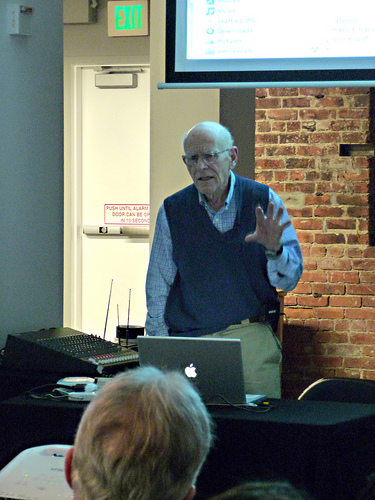
Max Mathews. Photo by Vlad Spears I had last seen Max Mathews, considered by many to be the “father” of computer music, at an 80th birthday tribute at the Computer History Museum in 2007, and before that delivering the keynote address at ICMC 2006. It is great to see him still going strong and engaged with technology and supporting others’ creative work. His talk primarily focused on his work at Bell Labs, and in particular the history and technologies surrounding his 1962 computer rendition of the song “Daisy Bell” (aka “Bicycle Built for Two”). It was an early example of physical modeling synthesis, where sections of the vocal tract were modeled as tubes, and sound generated directly from physics equations. His version of the song was popularized in the film 2001: A Space Odyssey, although Mathews revealed that the version Kubrick used in the film was not his recording. He also presented another famous example of computer-generated vocals, a performance of the “Queen of the Night” aria from Mozart’s The Magic Flute. This piece used formant synthesis in which focus on recreating spectral characteristics of the sounds (i.e., the formants that characterize vowel sounds) without necessarily modeling the physical processes that allow humans to create those sounds. The voice is quite compelling (if a bit dated), and demonstrates that the most realistic sounds are not necessarily those generated from physical models.

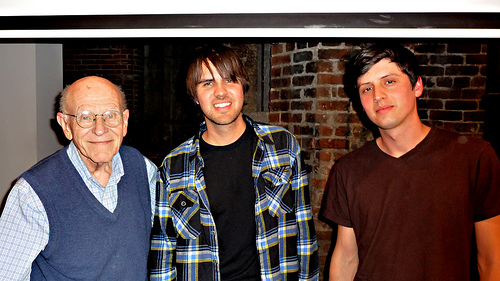
[Mathews, Koblin and Massey. Photo by Vlad Spears.]
Mathews’ presentation of “Daisy Bell” served as an introduction for a new project “Bicycle Built for 2000” by Aaron Koblin and Daniel Massey. Koblin has been working on a series of conceptual pieces that utilize the Amazon Mechanical Turk, a framework for harnessing human intelligence to solve large problems. There are some things that humans are quite efficient at and computers are very poor at, such as recognizing distorted text (think of the CAPCHA codes that we all deal with on websites, including here at CatSynth). The Amazon Mechanical Turk, which derives its name from an 19th century hoax where a supposedly mechanical chess-playing machine turned out to be a human hidden inside a box, provides a framework and API for defining tasks to be solved by humans, recruiting people to work on them, and then compensating them for their efforts according to a fixed budget. One of Koblin’s pieces provides the instruction to “draw a sheep” for a few cents. He then collected the resulting drawings of various sheep (and non-sheep) from around the world and compiled them into a larger mosaic work, The Sheep Market. You can see the overall mosaic as well as click on individual sheep and even see an animation of how they were drawn by the individual contributors.

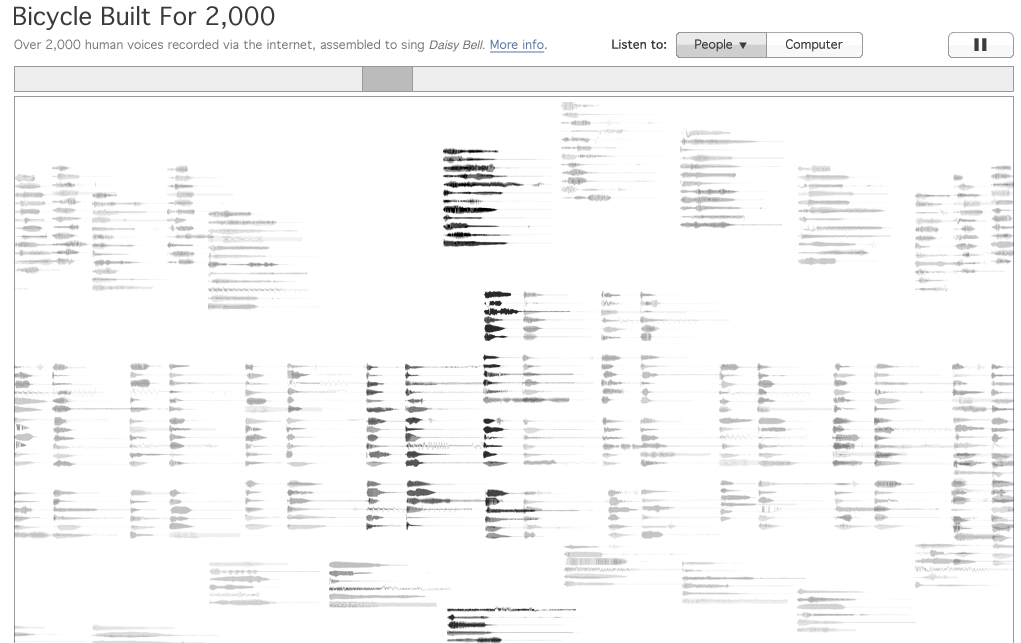
[Screenshot of Bicycle Built for 2000, by Aaron Koblin and Daniel Massey. Click to enlarge.]
For “Bicycle Build for 2000”, Koblin collaborated with Daniel Massey on a work that focused on sound and music. The Max Matthews rendition of Daisy Bell was decomposed in a sound segments no longer than one syllable, and for each segment an Amazon Mechanical Turk task was created for someone to sing back the sound. Koblin and Massey then reassembled the sounds to re-create the song as sung by the participants. The initial version, in which only one singer was used for each component, was almost unrecognizable, though quite interesting. A larger version which included a chorus of voices on each segment better represented the original qualities of the song, and clearly recognizable. You can hear the full version at the project website, along with an interesting visualization of the assembled recordings. The fact that the larger ensemble produced a more recognizable result, essentially averaging out the various sung renditions, is perhaps an example of the oft touted “wisdom of crowds”.
There is also a slightly more ominous set of questions from these works concerning exploitation of individuals who don’t know the overall purpose of their tasks, or about hive mentality and such, but I still find it quite interesting and am inspired to try out the Mechanical Turk for a future art project.