I started this site on July 19, 2006 as a novelty when a friend and former colleague at E-MU systems suggested that I “should make a website about cats and synths.”
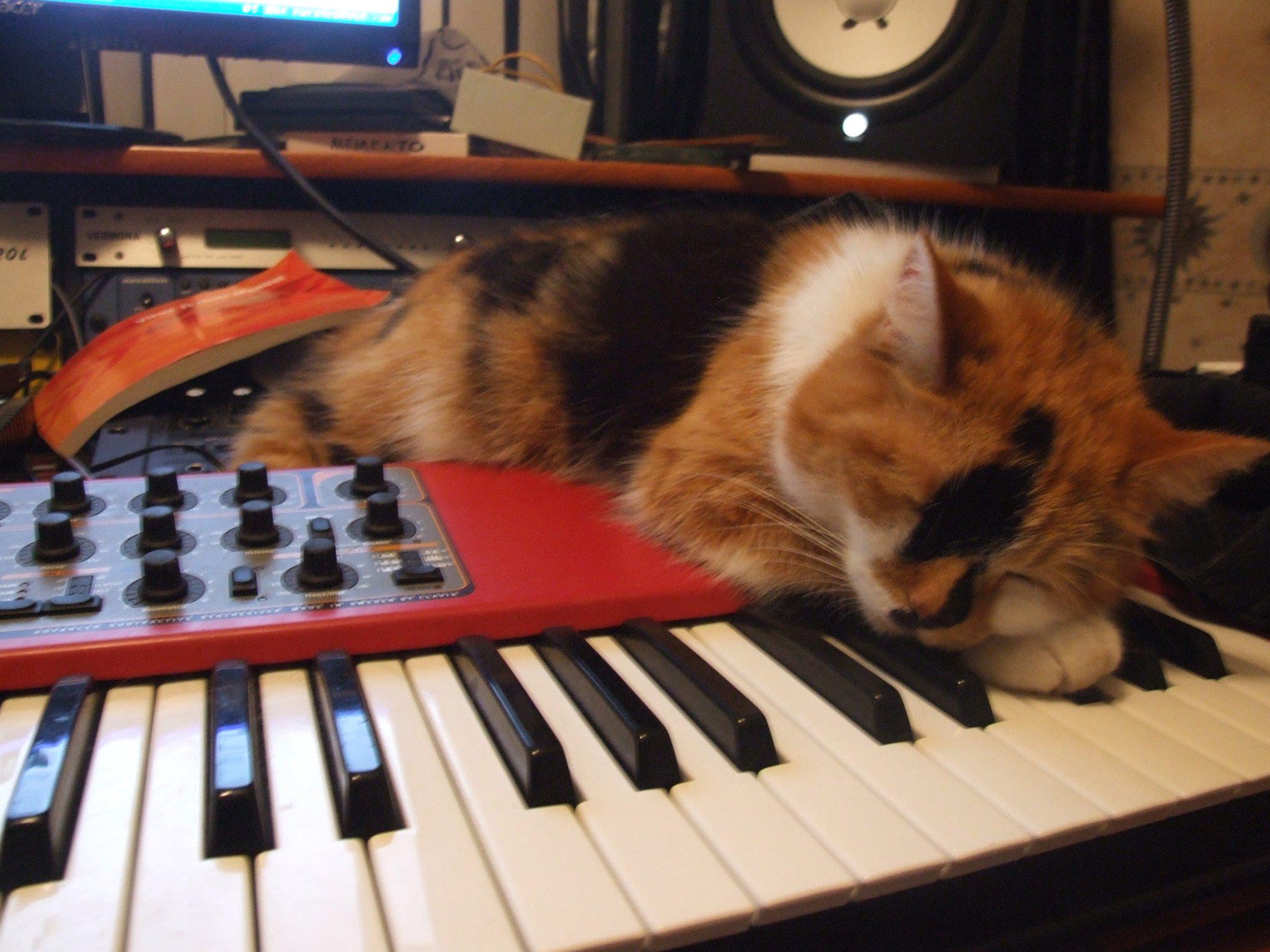
I still have that Novation keyboard, though it does not get used as often of late. Luna of course still is very territorial about that beanbag chair. Times have changed a bit, here is an iconic photo of Luna from this past year, this time with an iPad app (in this case, the Smule Magic Piano):
Another quirky way we like to celebrate is with statistics. First the basics:
1559 posts. 0.85 posts per day. 8784 comments. 5.63 comments per post. 476 posts featuring cats and synthesizers. 195 reviews (and gig reports). 381,735 visitors.
Even after five years, people from around the world continue to send us pictures of cats and music gear. These days most of those come via our Facebook, which together with twitter has become a major way people engage with this site.
From Google Analytics (which we finally got working properly over the past year), here is an overview of where our visitors come from around the world.
By far and away most of our visitors are from the United States, followed by the United Kingdom, Canada, India, Australia, France and Germany. I’m gratified to see so many visitors from India, though I’m curious why we never receive any comments from there…
It’s also interesting to look at cities.
Not surprisingly, the top cities are San Francisco and New York. In Google, it’s SF followed by NYC, while in Facebook, New York is the top city.
Our most popular posts judged by number of visitors are the annual endangered wild cats on earth day. Over the past year, our most commented posts were:
Thanks to all our friends (in time zones earlier than U.S. Pacific Daylight Time) who already sent in comments for the anniversary, and to the Cat Blogosphere for their anniversary shout-out!
And while we will continue to keep doing what we do, it has been more of a challenge over this past year to keep up with posts, especially the longer-form reviews. There is a trade between doing music and art, and writing about people doing music and art. But I still love doing everything here, and will find a way…
The 2011 Outsound Music Summit begins this Sunday at the Community Music Center, 544 Capp Street in San Francisco. I am planning to be the every night, and will be live tweeting @catsynth with hashtag #outsound for those who wish to follow vicariously and to dialog with friends and supporters. Of course, the best experience of any musical performance is to attend in person. Visit our Summit website for more information about the schedule and tickets.
The festivities kick off on Sunday with the annual Touch the Gear Expo. I will be participating again this year with gear that reflects the music that I have been doing over the past year, i.e., so think small devices. There will also be interesting DIY electronic and acoustic gear, musical art and novel repurposing of mainstream gear for experimental music.
Here is another classic cat-playing-theremin video. Indeed, a reader on twitter reminded me about this video and thus led to the theme of today’s post.
“Like most modular synthesizer users and builders, I suffer from Serge envy. Thankfully for all of us, Ken Stone licensed some of Serge’s designs to sell as CGS PCBs.
Here is my first module using these Serge designs”
The cat in the first photo is the “project supervisor.”
As another feline reference, “CGS” is “Cat Girl Synth”.
Perhaps a little bit of a stretch – a Fender Rhodes technically isn’t a synth nor is the drawing technically a cat – but I quite like this image. (And I am a big Rhodes fan.)
Today we look back on my solo concert at the Center for New Music Technologies (CNMAT) at U.C. Berkeley back in early March. It was part of my U.C. Regents Lecturer appointment this year, which also included technical talks and guest lectures for classes.
This is one of the more elaborate concerts I have done. Not only did I have an entire program to fill on my own, but I specifically wanted to showcase various technologies related to my past research at CNMAT and some of their current work, such as advanced multi-channel speaker systems. I spent a fair amount of time onsite earlier in the week to do some programming, and arrived early on the day of the show to get things set up. Here is the iPad with CNMAT’s dodecahedron speaker – each face of the dodecahedron is a separate speaker driven by its own audio channel.
[click image for larger view.]
Here is the Wicks Looper (which I had recently acquired) along with the dotara, an Indian string instrument often used in folk music.
[click image for larger view.]
I organized the concert such that the first half was more focused on showcasing music technologies, and the second half on more theatrical live performance. This does not imply that there wasn’t strong musicality in the first half or a lack of technological sophistication in the second, but rather which theme was central to the particular pieces.
After a very generous introduction by David Wessel, I launched into one of my standard improvisational pieces. Each one is different, but I do incorporate a set of elements that get reused. This one began with the Count Basie “Big Band Remote” recording and made use of various looping and resampling techniques with the Indian and Chinese instruments (controlled by monome), the Dave Smith Instruments Evolver, and various iPad apps.
The concert included the premier of a new piece that was specifically composed for CNMAT’s impressive loudspeaker resources, the dodecahedron as well as the 8-channel surround system. In the main surround speakers, I created complex “clouds” of partials in an additive synthesizer that could be panned between different speakers for a rich immersive sound. I had short percussive sounds emitted from various speakers on the dodecahedron. I though the effect was quite strong, with the point sounds very localized and spatially separated from the more ambient sounds. In the video, it is hard to get the full effect, but here it is nonetheless:
The piece was implemented in Open Sound World – the new version that primarily uses Python scripts (or any OSC-enabled scripting language) instead of the old graphical user interface. I used TouchOSC on the iPad for real-time control.
I then moved from rather complex experimental technology to a simple and very self-contained instrument, the Wicks Looper, in this improvised piece. It had a very different sound from the software-based pieces in this part of the concert, and I liked the contrast.
The first half of the concert also featured two pieces from my CD Aquatic: Neptune Prelude to Xi and Charmer:Firmament. The original live versions of these pieces used a Wacom graphics tablet controlling OSW patches. I reimplemented them to use TouchOSC on the iPad.
The second half of the concert opened with a duo of myself and Polly Moller on concert and bass flutes. We used one of my graphical score sets – here we went on order from one to the next and interpreted each symbol.
The cat one was particular fun, as Polly emulated the sound of a cat purring. It was a great piece, but unfortunately I do not have a video of this one to share. So we will have to perform it again sometime.
I performed the piece 月伸1 featuring the video of Luna. Each of the previous performances, at the Quickening Moon concert and Omega Sound Fix last year, used different electronic instruments. This time I performed the musical accompaniment exclusively on acoustic grand piano. In some ways, I think it is the strongest of the three performances, with more emotion and musicality. The humor came through as well, though a bit more subtle than in the original Quickening Moon performance.
The one unfortunate part of the evening came in the final piece. I had originally done Spin Cycle / Control Freak at a series of exchange concerts between CNMAT and CCRMA at Stanford in 2000. I redid the programming for this performance to use the latest version of OSW and TouchOSC on the iPad as the control surface. However, at this point in the evening I could not get the iPad and the MacBook to lock onto a single network together. The iPad could not find the MacBook’s private wireless network, even after multiple reboots of both devices. In my mind, this is actually the biggest problem with using an iPad as a control surface – it requires wireless networking, which seems to be very shaky at times on Apple hardware. It would be nice if they allowed one to use a wired connection via the USB cable. I suppose I should be grateful that this problem did not occur until the final piece, but was still a bit of an embarrassment and gives me pause about using iPad/TouchOSC until I know how to make it more reliable.
On balance, it was a great evening of music even with the misfire at the end. I was quite happy with the audience turnout and the warm reception and feedback afterwards. It was a chance to look back on solo work from the past ten years, and look forward to new musical and technological adventures in the future.