Tag: amy x neuburg

  • Vacuum Tree Head and Moe Staiano Ensemble at The UPTOWN

    Vacuum Tree Head and Moe Staiano Ensemble at The UPTOWN

    Today we look back at the show featuring Vacuum Tree Head and the Moe Staiano Ensemble at The UPTOWN in Oakland. It was also the subject of our most recent episode of CatSynth TV. 

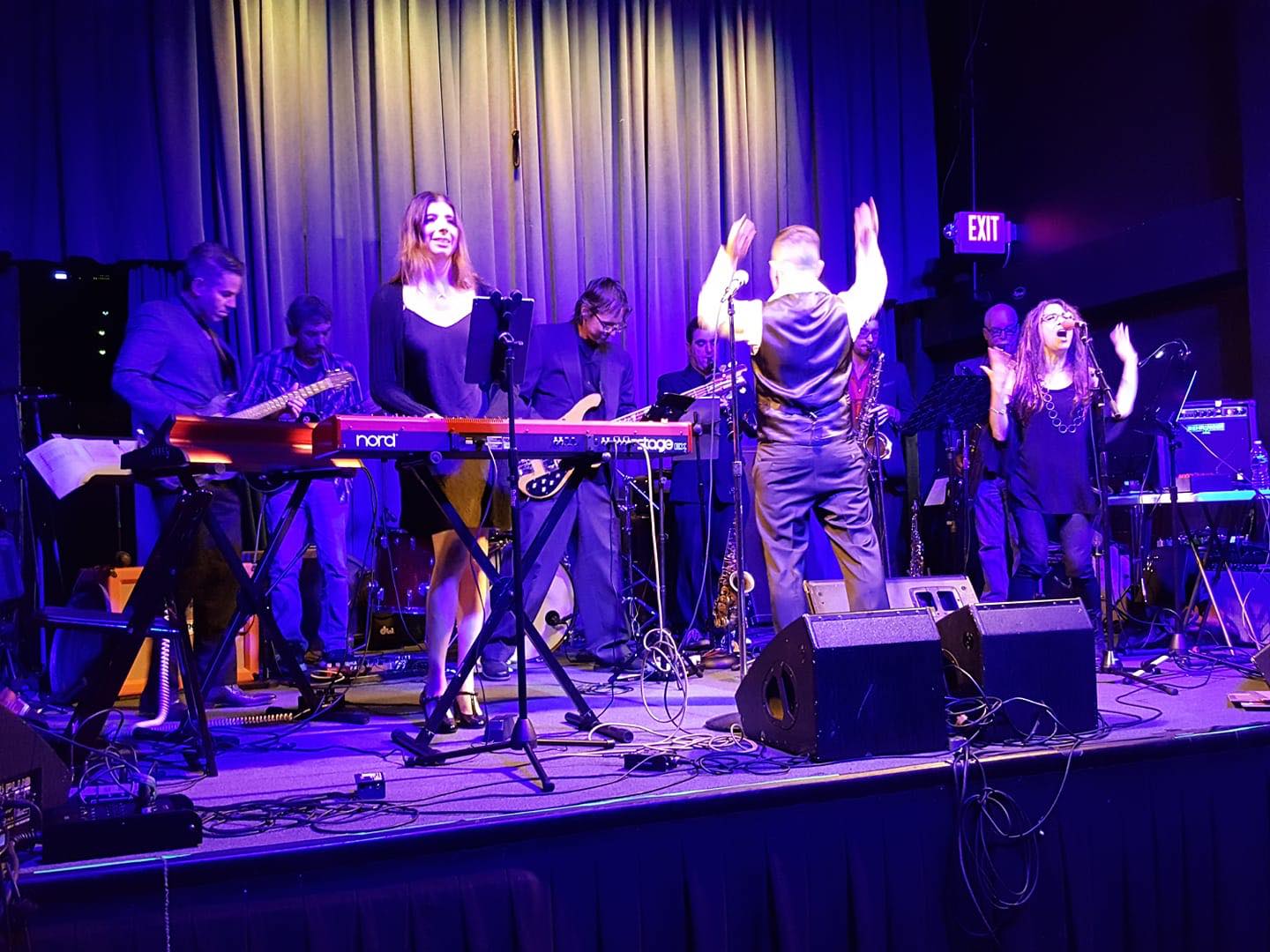
    This was the most ambitious Vacuum Tree Head show to date, at least during the time I have been involved in the band.  There were ten musicians involved: Jason Berry conducting, Steve Adams (of ROVA fame) on baritone saxophone, Jason Bellenkes on various woodwinds, Amanda Chaudhary on keyboard, Richard Corny on guitar, Michael de la Cuesta on guitar and synth, Justin Markovits on drums, Joshua Marshall on saxophones, Amy X Neuburg on voice and blippo box, and John Shiurba on bass. 

    Vacuum Tree Head.  Photo by Crystal Lee

    The band delivered an impressive and truly dynamic performance, going through a diverse mix of styles from our current repertoire.  And that fact that the core of the lineup has stabilized means that the tunes are always getting tighter and more idiomatic, especially our “big” numbers Nubdug and EMS Deluxe – I always have a lot of fun in the latter with a big 1970s style electric-piano solo.  But this set was more than just music – it continued the band’s pattern of adding new spectacle at each show.  This time, we had a juggler, Colin Hogan, and my friend and frequent collaborator Serena Toxicat held up signs for audience participation.  The juggling was a unique moment, with Hogan tossing lighted beanbags and other objects as we played a new version of the tune Marlon Brando

    Overall, I had a wonderful time playing, as I’m pretty sure the entire band did.  And we got a great response from the audience at The UPTOWN.  Next, it was time for the Moe Staiano Ensemble to take the stage.

    Moe Staiano Ensemble

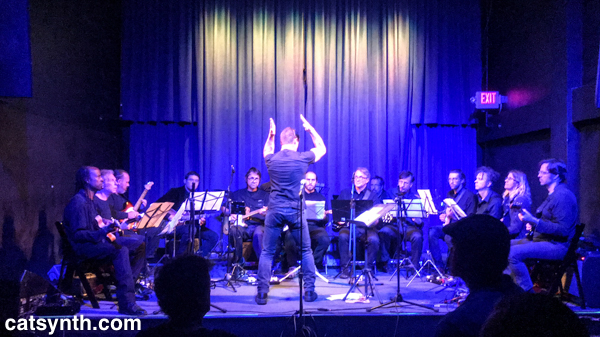
    This was also an ambitious set, building on Moe’s previous ideas but with an even larger ensemble of guitars:  Jay Korber, William Bohrer, Melne Murphy, Damon Wood, Robin Walsh, Drew Wheeler, Bill Wolter, John Shiurba, Josh Pollock, David James, Marc Zollinger, and Karl Evangelista.  That, my friends, is a lot of guitars!  But they were also joined by Steve Lew on bass and Jeff Lievers on drums.

    Moe’s large scale composition followed a classical form of three movements: a loud opening fanfare, a calm and moody second movement, and amore dynamic finale.  It featured many of the idiomatic elements I have come to know and appreciate in his compositions from my time playing in Surplus 1980, including the repetitions coming in and out of phase.  During the first movement, there was a driving eight-note patterns with phasing that created an intense but pointillated wall of sound.  The second movement, which contained slower notes and lots of open space, was exceptionally beautiful, and my favorite part of the performance.  You can hear some of it in our video.

    It was a wonderful night of music in Oakland, and I was happy to be a part of it both as a performance and an audience member.  There was a fairly decent turnout, especially for a Tuesday.  It’s not every day you can get this cast of musicians on a stage at once, as both groups did, but I look forward to the next time they do.

  • The Amy X-Perience at the Jewish Community Center, Berkeley

    The Amy X-Perience at the Jewish Community Center, Berkeley

    As we are in the middle of Passover, it seems like a good time to look back at a Jewish-themed show in which I participated earlier this year. The Amy X-Perience brought together a mix of artists in solo, duo and ensemble sets at the Jewish Community Center in Berkeley, California. The evening was curated by our friend and collaborator Amy X Neuburg.

    The night began with a piece by Neuburg featuring electronics and potato chips. Yes, potato chips. Small vending-machine-sized bags were distributed to the audience, who were instructed to on cue open the bags and start chewing the (edible) contents loudly, as Neuburg manipulated the sounds and added additional musical layers.

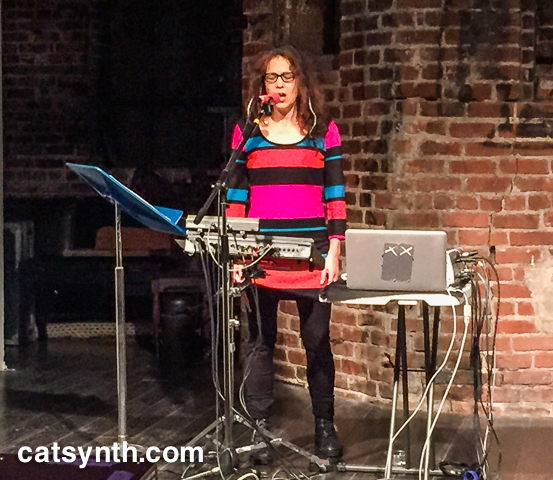
    Amy X Neuburg

    I was up next. Regular readers have likely already heard part of my solo set from this show – I posted the performance of piece White Wine in this article a couple of weeks ago. I also performed a live version of my piece Donershtik (Yiddish for “Thursday”), which you can see below.

    Amanda Chaudhary performing "Donershtik" at JCC East Bay from CatSynth on Vimeo.

    I was quite happy with how both solo pieces came out, but the real treat was having Amy join me in a duo of my piece North Berkeley BART, humorously appropriate for the location that evening.

    North Berkeley BART w/ Amy X Neuburg – JCC from CatSynth on Vimeo.

    I have always been impressed with Amy’s musicianship, discipline and ability to learn songs quickly, and very much appreciated her joining me. We also performed an avant-garde rendition of the American standard All of Me later in the evening.

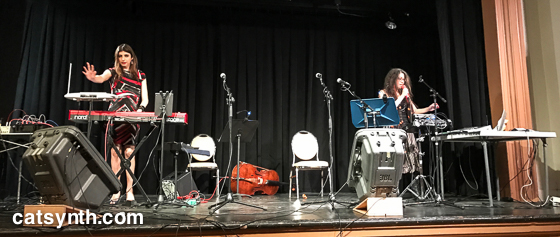
    Amanda Chaudhary and Amy X Neuburg

    Between the two of us, there was quite an impressive collection of musical electronics on stage.

    My solo set was followed by Alex Kelley, a veritable one-man band on cello and electronics.

    Alex Kelley

    His music blended jazz, klezmer and rock influences with experimental sounds. His cello acted not only as a melodic instrument, but also as the rhythm section, with Kelley striking it like a drum at times, and recording bass lines into a live looper and then riffing on top of that. His performance was both tight and humorous and a lot of fun to watch. You can hear a little bit in this video:

    Next up was Solstice: A Female Vocal Ensemble. Sadly, several members of the group were unfortunately absent that evening due to illness, but that didn’t stop the remaining trio from delivering a strong performance.

    Solstice’s repertoire spans a variety of styles and languages, and their set that evening included pieces from several places. I was quite impressed with their ability so sing in so many languages.

    The second half of the program brought together the various artists in different combinations. I already mentioned my duo rendition of All of Me with Amy X Neuburg. She also performed show tunes with Alex Kelley, and joined Solstice for a virtuosic rendition of an Eastern European song. And finally, all of us joined together for a rousing rendition of Mein Herr from Cabaret. It was a fun and fitting conclusion to the evening.

    Second half brought many voices in many languages and showtunes #AmyXNeuburg

    A post shared by @exej on

    All of the performances were well received by the enthusiastic full house. Thank you to Amy X Neuburg for inviting all of us to participate in this event, and to the Jewish Community Center of the East Bay for hosting! Please visit their website to find out about the many performances and other cultural programs hosted by the JCC.

  • Outsound New Music Summit: Vacuum Tree Head, avantNoir and Cabbages, Captain and King

    While the first night of the 2015 Outsound New Music Summit was billed as “Quiet Noise”, the second night was something altogether different. The concert features three exuberant but very different bands spanning a wide variety of musical techniques and styles.

    First up was Cabbages, Captain and King, a trio featuring Eli Wallace on piano, Karl Evangelista on guitar, and Jon Arkin on drums.

    Cabbages, Captain and King
    [Cabbages, Captain and King. Photo: peterbkaars.com.]

    I have become quite a fan of Eli Wallace’s piano playing, which is virtuosic and energetic. Combined with Evangelista’s intense and varied guitar performance and Arkin’s drums, the trio packed quite a punch. The speed and energy rarely let up throughout the 45-minute set. The music had an unsettled quality, always moving forward and never quite reaching a groove or tonal center. There were occasional quiet moments when the overall intensity of the performance let up, and the final notes with prepared piano were a nice touch.

    Eli Wallace
    [Eli Wallace. Photo: peterbkaars.com.]

    Next up was Liza Mezzacapa’s Bait & Switch performing her project avantNoir. The pieces in this project were all inspired by noir fiction. The first half was based on “hard-boiled” stories by Dashiell Hammett set in 1920s San Francisco – with many familiar places and streets references – and the second half was based on “soft boiled” stories by Paul Auster set in 1980s New York (also a familiar setting).

    Lisa Mezzacapa's avantNOIR with Bait&Switch
    [Lisa Mezzacappa’s avantNOIR with Bait & Switch. Photo: peterbkaars.com.]

    The music fit into the punctuated jazz style I have heard many times from Mezzacapa and her bands. But there was a distinctly 1970s crime show vibe to many of the pieces that contrasted with the times and places of the original stories’ settings. The interplay of bass, guitar with wah wah and drums, along with some of the electronic sounds from guest performer Tim Perkis led to this 1970s feel. The project itself suggests film scores for the stories, and I liked the idea of changing listeners’ expectations, especially if they have seen Hollywood versions of these stories. In addition to Mezzacapa and Perkis, the set featured Aaron Bennett on tenor saxophone, Jordon Glenn on drums, John Finkbeiner on guitar and special guest William Winant on vibraphone and sound-effects percussion. I found Winant’s seltzer bottle and tiny door particularly amusing.

    Aaron Bennet and William Winant
    [Aaron Bennett and William Winant. Photo: peterbkaars.com.]

    Then it was time for Vacuum Tree Head to take the stage.

    Vacuum Tree Head
    [Vacuum Tree Head. Photo: peterbkaars.com.]

    Led by Jason Berry who was conducting this evening, led us through fast-paced set of short pieces that ranged from classic jazz to deep funk to something approaching metal rock. Above the fray were vocals by Amy X Neuburg, who brought her theatrical and operatic voicings to the rather challenging music along with her very distinctive performance personality.

    Amy X Neuburg, Vacuum Tree Head

    Jason Berry, Vacuum Tree Head
    [Amy X Neuburg and Jason Berry. Photos: peterbkaars.com.]

    Many of the pieces, which were composed primarily by Berry and Michael de La Cuesta who together formed the band in 1989(!), were premiers. The band made the most of the variety of music, with an extended fusion keyboard solo by Amanda Chaudhary in DL DS, deep funk from the whole band behind Rich Corney’s guitar in EMS, a blindingly short jazz tune inspired by the Akhnaton dynasty of ancient Egypt, and a loud metal tune that may have been a first for an Outsound New Music Summit.

    Amanda Chaudhary et al, Vacuum Tree Head
    [Amanda Chaudhary et al. Photo: peterbkaars.com.]

    Rich Lesnick (also a band-mate of mine in Reconnaissance Fly) brought solid saxophone and bass clarinet, including an extended moody bass-clarinet solo in Cushion Fortress; and Michael de la Cuesta featured in many songs on analog synthesizer, guitar and glockenspiel. Justin Markovits held things together with his drumming, assisted in the rhythm section by Tom Ferguson on bass. There was even a bit of abstract electronics from Amy X Neuburg on Blippo Box and Amanda Chaudhary on modular synth.

    Michael de la Cuesta, Vacuum Tree Head Justin Markovits, Vacuum Tree Head
    [Michael de la Cuesta and Justin Markovits. Photo: peterbkaars.com.]

    The set was very well received by audience, some of whom were longtime fans of the band and some hearing us for the first time. And personally, it was quite a privilege to be part of the band for this event.

    Overall, it was a strong evening for the summit, one that stood out as quite contrasting among the sets as well as with the other concerts.

  • Vacuum Tree Head at Outsound New Music Summit

    Vacuum Tree Head at Outsound New Music Summit, July 30

    The band Vacuum Tree Head returns for a performance at this year’s Outsound New Music Summit. The event will be on July 30, 8PM at the Community Music Center, 544 Capp Street in San Francisco.

    Vacuum Tree Head is led by Jason Berry – that’s “J.B.” who draws the Mensa Cat Monday cartoons. The poster that appears above is his artwork as well. The new lineup for the band features Amanda Chaudhary on keyboards, Rich Corney on guitar, Michael de la Cuesta on guitar, orchestral chimes and synthesizers; Tom Ferguson on bass; Richard Lesnik on saxophones and bass clarinet, Justin Markovits on drums, and Amy X Neuburg on vocals and custom electronics. From the Summit website:

    VTH has created music ranging from ambient electronics pieces scored for feedback, bass clarinets, singing bowls and bowed gongs (Tar’Hai Wizard, a piece dedicated to the great Jean “Moebius” Giraud), to tightly composed, guitar-based punk/prog songs (the album “THIRTEEN”), to abstract electronics and audio collage (the album “Aum Carve Etude H”), and all stops in between. The band is currently moving into areas involving the intersection of tightly composed compositions and free improvisation

    The even also includes two other great bands. Cabbages, Captain, & King is a trio of Jon Arkin (drums), Karl Evangelista (guitar), and Eli Wallace. I have heard Wallace’s virtuosic piano a few times already this and looking forward to more. Finally, we will be treated to a performance of a new project avantNOIR by Lisa Mezzacappa with her Bait & Switch.

    Please visit the Outsound New Music Summit for a full rundown of all the evenings. (We at CatSynth will be the to cover all four concerts.)

  • Amy X Neuburg: Jerry Hunt’s “Song Drapes”

    Amy X Neuburg: Jerry Hunt’s “Song Drapes”

    Today we look at a recent performance by Amy X Neuburg at the Center for New Music featuring a new interpretation of Jerry Hunt’s “Song Drapes.” This project was part of commission Neuburg received from the Cultural Department of Cologne, Germany to reinterpret the piece, which was originally a collaboration between Hunt and the performance artist Karen Finley.

    We at CatSynth are immersed in a world of unique and often odd artists. But Jerry Hunt stands out as exceptionally odd and enigmatic. The evening began with screenings of his video work that is rarely shown in public. Many of them featured the artist alone in a dark room with his strange homemade electronic controllers and bits of electronic sound.

    Jerry Hunt

    There were other departures among his videos, including one powerful piece featuring a close-up of Hunt reciting what seems like a stream of random but intense thoughts; and other where he takes the viewer on a tour of his home in Texas pointing out the behavior of local wildlife and a customized homebrew toilet. Both of these pieces seemed to portend his tragic death by suicide while suffering from cancer. But there were also humorous at times.

    A similar mixture could be found in Neuburg’s live performance, which followed the screenings. “Song Drapes” includes Hunt’s original electronic background recordings and instructions to the performer to perform text of his or her own choosing with a live percussion rhythmic layer. The elements of electronics, percussion and voice were a perfect match for an “Amy X Neuburg treatment.”

    Amy X Neuburg

    The result was unmistakably her sound and style, filled with rhythmic hits, dramatic vocals and delightfully sardonic texts. Some were quite dark in keeping with the original work, but some of the best moments were the most quirky and humorous, including a tribute to Nebraska as the place one often flies over between frequent trips between California and New York (something which is part of my life as well), and her dance to a catchy rhythmic tune entitled “Little Legs”.

    The performance lasted exactly one hour, but was engaging throughout. I am glad to have attended it. I do also hope to see more exposure for Jerry Hunt and his work. You can read more about him here. You can also find out more about Amy X Neuburg’s interpretation

  • They Will Have Been So Beautiful: Amy X Neuburg with Paul Dresher Ensemble

    “They Will Have Been So Beautiful”, a collaboration between Amy X Neuburg and the Paul Dresher Ensemble, premiered a little over a week ago at U.C. Berkeley’s Zellerbach Playhouse. It was an event I was happy to have attended, as it lived up to its future-perfect-tense name.

    “They Will Have Been So Beautiful” was actually ten pieces by ten different composers, all inspired by Diane Arbus’ “stunningly poetic 1963 Guggenheim grant application titled American Rites, Manners and Customs“. Each composer selected a photograph or series of images that spoke and him or her and to use as the inspiration for the music. The performance featured Neuburg on voice and electronics, with members of the Paul Dresher Ensemble and guest performer John Schott on guitar.

    The evening opened with Pamela Z’s piece 17 Reasons Why based on a photograph by Donald Swearingen. It began in a fashion very typical of Neuburg’s solo work where she layers looped and processed live recordings of her voice to create thick textures. There is always a precision to her performance that makes it work live, and I can only imagine the challenge in getting the full ensemble to match it as tightly as they did.

    Lisa Bielawa’s Ego Sum was a much sparser piece, featuring text overheard in “transient public spaces”, such as the New York City Subway. The accompanying photographs featured people coming and going on a bench in a subway station in the Williamsburg section of Brooklyn (I know the station). It would be easy to dismiss the piece as “hipster” for its concept and visual setting, but in my case it made me feel a little homesick even though I was just in New York a couple of weeks earlier.

    Paul Dresher’s own contribution, A Picture Screen Stands in Solitude, was perhaps the most poignant of the evening. It featured two photographs: Richard Misrach’s image an abandoned drive-in theater near Las Vegas by , and Hiroshi Sugimoto’s photo of an empty movie palace in Encinitas, California. The text was from an essay by a young man named Michael Nelson named incarcerated in San Quentin for murder, written for a prison course named “Contemporary Issues in Photography.” The images themselves were quite powerful, and very much in the themes of urban decay and sparse built spaces that are featured in many of the photography reviews here on CatSynth. But Nelson’s words are make it emotionally strong. His observations are very detailed and articulate, and also quite melancholy on the subject of forgotten places (and in turn forgotten people). The music was extremely sparse in keeping with the photos, and did not get in the way of Nelson’s words.

    Ken Ueno’s piece Secret Meridian, features the composers’ own photographs of the meridian lines in two churches in Italy. It was perhaps the most abstract of the evening, both in its theme and the composition itself. The words felt secondary to me and I found myself focused on the electronic resonance sounds and impressive solos from John Schott on electric guitar and Gene Reffkin on electronic drums.

    The song cycle concluded with Amy X Neuburg’s composition Is It Conflict-Free and Were Any Animals
    Harmed in the Making of It?
    . From the start it was pretty obvious this was going to be a more humorous piece, with frequent references to the oft-used punchline “no animals were harmed in the making of this”. And Neuburg didn’t disappoint in that regard, using her distinctive mixture of operatic vocals, musical theater, and clear comedic lines. The piece did have a serious origin, using a photograph of a snowy mountain in Wyoming and the loss of wild winter spaces as the point of departure, but then veering into the absurd including the above lines and images of herself in the bathtub. She deftly managed to put all these elements together into a poetic and theatrical whole.

    10849875_10152940711558708_3416566875661567904_n
    [Photo by Moe! Staiano.]

    Five other pieces rounded out the evening, with composers Fred Frith, Guillermo Galindo, Carla Kihlstedt, Jay Cloidt, and Conrad Cummings. I regret not being able to write about all of them, as each contributed something to the whole of this event. The entire evening was well performed and choreographed between music, projection and lighting, and made for a quite impressive experience. Congratulations are in order to everyone involved in this multi-year project.

    Perhaps the strength and intensity of this concert made it even more surreal to exit to the reality of protests in Berkeley on the precipice of a violent confrontation only a few minutes later that evening. Certainly not a planned juxtaposition, but a powerful one.

  • ReCardiacsFly and Tim Smith Benefit at Cafe Du Nord

    With the launch of our ReCardiacsFly YouTube channel, it seems like a good time to look back at our ReCardiacsFly performance at Cafe Du Nord, part of a benefit concert for Tim Smith, leader and founder of the UK band Cardiacs that took place in May.

    In this video, you can see Polly channeling Tim Smith, along with Chris Broderick and Marc Laspina getting into their respective rolls:


    [Videography by Josh Wolfer.]

    The keyboard and marimba parts didn’t come out so strongly in the videos, but you can hear a bit of my attempt to get the original sounds in “Hello Mister Sparrow.”:


    [Videography by Josh Wolfer.]

    We did receive a great audience reception, undoubtedly some from Cardiacs fans who were familiar with the songs and performance style but perhaps from people hearing for the first time as well and taken in by the intensity of the performance.

    We did get a little worried early in the evening as attendance was sparse. But by the time we got on stage and looked out, there was a full and enthusiastic house – when you see and feel something like that, it always makes it easier to get through a set, even something as complex and intense as Cardiacs covers.

    Over all, it was a great experience, and we hope to perform again sometime soon!

    ReCardiacsFly consisted of members of Rennaissance Fly (myself, Polly Moller, and Tim Walters) together with Moe! Staiano, Chris Broderick, Marc Laspina and Suki O’Kane. Although we were the unofficially dubbed “tribute band” for the evening for our accurate musical renditions and costumes and makeup, all the bands performed Cardiacs covers, each in their own way.

    Amy X Neuburg opened the evening with arrangements infused with her trademark “avant cabaret” style. In a humorous gesture, she invited the audience to “sing along” to Tim Smith’s often difficult-to-follow lyrics.

    Before Weiner Kids came on stage, there was an arrangement that I described on twitter as a “cool riff with four on the floor bass drum and household metal items. Very danceable by #Cardiacs standards.” Even in the midst of a prog-and-punk-rock night, I am still drawn to my particular musical roots.

    Weiner Kids (with Jordan Glenn, Cory Wright, Aram Shelton) performed an arrangement for percussion and saxophones that made the often odd rhythms and meters of Cardiacs music very transparent. This is both the fun part and the biggest challenge of playing this music.

    Grex, a duo of Karl Evangelista on guitar and Rei Scampavia on keyboard, performed purely instrumental arrangements. The interpretations were much freer, and in particular gave Karl the opportunity to apply his virtuosic guitar style to the music.

    Inner Ear Brigade (featuring frequent collaborator Bill Wolter with Chris Lauf, Stevo Wright, Ivor Holloway, Melody Ferris, and David Shaff) also performed their own meticulous arrangements with their own personal stamp – their music tends is often itself an intense and energetic blend of jazz, experimental and art-rock influences. It was sometimes hard to tell where the Cardiacs’ influence ended and Inner Ear Brigade’s own style began, which I think made this performance all the more successful.


    [Inner Ear Brigade.]

    The concert concluded with Dominque Leone and his ensemble for the evening performing an “epic” arrangement of a Cardiacs song, building up towards a final climax that seemed almost religious in nature, with a full chorus of voices and loud frenetic keyboard and guitar (from Leone and Ava Mendoza) – this is one song that you can tell is the final song of the evening even before it ends!

    So what is next? We are certainly hoping to do more performances as ReCardiacsFly, and welcome suggestions for Bay Area venues and programs that would be appropriate. And we would like to send “Healing wishes from everyone to Tim Smith and love and respect to all past, present, and future members and fans of Cardiacs.”

  • Outsound Music Summit: MultiVox

    Today we at CatSynth conclude our series from the recent Outsound Music Summit with my own report from the MultiVox program that featured Reconnaissance Fly, the Cornelius Cardew Choir, and Amy X Neuburg. We did feature a guest review by Joe McMahon last week, which covers the same show from an outside perspective. My own perspective is anything but outside, given that I was in two of the three groups performing at night.

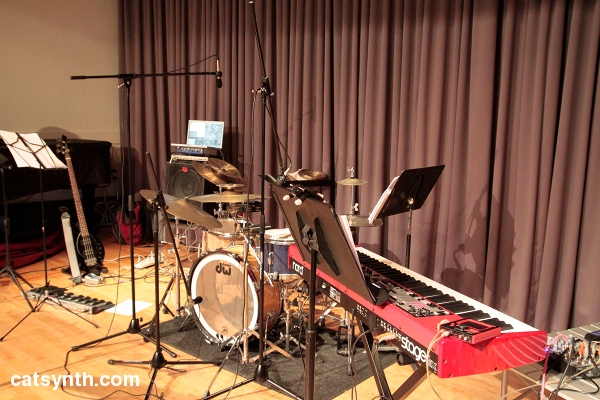
    This was a professional show, with formal load-ins, sound checks, and staging. Reconnaissance Fly features a full rhythm section, so we had a lot of equipment to set up:

    [click image to enlarge]

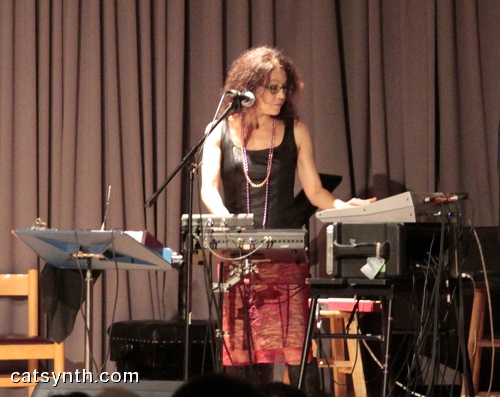
    On the left is Tim Walters’ bass and Macbook running SuperCollider. In the middle is Moe! Staiano’s drum set, and on the right is my own keyboard+electronics setup featuring the Nord Stage, the trusty Korg Kaoss Pad, and the little stuffed cat for good luck. Here is another perspective with more detail:

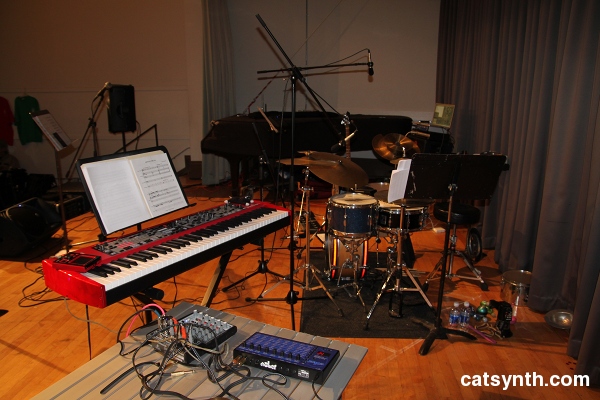
    [click image to enlarge]

    The Evolver was actually for the Cardew Choir, but I set up everything at once. One can also see Moe!’s toys and other support percussion instruments.

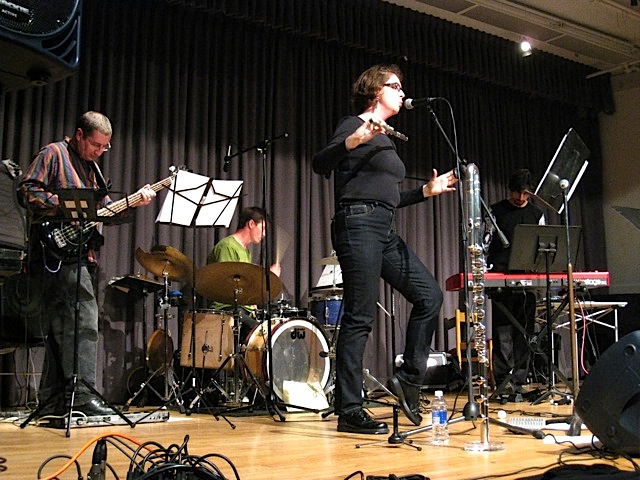
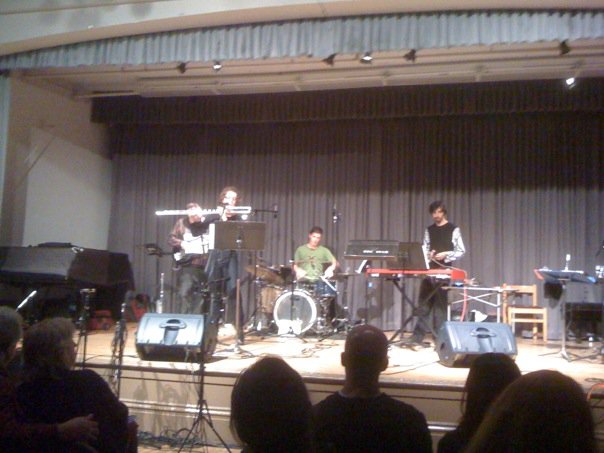
    Onto the show itself. Here is the full band on stage, with myself, Polly Moller (flute/vocals), Tim Walters (bass), Moe! Staiano as our special guest “concussionist”.

    [Photo by Michael Zelner.  Click image to enlarge.]

    We performed a full nine-piece set from Flower Futures, our “spong cycle” featuring music set to spam poetry. The set now has an eclectic mix of styles, from experimental avant-garde to prog rock, along with latin and jazz influences. We as always with Small Chinese Gong and ended with An Empty Rectangle – we always like playing that last one, but it’s even better with Moe!’s drums! I particularly enjoyed playing the medley of Electric Rock Like a Cat and Sanse is Credenza – the end of the first piece, with free-improvisation on flute set against B-diminished chords, elides into an early 1970s jazz fusion jam on the same chord (think “Chameleon” from Herbie Hancock’s Head Hunters album). This is a relatively high-energy and somewhat challenging piece, and while it was fun to play, it also felt good to then return to the relative calmness of Oh Goldfinch Cage, which featured samples of “human calls” for training birds to speak, with phrases like “Hello, how are you?” and “pretty bird”, processed with ring modulation and turntable effects.

    [Photo by Bill Wolter.  Click image to enlarge.]

    Overall, it was a great performance with a lot of energy. It’s easy to lose sight of that in the midst of playing, where one focuses on mistakes and challenges – personally, I forgot to check that patches for the Nord were all queued up at the start of the performance, and the heat from the lighting and large crowd added unexpected challenges. But it was received well by the audience (a full house), and it seemed like they were asking us for an encore!

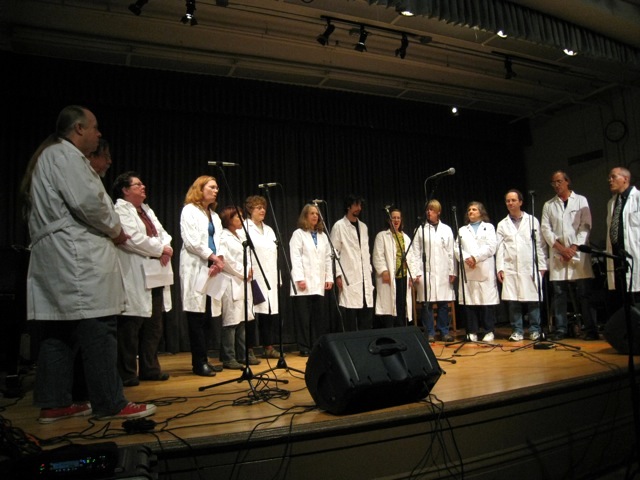
    The Cornelius Cardew Choir was a stark contrast to Reconnaissance Fly in terms of form and energy. Our first piece, Joe Zitt’s “That Alphabet Thing” was a cappella with a freeform structure. Basically, it unfolds by each singer intoning the sounds of the letters of the alphabet, starting with A and gradually working his or her way to Z. Everyone moves at a separate pace but mindful of others not to get too far ahead or behind, and there were a lot of fun moments of interplay among different choir members, such as back-and-forth with “Hi!” for H-I or “why?” for Y.

    [Photo by Michael Zelner.  Click image to enlarge.]

    We wear white lab coats.

    This was followed by “El Morro” by choir director and co-founder Tom Bickley. The piece was inspired by a trip to the El Morro monument in New Mexico and featured the text from inscriptions on a rock spanning carved messages from two centuries of Spanish, Mexican and American passers by, soldiers as well as other travelers. Each of us had a set of inscriptions to recite on a single pitch per inscription, set against an electronic background of rocks, birds of prey and highly processed vocal incantations. This was a rather complex piece conceptually, though not difficult to perform. Because we were so involved in the performance and the conceptual nature, it is hard to know how it was received in the audience.

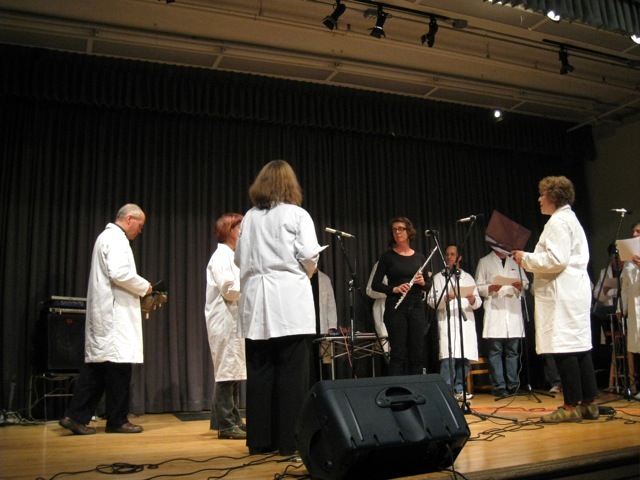
    The set concluded with a performance of Polly Moller’s Genesis. We had seen a previous performance of Genesis at the Quickening Moon Concert. The previous performance was entirely instrumental. This time, the parts of the spatial and higher dimensions were voice. I performed part of “universal time”, using the sequencer on the Evolver as the time-keeper and performed various modulations of the tempo and timbre. Polly played the role of the “new universe” with a flute solo featuring multiphonics and other techniques. Tom Bickley conducted the piece by walking around the stage and carrying chimes.

    [Photo by Michael Zelner.  Click image to enlarge.]

    This was a very meditative performance, with the chimes, the flute multiphonics, the ever changing electronic rhythm and timbre, and the vocalists singing their respective dimension numbers in different languages.

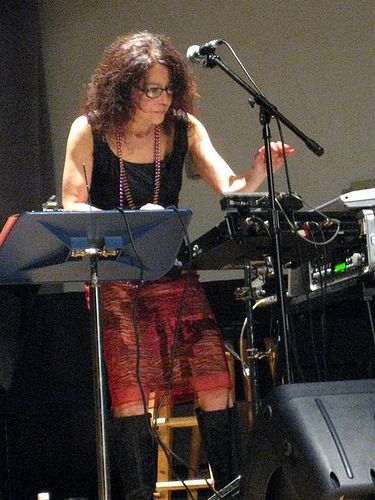
    The final set of the evening featured Amy X Neuburg. As always, her “avant cabaret” set was very polished and spoke well to both her technical expertise with her instruments and her versatility as a performer. She employs several styles of singing, often in a single piece, moving from classical to cabaret/jazz to experimental vocalizations. Her synchronization with looping electronics is very tight, seemlessly adding and subtracting samples and recordings within the rhythms and phrasings of the song.

    [click image to enlarge]

    There were pieces familiar from past performances, such as “Life Stepped In” where she deftly mixes looping technology and theatrical vocals. She also did a few improvisational pieces, the first of which featured the Blippo Box. This is an instrument with chaotic oscillators that never quite sounds the same twice, but she always manages to control it quite well – in this performance she made it sound like a voice, to which she responded with her own voice. She also performed an improvisation with a Skatch Box which she made at the “build your own Skatch Box” presentation earlier in the week (and which I unfortunately missed). It’s hard to make a skatch box sound like a voice, but she could make her voice sound like the growls and scrapes that it produced.

    [Photo by Michael Zelner.  Click image to enlarge.]

    She ended her set with a tribute to Kim Flint, who was very active in the looping and electronic-music communities, and the founder of Loopers Delight, and who passed away after a tragic accident in Berkeley in June. He was someone I knew as well from both music and social events. Amy’s tribute was a performance of the first piece she ever created using the Echoplex, which he co-invented.

  • Guest post: Friday at Outsound: Reconnaissance Fly, Cornelius Cardew Choir, Amy X Neuburg

    [While I work on the reviews for the Friday and Saturday shows at the Outsound Music Summit, we have a guest review from Joe McMahon, ambient music/soundscapes – pemungkah.com. Given that I was a performer in two groups on Friday, his review provides an interesting outside perspective.]

    Friday at Outsound: Reconnaissance Fly, Cornelius Cardew Choir, Amy X Neuburg

    An interesting evening of word (and other vocalization) related music. Reconnaissance Fly led off with their songs based on “spam poetry” – the sometimes strangely numinous texts randomly generated to try to evade spam filters. RF can, and does, play in a massive variety of styles, from samba and tango through pop, prog rock, and jazz, all the way to full-on avante-garde improv. These wildly disparate styles and surreal text are combined in pop song structures into catchily mind-bending conceptual smoothies. It appeared that the audience was ready for an encore, but time was short. The piece which included what seemed to be samples from a “teach your bird to talk” record and Polly Moller’s exceptional flute multiphonics and extended techniques was particularly fascinating, and Moe!’s drumming lent serious propulsion and quirky humor as well.

    The Cornelius Cardew Choir did three pieces: the first was based on the alphabet and reminded me a bit of “In C”, as the choir started at “A”, both reciting the letters and making their sounds, the individual members determining the speed at which they moved through the alphabet. Charming and fun. The second piece was based on rock inscriptions; very dense and almost surflike; I had a little trouble spotting a structure in this one, but that’s probably more the result of a long day on my part. The last piece added electronics and flute; a very evocative, ritualistic piece – fascinating textures and quite wonderful.

    Last on the bill was Amy X Neuburg, who wowed the crowd as always, performing, among others, several pieces from her _Residue_ album; her performances of these have evolved interestingly. In addition, she improvised a new piece on the spot using her Blippo Box and her just-built Scatchbox, and a tribute to Kim Flint the late founder of the Looper’s Delight mailing list.

    A very enjoyable evening; looking forward to hearing more from all the performers.

  • Outsound Music Summit: Touch The Gear Expo

    Once again, the Outsound Music Summit opened with Touch The Gear Night this past Sunday, in which the public is invited to come and, well, “touch the gear” and interact directly with many of the festival artists who use technology in their music. “Technology” included software, electronic devices, DIY projects, and mechanical and sculptural instruments.

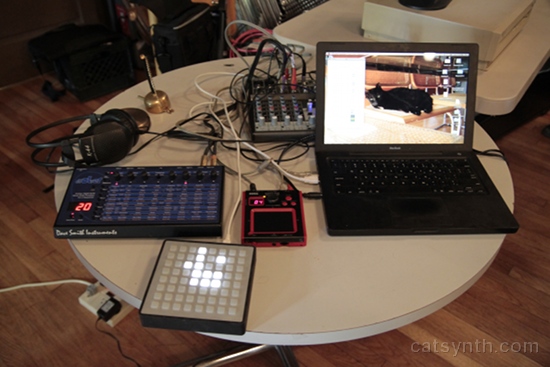
    I attempted to both cover the event for CatSynth and demo some of my own gear, which made for a hectic but fun evening. I kept my demonstration relatively minimal, with my Monome 8×8, the Korg Kaoss Pad and the Dave Smith Evolver:

    [click to enlarge]

    Basically, this was a subset of the gear I used at the Quickening Moon Concert (which was part of Outsound’s regular Thursday series at the Luggage Store Gallery). The monome was driving a simple software synthesizer, which along with the Evolver was being processed by the Kaos pad. The monome in particular attracted a lot of attention with its clean geometry and texture, and mysterious nature. It’s just an array of lighting buttons with no marking whatsoever, which invites curiosity.

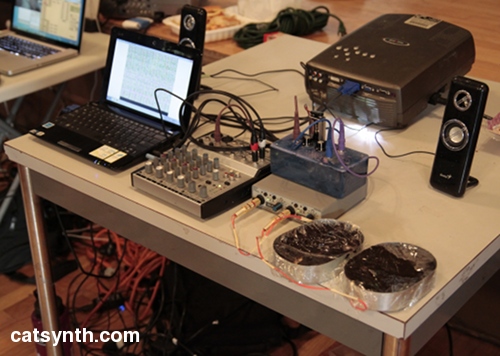
    Travis Johns brought a highly portable version of his worms in compost, this time attached to an analog ring modulator and open-source software the implements Slow Scan Television.

    [click to enlarge]

    One could hear the noise generated by the worms (which was a low-level rumbling static sound) and see the corresponding image generated by the SSTV software projected onto a screen.

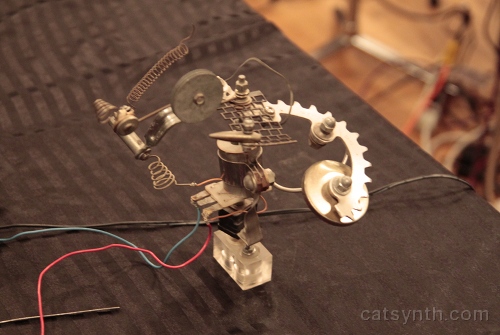
    Walter Funk presented a variety of instruments and objects, including Phoenix, a metal music object created by Fred the Spaceman. It was attached via contacts to an effect processor and a speaker, and could be struck or shaken to produce a variety of sounds.

    [click images to enlarge]

    He also had an old Realistic (remember that brand?) variable-speed tape recorder that included a bucket-brigade (BBD) chip which could be used for a variety of pitch and time shift effects. It would be interesting to modify the unit to take live input in addition to recorded tape input, although the use of tape is part of the charm of such a device. Additionally, he had a small custom analog synthesizer made from inexpensive breadboards made by Elemco that were originally designed for test equipment.

    Tom Duff demonstrated the Sound Labs Mini-Synth, a DIY synthesizer kit designed by Ray Wilson. It’s a basic subtractive analog synthesizer, a la a Minimoog. More intriguing were the two generations of Bleep Labs Thingamagoop and Thingamagoop 2. The Thingamagoop 2 includes the photocell-and-light control and analog sound-generation from the original, plus an Arduino for digital sound and control. I want one of these! It was also fun to put the two generations of Thingamagoops together to control one another.

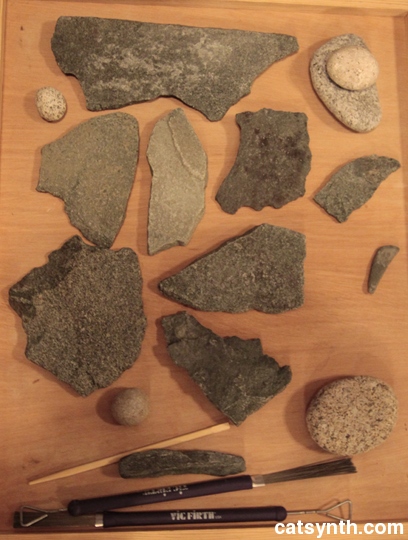
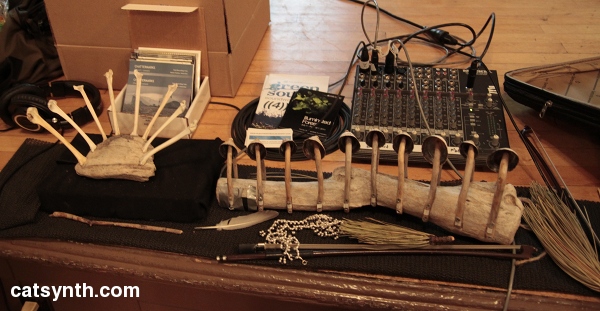
    Cheryl Leonard brought some musical objects from Antarctica, including flat stones, bones and limpet shells. The stones had a high but short sound when struck or rubbed against one another. These were used in her Antarctica: Music from the Ice project.

    The limpet shells had a resonant sound with well defined pitches. I found myself playing a subset of three shells that together produced an interesting set of harmonies and intervals.

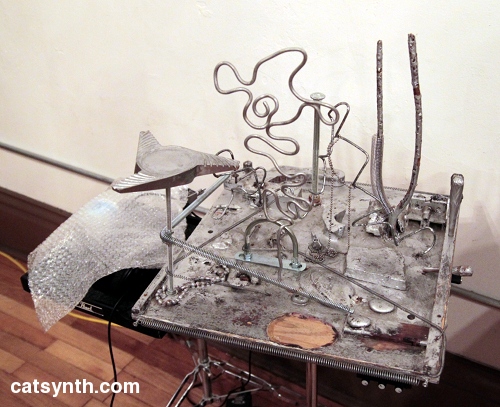
    Bob Marsh demonstrated Silver Park, a beautiful instrument that started as a proposal for a park in Detroit with metal sculptures and structures.

    [click to enlarge]

    Marsh sometimes performs with Silver Park as part of his Mr. Mercury project. The instrument version features springs in addition to the original metal objects, which add to its timbre. In a quiet room (unlike the room we were in) it can be played acoustically, but it can also be played with microphones and electronic effects. Whenever I see pieces like this, I am inspired to create one of my own, but also reminded how much work it is to create sculptures with metal, adhesives, etc. I did get some tips on some “baby steps” to work with similar sounds without necessarily committing to a sculptural artifact.

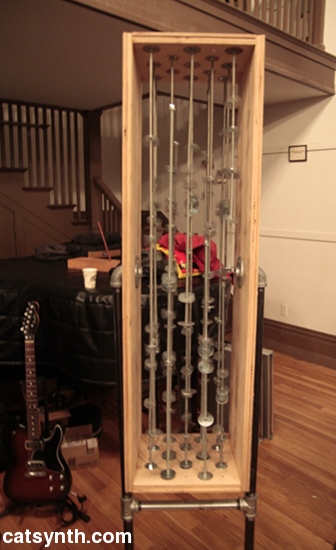
    Another visually powerful instrument was Dan Ake’s 12×13, a large box with 1/4″ metal rods and washers. When the box is spun, the washers slide and shake along the rods producing a metallic cacophony of sound and visual motion.

    By spinning the box, or leaving it tilted at various angles, one can get the full effect of the falling washers, or freeze them in mid-fall to cut off the sound.

    Philip Evert performed with an auto-harp processed by a large series of effects boxes. The control and sound of the effects chain was largely indeterminate, though the demo that I heard began with ring modulation before becoming a more complex mix.

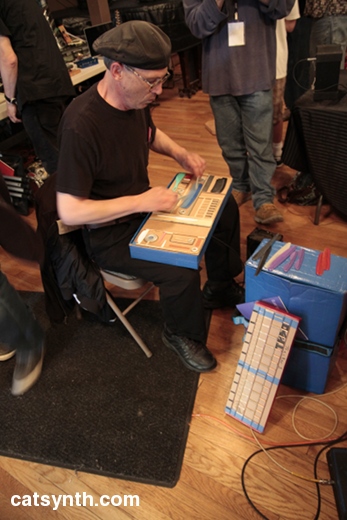
    Tom Nunn brought his Skatchboxes for visitors to try out. Here were see T.D. Skatchit demonstrating the main Skatchbox.

    [click to enlarge]

    He is a virtuoso on this instrument, and we have reviewed his collaborations with Nunn in previous performances.  The Outsound Summit included a demonstration and class on building your own Skatchbox, which sadly I was not able to attend.
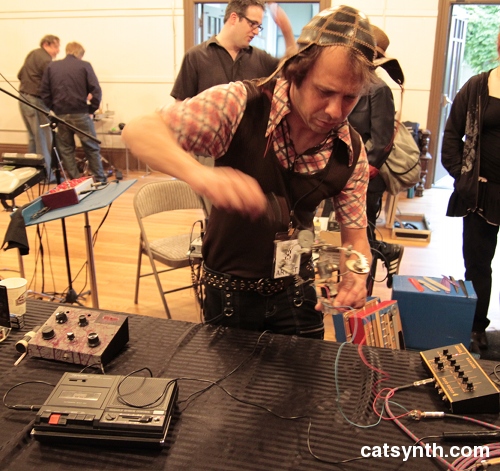
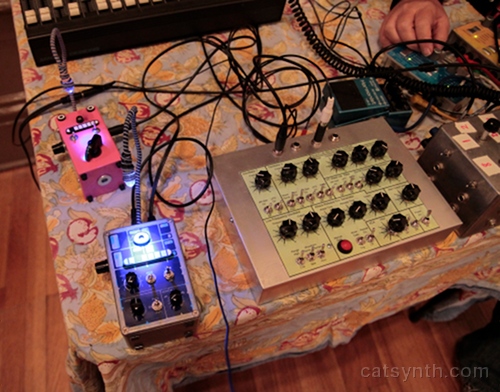
    Mark Soden (of phog masheeen) demonstrated a chain of effects processors including a Electrix Filter Queen that produced chaotic oscillations when driven with an appropriate sound source. He had a Roland SP-555 to drive the effects, but the more interesting demo was using a trumpet with contact microphones on its body. One could generate sound by blowing, tapping, or otherwise exciting the body of the trumpet which then drove the chaotic effects processing.

    Amy X Neuburg demonstrated the two instruments I have seen her use in her live sets. The Blippo Box produces chaotic signals that are compelling and very easy to play – the effect of turning knobs on the sound, even if it was unpredictable, was very smooth. Of course, the challenge is that the instrument is so chaotic that is very difficult to reproduce the same exact sound twice. She also showed her looping setup, which included a drum pad and an Echoplex.

    Rick Walker demonstrated his new “Walker Manual Glitch pedal”. It featured both built-in sound generators and live input, and the ability to “glitch” or reply snippets of sound from any of the sources. This seems like it will be a powerful instrument, especially when combined with loops as input or a live improvised performance.

    Thanks to Matt Davignon for organizing this event!  He was also a presenter and showed off his drum machines and effects boxes that he has used in many previous live shows.