
Tag: Art
-
September Photography Show at The Parts Room, Oakland
As I prepare for tonight’s opening at Art Explosion Open Studios in San Francisco, I look back at the opening just two weeks ago at The Parts Room in Oakland.
The Parts Room is located in Classic Cars West in Oakland, a venue that, as the name implies, primarily deals in classic cars. Many of these cars are themselves works of art.

In the above picture, we see two of the cars in display with large-scale artworks by GETBIZI. I thought his pieces would particularly well in conjunction with the cars, sharing the brought colors, clean lines, and including California-style landscape that is synonymous with car culture. I also found the pieces by Optimist, which featured a combination of industrial elements such as shipping contains with modern Asian signage and imagery, fit well with the environment and with my own work.

The overall show in the main gallery was titled “Mechanic Arts”, with many of the artist relating to the “mechanical” or “industrial” theme in different ways. Mark Schroeder’s sculptures combined new and old technologies with wood, metal and light generators were sprinkled throughout the main room, sometimes on top of old barrels. Similarly, Nicole Bommarito’s constructions with Polaroid emulsions combine various vintage technologies. John Paul Marcelo and MoE were also featured with painting and large installations, respectively. The work of these artists shared a weathered look of older industrial products and processes, which fit well with the space but were in sharp contrast to clean and streamlined quality of the cars, and of the large panels from GETBIZI.
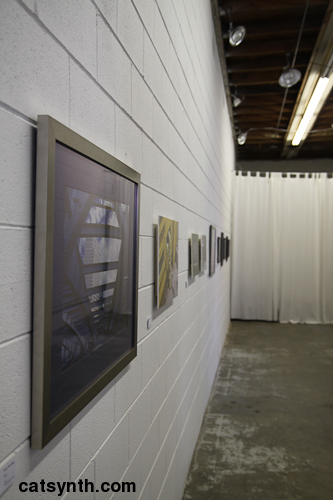
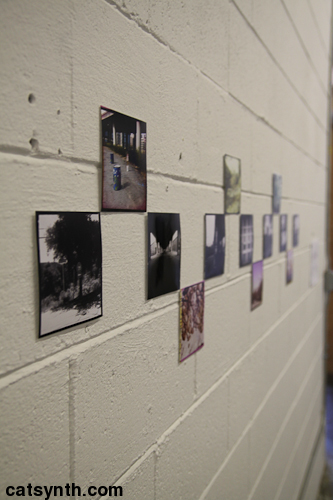
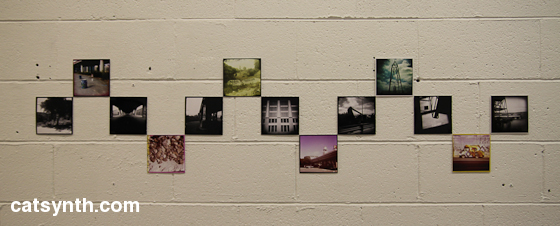
The Parts Room itself is a long and narrow space, which made for great opportunities to display both the large pieces as well as some of my iPhone Hipstamatic prints.


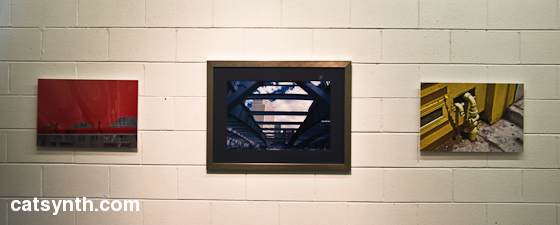
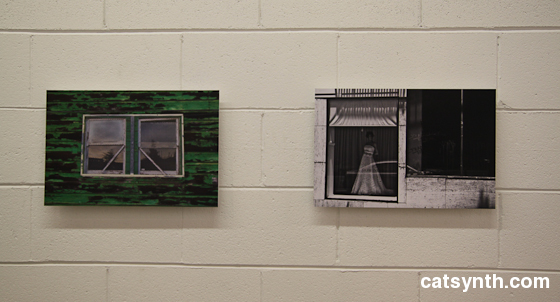
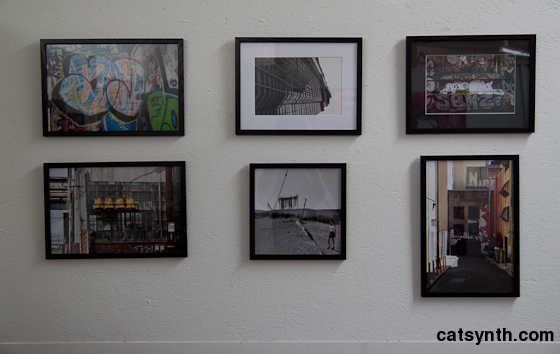
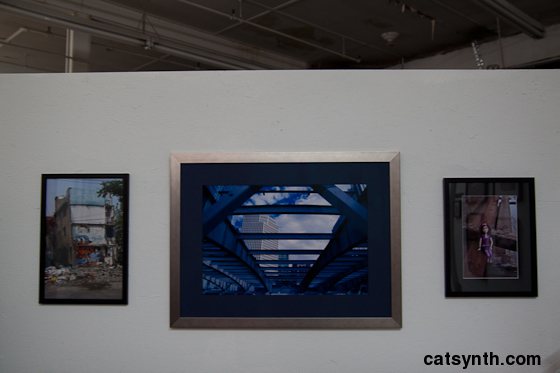
[click images to enlarge]We actually spent quite a bit of time meticulously lining everything up to make use of the space. In addition to just getting everything straight, I wanted to emphasize the lines, geometry and industrial elements on the pieces, as well as the prominence in one color in several of the pieces.


[click images to enlarge]
Overall, the response to the show was quite positive, and it was great to see so many people come through and show an interest, particularly on the Oakland Art Murmur night.

Overall, this was undoubtedly my best visual art show to date. It was well attended, and I received lots of positive feedback. It was great to have such support from Rebecca Kerlin to make this show happen, and to have the time and space to put in the effort to make it come out well. I also learned a lot about how to be precise in hanging and presenting work – something which I plan to bring forward with me in future shows.
It was sad to have to dismantle the show after only a couple of weeks, but I needed many of them for Open Studios. I did try and re-create the triptych of the red, blue and yellow pieces, although with less space. We will see how it goes.
-
Back Door! and Romanowski at Fabric8
Two concurrent shows at Fabric8 in the Mission District of San Francisco touched upon topics that frequently come up here at CatSynth, highways/transportation and modern geometric design. They also followed two artistic styles that I associate with contemporary urban art: cartoonish humor and street art, and geometric architectural elements.
In Back Door! at Fabric8, artist Andy Stattmiller “visually expounds on the subject that San Franciscans love to hate: the MUNI transportation system”. And it is true, we do have a rather strained relationship with transit system we depend on in the city – there have been numerous times I have opted to walk because I felt is was more reliable. On the other hand, MUNI is a place where the colorful residents of the city cross paths and sometimes get squished together, and where one can observe the contrasts among neighborhoods and streets.

[Andy Stattmiller. 14 Mission. Image courtesy of Fabric8.]
Stattmiller’s canvases featured individual lines from the MUNI system, mostly busses, which he populated brightly colored cartoon-like figures that simultaneously seem like real denizens of the city and creatures from other planets. The larger heads on the bus drivers were particularly fun. The busses themselves and the surrounding space take on different character of the lines and the neighborhoods that the serve. There is even a triangular canvas representing one of many steep inclines.

[Andy Stattmiller. 67 Bernal Heights. Image courtesy of Fabric8.]
This was very much an show for locals, who could identify, and identify with, the individual busses and metro lines featured. People did seem to enjoy finding the piece that featured the lines they often use, whether part of their daily routine, or a particularly memorable misadventure. I did find a couple that I have frequented.
In contrast to the chaos and humor of Back Door!, Romanowski’s pieces in the concurrent show Bees and Things and Flowers had a very serious and ordered quality, and was quite calming.

[Romanowski. Le Roy. Image courtesy of Fabric8.]
Although several of the pieces are assemblages of found objects, they give the appearance of abstract sculpture or even painting. Indeed, one can see similarities in the patterns of the found-object pieces and his Installation of stencil on paper.

[Romanowski. Installation (stencil on paper, framed). Image courtesy of Fabric8.]
Some of the more intricate pieces, such as Le Roy, remind me a bit of Lousie Nevelson’s sculptures. However, while the abstract geometric designs feel modern, the use of mostly wooden found objects gives them an older feel. And as such, they seem to get in touch with the older architecture in many parts of the city.
Bees and Things and Flowers closed yesterday (September 5). However, Back Door! remains open at Fabric8 until September 12.
-
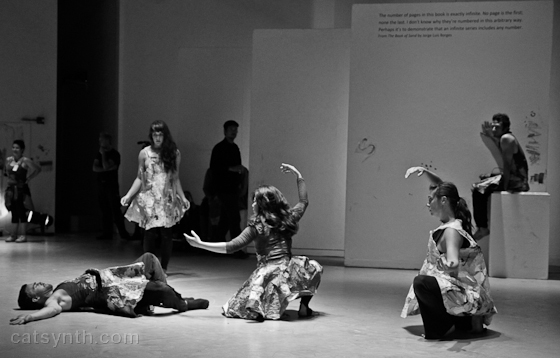
The Book (Part 2) at SOMArts: Avy-K with Ken Ueno and Matt Ingalls
A week ago I attended a performance of The Book, a monthlong project by Avy-K Productions at SOMArts as part of their Commons Curatorial Residency prorgram. Avy-K, founded by long-time collaborators Erika Tsimbrovsky (choreographer/performer) and Vadim Puyandaev (visual artist/performer), specializes in multidisciplinary pieces combining contemporary dance, live music, live painting and evolving installations. The Book used these elements to present a framework for audience interaction and narrative.

From the online program notes:
The Book is an installation-performance series accompanying an ongoing exhibition based in experimental non-theater dance. Each performance is a random page from The Book, and each invites a different guest artist to enter the structure, created by Avy K Productions and collaborators, in order to destroy it and give it new life.

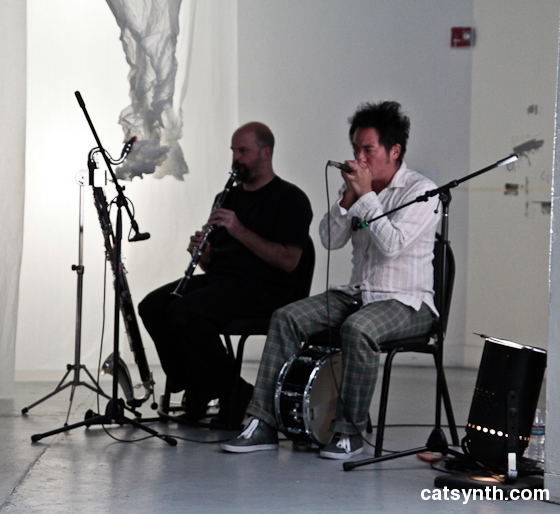
Matt Ingalls and Ken Ueno The performance featured live improvised music by Matt Ingalls and Ken Ueno. I have of seen both of them perform in a variety of venues on numerous occasions, but never together as duo until now. There were many moments where Ingalls’ wind instruments and Ueno’s extended vocal work matched perfectly. In fact, the timbres of the voice and instruments were close enough to seem indistinguishable at times. Both performances held single pitched tones, with only slight variations the led to pronounced beating effects. At other moments, clarinet multiphonics were set against low intense growling, or Central Asian (i.e., Tuvan) throad singing. There were also percussive notes passed back and forth between the performers in sparse rhythmic patterns – something that worked well with the movement of the dancers. I was interested in some of the more unusual uses of instruments, such as Ueno’s combining of a clarinet bell and snare drum with vocalizations or Ingalls’ decomposition of the clarinet into subsections.
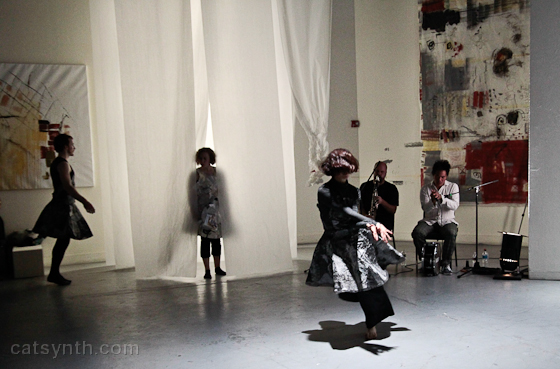
The dancers costumes featured “dresses” made of black-and-white patchworks that seemed to resemble newsprint on top of black – this costuming was used by both the male and female dancers. It matched the starkness of the room and the displays, which were mostly white with black text or markings. The music, dance movements and costumes provided plenty of empty space, which seemed in keeping with the stated mission of The Book for “artists and audience members [to] allow their personal stories to enter the performance space, creating a collective public diary.” The main source of bright colors were large paintings at various places on the wall – their significance would become apparent as the performance unfolded.
The dance began very subtly and quietly, with long pauses and brief motions that matched the soft percussive sounds from the voice and clarinet. The motion focused on dancers interacting in pairs or individual dancers interacting with the large white panels set up throughout the room, the floor, or their costumes.

As the dance continued, Vadim Puyandaev emerged in all black and began live-painting a new large-scale mural on one wall of the gallery. The painting used vibrant colors and it became clear that the colorful paintings I noticed earlier must have been the result of previous performances. As the painting progressed, the dancers gradually set down in close formation facing Puyandaev, as if in prayer or meditation. The music appropriately moved to a long clarinet drone and throat singing.
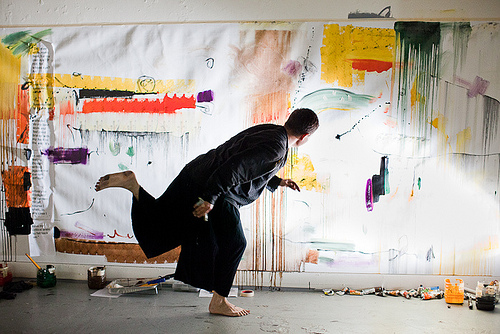
[Photo by Elena Zhukova, reprinted courtesy of SOMArts.]
As the next section of the performance began, the audience was invited to gather around one particular set of curtains. The shadowy figures of two dancers could be seen through the curtain, with the outline of their bodies coming in and out of focus. They emerged very gradually from underneath the curtain, first a foot poking out, then a head and neck, squeezing out like a caterpillar, As they fully emerged, the two dancers came together in slow, undulating and curving motions. This part of the performance was, to say the least, rather sexually charged. After continuing for a period of time, the dancers separated and retreated behind the curtain.

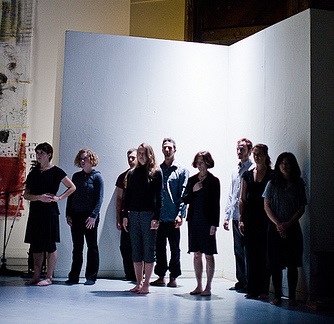
Photo by Elena Zhukova, reprinted courtesy of SOMArts The final section of the performance was more heterogenous in terms of content, with a greater variety of motions and interactions with the space. Large rolls of paper were spread out on the floor – a dancer proceeded roll himself up in one of these. Square holes were cut in some of the white curtains to create windows that performers peeked through. A large circle was created which some dancers followed as if on a monorail. Over time, the dancers one by one exchanged their costumes for “street clothing” – basically, the sort of things one might wear when to attend a serious art performance like this but remain casual. Were it not for the deliberate nature of their motion, they would have been indistinguishable from the audience. It was clear that it was coming to an end as the all gathered in one spot and the music went silent.

[Photo by Elena Zhukova, reprinted courtesy of SOMArts.]
So the question is how how successful the piece was at allowing audience members to enter their own stories? For me, I found myself focused on the literal elements of the visual design, music and movement. Even as the piece evolved over time, I was drawn the elements as abstractions – perhaps not surprising for someone who gravitates towards abstract music and art. Particularly through the costumes and overall shapes of the installation, I could also connect to the urban landscape.
The Book continues at SOMArts with additional performances, including a free closing event on July 29 where one will be able to see how the gallery space was altered over the course of the series.
-
I <3 SF (I Love SF), Driftwood Salon
The show I <3 SF (where “<3” is the the common emoticon for heart that may or may not appear properly in this print) is closing today at Driftwood Salon, but we take a little time today to look back on my visit to the opening of the show. It would have hard to not attend a show that features on the compact but diverse city we call home. It was scheduled to coincide with the 155th anniversary of the founding of the City and County of San Francisco on June 11, 1856, and features several artists’ interpretations of life in the city as a general concept but details and subject matter unique to San Francisco. There are street scenes, architectural details, references to cultural history, and some that are simply “tributes”.
The “centerpiece” of the exhibition was a large painted cardboard origami piece by Joe Spear with the show title “I <3 SF” emblazoned on the side, about where the US emblem might go on a fighter jet.

[Joe Spear’s metal origami in foreground. Rebecca Kerlin in background.]On the wall behind the origami one can see several pieces by Rebecca Kerlin, whose works featuring the highways and other infrastructure of our region and my own neighborhood in particular have often been featured on this site. The three selections on the wall are from her “Constructions” series, with the large “Underpass Under Construction in Blue” pieces and the smaller “Underpass Under Construction in Orange” depicting the freeway approaching the Bay Bridge over 4th Street.

[Detail of Rebecca Kerlin’s Underpass Under Construction in Orange.]Driftwood Salon is itself in an interesting location on a side street in SOMA near the Central Freeway, so it seems appropriate that Kerlin’s work has been featured in multiple shows here.
Jun Han Kim’s pieces, including the photorealistic A View of Sunset, SF #4 also take on the literal sights and neighborhoods of the city.

[Jun Han Kim]Here we see the edge of the quieter and often grayer Sunset District from the Great Highway on the Pacific coast. It is an interesting part of the city that feels quite distant from the downtown. It was placed in the exhibition next to a very contrasting painting by Mei-Ying Dell’Aquila.


[Mei-Ying Dell’Aquila.]Here we see a more surreal image of the downtown financial district, with a figure who is at once the Statue of Liberty, a cartoon superhero and a fashionably dressed urban denizen crossing the street.
Two very different pieces by Greg PNUT Galinsky reference music and architecture of the city without specific locations.

[Greg PNUT Galinsky]This first piece suggests jazz and brings to mind the frequent jam sessions around the city – but the image also has a very iconic and industrial quality with its sparse clean lines. The clean black lines are used quite differently in this piece which is painted on glass. The reference to the city here is a bit less clear, though the use of weathered wood in the frame reflects the older architecture in the city and a recent trend in local art.

[Greg PNUT Galinsky]The direct reference in these pieces by Lady Millard are also a bit more obscure, except for the title “Fog City”.

[Lady Millard.]But they do pay homage to street art, and to the cartoon-like elements that seem be part of international urban art and culture. Such images could be at home in a gallery in large cities in Asia as there are in San Francisco, and perhaps represent the city’s place in a larger “Pacific urban” cultural landscape.
Indeed, part of what made this exhibition interesting is that the collection of different views on the city reflect my own interests in infrastrcture, urban landscape, music, fashion, etc – but each taken in more specialized ways by the individual artists.
The exhibition will remain on display for today (July 9) at Driftwood Salon (39 Isis Street) with a closing reception this evening.
-
No Fooling, We Mean It! – McLoughlin Gallery
“No Fooling, We Mean It!” at The McLoughlin Gallery is a show that is simultaneously playful and serious. The cavernous space of the gallery plays host to several large-scale works by sculptors David Middlebrook, Jeff Schomberg and Doug Thielscher. Each of the sculptors has a different focus, Schomberg on metal, Thielscher on stone, and Middlebrook on mixed materials. But all three present very serious well-constructed and polished piece (“no fooling”) with a sense of humor and fun (“fooling”). Additionally, all three are local artists, working and residing in the extended Bay Area.
The overall presentation has a sparseness, with lots of empty space and exposure of the gallery’s bare concrete walls that make it easy to focus on a single piece at any given moment. Even the larger stone works are not crowded and blend with structure of the space. I was most immediately drawn to Schomberg’s metal work, and in particular his pair of geometric wall pieces, Hinged and Unhinged.

[Jeff Schomberg, Hinged (2009). Found metal objects in steel frame. Image courtesy of McLoughlin Gallery.]

[Jeff Schomberg, Uninged (2009). Found metal objects in found frame assemblage. Image courtesy of McLoughlin Gallery. Click to enlarge.]
The rectangular frames serve as a boundary between the space of the gallery and the empty space within the pieces. Inside, each object is given room to be seen separately, such as the large circle in Unhinged or the intricate thin metal lines in both pieces that remind of my street maps. Indeed, the combination of geometric elements and metal coincide with my own focus on urban landscape and infrastructure. (See the similar elements in yesterday’s Wordless Wednesday post.) The circular elements seem particularly prominent in contrast to the mostly straight-line shapes of the found-metal components. Still other objects manage to retain their original functional shape and industrial history from before they became art. His mixed-media piece Trumbull takes the industrial theme one step further. An old rusted fuse box has been combined with a video of a fireplace and reassembled into a new piece of machinery. It is futuristic, in that delightful dystopian sort of way, even as it looks back on earlier electrical technology.

[Jeff Schomberg, Trumbull (2011). Fuse box with video. Image courtesy of McLoughlin Gallery. Click image to enlarge.]
These pieces, however, do stand apart within the overall exhibit. If there is one theme that cuts across all of the artists, it is “human-like forms that really aren’t human.” Among Schomberg’s metal sculptures are a series of small human-like figures with heads shaped like pipes or other pieces of hardware – probably the most humorous of his offerings. David Middlebrook’s assemblages have an organic look about them and some such as King of Things seem like they could get up and walk around. Think of Terry Gilliam’s cartoons or some of the creatures from the 1970s animated film Fantastic Planet.

[David Middlebrook, King of Things (2010). Bronze, aluminum, Indian gibble, cast expoxy. Image courtesy of McLoughlin Gallery. Click image to enlarge.]
The bronze box that serves as the base for the large stone egg in Middlebrook’s Carbon was an interesting touch. Doug Thielsher’s stone sculptures are the most directly figurative, but even here the figures are quite distorted, as in the two marble heads of The Ninth Circle that melt into one another. Thielsher’s sculptures were most noticeable for their use of the gallery space. From a distance, they seem like well-placed classical sculpture in a traditional art museum – and indeed they all draw from biblical or mythological themes. Up close, one sees the more surreal and humorous nature. Again, the one that most resonated for me was the most geometric. In Cain #3, the detached hand is almost lost underneath the large white cube and the black dot. Similarly, the hand seems to disappear into the large black cube of Cain #1.

[Doug Thielscher, Cain #3 (2006). Carrara and Belgian black marble. Image courtesy of McLoughlin Gallery. ]
The exhibit opened, appropriately, on April 1, and will remain on display though May 21. For more information about the exhibition and visiting, visit the gallery’s website.
-
Report from Spring Open Studios, Art Explosion
Open Studios has become a semi-annual experience for me since moving to San Francisco in 2008. Each time, I frenetically go from studio to studio in my guise as a reviewer and collector, seeing large amounts of work and interacting with artists. This time the tables were turned, as I was presenting my own photography work as part of the Spring Open Studios at Art Explosion. So rather than reviewing art, I will be reviewing the experience of presenting art, and interacting with viewers. Art Explosion is composed of two large buildings of artists’ studios in the ambiguous industrial neighborhood between the Mission and Potrero Hill. It was often one of the first stops on my Open Studio tours, and the small open studios were and supportive community were a natural choice for presenting my work.
I had two walls of an open studio space, along with additional space in the main hall and one piece in the entranceway (every artist had a piece here as part of a “sampler” wall). You can see the three walls in the images below (click on the small images to enlarge).


[Click images to view full size]
In all, I had 16 pieces featured. Additionally, I made a few “mini editions” of some of the pieces (4×6 inches) and had two video presentations of works that were not physically part of the show.
Over the three main days of Open Studios (and an additional Saturday the week after), I sat and waited as people walked by and sometimes stopped to view my work, and occasionally ask questions or give feedback. Some walked through without stopping to look, others spent a couple of minutes viewing intently without saying a word, or maybe a quick “very nice work” before wandering off. But a decent number of people did ask questions or more detailed responses. The most common questions I got were about the locations of the photographs, i.e., “Where was this one taken?” All the pieces I presented were from the Bay Area, New York or Shanghai, and discussing the locations or having viewers try to guess which was which became part of the interaction. There were definitely clues in each, in particular the more exotic architecture of the Shanghai high-rises and the distinctive San Francisco “No Parking” signs. Very few people were able to recognize the half-demolished overpass from the Transbay Terminal in San Francisco featured in the largest piece, though this one was among pieces most positively received.
The other pieces that seemed to receive the most intention were Asians.com (Invisible Bike) with the big orange cat, and Dragon (Moganshan Lu) with the dragon mural, half-demolished building and garbage-strewn street. I did an experiment moving these two pieces around after the first day to see if it was the location or the content that attracted people, but they still seemed to get the most attention. I had not predicted that Dragon would get so much attention – or eventually be the first large piece to be sold! It was one of those interesting surprises when exposing the work to public viewing.
I also had an interesting conversation about the location in 5348, one of two pieces in the show featuring a model. I have used that building on multiple occasions, with its mysterious mess of hanging cables.

It turns out that someone who came through and saw the show was familiar with the building and the people who owned it, and informed me that the structure with the cables was in fact for lifting large objects, freight, etc., but had not been in use for a while. A group of viewers said that the big orange cat was part of a scavenger hunt they participated in.
 ]Some people seemed more drawn to the aesthetics of individual pieces rather than the subject or context – like me, the focused on lines and textures. Among these viewers, 7059 (Blue) got the most attention. A few viewers did try to look for “musical” elements within my work after learning that music was my primary art form – they noticed repeated patterns and motives in the lines.
Overall, it was a good experience. I was able to show my photographs in physical form to a large number of people and received quite a bit of positive feedback. Among those who came to see the show were a few of the artists I have reviewed here on CatSynth in the past, which was very gratifying; and many friends came by over the four days I was showing. Selling a large piece and a handful of miniatures, of course, nice as well. Interestingly, I also managed to sell some music CDs. Some things I may do differently in future shows is have a larger variety of miniatures on hand – e.g., at least one of every piece I think can be reasonably represented in a small size (some just don’t look good small). I may also experiment with different types of framing and mounting – this was probably the hardest part of preparing for the show.
One unfortunate aspect of presenting my own work is that it left me very little time to explore and see what others were doing. I did take a few breaks to see friends as well as discover new work, though not at the level of detail I would have done in previous shows.
You can see images from Open Studios at this flickr set, or visit my page at Art Explosion.