Dahlia and GR-1 Granular Synthesizer

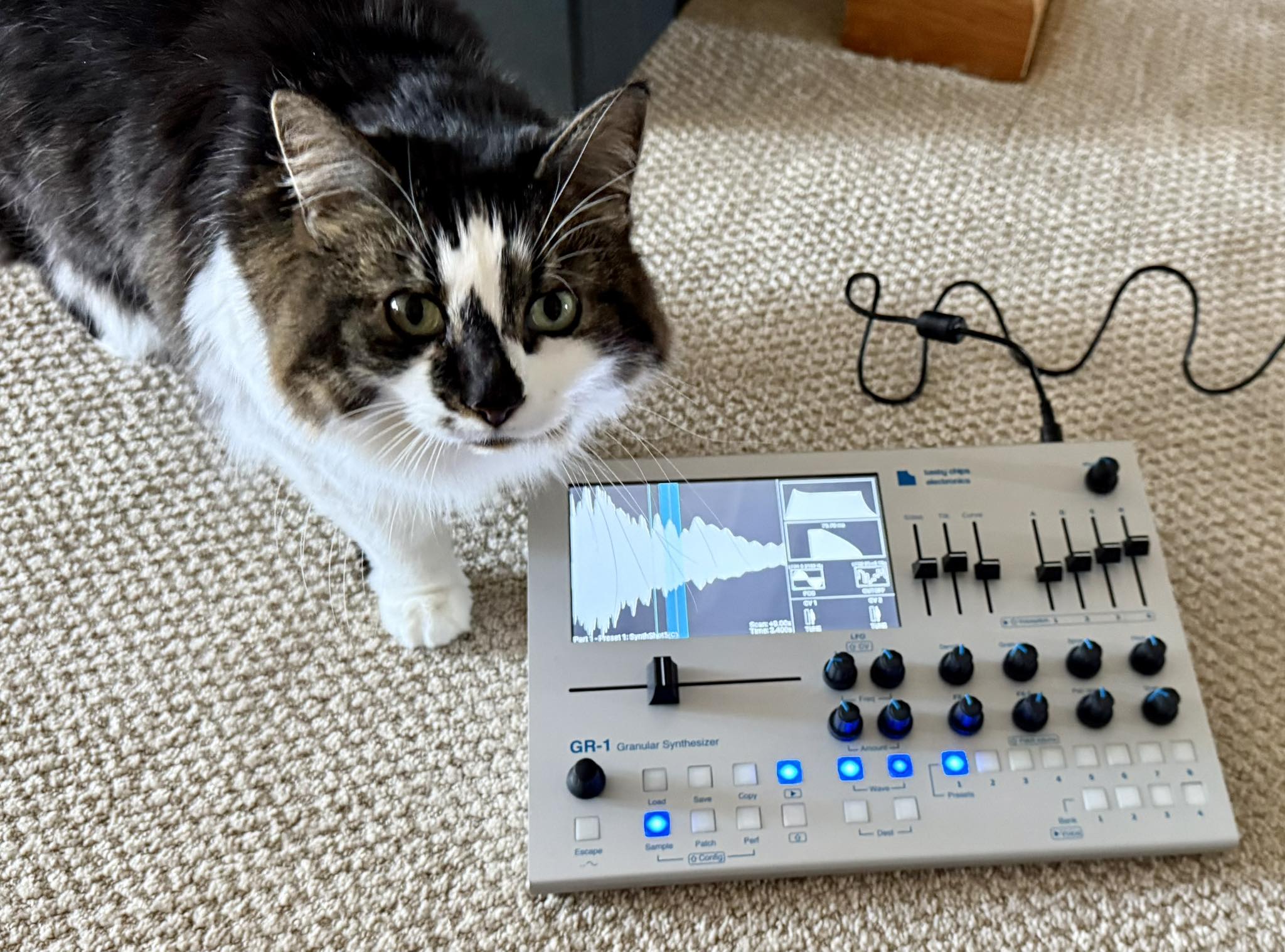
The beautiful Dahlia returns once again, this time with a GR-1 granular synthesizer from Tasty Chips Electronics. From our friend Rob Robinson (orderofthestatictemple on Instagram).

The GR-1 is relatively new to me, but I do know that granular synthesis is in right now. Here is some more info from Tasty Chips’ website.

The GR-1 is massively polyphonic: It’s capable of 128 grains per voice, which can add up to a total of 1000+ grains simultaneously. Playing rich chords to create granular harmonic clouds is an easy task for the GR-1. Hook up your (USB or DIN) MIDI keyboards and you are ready to go.

The GR-1 is a sample-based device. Load in your own samples or feed live audio through it using a class-compliant interface and you are now ready to granulate all your source samples into countless variations. Anything is possible, ranging from subtle changes that still represent the original sample to a completely mangled and scattered manipulation of the original. Imagine what it would sound like if you hear thousands of little sound particles (grains) swarming around to reconstruct any sample you present it. Depending on what source sample you want to use, results can be lovely, soft, and soothing but also chaotic, aggressive and unpredictable and everything in between.  
NAMM: Qu-Bit Electronix New Modules

Qu-Bit Electronix modules

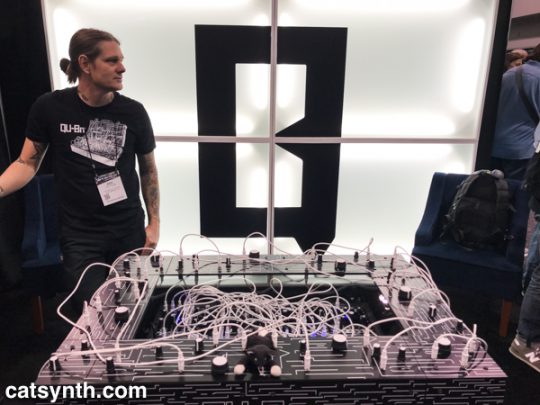
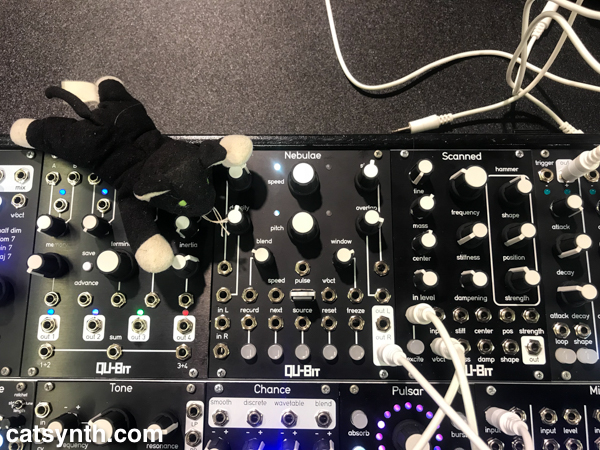
One of our first stops at NAMM 2018 was to visit our friends at Qu-Bit Electronix to see what they are up to.  They have three new modules, Synapse, Nebulae MK2, and Scanned.  We had a chance to try them out for ourselves – you can see a bit of our experience in this video.

We at CatSynth own and enjoy using the original Nebulae module, but the MK2 is a significant improvement, with more versatile and expressive controls for pitch, speed, and granularity (rate, window, etc.).  The main speed button traverses quite a range both forward and backward, and features a quick reset to unity by pressing.  Similar functionality is available with the pitch button.  The granularity features go beyond the original, including the ability to freeze the sound in place to create a steady timbre from any section of a recording.

The Scanned module is perhaps the first hardware implementation of scanned synthesis technique pioneered by Max Matthews and others.  The simplest way to describe it is as a system that provides the control of a struck or plucked string, but with a far greater range of sound than a vibrating string, such as any wavetable source.  The module has independent controls for pluck, tension, and many more parameters, of course all individually controlled via CV.  With pitch and gate input, it becomes the starting block for a rich modular instrument.

Although not included in the video demo, the Synapse is an interesting and handy module for mixing, switching, and otherwise routing a variety of CV sources to various destinations all from a single module.  It makes your CV sources more like a mixer with cross-fades and such.

Qu-Bit Electronix


It’s always fun to check in with Qu-Bit, and we look forward to seeing more of these modules.