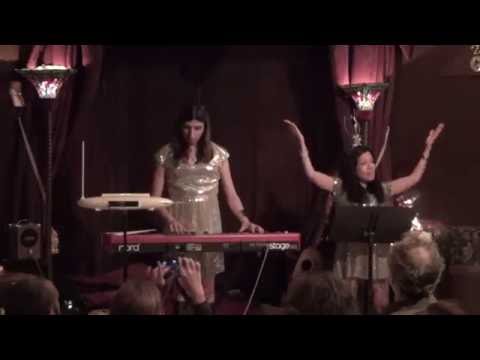
Please visit the comments section to read more about this “Wordless Wednesday” photo.
One week of musical adventures in San Francisco has taken us a bit longer than one week to share on these pages. But today we look at the final show from that week, featuring Faust at The Chapel.

So how exactly does one describe a band like Faust? As it says in the show description from The Chapel, ” Neither the habitus nor the music of this Hamburg group is easy to grasp.” The usual label of “krautrock” isn’t particularly descriptive, though it does orient them within the world of hard rock and experimental music coming out of Germany in the early 1970s. Many of the experimental elements around European and North American rock in that era can be found in their early albums like Faust IV. These elements were in abundance during the performance, with simple but meandering patterns mixed with a multitude of avant-garde elements. And it was all anchored by steady hands of original members Werner “Zappi” Diermaier and Jean-Hervé Péron.
There is a basic underlying hard-rock jam underpinning the music, which is then mixed with words, a variety of electronic sounds, and elements that were unique to the San Francisco show, including antiphonal vocals from the Cardew Choir and Lutra Lutra. (We have written about the Cardew Choir numerous times before on this site). The highlight of the collaborations was a final procession to the center of the crowd with large brass instruments dancing above the heads of the audience.

This was a contrast to the beginning of the set that featured soft vocals and percussion against a film playing in the background.

Another unusual feature of the set was the use of a graphical score, projected so that it could be seen by the audience as well as the musicians. Diermaier even turned his drum set around to face the projected score.

This photo also illustrates one other unique element to Faust’s performance: a “knitting lady” sat at the front of the stage calmly and silently knitting throughout the set.
I also spied friend and fellow Bay Area synthesizer player Benjamin Ethan Tinker sitting in with the band, which was a fun surprise.
The show was sold out to a very appreciative audience and they were well received by longtime fans and newcomers alike. It was definitely a unique and unusual experience, but still one that felt very musical. I would not describe it at all as an evening of “noise” (not that there is anything wrong with that). They lived up to their billing as legendary purveyors of experimental avant-garde rock.
Faust was preceded by two opening acts: a solo performance by Bill Orcutt on guitar. It was a softer, but quirky take on blues guitar. Orcutt was followed by Heron Oblivion. While coming out of the milieu of “cosmic guitar music”, they did have a darker, and sometimes frantic sound. They moved back and forth between more frenetic drum and guitar, and that soft plaintive sound in alternative pop. Overall, both acts fit with the theme of the evening, adding a bit of weirdness grounded in various conventions.
The final night of the Outsound New Music Summit featured three sets combining music with visuals. The room was dark, with all illumination coming from the visuals on the screen and the sonic elements abstractly arrayed around them.
The evening opened with Mika Pontecorvo’s project Bridge of Crows performing an improvised set to a segment Pontecorvo’s film The Bedouin Poet of Mars: The Last Poet.

[Photo: PeterBKaars.com]
The film’s story is a bleak tale of a poet who is the last survivor of a once-thriving civilization on Mars, searching for a home for himself and the last surviving plant. He sees the results of several self-destructive civilizations on his journey. Despite the dark subject matter, the visuals themselves were lively and abstract at times, with lots of interesting visual and image processing.

The music moved in and out of a variety of textures and dynamic levels, though the focus remained on the visuals throughout. Joining the regular ensemble was Bob Marsh, wearing one of his trademark suits and performing on a string instrument made from a tree.

[Photo: PeterBKaars.com]
One disadvantage of the darkened environment was that I did not get to see much of Marsh or his instrument, which I would have liked to. Rounding out the ensemble were Kersti Abrams on winds, Elijah Pontecorvo on electric bass, Greg Baker on electronics, hydrophone and clarinet, Mark Pino on percussion, and Mariko Miyakawa on vocals.
Next up was Tender Buttons, a trio featuring Tania Chen on small instruments, with Gino Robair and Tom Djil on analog modular synthesizers. The trio performed sounds against live interactive video by Bill Thibault.

[Photo: PeterBKaars.com]
The set was anchored by Chen’s piano, which ranged from intricate and complex to loud and aggressive, augmented by small toy instruments. The piano interlaced with Thibault’s abstract visuals, which started out simply but grew more complex over the course of the set. Throughout, the visuals displayed words from Gertrude Stein’s poem Tender Buttons, but were increasingly mixed with the more complex elements.

[Photo: PeterBKaars.com]
Robair and Djll provided a variety of adept sounds from modular synthesizers and circuit-bent electronics to complement the piano and video.
The final set featured live interactive video by Bill Hsu with James Fei on reeds and Gino Robair returning on percussion.

[Photo: PeterBKaars.com]
I am quite from the minimalist quality in Bill Hsu’s visuals. The began with very simple geometric elements, but soon hope added a bit of controlled chaos that led to very organic elements on the screen.

Befitting the visuals, the music in this set was more sparse, with moments of quiet and loud solo bursts from Robair and Fei. Robair percussion worked best with the early geometric elements, and Fei’s complex runs on saxophone worked well with the more organic visuals.
I enjoy sets that integrate visuals and music into a single unit. It can sometimes be a challenge to take everything in, much less write about it afterwards. But I hope this gives a little insight into the evening. It was a good closing concert for this years Summit, and was appreciated by those who came only that night as well as the loyal audience members who were there most or all days. This concludes the 2015 Outsound New Music Summit, and I look forward to its return next year.
While the first night of the 2015 Outsound New Music Summit was billed as “Quiet Noise”, the second night was something altogether different. The concert features three exuberant but very different bands spanning a wide variety of musical techniques and styles.
First up was Cabbages, Captain and King, a trio featuring Eli Wallace on piano, Karl Evangelista on guitar, and Jon Arkin on drums.

[Cabbages, Captain and King. Photo: peterbkaars.com.]
I have become quite a fan of Eli Wallace’s piano playing, which is virtuosic and energetic. Combined with Evangelista’s intense and varied guitar performance and Arkin’s drums, the trio packed quite a punch. The speed and energy rarely let up throughout the 45-minute set. The music had an unsettled quality, always moving forward and never quite reaching a groove or tonal center. There were occasional quiet moments when the overall intensity of the performance let up, and the final notes with prepared piano were a nice touch.

[Eli Wallace. Photo: peterbkaars.com.]
Next up was Liza Mezzacapa’s Bait & Switch performing her project avantNoir. The pieces in this project were all inspired by noir fiction. The first half was based on “hard-boiled” stories by Dashiell Hammett set in 1920s San Francisco – with many familiar places and streets references – and the second half was based on “soft boiled” stories by Paul Auster set in 1980s New York (also a familiar setting).

[Lisa Mezzacappa’s avantNOIR with Bait & Switch. Photo: peterbkaars.com.]
The music fit into the punctuated jazz style I have heard many times from Mezzacapa and her bands. But there was a distinctly 1970s crime show vibe to many of the pieces that contrasted with the times and places of the original stories’ settings. The interplay of bass, guitar with wah wah and drums, along with some of the electronic sounds from guest performer Tim Perkis led to this 1970s feel. The project itself suggests film scores for the stories, and I liked the idea of changing listeners’ expectations, especially if they have seen Hollywood versions of these stories. In addition to Mezzacapa and Perkis, the set featured Aaron Bennett on tenor saxophone, Jordon Glenn on drums, John Finkbeiner on guitar and special guest William Winant on vibraphone and sound-effects percussion. I found Winant’s seltzer bottle and tiny door particularly amusing.

[Aaron Bennett and William Winant. Photo: peterbkaars.com.]
Then it was time for Vacuum Tree Head to take the stage.

[Vacuum Tree Head. Photo: peterbkaars.com.]
Led by Jason Berry who was conducting this evening, led us through fast-paced set of short pieces that ranged from classic jazz to deep funk to something approaching metal rock. Above the fray were vocals by Amy X Neuburg, who brought her theatrical and operatic voicings to the rather challenging music along with her very distinctive performance personality.


[Amy X Neuburg and Jason Berry. Photos: peterbkaars.com.]
Many of the pieces, which were composed primarily by Berry and Michael de La Cuesta who together formed the band in 1989(!), were premiers. The band made the most of the variety of music, with an extended fusion keyboard solo by Amanda Chaudhary in DL DS, deep funk from the whole band behind Rich Corney’s guitar in EMS, a blindingly short jazz tune inspired by the Akhnaton dynasty of ancient Egypt, and a loud metal tune that may have been a first for an Outsound New Music Summit.

[Amanda Chaudhary et al. Photo: peterbkaars.com.]
Rich Lesnick (also a band-mate of mine in Reconnaissance Fly) brought solid saxophone and bass clarinet, including an extended moody bass-clarinet solo in Cushion Fortress; and Michael de la Cuesta featured in many songs on analog synthesizer, guitar and glockenspiel. Justin Markovits held things together with his drumming, assisted in the rhythm section by Tom Ferguson on bass. There was even a bit of abstract electronics from Amy X Neuburg on Blippo Box and Amanda Chaudhary on modular synth.

[Michael de la Cuesta and Justin Markovits. Photo: peterbkaars.com.]
The set was very well received by audience, some of whom were longtime fans of the band and some hearing us for the first time. And personally, it was quite a privilege to be part of the band for this event.
Overall, it was a strong evening for the summit, one that stood out as quite contrasting among the sets as well as with the other concerts.
If you have followed our past coverage of the annual Outsound New Music Summit you have encountered the photography of Peter B. Kaars. Indeed, his photos appear on many of our reviews of Outsound events and beyond. This year, his work was the subject of an evening of the summit, with a gallery installation and reception.

[Image by Rent Romus, Outsound Presents]
For this event, Kaars selected images that were single portraits, each capturing an aspect of the performers’ musical personality.

I was particularly happy and honored to be the subject of one of his selections: a close-up of my hand on a modular synth.

The exhibition was a chance to see Kaars’ work as an artistic endeavor independent of the performances being documented. Or as Executive Director Rent Romus put it: “an artist making art of artists making art.”
The evening also featured a screening of Tim Perkis’ film Noisy People, which documented the Bay Area new-music and free-improvisation scene in the period 2002-2007 by following a collection of familiar artists.

Indeed, all of the artists featured in the film are people and I know and in many cases played with, either during the period chronicled or through countless events after I moved to San Francisco in 2008. It was fun to see some folks I know now in an earlier incarnation, and how their music has collaborations have changed. Of course, seeing it in an audience comprised of members of scene made the experience that much more fun.
You can find out about the concerts for this year’s Summit at the official website.

The band Vacuum Tree Head returns for a performance at this year’s Outsound New Music Summit. The event will be on July 30, 8PM at the Community Music Center, 544 Capp Street in San Francisco.
Vacuum Tree Head is led by Jason Berry – that’s “J.B.” who draws the Mensa Cat Monday cartoons. The poster that appears above is his artwork as well. The new lineup for the band features Amanda Chaudhary on keyboards, Rich Corney on guitar, Michael de la Cuesta on guitar, orchestral chimes and synthesizers; Tom Ferguson on bass; Richard Lesnik on saxophones and bass clarinet, Justin Markovits on drums, and Amy X Neuburg on vocals and custom electronics. From the Summit website:
VTH has created music ranging from ambient electronics pieces scored for feedback, bass clarinets, singing bowls and bowed gongs (Tar’Hai Wizard, a piece dedicated to the great Jean “Moebius” Giraud), to tightly composed, guitar-based punk/prog songs (the album “THIRTEEN”), to abstract electronics and audio collage (the album “Aum Carve Etude H”), and all stops in between. The band is currently moving into areas involving the intersection of tightly composed compositions and free improvisation
The even also includes two other great bands. Cabbages, Captain, & King is a trio of Jon Arkin (drums), Karl Evangelista (guitar), and Eli Wallace. I have heard Wallace’s virtuosic piano a few times already this and looking forward to more. Finally, we will be treated to a performance of a new project avantNOIR by Lisa Mezzacappa with her Bait & Switch.
Please visit the Outsound New Music Summit for a full rundown of all the evenings. (We at CatSynth will be the to cover all four concerts.)

The 2014 Outsound Music Summit in underway. And as usual, we began with our popular community event Touch the Gear. We had a large crowd of all ages, and delightful cacophony of unusual musical sounds.

This year, I brought the analog modular (specifically, about two-thirds of the current module collection) and the new Moog Theremini:

[Photo by Frank Lin]
There were several first-time participants this year, including Elise Gargalikis and Dmitri SFC of coa-modular.comwith their “wall of Serge”. It was fun to get to try this out myself.

[Photo by Elise Gargalikis]
There was more Serge modular to be found, courtesy of Lx Rudis.

Aaron Oppenheim brought classic circuit-bent toys, including a Speak&Math and the Talking Computron.

It was a bit of inspiration to get of my tuchus and circuit-bend the Speak&Spell sitting in my studio!
There was a Minimoog sighting, of course.

Long-time participants Matt Davignon and CJ Borosque demonstrated their recent work with effects pedals. Davignon processed drum machines and samplers while Borosque’s pedals were in a closed loop circuit generating their own sound.


There were acoustic instruments as well. David Samas brought his very impressive contrabass ehru. This beast was huge. And it had bells in addition to the strings and resonant chamber (made out of a trunk).


Bryan Day presented his mechanical/electrical/acoustic inventions.

Jaroba shared a variety of wind and percussion instruments with a bit of electronics.

[Photo by Frank Lin]
There were several more presenters, and as usual I don’t have room for everyone in this post. But it was a great event as always, and we at Outsound appreciated everyone’s contributions. Now it is on to the concerts including tomorrow night’s Poetry Freqs show. Please click here for the full schedule!