Tag: News

  • R.I.P. Don Buchla (1937-2016)

    2016 has not been a good year for our musical heroes. And we have just lost one more, Don Buchla.

    Don Buchla at SFEMF 2010
    [Photo by Michael Zelner]

    Don Buchla was producing his first synthesizers about the same time that Robert Moog released his earliest models. But he took a very different approach, eschewing keyboards and other traditional interfaces to make a truly radical instrument. This led to some describing “East Coast” and “West Coast” schools of synthesizers – something that we at CatSynth largely reject. But there are nonetheless characteristics that set apart Bucvla’s instruments, such as the use of metal plates as controls; the ubiquitous use of low pass gates (LPGs) as sound units; the crispier/crunchier sound compared to Moog-inspired synths; and the visual beauty and oddness of the instruments. Indeed, they have appeared on CatSynth many times – follow this link to see a few.

    In addition to his synthesizers, Buchla also created numerous controllers, such as the Thunder, Lightning, and Marimba Lumina. Indeed, I was introduced to Buchla’s instruments and the man himself through David Wessel at CNMAT, who used the Thunder extensively in his performances. My personal memories of the two of them together mostly revolve around the wine-and-beer-fueled gatherings after formal events at CNMAT, ICMC conferences or elsewhere. They would talk endlessly but anyone else could chime in, and occasionally Don and I would have a sidebar, less often of a technical nature than lamenting strictures in one institution or another, or non-musical scientific concepts. Overall, however, he was often a laconic presence, off in a corner or just off frame, but then fully engaged when the moment arrived.

    Buchla and Roger Linn
    [Buchla sighting at Roger Linn’s NAMM booth in 2015]

    It was rare to see him perform. I did get a chance to do so at the

  • Happy 83rd Birthday Wayne Shorter

    Wayne Shorter, one of our musical heroes, turns 83 today. Please join us in wishing him a Happy Birthday!

    Wayne Shorter
    [By Tom Beetz @ http://home.hetnet.nl/~tbeetz/index.html (Flickr) [CC BY 2.0], via Wikimedia Commons]

    He is still going strong, composing and performing regularly. I had the chance to see him perform last year at SFJAZZ with his quartet. This was only his most recent musical incarnation, quite different from what he had done before with the Miles Davis Quintet in the 1960s and then with his own band Weather Report in the 1970s. Weather Report is sometimes under appreciated, but their early work is great and something that deserves its own article. Most recently, I have been listening to the album Algeria which includes members of the quartet I heard last year.

    Wayne Shorter Algeria

    Although I’ve known and appreciated his work for years, it is only the past couple of years that it has become a stronger influence and part of the regular rotation of music at CatSynth HQ. And we hope there is still more to come.

  • The Sound of Philadelphia

    Presented in honor of the opening of the Democratic National Convention. I listen to this today to try and remain optimistic.

  • SF Trans March 2016

    SF Trans March 2016

    It is pride weekend in San Francisco, and it is a particularly poignant one after the shootings in Orlando only two weeks ago. It is an extra mission for many of us to show up this year and be present, and be defiant. Before the main parade and event today, I wanted to share a report from the annual Trans March that opened up pride on Friday evening.

    I met up with the march on Market Street in downtown San Francisco, not far from CatSynth HQ.

    20160624-IMG_0603

    Here are some scenes moving forward with the march.

    20160624-IMG_0607-2

    20160624-IMG_0604

    I particularly liked this moment with both the transgender pride flag and the kitty cat.

    20160624-IMG_0610

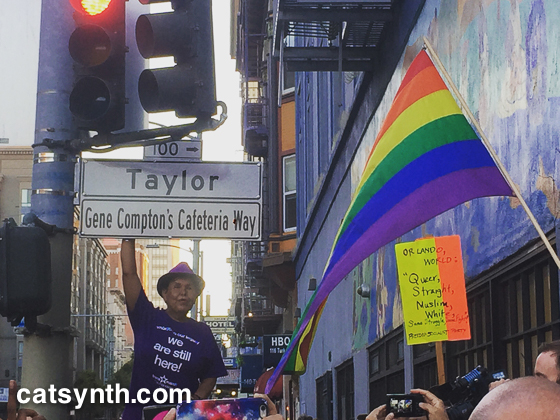
    The march turned from Market onto Taylor Street and stopped at the corner of Turk and Taylor in the Tenderloin.

    20160624-IMG_0615

    I have written about walking the entire length of Taylor in a previous article, including passing through this stretch. But it turns out to also be a very important spot in LGBTQ history, in particular for the history of transgender identity and rights. The corner of Turk and Taylor is the site of the Compton’s Cafeteria Riots in 1966 – three years before Stonewall. Compton’s Cafeteria at 101 Taylor Street was one of the few “safe” gathering places for transgender people in the city in the 1960s. You can read a brief account of the riot here. The history is not as well known as Stonewall, but this 50th anniversary commemoration was a step towards correcting that. The ceremony included veterans of the riots, and the unveiling of a new street name.

    20160624-IMG_0630

    Immersing myself in this history is a relatively new things for me, as I have been mostly involved in my own process and in the larger LGBTQ community. But I am happy to be getting deeper into it, and to participate in events like this.

  • #WeAreOrlando Personal Response

    More than any of the mass shootings in the last few years (and they seem to happen more and more often), this one has especially rattled me and affected me. There is the realization that this wasn’t random, but targeting a specific group. Targeting the LGBTQ community. Targeting us. I see more of myself in the 49 names and faces than I do in the victims after most shootings, not because their lives weren’t as precious, but because these victims could have been me. And then there is the frustration that this will get lost in the prevailing rhetoric that predictably goes to gun control and fears of Islamic terrorism. Sure, there have been a lot of statements of sympathy towards the LGBTQ community, and articles documenting the sad history of attacks over the decades, but nothing that puts the violent hatred towards us at the center of the conversation or looks at the causes of why this persists despite so much advancement legally and politically.

    It is connected to things that do not involve guns but involve similar hate, such as the series of killings of trans women of color here in San Francisco, or the “bathroom laws” targeting the trans community that “other” and demonize trans women making them such likely targets. It’s the long history of arsons of gay clubs and even churches. Of beatings, particularly of gay men. Of the much mythologized Stonewall Riots themselves.

    This occurs not in a vacuum but in the context of issues in the U.S. that don’t get enough scrutiny. We need to talk about how toxic masculinity fuels hatred towards sexual minorities. Young men already disaffected by whatever repulsed by two men kissing or a woman who may have been born a man. And we need to talk about the problem of religious fundamentalism. Even when it’s not in the forefront such as discrimination based on “religious freedom” it’s lurking in the background, with some connection to Christian or Islamic fundamentalism in particular used as justification. One must wonder why these religions would put so much focus on sexual identity and behavior that they would justify hurting or killing someone, but they do. And statements simply saying “we believe in peace” is not enough – we need people of faith to question why tenets against sexual minorities are even important to their religions at all, let alone something of such dire importance to discriminate or incite violence (or call special legislative sessions). They should to start to move away from these doctrines even if it is a break with “tradition”, and make it a priority to speak out against fear, hatred and violence of LGBTQ individuals. And those on the progressive left of U.S. politics, whom I see as comrades in most circumstances, need to also make this a priority. It’s hard to care about who is getting campaign money from whom when misguided laws and violence put ones own existence in question.

    I certainly hope this moment doesn’t turn into an excuse for counter violence against anyone, much less a call to war. That would be the wrong outcome. The important thing is for those from communities most responsible for the hate and violence, angry disaffected men and religious communities, to question and show that they are ready to change and to say “no more of this. Not from us.” That’s a lot to ask, but we can at least start.

  • Super Owl 2016

    Superb Owl on a Minimoog

    For Superb Owl Day, please enjoy this superb owl on a Minimoog.

  • CatSynth pic: #FeelTheBern

    Bernie Sanders, Cat and Nord

    From Cats On Synthesizers in Space on Facebook.

    COSIS for Bernie Sanders
    #catsonsynthesizersinspace #feelthebern

  • CatSynth at NAMM 2016

    namm2016-catsynth

    Once again, it’s that most glorious time of the new year when we CatSynth trek down to Anaheim, California for the NAMM show.  Synthesizers have been quite the thing the last couple of years, and we expect to see more that again this year.  Follow us here on the blog for detailed coverage, as well as on Twitter and Instagram for live coverage and photos!

  • Boulez and Bowie

    Boulez and Bowie

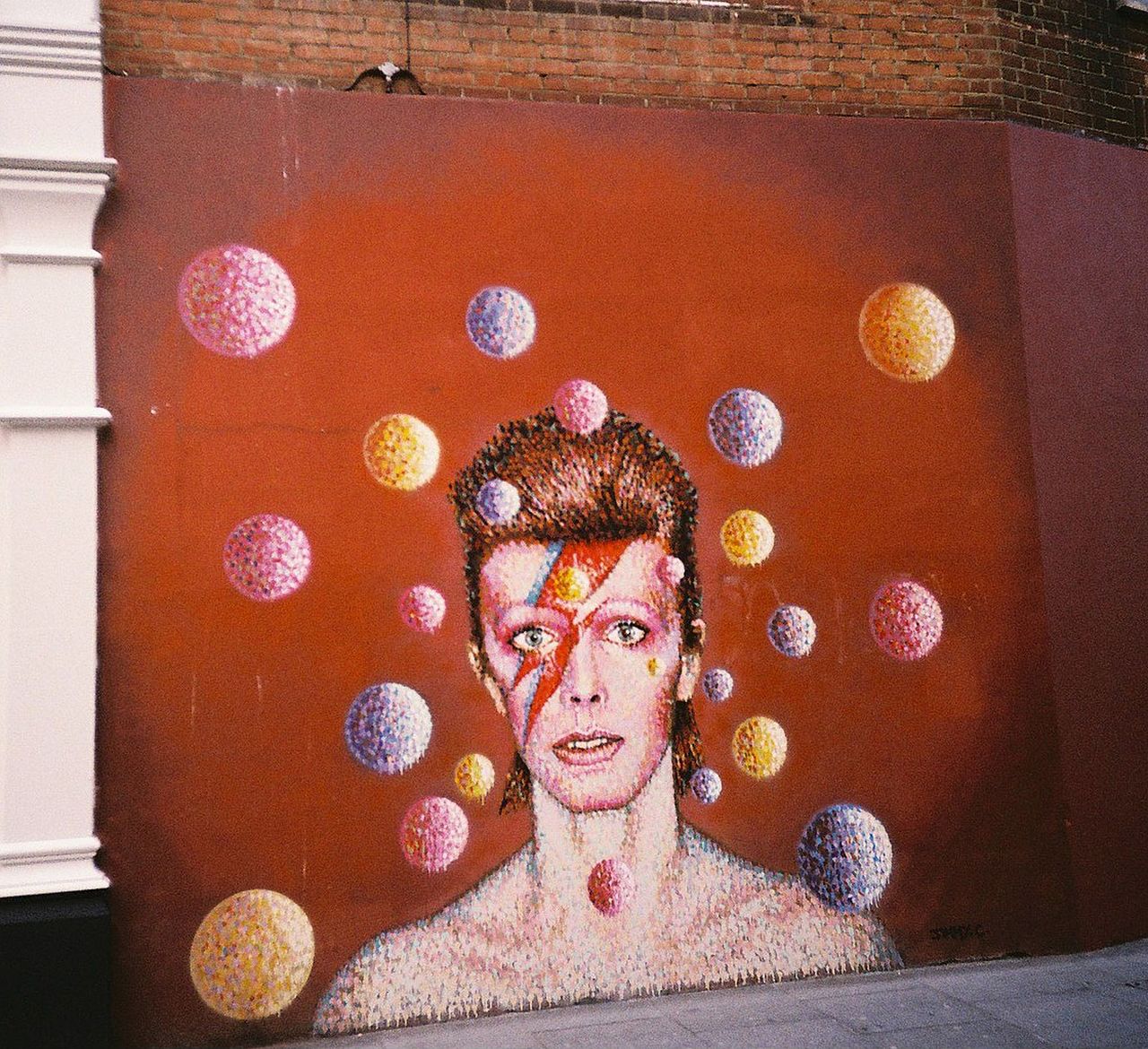
    In the span of just one week at the start of this new year, we lost two musical heroes (whose names, coincidentally, both begin with “B”). Pierre Boulez and David Bowie may seem worlds apart musically and stylistically, but they both had strong influences on where my own music and performance has gone especially in the last few years.

    By Joost Evers / Anefo (Nationaal Archief) [CC BY-SA 3.0], via Wikimedia Commons
    By Joost Evers / Anefo (Nationaal Archief) [CC BY-SA 3.0], via Wikimedia Commons
    I am most familiar with Boulez not as a composer but as the founding director and god father of IRCAM in Paris; and as a renowned conductor. One fun memory of the latter involves one of his recordings conducting Luciano Berio’s Sinfonia. It was a favorite of mine, and when I got the chance to present it to Berio for an autograph, he declared his dislike of the recording, but signed my CD atop Boulez’ face. As a figure who loomed large in the world of avant-garde music, and then electronic music, he certainly evoked strong opinions from others. There is no doubting the influence of his leadership at IRCAM in both my electronic-music composition and research, even as I disagree with aspects of the institution’s culture, such as strict control and division of music and technology research. But it’s worth stepping back and looking at Boulez as a composer. His masterpiece Répons combines electronics with an acoustic chamber ensemble in ways that make the electronics disappear at times. It also has a very visual quality to it, evoking a complex film scene or theatre piece.

    By k_tjaaa (Flickr: David Bowie Mural) [<a href="http://creativecommons.org/licenses/by/2.0">CC BY 2.0</a>], <a href="https://commons.wikimedia.org/wiki/File%3ADavid_Bowie_Mural.jpg">via Wikimedia Commons</a>
    By k_tjaaa (Flickr: David Bowie Mural) [CC BY 2.0], via Wikimedia Commons
    The theatrical is one of many ways David Bowie’s influence comes into the picture, along with the use of gender experimentation and constant stylistic reinvention. His gender-fluid and sometimes overtly feminine presentations on stage were “transgressive” for the time, but have certainly impacted many of us and made space for our own expression in music and in person. It set an example for me to be able to first come out on stage and then eventually in person. In addition to gender, Bowie’s onstage persona gave freedom to be decadent and glamorous, something which many styles of music seem to lack. Now when I perform Boulez-influenced music, it is definitely with Bowie-influenced staging and theatrics. And of course the costuming.

    But David Bowie was himself a talented musician and writer. In the same ferment of the 1970s in which he developed his personae, he also pushed the use of synthesizers and electronics in music that was still referred to as “Rock”. His song Subterraneans is a prime example of both technology (ARP synthesizers, backwards bass guitar) and theatrics in his music, as illustrated in this tribute video.

    The album that includes this song, Low, was preceded by Station to Station, one of my favorites for its funk influence, including the song Stay. The funk and soul sound of this album, along with his more unambiguously masculine persona in the album art (at least to my sensibilities), exemplify his ability to change and reinvent quickly from one project to the next. It’s the album I have returned to primarily after the announcement of his death on Sunday night. But I do want to close with one if his most hauntingly beautiful songs: Drowned Girl is one again something different altogether.