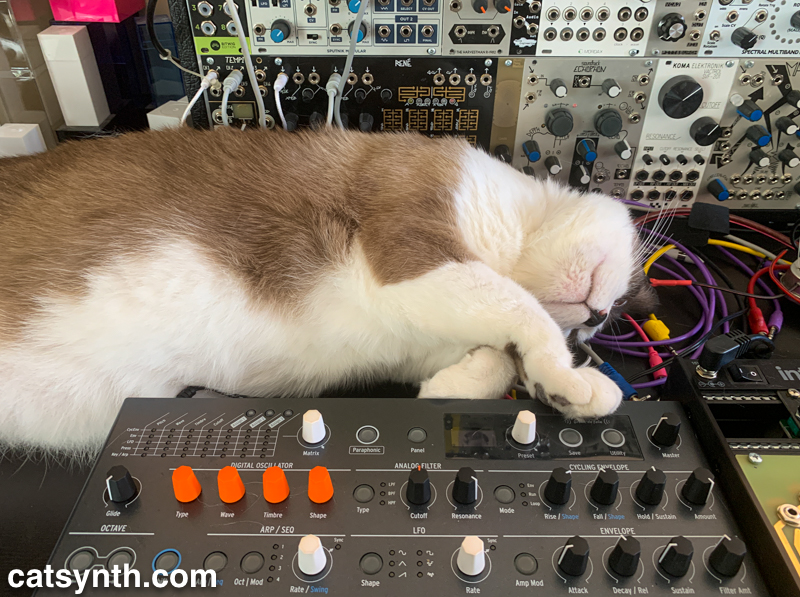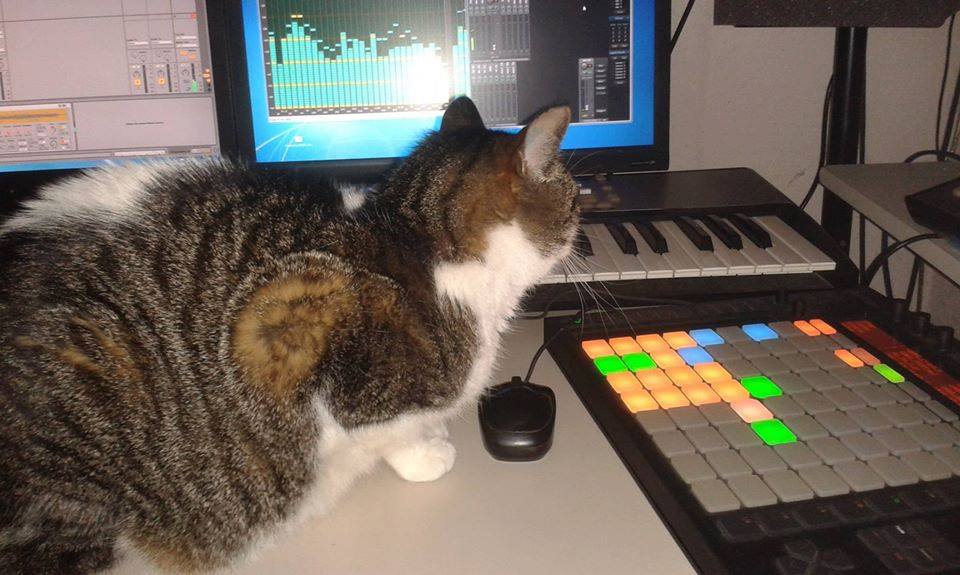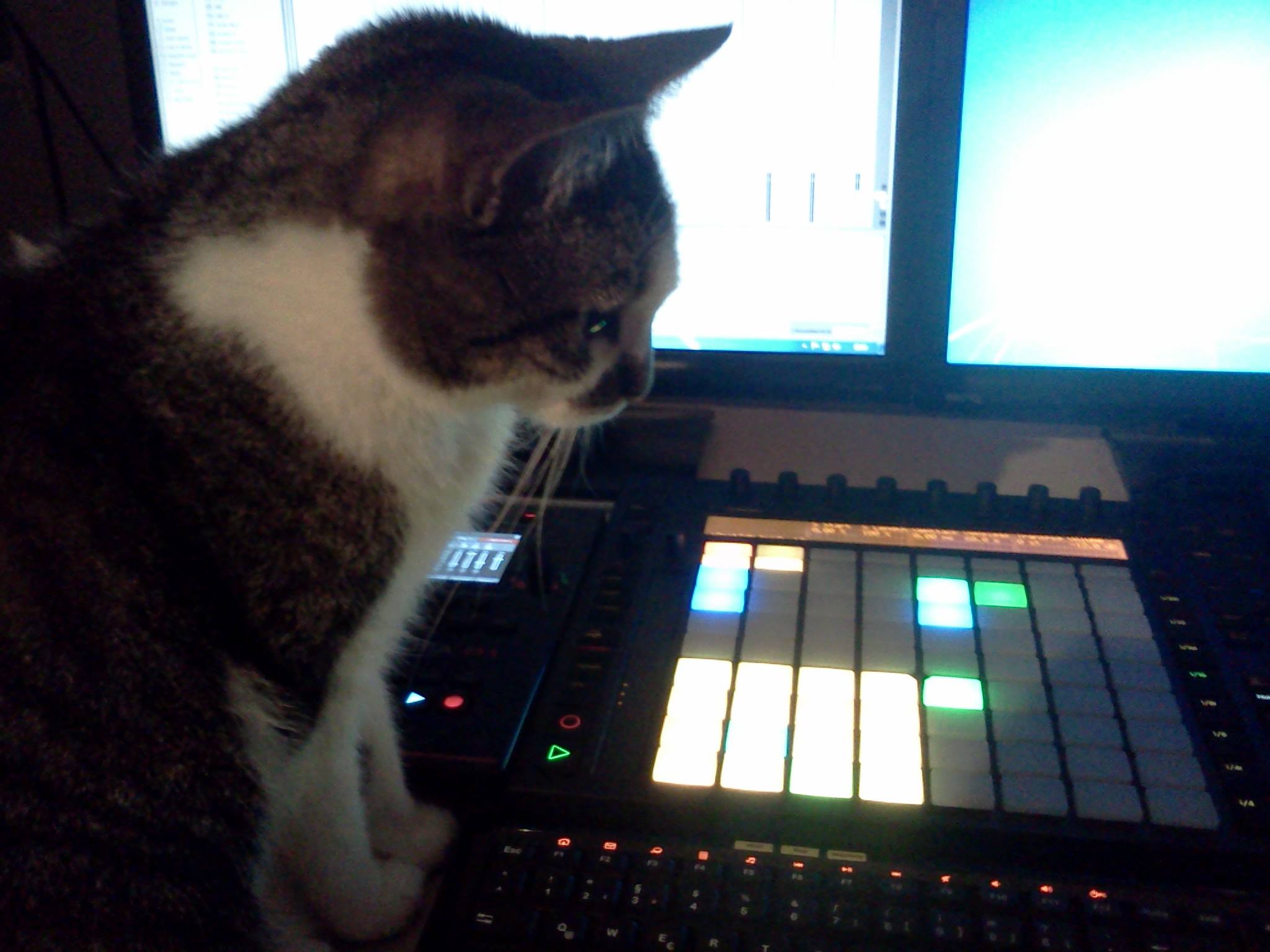
Jet and Milo continue their weeklong march through the pages of CatSynth. Today, Jet shows of two classic Sequential synths, the Pro One and Prophet 5.
Submitted by Keith Winstanley via our Facebook page.


Jet and Milo continue their weeklong march through the pages of CatSynth. Today, Jet shows of two classic Sequential synths, the Pro One and Prophet 5.
Submitted by Keith Winstanley via our Facebook page.


The weeklong takeover by Keith Winstanley and his cats Milo and Jet continues. Today we have Milo sitting comfortably (?) in front of a classic Minimoog Model D.
The Minimoog is a favorite of ours at CatSynth. You can see photos of our own and others here.


We have a special treat this week as Keith Winstanley and his cats Milo and Jet take over with a new CatSynth pic each day! First up, we have Jet with The Electric Music Box, the keyboard part of a Music Easel. this one has an unusual monochromatic face, but I like it. And it matches the cat 😸🎹

We pick up our report from our recent visit to the Museum of Modern in Art where we left off after Part 1. Working my way gradually downstairs, I came to the special exhibition Sur moderno: Journeys of Abstraction―The Patricia Phelps de Cisneros Gift. This is a major exhibition that fills several galleries with modernist works by South American artists through the 20th century.
As in other parts of the world, South American artists embraced abstraction in the decades following World War II, with lines shapes of minimal color palettes. In his aptly named Curves and Straight Series, Argentine artist Alfredo Hlito takes this to an extreme with thin lines and curves against an off-white background, while Uruguayan artist María Friere used bolder lines and colors in her Untitled.


Both of these pieces feel like they could have been three-dimensional pieces of design, and in fact, the exhibition does include several striking three-dimensional works. When seen head-on, Jesús Rafael Soto’s Double Transparency appears to be a plat painting or print, but from the side the depth becomes apparent.


The lines-in-space motif is also used in Ocho cuadrados (Eight Squares) by Gertrud Goldschmidt, also known as Gego.

The recurring motifs in many of the works show the influence of Piet Mondrian, not just the most familiar neoplastic pieces but his earlier and later work as well. Indeed, I was happy to find Broadway Boogie Woogie hanging in this exhibition after not seeing it in the main collection display. As much as any work in MoMA’s permanent collection, I have a regard for this painting as if it were a friend and not just a work of art.

But perhaps the most extreme interpretation of the grid was found in Antonieta Sosa’s Visual Chess.

As part of its expansion, MoMA launched a new gallery space called the Marie-Josée and Henry Kravis Studio, or simply “the Studio”, a space dedicated for live, interactive, and multimedia art. The inaugural exhibit was Rainforest V, an evolution of David Tudor’s Rainforest. Originally a score for a collaboration with Merce Cunningham, it evolved into a performance installation. The latest version, realized by Composers Inside Electronics (CIE), is controlled by computer rather than live performers, as visitors wander through the space.

The installation is constructed from everyday objects, such as a metal barrel, a vintage computer hard disc, plastic tubing, wood crates, and more. The objects and materials are fitted with a vast array of speakers and become resonators that shape and amplify the sound.
The best moments are getting close to an object, such as the barrel or balsa-wood box with simulated earphones, and standing for a moment then walking around. I regret that an iPhone in a crowded gallery is not the best way to record and share it with readers – it really music be seen in person.
There was still more to see, including the newly expanded second-floor gallery for contemporary (1980s-present) works. This period has traditionally been a more mixed one for me, but there are gems and inspirations to be found. There was a large gallery-spanning work by Keith Haring.

An equally monumental piece by Julie Mehretu called Empirical Construction: Istanbul a fantastic futuristic cityscape radiating in multiple dimensions.

On the opposite scale is Eduardo Kac’s Reabracadabra, a video piece realized as graphics inside a vintage Minitel terminal.

Kac’s piece reminded me of my interest in vintage electronics finding new life as dynamic art pieces.
We end with one panel from a larger work by the artist Zarina, Home Is A Foreign Place.

There is something bleak about an entire musical score made of rests, but also intriguing, and even curious. It is perhaps a reminder that exploring a museum top to bottom invites one to escape one’s comfort zones even at the same time as seeking comfort and solace. I’m glad this visit afforded opportunities for both.


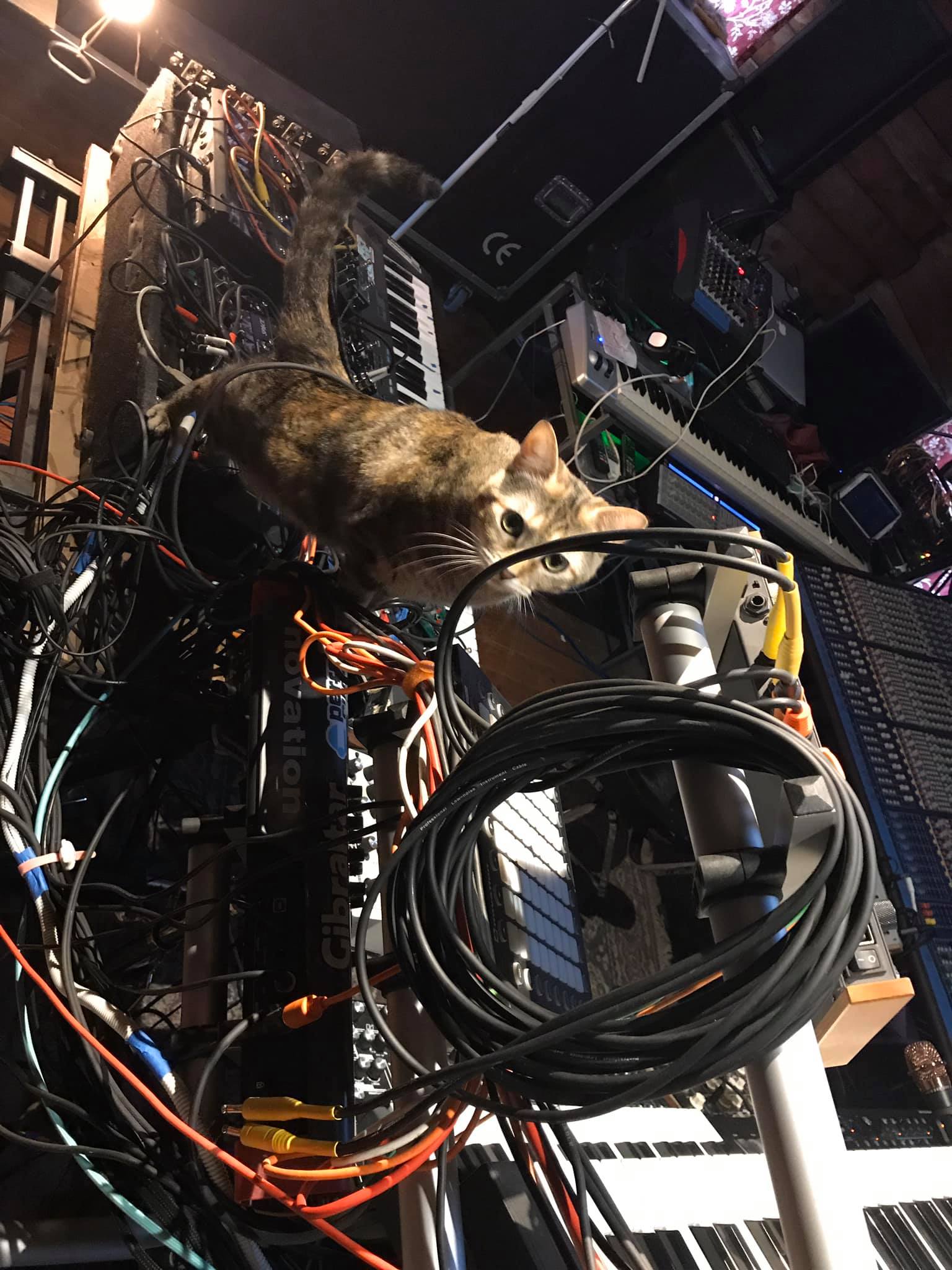
George sits atop a modular system. From Cat Full of Ghost Electronics via their facebook page.
Looking to the future, sitting on the past.
Identification of the “past” modules left as an exercise to the reader.


Today we have three adorable pics from Brian Moran of his cat with a Make Noise 0 Coast synthesizer and a Korg SQ-1 sequencer.

The three together make for a cozy winter cat-and-synthesizer session on the bed.


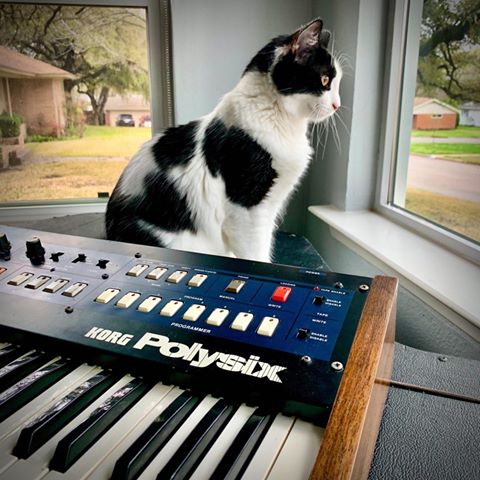
Cat posing with a Korg Arp Odyssey synthesizer. From Jenna Leigh-Raine via Facebook.
Modelling for Korg. Ha
We’ve long been intrigued by the Korg Arp Odyssey since it came out – you can see our NAMM review when it was first released. But we don’t have one of our own…yet.


This cat is showing off a great find: a Moog MG-1, which was made for the Realistic (Radio Shack) brand in the early 1980s. From Paul Cunningham via Facebook.
Found this Moog at the pawn shop. Already had the cat. Look it’s got all it’s slider knobs!
The slider knobs (and other knobs) do fit the industrial design of the time. And the colorful section borders suggest a precursor to Moog’s current Matriarch series. It is, nonetheless, a fully equipped analog subtractive synthesizer:
The MG-1 includes:


The subject line says it all. This little tabby is clearly owning the Kurzweil K2000S synthesizer. Submitted by Ron Gallagher via our Facebook page.
The K2000 was a big deal in the 1990s (though we at CatSynth never had one ourselves).
he K2000S uses V.A.S.T. (Variable Architecture Synthesis Technology) which allows you to take any multi-sample, noise or waveform and process it using just about any synthesis technique. The source of these multi-samples are from the 8MB of ROM which hold tons of authentic and superb quality samples. The internal processing is 32-bit with 18-bit DACs. The K2000 uses 31 sound-shaping algorithms to provide a variety of resonant filters, EQs, continuous panning, amplitude modulation, crossfade, distortion, digital wrap, waveshaper, pulse width modulation, high frequency enhancement, low frequency oscillators, hard sync oscillators and mixing oscillators, all with real-time MIDI control.
http://www.vintagesynth.com/kurzweil/k2000.php