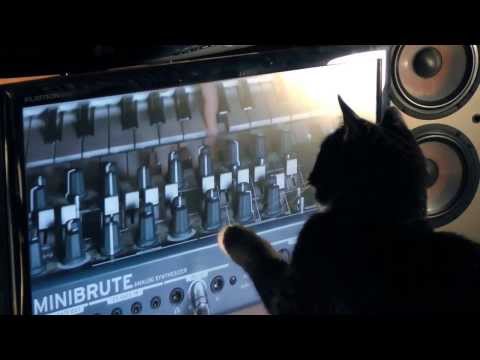
From N2 the Talking Cat via YouTube.
“What Does the Cat Say? A cat parody of Ylvis – What Does the Fox Say”
The main cat looks a lot like Luna 🙂
From N2 the Talking Cat via YouTube.
“What Does the Cat Say? A cat parody of Ylvis – What Does the Fox Say”
The main cat looks a lot like Luna 🙂

I snapped this picture of a bashful Luna during a rehearsal yesterday for my upcoming Pitta of the Mind performance at the Meridian Gallery in San Francisco. Luna is often very shy around company, but she does come out for a few select friends whom she has decided are OK.

The 2013 APAture festival concluded with a diverse evening of music, ranging from avant-garde jazz to metal to rap. The event took place at SUB/Mission in San Francisco. Featured artist Karl Evangelista opened the evening with a group that included Francis Wong, Margaret Rei Scampavia, Cory Wright, and Jordan Glenn.

[© 2013 Karen Ng/Kearny Street Workshop]
The music was a frenetic style of avant-garde jazz, which moved freely in and out of more conventionally harmonic sections. Many of the pieces were inspired by Evangelista’s own personal history and his Filipino heritage. It was also fun to see Francis Wong, whom I usually encounter in more rarefied venues, at punk club in the Mission.

[© 2013 Karen Ng/Kearny Street Workshop]
The Evangelista group was followed by something completely different both sonically and visually. Bestiary, a solo project of Rai Yin Hsu featured experimental noise guitar and a rather unique black-and-white suit.

There were a variety of long sounds processed through effects, with a few sharper elements as well.
Some of the evening’s entertainment happened in between the official musical acts, with our hosts Rupert Carangal Estanislao and Jennifer Chu keeping the crowd energized.

[© 2013 Karen Ng/Kearny Street Workshop]
Next up was The Residuals, a self-described “hardworking, Do-It-Yourself metal band.”

[© 2013 Karen Ng/Kearny Street Workshop]
As expected, they were quite loud, and Joshua Lykkeberg provided vocal fry. But the group, which also featured brothers Anand Jobanputra and Rohan Jobanputra was quite tight, with unisons and fast syncopations.
From metal we then moved to rap, with a set by Joal Vargas that focused on community issues as well as his experience as a teacher.

[© 2013 Karen Ng/Kearny Street Workshop]
The diversity of the evening continued with a cabaret style performance by Bellows, featuring chanteuse Kyle Casey Chu and Rachel Waterhouse on keyboards.

[© 2013 Karen Ng/Kearny Street Workshop]
After the fast energy of the previous two sets, the mellow and expressive style was welcome, and their stage presence was a lot of fun.
Bellows was followed by Little Sister, an East Bay rock trio featuring Erica Benton, MonBon and Nada Diaz.

[© 2013 Karen Ng/Kearny Street Workshop]
They had a contemporary rock sound that was quite moody and a bit melancholy at times, but they still had a warm stage presence. Benton and MonBon traded off guitar and bass duties during the course of the performance.
There was still more music to come in this rather long event. I unfortunately had to depart after Little Sister, but glad I had the opportunity to be there for most of it and hear such a cross section of music in the Bay Area.
(For a review of the APAture opening-night event and gallery show, please visit this link.)


It is the annual Blog Blast 4 Peace, a day when countless bloggers pause for a day to post a “Peace Globe”, a simple image with the words dona nobis pacem, Latin for “grant us peace.” Visit the website to find out more on how to participate.

Last weekend, Robotspeak in San Francisco hosted a modular synth meet, with several manufacturers of synth modules on hand along with collectors and enthusiasts.
Eric Barbour of Metasonix was on hand, demonstrating his distinctive yellow tube-based modules, including a new spring reverb still in a pre-production phase.

I had the opportunity to try these out for myself. I particularly had fun with R-54 VCF, which I may have to get as a companion for my R-53.

[Photo by Edward Sharp.]
Another favorite, Make Noise, was also present. I was particularly impressed with the Phonogene – I had heard it before, but this demonstration made the power of the module more apparent.

I also finally saw and understood what the Wogglebug module does.
Pittsburgh Modular’s offerings were more down-to-earth, workhorse modules. They make an entire basic range of oscillators, filters and modulators that can be obtained separately or in very accessible pre-packaged units like this one.

The Pittsburg Modular demo was quite extensive, spanning several interconnected cases.
In the back room, there was a Buchla modular synth being demonstrated. It is a thing of beauty.

In an interesting twist, the owners of the Buchla and the adjacent Arp 2600 decided to hook them up together. You can hear a little bit of the result in this video:
While Dave Smith does not build modulars, he is a San Francisco institution in the synth world, and was represented at the synth meet. We even got a sneak preview of the upcoming tabletop version of the Prophet 12.

It had the same luscious sound as the keyboard version, though in my opinion the QuNexus keyboard does not do it justice. This is probably a bias a trained keyboardist.
In all, it was a fun afternoon at what I have decided is one of the “most dangerous stores in San Francisco”.

A post-Hallowe’en treat for our readers: black kitty with the Korg MS-20 mini in my company’s office.

There is never a shortage of music and art festivals in the Bay Area in the fall, and one can’t see them all, especially while also being a participant. But I was fortunate to catch the final show of the Music for People & Thingamajigs festival on October 14 at Berkeley Arts. For those who are not familiar with Thingamjigs, they focus on music and educational programs using “made/found materials and alternate tuning systems.” Both of these concepts were integral parts of the performances on this evening.
The show opened with an ensemble led by Dennis Aman. The stage was populated by a variety of instruments, including a tuba with a rotating leslie mute, and modified/re-created toy xylophones with alternate tunings.

The music varied considerably. I enjoyed the more esoteric pieces that showcased the instruments and way experienced musicians play them. The toy percussion and electronics worked particularly well. There were also some more conventional pieces, including one that sounded like a typical celtic folk tune, that did not particularly work for me in context of the darker, more percussive sounds of the other pieces.
The second half featured the premier of Symphony in Sea by David Samas. Rather than simply a piece inspired by the sea, Samas took the concept rather literally, with instruments of his own creation as well as contributions from Tom Nunn. The stage was set up with a variety of aquatic themes both natural an artificial, with a beach lounge as well as pirate apocrypha.

[Photo by Bryan Day.]
The piece unfolded over several movements, each related to a well-known phrase about the sea. Different combinations of instruments and vocal techniques were used to evoke different environmental qualities of life in or around the sea.

[Photo by Bryan Day.]
During the early movements, the music was more abstract, with room to listen to the timbral details of the various instruments. However, the later movements were more idiomatic, and even a bit tongue-in-cheek, such as a rousing pirate shanty.

Things did take a turn for the darker with a dance segment featuring Bob Marsh as a sea monster.

In the end, it was a fun performance to attend, both musically and visually. Thingamajigs has several other programs coming up. Please visit their website for more information.