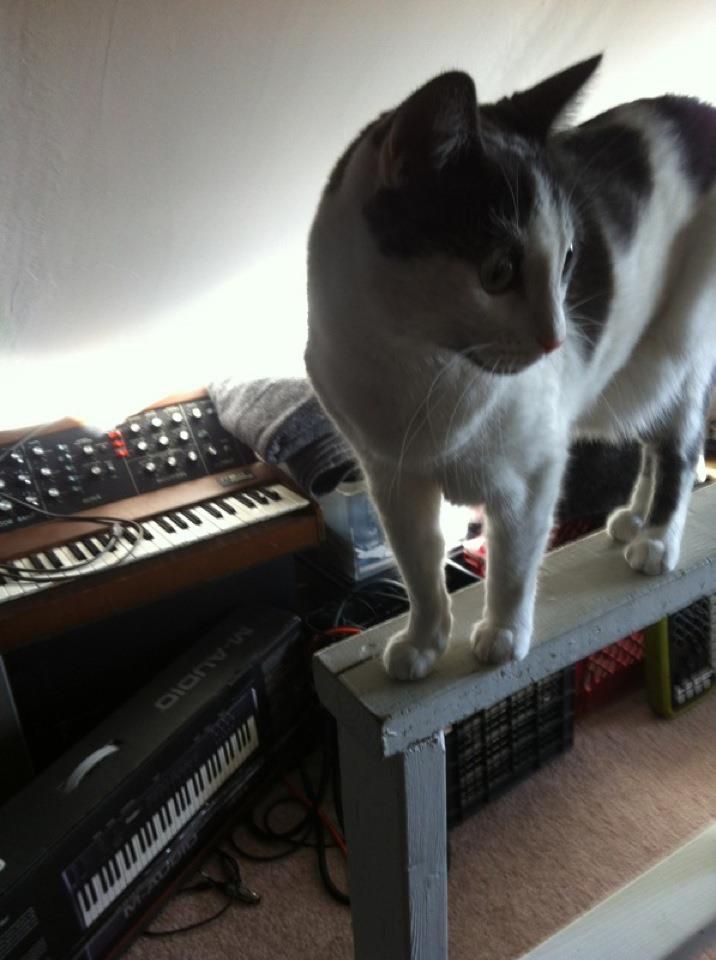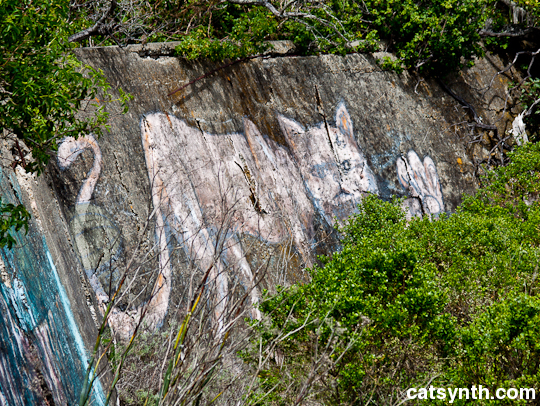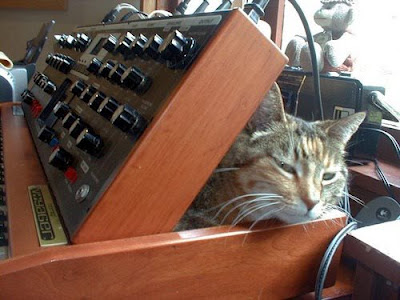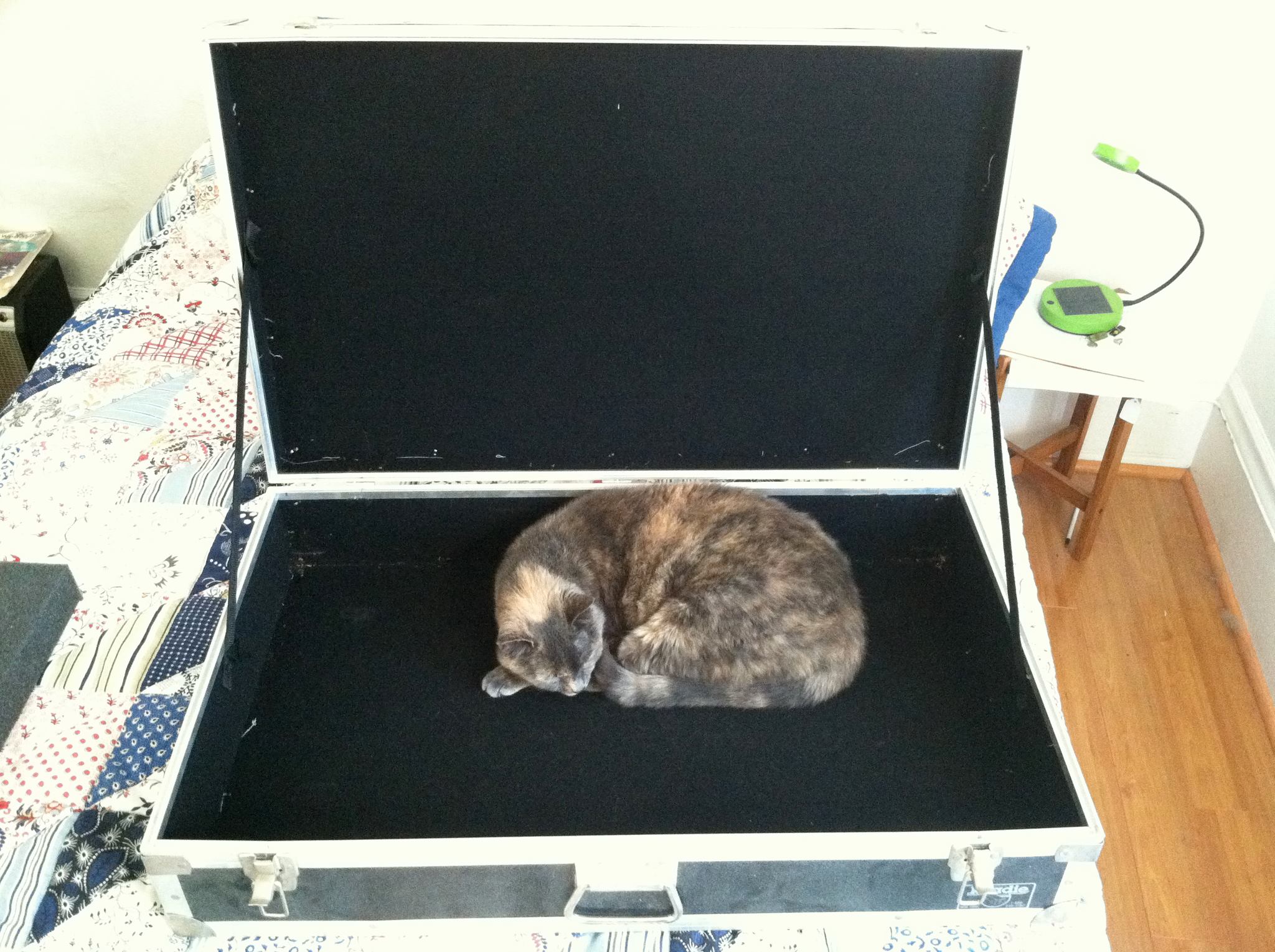
Submitted by vlern via our Facebook page.
Roberta still likes the Kaoss Pads.


As always, check the comments for some info on the picture. But please also check out the associated review of my LACMA visit.

While in southern California for NAMM last month, I made a point of stopping at the LACMA (the Los Angeles County Museum of Art). The museum and the trip to get there through downtown LA were the perfect coda to the overload of NAMM. And by chance, it was the opening day for a retrospective exhibit of works by Ellsworth Kelly.

[Installation view. Ellsworth Kelly: Prints and Paintings. January 22-April 22, 2012. Los Angeles County Museum of Art. Photo (c) 2012 Museum Associates/LACMA]
I am quite familiar with Ellsworth Kelly’s paintings through SFMOMA (see my review of the Fisher Collection show from 2010 which featured several large pieces). His large panels in single colors with rectangular or curvilinear shapes are quite iconic, as are his grids of colored squares. But in LACMA’s comprehensive exhibition, which focused on Kelly’s printmaking along with some drawings and paintings, I was exposed to different and unexpected directions in his work. There was a room of minimalist panels, but all in black and white instead of his usual bright colors. There were also pieces with organic and complex patterns based on plants and rivers. In between there were brightly colored abstract works that seem to bridge the gap between the organic and the minimalist.
An example of the familiar and unfamiliar in Kelly’s work appears in the first gallery. Around the corner from a large set of four solid shapes is a piece with a similar curvilinear shape but a rougher and more natural looking texture.

[Installation view. Ellsworth Kelly: Prints and Paintings. January 22-April 22, 2012. Los Angeles County Museum of Art. Photo (c) 2012 Museum Associates/LACMA]
The next section featured Kelly’s studies in abstraction, influenced from his time in Paris in the 1950s. Here were see experiments with different pairs of colors on the same shape, with simple titles such as Orange over Blue (Orange sur Bleu). The shapes, rounded rectangles and arrows, seem manually cut and have the imperfections of natural (or at least handmade) forms. But through the medium of printing with different colors, they become more mechanized.

[Installation view. Ellsworth Kelly: Prints and Paintings. January 22-April 22, 2012. Los Angeles County Museum of Art. Photo (c) 2012 Museum Associates/LACMA]
The next room was the most surprising. All the works here were in black and white, something which I had not associated with Kelly up until this moment. One wall featured the same curvilinear or angular shapes as his more colorful abstract works, but in monochrome they are far more severe. But this is good thing. In monochrome, he plays with contrasts and positive and negative space with the shapes without the distraction of color.

[Installation view. Ellsworth Kelly: Prints and Paintings. January 22-April 22, 2012. Los Angeles County Museum of Art. Photo (c) 2012 Museum Associates/LACMA]
But even more unexpected were his monochrome prints based on natural forms, which were in this same room. He did a series of lithographs of botanical forms in the late 1960s that featured simple line drawings that capture the imperfections of natural subjects. I would never have guessed these pieces were his without the labels. More recently, he did a series of large monochrome prints based on the texture of the moving water in the some of the world’s most famous rivers.

[Installation view. Ellsworth Kelly: Prints and Paintings. January 22-April 22, 2012. Los Angeles County Museum of Art. Photo (c) 2012 Museum Associates/LACMA]
So how does one fit these in the context of Kelly’s more colorful abstractions? Certainly, the black fields can be seen as simply another color study; and the rivers can be seen as abstract but complex textures informed by nature. The textures of the rivers can be seen reflected in abstract piece Red Curve (State I) from the first room of the exhibit. The botanical pieces are the ones that are the most difficult to place in context aesthetically, the artist himself states that “the drawings from plant life seem to be a bridge to the way of seeing that brought about the paintings of 1949 that are the bases for all my later work.” It is possible to see the repeated curving shapes in his abstract work as inspired by plant forms.
The final room featured more of the style that I most associated with Kelly: angular solid fields and color grids.

[Installation view. Ellsworth Kelly: Prints and Paintings. January 22-April 22, 2012. Los Angeles County Museum of Art. Photo (c) 2012 Museum Associates/LACMA]
It was in this last room that another museum visitor came up to me and asked, “Why is this good? What do you see in it?” I’m sure I was gazing rather intently at various pieces which probably signaled to her that I had a genuine interest in this work. I did my best to try and answer her question, which seemed to be as much about minimalist artist general as Ellsworth Kelly in particular. For me, good abstract and minimalist art captures my attention and “arrests the mind” (with apologies to James Joyce). Additionally, all art and perception of art has context. There was the context of each piece, even if a single-color panel, within the greater body of work on display. There was context of my experience, and joy in looking at these works in the quiet gallery, the calming effect. There is also the execution, choosing the right colors and the right proportions for shape and size of each piece, that Kelly was able to do consistently. I’m not sure the woman was particularly satisfied with my answers. She walked away saying “I guess I just don’t understand why this belongs in a museum.” I did my best – I do truly want to share the enjoyment of modern art, and especially abstract art, with others, which is why I write articles like this.
Also on view at LACMA was Metropolis II, large kinetic installation by Chris Burden. It features stacks of highways weaving their way among densely packed buildings. A continuous stream of cars speed along the highways, some of which are six lanes across. The result is a frenetic pulsating vision of a future city, or an imagining of the pace and anxiety of a contemporary city. This piece is best experienced in motion, and you see a bit of it in this video:
This piece of course appealed to me as a person who loves cities and the urban landscape and who has a fascination with the patterns of roads and highways. Looking from above, the traffic is simply a current like moving water and provides none of the stress that one experiences on actual city streets. I can also admire the amount of work that must go into making something like this. The toylike scale of the installation also gives it a playful quality. It was just fun to experience.
Ellsworth Kelly: Prints and Paintings will be on display through April 22, and Metropolis II is ongoing. Both are worth seeing if you are in Los Angeles.
By KidsAtMidnight on YouTube, via matrixsynth.
PHOENIX – Love Like A Sunset Sound (nearly)
Was supposed to be working on new track (and feeding the cat) but got sidetracked by the MoogerFoogers. Found a sound a bit like the mad glissando CS80 at the start of Love Like A Sunset so tried to work out the part a bit. Stole the Marimba-like bit from the Multitrack they put online.
Arthur (cat) was just hungry and attention seeking. He’s not normally too bad a chewer. Mind you, I did find all but one knob from my Digi002 in the hallway once. Bad boy …

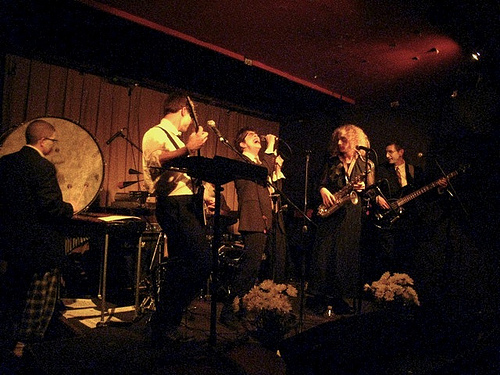
Today we look back at two Reconnaissance Fly performances in early January. The first was a return to Luna’s Cafe in Sacramento, and the second was at Revolution Cafe in West Oakland. By coincidence, we shared the bill on both nights with guitarist Luke Westbrook who was visiting from New York.
This was Reconnaissance Fly’s third gig at Luna’s – we like playing there and not just because it shares my cat’s name. But the stage was once again a bit cozy for a band of our size, even more so now that we have a fifth member, Chris Broderick on reeds (saxophone, clarinet, bass clarinet). This was our first public performance with the new quintet lineup. So it was a bit of puzzle trying to get the bass, drums, keyboard and bass flute on the stage, and still find room for the people who play them. But somehow we managed.

[Photo by Tom Djll]
Our set went well – at least, I was pretty happy with it. Our opening graphical score improvisation piece Small Chinese Gong went off without a hitch. As Neat As Wax is becoming our most consistently well-played song, as it is not too difficult and it is quite lyrical and rhythmic. Electric Rock Like a Cat and Sanse Iz Crede Nza are our most difficult, but also the most energetic and got a great response from the small but enthusiastic audience when we hit the final notes.
After striking the stage, it was time to relax with beer and guacamole and other treats and enjoy the next sets. Luke Westbrook took the stage for a solo guitar performance.

He has a very intense stage presence and a virtuosic technique, but the music itself has a certain ease to it. It began with gentle arpeggios that had a consistency even as they were constantly changing. These evolved into more defined repeated phrases over time that were occasionally punctuated by the occasional chromatic tone or blues-like bend. Later on, the music become more distorted with noisier and more percussive elements. There was a passage of single repeated tones that provided an increasingly anxious vibe before settling down again.
Westbrook was followed by Philip Greenlief and Jorrit Dykstra on saxophones with Tim Perkis on electronics. On the things I look for in electro-acoustic combos is how well the electronic and acoustic parts blend. In the case of this trio, they blended quite seamlessly from the start with long tones of subtly different intonation. The music soon became more animated, with syncopated saxophone rhythms set against low gurgly electronic sounds.

There were many humorous moments with matching squeaks and bleats, and richly textured moments with multiphonics against electronic pads. Perhaps the most amazing moment of the entire set was a long virtuoso noise solo by Dykstra. It is hard to describe in text, but it was one of the most impressive saxophone performances I have heard in a while. The later sections of the performance featured more percussive saxophone sounds, key clicks and striking of the metal hardware set against contrasting electronics with vocal and wah-wah effects.
Revolution Cafe is located deep in West Oakland, not far from the rebuilt I-880 freeway, which makes for an interesting exterior environment. The interior is something altogether different, with every surface adorned with vintage and eclectic artifacts. There were street and highway signs, political posters (from old Oakland Mayoral elections to the most recent Jean Quan recall announcements), vintage keyboard instruments, strange dolls and even a shrine of sorts of Frank Zappa. I spent quite a bit of time just photographing the space before even considering the music.
The show was actually the latest incarnation of Karl Evanglista’s Light A Fire series. I had performed in this series last year with solo electronics. This even opened with another solo guitar set by Luke Westbrook.

Westbook’s performance was actually quite different from the one he did two night’s earlier. While his technique was on display both nights, this one was more virtuosic and more diverse in terms of material and sound. This performance was mesmerizing. I had a sense of warmer colors as he played, though that may have been a kinesthetic combination of the cafe’s ambience and Westbrook’s harmonies.
Next up was Grex, the duo of Karl Evangelista on guitar and Rei Scampavia on keyboard, voice and flute. Their music covered quite a bit of range, some more song-like with voice, keyboard and guitar, some closer to free-jazz with fast-moving improvised lines. One memorable moment featured featured a mellow guitar solo – Evangelista is quite a versatile guitarist – that morphed into in a driving loop pattern with distortion that produced its own harmony.
I believe at least some of the material was from Grex’s recently release CD. You can follow the link above to find out more info.
Finally, it was our turn to take the stage. I had toyed with the idea of using the Cafe’s B3 for An Empty Rectangle, but in the end decided it would have been a lot of effort, especially with a stage that seemed to be even smaller than Luna’s Cafe We had a lot of fun and played with a lot of energy that matched the intensity of Revolution Cafe’s decor. It didn’t feel as tight or accurate as we would want for a Reconnaissance Fly set, but it did have the humor that has become part of our band’s character.
Additionally, the visuals of the space and the presence of the old keyboard instruments did inspire me to consider a future solo performance or installation there. I don’t have much more to say about that yet given everything else that is going on this season, but something to consider for later…


We at CatSynth are happy to host Carnival of the Cats #414!

The Carnival of the Cats occurs every Sunday and features feline-themed posts submitted from around the “blogosphere.” You can participate by leaving a comment or using the handy submission form. Although we are questioning the handiness of the submission form this week, as we have very few participants. But we’re here for those who are participating, so let us get started.

Elvira turned two years old this past week. Please join us in wishing her a happy birthday! It looks like she had a good celebration with her family. Her birthday week also happened to coincide with Valentine’s Day.

Meanwhile, Nikita relates his dad’s recent acquisition of cat-themed books. It looks like they have quite a collection going, including some vintage books from the 1940s and 1950s. [Note: it is actually Elvira in the photo above.] It reminds us at CatSynth that we should do a similar post one of these days.

In addition to hosting this carnival, we did a photo of Luna for the Weekly Photo Hunt on the theme of “point”, along with a pointing maneki neko. We encourage visitors to check it out. There is a highway sign as well (yes, we’re a little odd).

It’s Flash Back Sunday at Life from A Cat’s Perspective, with significant pictures from the past, including one of the last with Samantha and Mr. Tigger together. They all miss him very much.

Over at Sweet Purrfections, Truffle and Brulee claimed this bed as their own and are enjoying a nap on it. I think they match the bed and the room quite nicely.

Jill of BabyBakes introduces Chuck (aka “Kat”), a new kitten. She relates the story of how this tiny kitten came into their lives, and also the adventures of putting together a new “kat tree.”

At Animal Shelter Volunteer, Moosey knows exactly how to spend a Sunday: enjoy a nap in a patch of sunshine. He looks quite comfy and relaxed there.
Intermezzo on Water
The words and sentences float losing their coherence as the visions and narratives of seaside communities decay into dreams of filtered sunlight and free verse and fog and failed concentration and ambiguous affections and terraced layers of improbable houses and the percussion and the solitude and concrete ruins washing into the ocean.
From the dissolving darkness a faint buzzing punctuated by clicks spirals outward along silent waves. In its wake sparks radiate and melt into the meandering trail of a melancholy story.
[Originally written September 15, 2003]

There are so many interesting ways that one can interpret this week’s Photo Hunt theme of Point. Mathematics and highways come to mind, but this is of course also Weekend Cat Blogging, so as usual we feature cats. First, one of our many maneki nekos points its paw:

And here is Luna pointing while basking in the morning sun:

Both of these photos were taken with the latest lens and film options I got for the Hipstamatic app on the iPhone.
Another Hipstamatic photo on the theme does veer into the realm of highways. Here is one of several studies I did with the freeway entrance shield for the Bay Area’s infamous Interstate 238 for an upcoming article on the highway. It has the customary downward pointing arrow of freeway entrances in California.

Tomorrow (Sunday), we at CatSynth will be hosting the weekly Carnival of the Cats. If you have a feline-themed blog post from the past week, you are welcome to participate. Just visit the handy BlogCarnival submission form or leave a comment below.
Weekend Cat Blogging #350 is hosted by Kashim, Othello and Salome.
The Weekly Photo hunt theme is Point.
As stated above, we are hosting the Carnival of the Cats tomorrow.
And the Friday Ark is at the modulator.

Today we return to to the topic of mathematics with a look at Ackermann’s Function. Anyone who has studied computer science has probably encountered this function (though I’m sure many have gone on to forget it). It is most commonly defined as follows:

This is actually a variant of Wilhelm Ackermann’s original function, often called the Ackermann–Péter function. It is quite a simple function to define and to trace, and it is very easy to implement in just about any programming language, including Python:
def ackermann(m, n):
if m == 0:
return n + 1
elif n == 0:
return ackermann(m - 1, 1)
else:
return ackermann(m - 1, ackermann(m, n - 1))
However, its complexity (in terms of run-time and memory) grows quite quickly. As such, it is often used as an exercise in teaching students more complex forms of recursion, and also as a test case in compiler development for optimizing recursion. It also has some interesting mathematical properties for particular values of m:
The numbers in the case of A(4,n) are quite large. Indeed, one could describe Ackermann’s function as “computing really really large numbers really really slowly.” Although the numbers grow quickly, the function is really just doing subtraction and recursion. We can take advantage of the properties described above, however, to make some shortcuts that yield a much more efficient function.
def ackermann(m, n):
while m >= 4:
if n == 0:
n = 1
else:
n = ackermann(m, n - 1)
m -= 1
if m == 3:
return 2 ** ( n + 3) - 3
elif m == 2:
return 2 * n + 3
elif m == 1:
return n + 2
else: # m == 0
return n + 1
With this version computing A(m,n) for m≤3 becomes trivial. And this makes computations for m≥4 possible. Or at least A(4,2), which we can actually run in python to reveal the 19,000 digit answer.
You can see the full value on this page. Computing A(4,3) is infeasible. Even with the optimizations, most computers will run out of memory trying to compute this value. But one can still reason about these rather large numbers. Let us move from the more common function we have been using to Ackermann’s original version:

This version has three arguments instead of two, and on the surface it may seem a bit more complicated. However, different values of the third argument p yield very familiar operations.
![]()
![]()
![]()
Again, this function is a rather inefficient way to compute addition, multiplication and exponentiation, but it is an interesting way to reason about them and extrapolate to other more exotic operations. For example, if we take p to be 3, we get the following operation.
Just as m x n is adding m to itself n times, and exponentiation mn is multiplying m by itself n times, this new operation (sometimes called tetration) is the next level: exponentiating m by itself n times.

Such an operation grows so fast as to be uncomparable to exponential growth. It grows even too fast to compare to the gamma function which have explored on CatSynth in the past. This series of ever higher-order operations is often noted with an arrow, called Knuth’s up-arrow notation after legendary computer scientist Donald Knuth.
Using this notation, we can define as sequence of numbers, called Akermann Numbers, where each is an ever higher-order operation of the element applied to itself.
Even just the 4th number is this sequence is so large that we can’t even easily notate it with exponents. So forget about the 5th number in sequence. But a question that interests me is what about interpolating with real numbers. What is the 1 1/2th Ackermann number? That question, if it even has an answer, will have to wait for another time.


Submitted by Alessandro Automageddon on our Facebook page.
The Evolver is a particular favorite here at CatSynth. Always great to see it make an appearance with the cats.