Another submitted by Nicolas Pauly, via facebook:

We resume our reports from the 2010 Outsound Music Summit after a brief break. In this article I review the last night of the festival, titled “SoundScapes” and featured musicians whose music focuses on noise and sound textures. While this is often from electronic sound sources such as effects pedals or DIY synthesizers, many were from acoustic sources such as metal objects or conventional instruments like piano.
The evening was framed by the theatrical announcements of the artists by guest emcee Cy Thoth, a regular DJ on KFJC 89.7 FM.

[click image to enlarge]
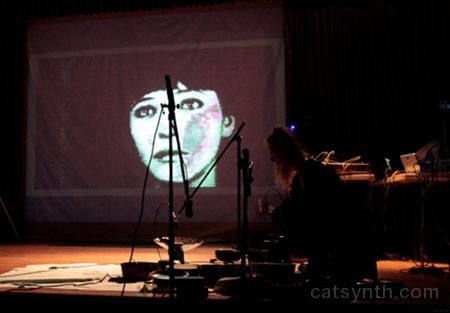
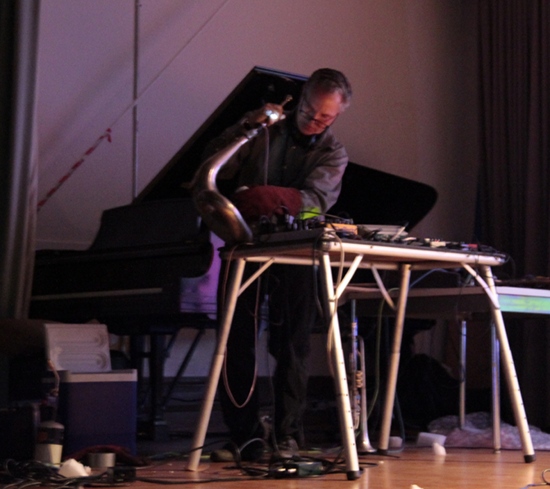
The concert began with Phog Masheeen, a trio featuring Mark Soden, Jr, Dr. Francene Laplan and William Almas. They presented a single large-scale work for electronic and acoustic sound plus video called “Anthroscopic Tourism.” I was not quite sure how the medical term “anthroscopic” related to the sounds and images in the piece, which focused on the interplay of Kaplan’s pots and pans set against electronic sounds and loops and Soden’s electronically enhanced performance on trumpet and a large pipe from a Yamaha motorcycle. Soden had demonstrated some of the techniques he was using with the trumpet during the Touch the Gear event. But he added to the the performance techniques Soden used with his instruments rubbing dry ice against them. As most readers know, dry ice is extremely cold (and difficult to handle); and this it can have a strong effect on the shape and behavior of metal tubes. At one point, he smashed a block of dry ice before picking up pieces to use. He also had a blowtorch. The music often involved loops (sample based or otherwise) against which Kaplan played rhythms and timbres on the pots and pans – this was offset by the more freeform sections with Soden’s trumpet and pipe. Almas’ visuals included a variety of urban and industrial scenes, text, and footage of old musicians, which were mixed with live video of Soden’s performance.
[click images to enlarge]
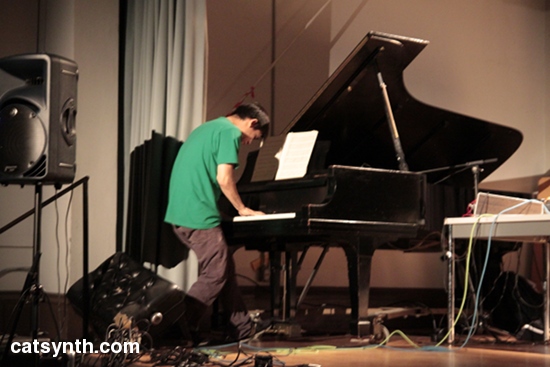
Next up was Headboggle (aka Derek Gedalecia). The tone was set from the beginning both in terms of sound and slapstick comedy by his stepping on bubble wrap that happened to be placed behind the table with his electronics, and then slipping on the way to the grand piano. Actually, the comedic timing of his various slips, slides, tripping over his own feet and double-takes was expertly done, as in an old silent film or Vaudeville act. There was a bit of a scare for several of us in the audience when it appeared he had broken the bench of the piano, but I was assured this was all part of the act, this particular bench was found broken, and that no pianos were actually harmed in the making of this performance. Musically, he combined chaotic oscillators from Ciat Lombarde synthesizer – a reminder to finally put together my Ciat Lombarde kit – with classical and ragtime piano phrases, loops and deep bass sounds from a Micromoog. The piano and electronics are of course quite contrasting, but every so often the sounds and phrases (and physical humor) converged quite well.
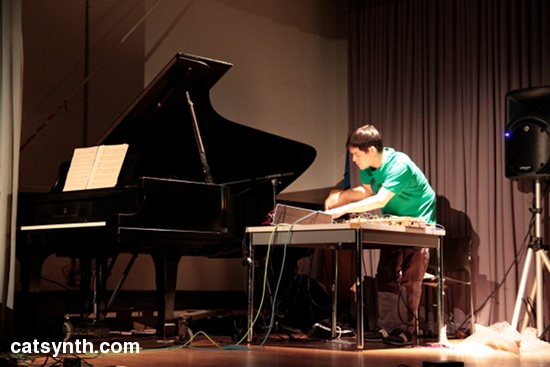
[click images to enlarge]
Headboggle was followed by Kadet Kuhne, who presented video and live-music piece Fight or Flight, described by our emcee Cy Thoth as “space madness.” In fact, it was a very polished live electronic performance, very dark and ambient (although interestingly Kadet Kuhne talked in the pre-concert Q&A session about her desire to perform “lighter” ambient music). It began with low frequency sounds and a rumbling buzz, and included doors opening and closing and various sounds of machinery, with electric hums, blips and glitches. It was quite captivating and easy to get lost in. At one point, arpeggios and then beats emerged from the combination of noise percussion and more harmonic sounds, which got progressively louder as the piece built up to a climax and then faded to nothingness. The music was set against a video that focused entirely on a cloth-encased figure suspended in mid-air. It wasn’t clear at first whether this was a cloth figure or an actual person, though as the video progressed it became clear that it was the latter. The frequent shot and angle changes gave the video a glitchy quality which matched many of the electronic sounds in the music.
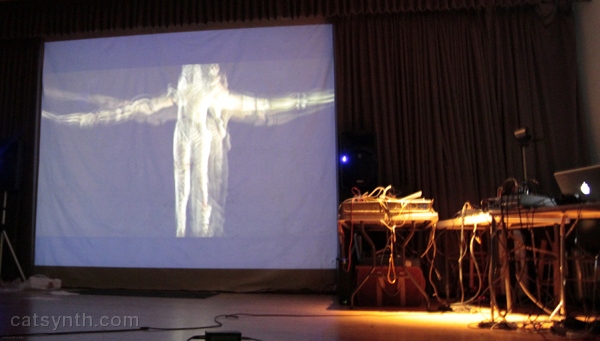
[click image to enlarge]
The final set featured Chen Santa Maria, the duo of Steve Santa Maria and George Chen. Both members of the group played electric guitar and a variety of electronic effects. The set began with a guitar drone set against high squeaking humming sounds. These sounds were soon joined by full guitar chords with heavy distortion and undulating raspy sounds from synthesizers or effects units. There were bursts of noise distortion and high shrieking. This was definitely a loud set. But there were still details to listen to (with appropriate ear protection). The harmonic patterns of the distorted guitars created rhythms, which was set against a more formal triplet rhythm from the electronic sound sources. This rhythmic pattern essentially continued for the remainder of the set, with periods of driving guitar, bursts of noise and more high shrieking tones which then decayed into a low rumbling noise. As the set drew to a close, the sounds became more “digital” with lots of blips and choppy sounds, but then this was replaced by a loud square wave. The square wave started out at a moderate pitch, but got lower and lower until it became a series of audibly distinct pulses, and then came to an abrupt stop.
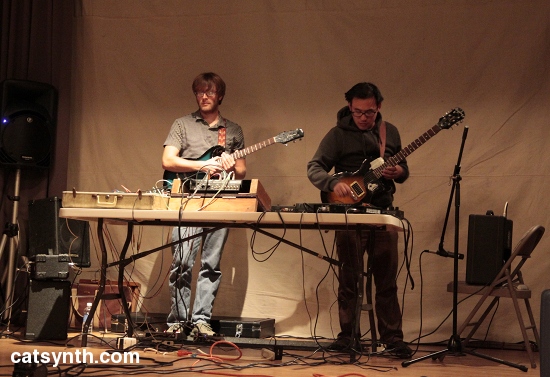
Although this was the last performance of the festival, I will be presenting one more article, where I return to the MultiVox night which included my own performance with Reconnaissance Fly and the Cornelius Cardew Choir…
[Please click to enlarge photo. The details are an important element of this one.]
Note: you can always see more photos, including past Wordless Wednesday images, at my flickr site.
Submitted by Nicolas Pauly via facebook:
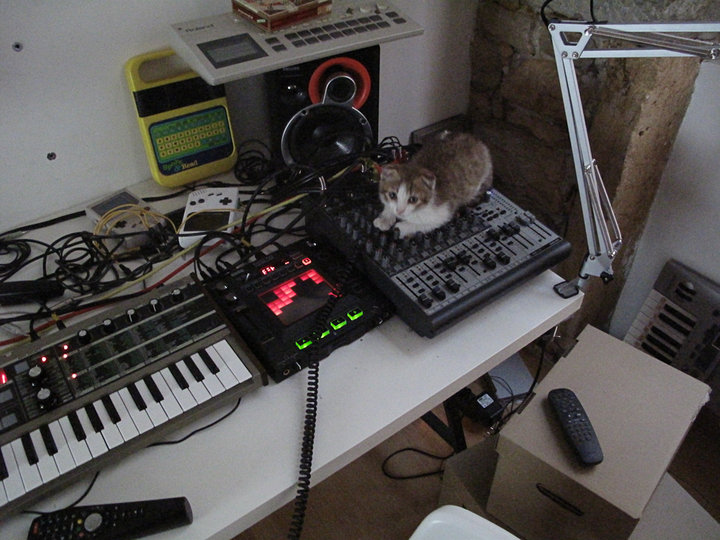
[click to enlarge image]
“pictures from my kitten, who loves to sleep on my mixtable.”
I see a Korg Kaoss Pad (the big kind, not the mini that I often use), a Microkorg, and a Speak and Read, among other sundry items.
As always, you can submit you own cat-and-music pictures via facebook, twitter, or our submission form.
sonoio2 from Alessandro Cortini on Vimeo, via matrixsynth:
sonoio2 from Alessandro Cortini on Vimeo.
[While I work on the reviews for the Friday and Saturday shows at the Outsound Music Summit, we have a guest review from Joe McMahon, ambient music/soundscapes – pemungkah.com. Given that I was a performer in two groups on Friday, his review provides an interesting outside perspective.]
Friday at Outsound: Reconnaissance Fly, Cornelius Cardew Choir, Amy X Neuburg
An interesting evening of word (and other vocalization) related music. Reconnaissance Fly led off with their songs based on “spam poetry” – the sometimes strangely numinous texts randomly generated to try to evade spam filters. RF can, and does, play in a massive variety of styles, from samba and tango through pop, prog rock, and jazz, all the way to full-on avante-garde improv. These wildly disparate styles and surreal text are combined in pop song structures into catchily mind-bending conceptual smoothies. It appeared that the audience was ready for an encore, but time was short. The piece which included what seemed to be samples from a “teach your bird to talk” record and Polly Moller’s exceptional flute multiphonics and extended techniques was particularly fascinating, and Moe!’s drumming lent serious propulsion and quirky humor as well.
The Cornelius Cardew Choir did three pieces: the first was based on the alphabet and reminded me a bit of “In C”, as the choir started at “A”, both reciting the letters and making their sounds, the individual members determining the speed at which they moved through the alphabet. Charming and fun. The second piece was based on rock inscriptions; very dense and almost surflike; I had a little trouble spotting a structure in this one, but that’s probably more the result of a long day on my part. The last piece added electronics and flute; a very evocative, ritualistic piece – fascinating textures and quite wonderful.
Last on the bill was Amy X Neuburg, who wowed the crowd as always, performing, among others, several pieces from her _Residue_ album; her performances of these have evolved interestingly. In addition, she improvised a new piece on the spot using her Blippo Box and her just-built Scatchbox, and a tribute to Kim Flint the late founder of the Looper’s Delight mailing list.
A very enjoyable evening; looking forward to hearing more from all the performers.
I had no idea what to post for Weekend Cat Blogging (I have been so focused on the performances, rehearsals and other goings on). But while sitting on the patio this morning, I saw Luna looking up at something, and managed to get a few good pictures. Here is one. It is definitely worth doing the “click to enlarge” thing:
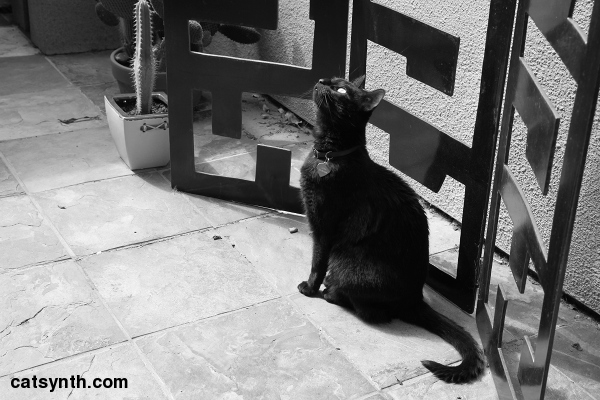
[click image to enlarge]
I have no idea what she was looking at.
Yesterday on a whim I tried out the HD video feature on my camera – this camera is for still photography, so the video feature was mostly coincidental – and caught a bit of Luna scampering about. You can hear her give one little squeak early in the video.
Behold the power of HD video to use up hundreds of megabytes of slightly shaky and blurry motion! Also, as this an impromptu recording, the house is in the middle of normal daily use, with cat toys and the incongruous bright blue yoga mat spread out in our usually clean living room. (Actually, the cat toys are usually scattered about.)
While on one of my long urban walks yesterday, I saw one of the mobile adoption stations set up by the San Francisco SPCA. This one was along the Embarcadero, near the Gap company headquarters. Lots of kittens, mostly curled up for an afternoon nap. We certainly hope they find good homes. The mobile adoption stations are out regularly in the summer, so if you’re in San Francisco downtown, check out their schedule and stop by.
Weekend Cat Blogging #268 is hosted by Nikita and Elvira (the new edition to their household) at Meowsings of an Opinionated Pussycat.
The Carnival of the Cats will be hosted tomorrow by Kashim, Othello and Salome.
And the Friday Ark is at the modulator.
 This week has all been about the Outsound Summit, either attending programs or rehearsals, including two rehearsals for Reconnaissance Fly and one for the Cornelius Cardew Choir.
For Reconnaissance Fly, We now have our full Flower Futures set:
1. Small Chinese Gong
2. One Should Never
3. Neat As Wax
4. Emir Scamp Budge
5. Seemed to be Divided in Twain
6. Electric Rock Like a Cat
7. Sanse is Credenza
8. Oh! Goldfinch cage
9. An Empty Rectangle
There is actually a tenth movement, but we had to leave it out of this performance for timing reasons. One of the pieces, “Electric Rock Like a Cat”, was first premiered on KFJC last weekend. And three others are brand new that we only read and rehearsed in the past week. This included a final rehearsal last night. Sadly, it means I was not able to attend last night’s performance, but the extra rehearsal time paid off and I think we are going to play a great set tonight!
Technologically, things are relatively simple compared to the solo shows like the Quickening Moon Concert. I will primarily be using a Nord Stage keyboard for classic Fender Rhodes and organ models and acoustic piano, with support from the Korg Kaoss pad on several pieces and a loop/sample playback application on the iPhone. Tim Walters will be using SuperCollider for signal processing alongside bass guitar. Moe! Staiano will probably have toy instruments along with his drum set. We don’t have any live processing of Polly Moller’s flute or vocals in this particular set. I like the way our music has evolved to require less feats of technology and more musicianship.
For the Cardew Choir, I will be performing the role of “Universal Time” in Polly Moller’s Genesis using a combination of “space like” and “drum like” patches on the DSI Evolver. Other than that, the set is all vocals.
For those in the Bay Area who would like to attend, the show is 8PM at the Community Music Center, 544 Capp Street in San Francisco. You can get full schedule and ticking info here.
Last night was the first full concert of the Outsound Music Summit. “Blurred Lines” focused on the combination of music and visual media, i.e. film and video. The pieces were more of a collaboration between film and music rather than one serving the other per se, although in each case the music making and film/video making were done independently .
The first half of the concert featured films by Martha Colburn with live piano improvisation by “local Bay Area pianist impresario” Thollem McDonas. Colburn’s films employ stop animation with original artwork and found images, as well as found footage. The overall look reminded me of Terry Gilliam’s animations (e.g., from Monty Python), though the material was generally much darker. Several of the films dealt with death and violence, particularly in U.S. history and current events. Destiny Manifesto in particular juxtaposed images of western settlers in conflict with Native Americans alongside contemporary looking soldiers and scenes that could have been from the Middle East or Central Asia. Images of people being killed and dismembered abound in these films. Other films, such as Meet Me in Witchita with its images inspired by the Wizard of Oz, but here again things turned dark with Osama Bin Laden’s head superimposed on the Wicked Witch and then being killed and collapsing in a mess of bloody body parts. There were lighter images in some of the films, such as figures that seemed influenced by South Asian shadow puppets and even abstract graphic squares reminiscent of a disco dance floor.
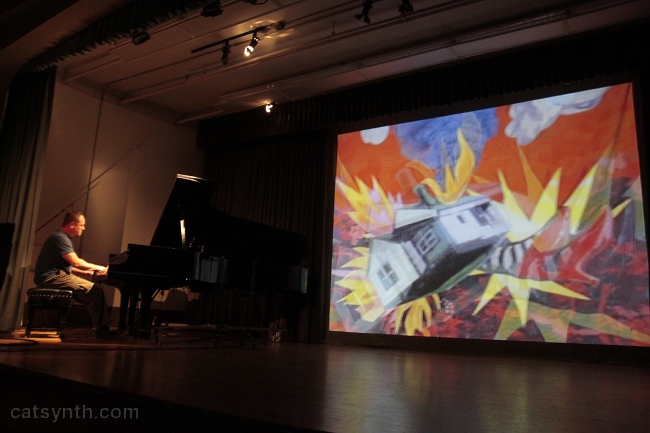
[click image to enlarge]
McDonas’ piano veered between more classical or film-score inspired music and more percussive prepared piano. The music did not follow each film structurally per se (i.e., in the manner of a film score), but did evolve over time and present a particular character in each film. Initially, it started off lighter with fast runs and anxious chords, later on being more percussive and employing prepared piano or plucked strings. As the set progressed, the piano music became dense and darker, with large clusters of fast patterns and arpeggios in lower registers, every so often punctuated by more percussive and plucked elements. Overall the music had an aggressive feel which both showed of McDonas’ piano skills and fit with the violent nature of the films.
The second half of the program featured the 2009 60×60 international compilation. This is a set of 60 one-minute compositions that were selected and ordered into a continuous hour-long performance. For this program, each piece was set to a one-minute video) by Patrick Liddel. I had actually heard the 2009 60×60 compilation before (without the videos) at the Long Night’s Moon Concert last December, and recognized several of the pieces from that performance. Many of the videos were abstract graphics, such as the pixelated images that accompanied the opening pieces by Halsey Burgund and Matthew Dotson, or the abstract kaleidoscopic images set to Polly Moller’s “Abdominal Cyclist Ultra”. Others had more representational images. #16 by Jane Wang featured toy piano and was set to footage of a toy piano being played.
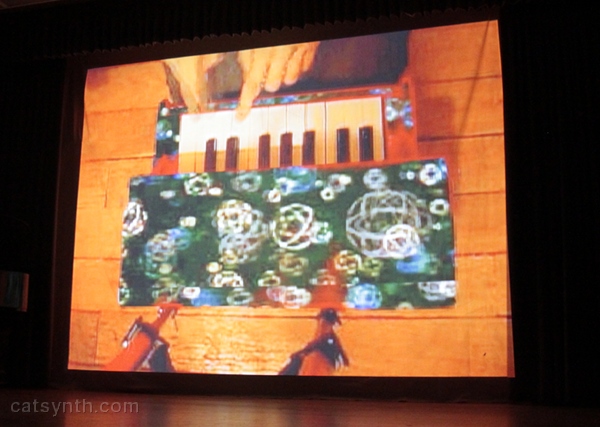
[click image to enlarge]
Some were less directly representational and more evocative of the music, such as the scenes from 1950s television commercials set to Gregory Yasinitsky’s jazz piece. Although it was far more abstract, I would put the constantly moving gray rectangles against Patrica Walsh’s electronica dance music in the same category.
Among my favorite of the combined video+music pieces were Brian Lindgren’s music set to a slowly moving film of a woman in a black dress in front of a brick wall; and Enrico Francioni’s sounds featuring strong resonance and feedback that were set to a beautiful film of forward motion in a dark industrial hallway. Also of note were Jay Batzner’s music (which reminded me of Xenakis) set to geometric views of industrial girders, perhaps power lines; and the intricate grid (along with spiders) set to Anton Killin’s metallic sounds.
Overall, with 60 sets of constantly changing visuals and music, and my attempt to take at least few notes on each, the experience became one of sensory overload. Looking back on the notes, it is interesting in looking at my previous review of the 2009 60×60 mix how different pieces stood out more in the mix without the visuals while others seemed more prominent in the music+visuals mix.
Submitted by Julian on facebook:

“i can’t believe there’s a page dedicated to cats and synth. finally.”