Category: Art

  • Weekend Cat Blogging: Cats of China

    This weekend, we visit the cats of my recently concluded trip to China.

    Suzhou is renowned for its silk. The climate is particularly suited to silkworm cultivation (though one would not think so given the freezing temperatures during this trip), and the city has long been a center for both production and craft. Cats are a common motif on the “two-sided” embroidered silk paintings of Suzhou:

    Outside the Suzhou Number One Silk Factory, I encountered this stray cat running through the parking lot.

    Cat in Suzhou, near the Number One Silk Factory

    In Shanghai, I saw this cat in a clothing shop on Dingxi Road:

    Dingxi Road is a commercial street in an outer neighborhood, not far from Zhongshan Park and completely devoid of foreigners. The shops that line the street cater to local residents, and the clothing shop where I encountered the cat was no exception. I think the shop’s owner was surprised and delighted to encounter a foreigner – and more surprisingly, a scruffy “white guy” – who was interested in cats. On the other hand, I think the cat was a bit annoyed by the attention and would prefer to sleep:

    Some things are the same everywhere.


    We are spanning continents, as Weekend Cat Blogging #190 hosted by Kashim at Paulchens FoodBlog in Vienna.

    In the far away state of Florida, Pet and the Bengal Brats host the Bad Kitty Cats Festival of Chaos.

    The Carnival of the Cats will be hosted this weekend by the House Panthers (of which Luna is a member).

    And of course the Friday Ark is at the modulator.

  • Suzhou Humble Adminstrator’s Garden and Tiger Hill

    In addition to its many canals, Suzhou is famous as one of the major centers of classical Chinese gardens. Perhaps the largest and best known is the Humble Administrator’s Garden.

    The garden is about 13 acres and about 500 years old (at least one site suggests it is exactly 500 years old, having been built in 1509). The “humble administrator” was a government official Wang Xianchen, who clearly could not have been that humble with a spread like this. It is interesting to note that gardens such as these were almost always private, and the idea of maintaining them is relatively recent.

    The elements of the garden include the plants, water, architecture (much of it the more minimalist and geometric Ming Dynasty style) and rocks, such as the lakebed rocks in the photo above. The natural and geometric elements fuse in a way that seems very fresh and modern, and one can see where many twentieth century artists, architects and designers may have gotten their inspiration.

    This is the sort of place where I could easily get lost in the visual elements for a long time.

    But of course we had to move on. We next visited one of Suzhou’s other well-known landmarks, Tiger Hill. The highest point in the city, Tiger Hill was originally the site of a king’s tomb, and later a Buddhist monastery and temple.

    Although this photo makes the pagoda at the top of the hill look perfectly straight, it is actually leaning quite strongly to one side:

    Supposedly, it is the many attempts over the years to locate and excavate the tomb in the hill that has led to the weakening of the ground below the tower and its severe tilt. The entrance to the tomb was finally discovered in the 1960s in pool lower on the hillside during a sever drought. However, it has remained unexcavated, lest the tower tilt even further.

    The top of the hill supposedly provides a spectacular view of Suzhou, but with the dense winter fog I was not able to see very much.

  • Suzhou Grand Canal at Night

    So far most of my touring has been at night. That will change over the weekend, but meanwhile here are some nighttime images from the Grand Canal in Suzhou. The city is crisscrossed by a network of canals, one of many things for which it is famous.

    The architecture of the bridges and buildings along the canal range from very traditional, as in the above photograph, to more modern. In all cases, however, things are always brightly lit with colored lights here. Even the trees are bathed in a green glow.

    The Grand Canal forms a loop that circles the old city, and one can observe segments of the old city wall and the towers just beyond it.

    Here is a more modern building along the bank of the canal. It blends the geometric modern features that regular readers of CatSynth know I am fond of with more traditional elements.

    Daytime will provide different view of the city entirely. The large buildings and their lights which are so prominent at night fade into the background, while the more modest homes that come down to the edge of the water become visible, as do the city’s famous gardens.

  • Stories for the last night of Channukah

    I should have written this earlier, rather than waiting for the last night of Channukah.

    As most readers know, this is the Jewish holiday that lasts for eight days and commemorates one of the world’s greatest stories of energy conservation. No ritual oil has ever had a lower carbon footprint.

    I wanted to share this series of new Channukah fiction that was read on NPR. Each of the stories is beautiful and modern. But I was perhaps most drawn to Holiday by Steve Stern, a retelling of the Channukah story in a somewhat dystopian United States in 2015 with chronic energy shortages, economic ruin, and cranky old Jewish stereotypes.

    As CatSynth HQ is only beginning to recover from our brief little dystopia, our celebrations were rather quiet this year. But we did connect with family and friends even in the middle of everything. And I suppose that is what really counts.

  • MoMA, Miró, Modernism and Theremins

    In addition to my adventures on the F train, I did have a small amount of time to enjoy art and music while was in New York for the Thanksgiving holiday.


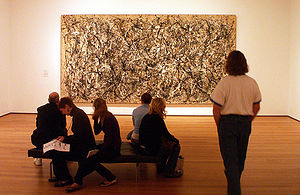
    One of the featured exhibitions at the Museum of Modern Art (MoMA) was Joan Miró: Painting and Anti-Painting 1927–1937. Miró often appears in my artistic travels – I have been to multiple retrospectives and visited the Miró Museum in Barcelona. This exhibition was more specific, focusing on a single decade of his career, during which he challenged the definition of “painting.” It opens with his declaration in 1927 “I want to assassinate painting” and features several examples of “non-painting”, including collages (such as Composition with Wire, shown to the right) and wooden sculptures. At the same time, however, many of the works are things we would consider paintings. Some of the canvases are unprimed, and several use new media such as masonite. But there are still primarily two-dimensional works involving paint on a surface. And most of the paintings and non-paintings include Miró’s signature elements in his more famous works such as bulbous abstract figures, curing shapes, stars, and scarabs. In addition to the theme of “anti-painting”, the exhibition follows the events in Europe, and particularly in Spain, in the late 1920s and 1930s, with the impending civil war and rise of Fascism. It ends with the Fascists coming to dominance in 1937 and the painting Still Life with Old Shoe that marks the end of Miró’s period of anti-painting.

    The MoMA’s website includes a detailed online exhibition.

    A few of the smaller exhibits also caught my attention. Dreamland: Architectural Experiments since the 1970s featured experiments in architecture, primarily centered around New York, or the modernist urban ideal of New York, as seen be architects. Some of the ideas, such as those in Rem Koolhaas’s Delirious New York: A Retroactive Manifesto for Manhattan, can be quite fantastic, such as an island oasis in a glass bubble atop a highway. Others were not only more realistic, but also realized, including some impressive homes in the country surrounding New York. It’s always great to see a celebration of modernism as it once was, before contemporary design and architecture took a turn away towards more mundane ideas.

    Keeping with the idea of the 1960s and 1970s as particularly modern decades, the exhibit Looking at Music features visualizations of music from the era. This includes direction visualizations, such as the scores of John Cage, as well as early media works by Nam June Paik, Laurie Anderson, Steven Reich and others.


    I did have a chance to hear some music as well. The weekend after Thanksgiving is often low on opportunities for new music (which is probably why I was able to book an NYC show without much difficulty after Thanksgiving in 2005). But the reliable Issue Project Room in Brooklyn hosted a show sponsored by the New York Theremin Society. The first set featured rather graphic stereo photos from World War I – still a horrific war when viewed a century later – with theremin accompaniment, presented by Robert Munn and Sara Cook. By Munn’s own admittance, this was not a performance for the faint of heart. The second set featured “Master Thereminist” Kip Rosser, who treated us to a series of jazz and pop standards that would be very much at home at a wedding or bar-mitzvah. It is interesting to think about a hybrid program featuring Rosser’s light jazz on theremin against Munn and Cook’s disturbing images from the Great War. But perhaps that would be a bit too ironic.

  • Wordless Wednesday: Hallowe’en Past


    [click to enlarge]

    And something really scary: