Category: Art

  • Hypnagogia, Climate Theater

    Hypnagogia defines the state between sleeping and waking: the state in which our dreams can seem more real to us than the waking world, and which, depending upon the nature of our dreams, our limbo-selves seek to flee, or to sustain.

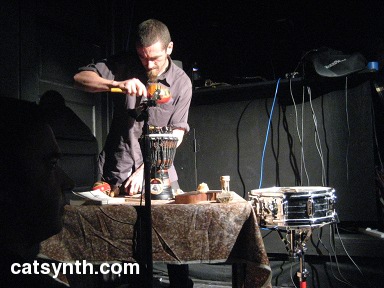
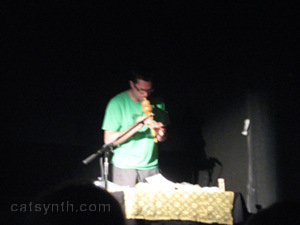
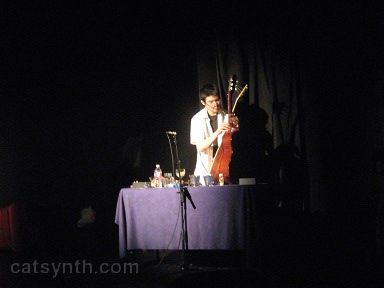
    My primarily mission in attending Hypnagogia at the Climate Theater was to see the performance of The Flip Quartet by Polly Moller, as I will be part of upcoming performance of the piece in July. The performance featured Karl Evangelista, Jason Hoopes, Thomas Scandura and Bill Wolter. The Flip Quartet is a composition for four improvisers who move between four stations representing the cardinal directions (north, east, south, west) and the four medieval elements: earth, air, fire, water. Each station had a variety of instruments and sound-making objects to represent elements.


    [click to enlarge]

    “Earth” had drums, stones, and blocks. “Air” included various wind instruments and shakers. “Fire” featured metal instruments and electric instruments (keyboard, electric guitar, etc.). And “Water” included water-filled containers, but also acoustic string instruments – this was the only association I had a difficult time figuring out, with my own interpretation being “standing waves.” Each section of the piece starts with the performers “flipping” a timer. When the time runs out, they stop and move on to the next station.

    The audience sat in the middle of the theatre, with half the seats facing one pair of elements and half facing the others. Since there were two performances, I got a chance to see and hear the piece from “both sides.” Musically, the piece unfolded as ever changing harmonies of the different objects, often very discrete and percussive, along with many theatrical moments such as attempting to balance on the “earth” elements on the head of a drum. My favorite moment musically was the combination of the Asian pipe (shown one of the photos above), lute, shakers and thunder tube.

    The other musical performance was Philip Greenlief performing a solo work The Fourth World. The piece is based on Hopi conception of time and the Fourth World from Hopi mythology, and is a solo performance featuring Greenlief’s expressive and virtuosic saxophone playing. I am always impressed with his multiphonics, which he manages to make seem as easy to play as standard tones. Spatially, this performance was the opposite of The Flip Quartet, with the audience seated in a circle facing inward and creating a more intimate space.

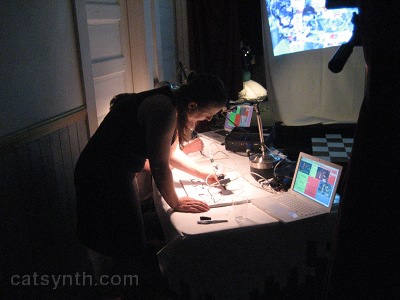
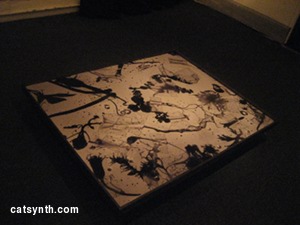
    In addition to the featured live musical performances, there were visual art pieces, installations, and media and performance art. Sean Clute, Jessica Gomula and Gina Clark presented a “video action painting and performance” entitled Slippery Dreams 2009.

    Live video of the drawings being created were projected onto the screens, and I believe also used to control the sound that was generated.

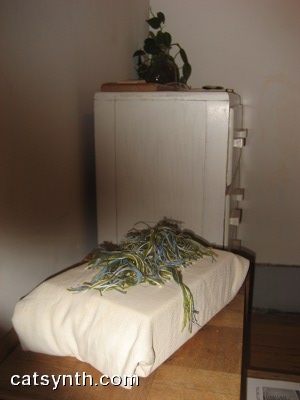
    Louis Rawlins presented the installation Sleep Patterns, set up as a bedroom or sitting room where one could relax and touch the ball of yarn on the table.


    [click to enlarge]
    The string (which included conductive thread) was used to generate sounds in response to the viewers interactions. Presumably, one could interact with this piece while asleep.

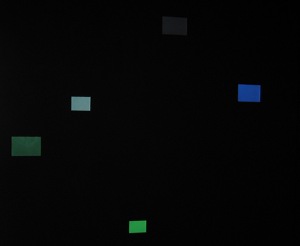
    The were several video pieces of varying subject and quality. I did like Vanessa Woods’ What the Water Saw, a short film that originally was shot on 16mm/35mm film and transferred to video. It was meant to mimic ocean with the distortion of images through water, as represented by the intense layering and deep colors of the film. After looking at Woods’ website, I think I might have been more interested in some of her black-and-white films. Rebekah May’s Celestial Cadence for video on five iPod Touches was an interesting visual in itself, with its arrangement of abstract color and shape patterns:

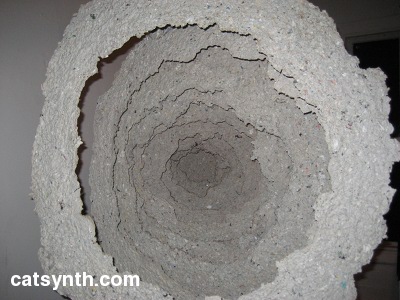
    Among the purely visual works that caught my attention was the undulating Circulation III by Julia Anne Goodman, a mobile work that was created from junk mail (and there is certainly plenty of that around); also Klea McKenna’s Taxonomy of My Brother’s Garden from Center of Gravity:


    [click to enlarge]

    Finally, as it was quite stuffy inside the theatre and gallery on this rather warm night, there was the welcome retreat to the rooftop, where VoxMaids performed rhythmic and traditional-sounding music for drums, accordion and voices against projections of astronomical objects. Alternatively, one could look at a real astronomical object, the moon, on this rather clear night.

  • Cats of Tokyo

    “He wrote me that in the suburbs of Tokyo there is a temple consecrated to cats. I wish I could convey to you the simplicity—the lack of affectation—of this couple who had come to place an inscribed wooden slat in the cat cemetery so their cat Tora would be protected. No she wasn’t dead, only run away. But on the day of her death no one would know how to pray for her, how to intercede with death so that he would call her by her right name. So they had to come there, both of them, under the rain, to perform the rite that would repair the web of time where it had been broken.”

    I remembered this scene from Chris Marker’s film Sans Soleil of the temple in the suburbs of Tokyo that was dedicated to cats, and when I knew that I was in fact going to be in Tokyo for a couple of days, I decided I would find this temple. It is in fact the Gotoku-ji Temple in the Setagaya ward in the western suburbs of Tokyo.

    It really was tucked away in a relatively quiet residential neighborhood, easily missed if one did not know where to find the gate. The temple grounds were very quiet, with very few visitors other than myself.


    [click to enlarge]

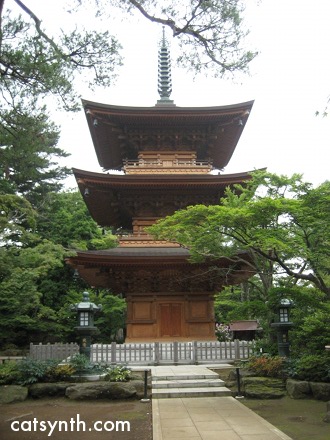
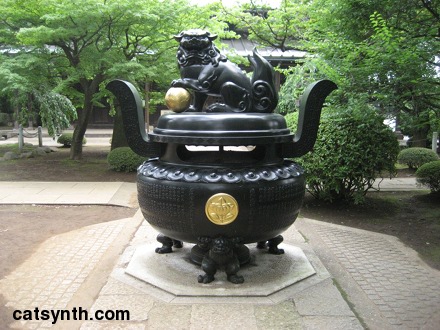
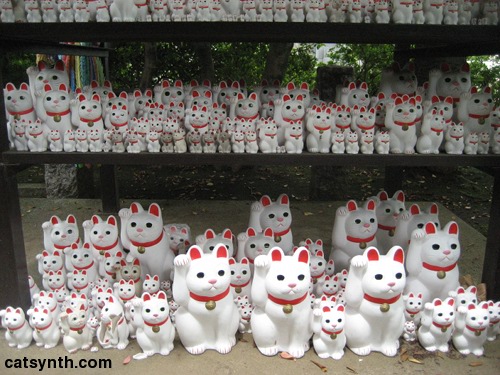
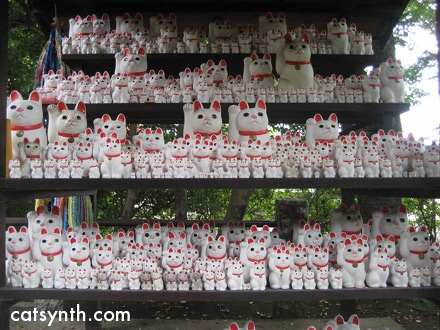
    There is a small building near the large tower in the photo above. I believe it is a side temple of sorts. Behind it is a set of shelves containing hundreds of maneki nekos, or beckoning cats, left as offerings. Indeed, Gotoku-ji claims to be the birthplace of the popular cat figurines.


    [click to enlarge]

    This was definitely the temple from Sans Soleil, I had succeeded in finding it. And having come this far, I spent a little time to linger in this small, quiet place.

    Gotoku-ji is not the only site that claims to be the birthplace of the maneki neko. In Akasuka, not far from the famed Senso-ji temple, is the Imado Shrine.

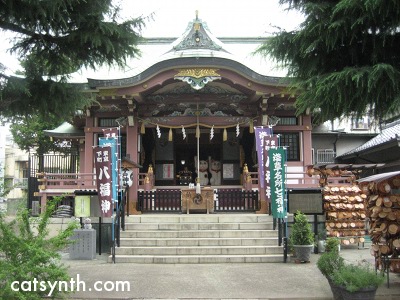
    Like Gotoku-ji, the shrine was tucked away in an alley in a quiet residential neighborhood. It was quite small, but had enough space for gardens, trees and statues leading up to the main building:


    [click to enlarge]

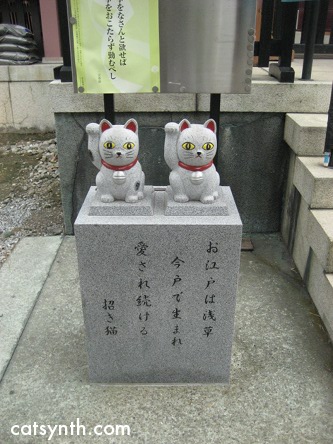
    Inside on the altar is a pair of large cats:

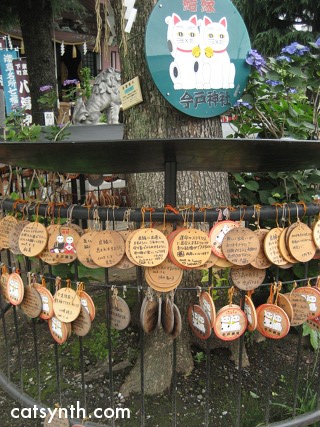
    The one on the left has spots and is the male cat, while the one on the right is the female cat, and together the lucky cats of Imado are supposed bring good fortune to couples or those seeking love. Images of the pair of cats can be found throughout the shrine:


    [click to enlarge]

    The wooden plaques tied below the image of the cats contain wishes left by visitors. This is a common practice at temples and shrines, but it was specifically here that I chose to leave such a wish myself. Another common practice is selecting a fortune from a box near the shrine – at the Imado temple, each fortune comes with a tiny cat figure. I did get one of these, and of course a few ceramic cats from both Imado and Gotoku-ji.

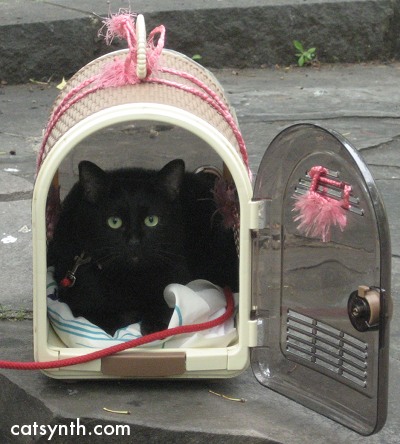
    One cannot help but think a little bit about spiritual things after visiting spiritual places, and a coincidence that occurred soon after leaving Imado contributed. Heading back south towards the Senso-ji temple, I saw a small narrow park, really a stone path lined with trees, and decided to walk in that direction. About halfway, a saw a woman with an open cat carrier, and inside was a black cat with green eyes!


    [click to enlarge]
    Although we had almost no words in common except basic greetings and “neko”, I was able to express my appreciation of her cat, and showed photos of Luna. “Lady?”, she asked in English. I nodded. She pointed to her own cat and smiled “Boy!”

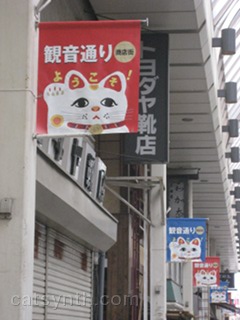
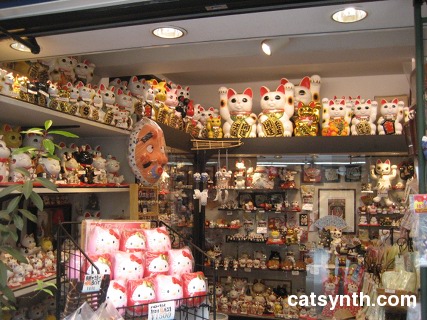
    The symbol of the cat is ubiquitous in Tokyo, spiritually as well as commercially:


    [click to enlarge]

    In the image above, we see a shop carrying not only an impressive array of maneki neko, but some examples of Japan’s other famous feline symbol, Hello Kitty. I have approximately zero interest in Hello Kitty, but during my trip I did build up a small collection of maneki neko, of which a subset are shown below:
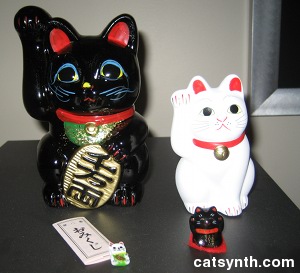
    Included are one of the simple ceramics from Gotoku-ji, the tiny cat that came with the fortune at Imado, and a couple of black cats that I found.

    Beyond the black cat in the park, I did not see very many live cats during my short visit. Apparently, this is an issue from Japanese ailurophiles as well. There are now several cat cafes around Tokyo, where for a fee one can spend an hour or so interacting with the cafe’s very friendly (and very clean) cats. I did see a cat cafe in Akiabara (an area which will be the focus of one of our next articles), but I did not have time to check it out. However, Akiabara, the center of electronics and anime in Tokyo, will itself be the topic of an upcoming article here at CatSynth.

  • Suzhou Museum and Zhong Wang Fu

    On Saturday morning, I visited the Suzhou Museum. I have been in the area around the museum, which includes the old canals and the Humble Administrator’s Garden, but never had the time until now to venture inside.

    The museum is more a culture and heritage museum than an art museum. Its collection is primarily traditional Chinese items, though it does have a contemporary art wing as well. For me, however, the main attraction was the building itself. It was designed by the architect I. M. Pei, whose family has long resided in Suzhou.

    The museum’s architecture incorporates the shapes and elements the adjacent traditional gardens and palaces, including its own gardens, pools and rockeries, but stripping away the ornaments and focusing on the lines and geometry. This extends to the interior as well:

    Overall, the architecture and design of the museum was quite photogenic, and readers should look for more examples in future photo series, and of course “Wordless Wednesday.”

    One exhibit recreated a traditional Chinese study, and suggest that traditional elements of Chinese design can fit very easily into a modern context:

    I wish my office looked like that.

    I did take some time to see a few of the traditional artifacts, including several examples of animal figures such as this black-and-white jade cat:

    Before the new museum building opened in 2006, it was housed in the neighboring Zhong Wang Fu, a traditional Chinese mansion with gardens and courtyards. The grounds and buildings have been restored and remain open to the public:

    One can observe which elements were incorporated into the new building, and which ones were not.

  • Berkeley, Pacific Film Archive, Le Bonheur

    I actually don’t get back to the Berkeley campus or its surroundings very often, and when I do, it’s usually on the north side where my graduate-school life centered: the computer-science or computer-music centers, the winding roads of the hills, or the “gourmet ghetto.” It’s pretty rare that I find myself on Telegraph Avenue or along the south side of campus, as I did this time. It seemed like very little has changed, many of the shops, restaurants and institutions along the street are still there, many of the buildings look the same. But it did seem a bit cleaner.


    While in Berkeley, I saw a screening of Agnès Varda’s film Le Bonheur at the Pacific Film Archive.

    It basically a film about a young family living a Paris suburb and leading a life that seems so overly perfect that something bad clearly is going to happen. In this case, it is the husband and father François beginning an affair with another woman. As the affair progresses, the film, whose its rich colors and classical soundtrack do seem to resonate “happiness”, very gradually begins to feel a bit unsettling, and eventually a bit creepy.

    Even as it is a film about a particular set of circumstances and events that happen to a family, it is also very much a film about colors. Each scene seems to focus on a specific color. The initial scene of the family on a picnic in the countryside is all yellow, and the family’s (somewhat small and cramped) apartment is blue. In each of these scenes, everything matches the primary color, from the flowers to the background light to the clothing worn by the family. This is particularly apparent with yellow and blue dresses of Therese, the wife and mother (and coincidentally, a dressmaker). She reprises these colors throughout the film, they seem to represent the “happy” aspect of the family. By contrast The scenes with mistress Émilie, particularly those in her apartment, are stark white, with only sparse adornment such as movie posters on the wall. The colors also change with the seasons over the course of the film, from yellow in spring to bright green in summer, to muted orange and brown in the autumn.


    Before the film, I did take a quick trip through the Berkeley Art Museum. Although they did have interesting exhibitions – Mario García Torres’ multimedia installation focusing on ruined buildings on a Greek Island that once housed modernist performances and installations, and an eclectic assortment from the permanent collection – it was in some ways overshadowed by the building itself, with its large space and oddly angled concrete balconies.


    Perhaps the thing that makes visiting Berkeley most different now is that I am living in San Francisco, so the trip is now going from a large city to a medium-sized college town and then back at night. It’s not good or bad per se, it’s just different, and coming home to the city at the end of the day (instead of the trip in the middle) has become quite familiar, and comforting.