
Category: Modernism
-
First Thursday and Mission Arts & Performance Project
Today we at CatSynth review two very different recent art events we visited here in the city.
First up is First Thursday, which I haven’t been able to attend for the past few months because Thursdays tend to be busiest days of the week (several of my performances have been on Thursdays, for example). This Thursday was no exception, but I was able to do a “speed tour” before heading off to a friend’s party.
 My favorite exhibit of the evening was Dystopia at the Robert Koch Gallery. This was an exhibition of photographs exploring the edges of the urban landscape, including “ruins”, abandoned lots and buildings, and some whimsical photos that played with human elements within architectural settings. Regular readers will know the theme of this exhibition is in line with my own photography, which most often features urban and architectural elements. The participating photographers were Benoit Aquin, Ken Botto, Jeff Brouws, Matthias Geiger, Alejandro Gonzalez, Richard Gordon, Colin Finlay, Navad Kander, Shai Kremer, Brian Ulrich, and Michael Wolf. The gallery has provided an excellent online slideshow of the exhibit, which I encourage everyone to check out, especially if you have enjoyed Wordless Wednesdays here at CatSynth.
Part of the fun of events like this is all the interesting people that one sees. And the occasional non-human as well. This dog I saw at the Don Soker Gallery had decent taste:

Our canine art critic also stopped by some interesting modernist and text-based works at the neighboring Altman Siegel gallery, part of an exhibition called “A Wild Night and a New Road”.
Down the hall, the show entitled “Who Got the Chickens” by Stephan Pascher was wholly uninteresting to me, except of course for having the best title of the evening.
We made a brief excursion from Geary Street to Hang, which featured an opening by Freya Prowe. Several of her paintings include the interesting combination of fish and a female angel or fairy creature dressed in black, as illustrated in this detail from a larger work:

I attended a very different kind of art event on Saturday. The Mission Arts and Performance Project (MAPP) is a “bi-monthly street-level community arts happening”, featuring local artists in garages, storefronts, studios and private homes in the Mission District of San Francisco.
By transforming garages and backyards into mini-galleries MAPP shows how ordinary spaces can be made extra-ordinary to bring people together to share in a diverse experience of fine art and performance. The garages, as they are unpretentious and open to the street, pose the possibility of exposing the arts to a lot of folks who might not ever enter a gallery or theater. This process helps take the art from the margins of our communities to where it may come to be more widely see and understood as a vibrant and vital force necessary to the health of our society.
The Red Poppy Art House was for a longtime the force behind MAPP, and you can see images of past events on their website. They were not participating in this months event, and indeed the entire program was much smaller than the one I attended last year. This month also focused primarily on performances, music as well as spoken-word and dance, with very little in the way of visual art. Nonetheless, there were some interesting performances.
 The Peace Planet was set up in a private residence on Harrison Street, providing an intimate setting for musical performance. Of course, the extremely large attendance made things feel more crowded than intimate. But I did manage to get a seat, and heard Classical Revolution perform some very traditional string works by Bach – the mission of Classical Revolution is bring classical music out of the concert-hall setting into “highly accessible” public venues, such as bars and cafes. There was also a more contemporary piece the program called Spontaneous Combustion by Jorge Molina , for prepared piano, classical voice, percussion and several didgeridoos. The piece had heavy Latin and jazz influences, and was relatively tonal in C minor (my favorite tonal key). I am not sure how much was improvised, and because of the crowd I did not get a chance to talk with the composer or performers.
Down the street at Area 2881 was the evening’s primary visual-art exhibit, featuring robot performance and kinetic sculpture by Carl Pisaturo:


These robotic sculptures combine technology with modernism and industrial themes, which in some ways brings us full circle to the photography exhibit that opened this article.
-
San Francisco Tape Music Festival
As promised, here is my post on the San Francisco Tape Music Festival. I had an opportunity to attend last Saturday’s program.
First, a word about “tape music.” Of course, it does not actually have to be on tape. Indeed it is now most often rendered as digital media: DVD or audio files. The San Francisco Tape Music Collective (which runs the festival) defines it as “audioArt diffused through a surround-sound speaker environment.” Essentially the “audio art” is music or other sound rendered onto media, and the performance is the live performance of that media in a hall through a speaker system. The way the media is mixed into the speakers and the live space creates a unique performance. And the fact that the material is recorded on media allows composers to create sounds that could never be performed live, even with modern computers – although the gap between what can be done live and what can only be rendered is narrowing over time. In the early days of electronic music, tape was in fact the only way to realize sounds, and thus the only way to perform the music. Modern tape music carries on that tradition.
The idea of going to concert hall and listening to a recording may seem odd, but like any other performance, it is about matching the content and presentation. There are really good tape-music performances, and really bad ones, and I have been to both. The Saturday performance at the festival was definitely a good one. It included classics of electronic music, such as John R Pierce’s Stochatta, one of early experiments in computer music at Bell Laboratories; and Lubiano Berio’s Thema (Ommagio a Joyce). Both pieces were premiered over 50 years ago. John R Pierce may be familiar to longtime readers of CatSynth as one of the co-discovers of the Bohlen Pierce scale.
Most of the other pieces on the program were far more recent, with the most recent being the premier of Cupido’s Suitcase by Cliff Caruthers. A series of three pieces in the first half, Winter Light (for Ingmar Bergman) by George Cremaschi, Pre-fader: Highly reverberant states by Goran Vejvoda and Chart Tempo & World Retrograde by Jon Liedecker/Wobbly explore three different aesthetics within recorded sound art: simple (but very powerful) sound synthesis with two oscillators, complex collages of sounds, and remixing of popular-music elements, respectively.
One piece that also got attention when the program was first announced was a piece by The Fireman, which is actually a due of Paul McCartney and Martin Glover aka Youth. As a piece on the program, I don’t know that is as memorable as the others I have discribed.
The program closed with a rather “hard” piece buzzz by Geraud Bec, which I leave to the reader’s imagination. Works by Maggi Payne, Zhiye Li and Kent Jolly rounded out the program.
Overall, a very even performance, there was no point at which I didn’t want to be there listening. I also think that this series is fairly accessible for those who are not familiar with contemporary or experimental music, nothing is too harsh or too provocative – then again, I don’t know if I am the best judge of that.
-
Art and music notes from the past week
 During one of my long walks this weekend, I stopped in at Crown Point Press and found in the hallway several prints from Changes and Disappearances by the composer John Cage, a hero of ours here at CatSynth. My first impression was that these were graphical scores (i.e., scores where the performers interpret visual images), but they are in fact intended as independent works of visual art. However, many of the same compositional techniques can be found in both Cage’s music and visual art, as described in this essay by Ray Kass:
It occurred to me that his etchings had an extraordinary correspondence to the methods he utilized in composing his music – and that they were visual counterparts of sorts, related in a manner that one might not have expected…But the connection between Cage’s use of “chance” methodology in his various kinds of work (composing, writing, installation & performance art, & now printmaking) made sense in a way that awakened me to the great scope of his work.
I don’t think this was a special exhibition per se, as Cage had a longstanding relationship with Crown Point Press and they have displayed his work on several occasions. The main exhibition was a series of works by Tom Marioni.
Both Marioni and Cage were featured in The Art of Participation at the San Francisco Museum of Modern Art (SFMOMA). Among the works in the exhibition were Marioni’s Free Beer (sadly, no free beer was being dispensed at the time, even though it was “Superbowl Sunday”), and John Cage’s most famous piece 4′ 33″. The full score was posted on a wall, and it was also displayed on a grand piano in its original form. I can’t say this was presented as a “participatory work”, however. Simply looking at the piano and listening to the museum commotion for the alloted time does not constitute a proper performance of the piece.
There were, however, plenty of other interactive pieces in the exhibition to explore, such as Lygia Clark’s Diálogo: Óculos (Dialogue, Goggles):

Last week, I attended an evening of electronic-music performances at the Climate Theatre, part of the regular Music Box Series. This series usually does not feature electronic music, but this time they darkened the room and presented “electronic soundspaces.”
Christopher Fleeger opened the evening with lively performance featuring a touch screen, percussion controller and laptop. The music mixed synthesized and other familiar electronic sounds with some odd and amusing recordings, such as a rap extolling the virtues of Tallahassee, Florida as a center for faiths of all kinds, and a very memorable piece of “stand-up tragedy” about one man’s experience with “the store” – in the poem, every line ended with “the store” and often included other references.
The second performance was by James Goode and featured a mixture of acoustic sources (percussion, toys, etc.) with sampling and looping, and reminded me a bit of my own performances at the Santa Cruz Looping Festival and other venues (it reminds me that I haven’t written about that). It can sometimes be a challenge to sustain full energy for an entire solo set of this nature, but Goode made this seem easy.
Goode and Fleeger closed with an extended duet improvisation. At least one balloon went flying into the audience.
I also attended the Saturday performance of the 2009 San Francisco Tape Music Festival, which I will discuss in a separate article.
-
Jackson Pollock’s Birthday
Yesterday (January 28) was the birthday of the artist Jacskon Pollock.

Regular readers know that we at CatSynth are big followers of modern art, and Pollock was one of the most well-known and influential artists from the rich period of American art in the 1950s and 1960s. He is most often associated with the large and diverse movement abstract expressionism, but his work is quite distinctive even with in that context, and his large “drip paintings” are instantly recognizable.
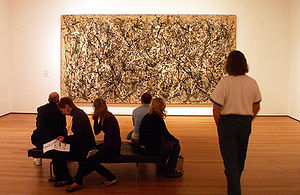
I first encountered Pollock’s work at the Metropolitan Museum in New York, and later at the Museum of Modern Art (MoMA). I did have an opportunity to see a major retrospective at the MoMA in 1999, which brought together not only his large iconic paintings, but his earlier works that mixed abstraction with Native American and folk influences – although these works were “modern” they were more conventional for contemporary art of the time. I managed to find this article from the News Hour (PBS) discussing Pollock and the 1999 retrospective.
Although Pollock is held in high regard by those who follow and care deeply about modern art, he is often treated derisively by people who simply don’t like modern or abstract art. He is perhaps the most associated with the phrase “my five year old could do that.” The idea is laughable. This is unique and skillful art, especially on such a large scale. Such paintings were not seen before the 1940s, and centuries of five-year olds never produced anything like it.
Google has a tradition of honoring major artists on their birthdays with a themed home page, and yesterday they did so for Jackson Pollock:

Thanks to The Madville Times for capturing the above image.
-
MoMA, Miró, Modernism and Theremins
In addition to my adventures on the F train, I did have a small amount of time to enjoy art and music while was in New York for the Thanksgiving holiday.

One of the featured exhibitions at the Museum of Modern Art (MoMA) was Joan Miró: Painting and Anti-Painting 1927–1937. Miró often appears in my artistic travels – I have been to multiple retrospectives and visited the Miró Museum in Barcelona. This exhibition was more specific, focusing on a single decade of his career, during which he challenged the definition of “painting.” It opens with his declaration in 1927 “I want to assassinate painting” and features several examples of “non-painting”, including collages (such as Composition with Wire, shown to the right) and wooden sculptures. At the same time, however, many of the works are things we would consider paintings. Some of the canvases are unprimed, and several use new media such as masonite. But there are still primarily two-dimensional works involving paint on a surface. And most of the paintings and non-paintings include Miró’s signature elements in his more famous works such as bulbous abstract figures, curing shapes, stars, and scarabs. In addition to the theme of “anti-painting”, the exhibition follows the events in Europe, and particularly in Spain, in the late 1920s and 1930s, with the impending civil war and rise of Fascism. It ends with the Fascists coming to dominance in 1937 and the painting Still Life with Old Shoe that marks the end of Miró’s period of anti-painting.The MoMA’s website includes a detailed online exhibition.
 A few of the smaller exhibits also caught my attention. Dreamland: Architectural Experiments since the 1970s featured experiments in architecture, primarily centered around New York, or the modernist urban ideal of New York, as seen be architects. Some of the ideas, such as those in Rem Koolhaas’s Delirious New York: A Retroactive Manifesto for Manhattan
, can be quite fantastic, such as an island oasis in a glass bubble atop a highway. Others were not only more realistic, but also realized, including some impressive homes in the country surrounding New York. It’s always great to see a celebration of modernism as it once was, before contemporary design and architecture took a turn away towards more mundane ideas.
Keeping with the idea of the 1960s and 1970s as particularly modern decades, the exhibit Looking at Music features visualizations of music from the era. This includes direction visualizations, such as the scores of John Cage, as well as early media works by Nam June Paik, Laurie Anderson, Steven Reich and others.
I did have a chance to hear some music as well. The weekend after Thanksgiving is often low on opportunities for new music (which is probably why I was able to book an NYC show without much difficulty after Thanksgiving in 2005). But the reliable Issue Project Room in Brooklyn hosted a show sponsored by the New York Theremin Society. The first set featured rather graphic stereo photos from World War I – still a horrific war when viewed a century later – with theremin accompaniment, presented by Robert Munn and Sara Cook. By Munn’s own admittance, this was not a performance for the faint of heart. The second set featured “Master Thereminist” Kip Rosser, who treated us to a series of jazz and pop standards that would be very much at home at a wedding or bar-mitzvah. It is interesting to think about a hybrid program featuring Rosser’s light jazz on theremin against Munn and Cook’s disturbing images from the Great War. But perhaps that would be a bit too ironic.
-
Art Overload! SF Open Studios (and the Anderson Collection)
[For Weekend Cat Blogging, please follow this link].
Since last Sunday (after my performance at the Y2K8 Looping Festival), visual art as taken over. October is Open Studios in San Francisco, where artists open up their studios to for public visits. I took advantage of the opportunity to get acquainted with local artists, mostly in the neighborhoods in walking distance, and the local art scene.
Taking in so much art and so many artists in such a short period of time is quite overwhelming, and I will only be able to describe a small fraction of what I saw. What makes a particular artist memorable and noteworthy is not only the quality of his or her work, but the conversations and personal connections. In some cases, I remember artists whose work may not fit my own aesthetic, but whose meeting was memorable. It was also the setting, and how their work fit in with my vision and sense of the neigbhorhoods.
Potrero Hill, The Mission District, and Bernal Heights
 My first day out was last Sunday during which I visited several large studios in the Potrero Hill and Mission districts. The first stop was Art Explosion Studios. Here I met and had a change to talk with Amy Seefeldt; and Victoria Highland, whose large city-scape on a hill in front of a bay (where have I seen that before?) was one of the better large-scale paintings I saw. Heidi McDowell had an interesting large-scale painting featuring a young girl at Lassen National Monument, which I visited last year. The recent work of Melisa Philips is perhaps closer to my own interests. One of her paintings featuring stenciled text is shown to the right. I have discussed here on CatSynth in the past my interest in text within visual art, and whether the words and letters are simply visual elements or retain their meaning. Melisa Philips and I had an interesting conversation about this topic. Additionally, her earlier work includes some of the more interesting female figures I encountered on this particular day.
It is hard to tell specifically where Potrero Hill ends and the Mission begins, and many of the venues on this particular trip sit in that ambiguous area of old industrial buildings dotted with lofts and art spaces. Within these spaces, I encountered not only traditional fine art, but other media as well, some which would have been traditionally classified as “craft.” There were several jewelry makers, for example – there is a fuzzy dividing line at which things like jewelry become art, perhaps when they become more an item to collect and display, rather than to wear. There were the chandeliers by “adventurer” Derek E. Burton, which were quite intricate and intriguing, and although they are completely opposite of my personal style and the style of CatSynth HQ, I enjoyed hearing Derek’s story and his passion for his work. Aliza Cohen presented mix-media art, but it was her wool pillows that caught my attention. I did also encounter more traditional media, such as the photography of Christine Federici that incorporated some architectural and space details, as well as a mixture of natural and artificial textures.
Interestingly, it seemed that “modern” art, which is my main interest, was a distinct minority among the works encountered on this first trip. Certainly, there were many artists working with abstraction, but overall it did not have the stark geometric or textural qualities that I have come to expect.
When searching for “abstract” on the main website, the work of Pauline Crowther Scott showed up on the list. Her works features images of cats. Cats and abstraction seem like a good combination, so I made the trip out to her home studio in the Bernal Heights neighborhood. The trip to the narrow and sometimes vertical streets and older houses in this neighborhood in the southeast of the city, on a somewhat chilly late afternoon, was an interesting experience in itself. Scott’s work was much less abstract than I had expected (she was in fact surprised by the designation), but she did have several works featuring cats that were added to earlier (and indeed somewhat abstract) images. One example was Three Cats on a Bedspread.
South of Market and Mission Bay
This weekend featured open studios the South of Market (SOMA) area, which is my own neighborhood. Overall, the works I encountered were decidedly more modern, and often seemed to take inspiration from the industrial and urban surroundings. Indeed, the mixed media works of Rebecca Kerlin draw upon the highway overpasses, such as I-80 and the approach to the Bay Bridge, that I have featured in many posts here at CatSynth, such as in this Wordless Wednesday post. Her work incorporates photos of familiar landmarks and details into mixed media pieces.
One of my longer pieces about walking in SOMA included this photograph featuring an onramp to the Bay Bridge over Bryant Street, near the landmark Clock Tower:

 It turns out that building in the foreground contains several artist studios. Among the artists at this locations was Paule Dubois Dupuis. Her work includes large abstract modernist paintings, the type of art I am currently quite interested in. Some of her pieces also included stenciled text, another common theme among works that draw my attention. In addition to the art itself, her studio is in quite a location, with windows that look out onto the bay, the industrial/office buildings and the highway supports, depending on the direction of one’s gaze. I was inspired to take this photo:

 At Clara Street Studios, I encountered the work of Jerry Veverka, whose work involves plays on architecture and geometry, with some surrealist elements. I had seen an example at the SomArts exhibit, and was particularly drawn to his “Impossible Cities Series,” an example of which is displayed to the right. (Click on the image for a full size version at his website.)
Two other photographers I also encountered at included familiar sights from both New York and San Francisco in their work, and I had fun identifying and discussing them. I have unfortunately misplaced both photographers’ contact info (and I cannot find them on the original list. Hopefully, I will be able to get in touch them soon.
Back at Soma Artists Studios (same location as Rebecca Kerlin), I saw an interesting progression the work of Flora Davis. Her early work featured oil paintings of cats, while her more recent work involves sheet metal. They were quite separate, indeed they were displayed in two separate studios. However, I think it would be interesting to place one or two of the smaller cat paintings next to her multi-panel metal works, and considering them as a unit. Indeed, it would summarize my experience as modernism, abstraction, geometry, and cats.
After an exhausting but rewarding walk around the neigbhorhood, I did have to time for a brief excursion south to some studios in the Mission Bay area, which includes much of the old industrial waterfront.

 The view behind the studios at 1 Rankin Street onto the Islais Creek Channel were quite inspiring, even without the presence of art. Fitting with the environment, this studio featured metal sculptures. The large sculptures of Béla Harcos greeted visitors. No matter how much I am supposed to be looking for prints and paintings, I am still drawn to abstract metal sculpture. Rebecca Fox also had large works on display, and I able to glimpse her workspace and her collection of metal waiting to be used. The “artist blacksmith” Wolf Thurmeier has some smaller, even “miniature” abstract metal sculptures (what I would consider “apartment-sized”), forged from recycled metal.
The Anderson Collection
Quite by coincidence, I also had the opportunity this weekend to attend a private tour of the Anderson Art Collection. The collection is located in Menlo Park (south of San Francisco, near Stanford University), and features late 20th century and early 21st century American art. It includes over 800 works, spanning about five decades and several notable styles and schools, including color fields, minimalism, the New York school of the 1950s and 1960s (e.g., Jasper Johns and Robert Rauchenberg). There were also recent computer-assisted works by Chuck Close, as well as emerging artists that the Andersons are supporting. One interesting discovery for me was Frank Lobdell. I will have to look for him on the outside. I found it interesting how some of his work resembled the Jasper Johns’ prints featured in the collection (especially the reductions in the very detailed brochures).
This visit to one of the premier private collections was an interesting contrast to many local independent artists over the past week. I would to think that my art experiences will continue to include both.


