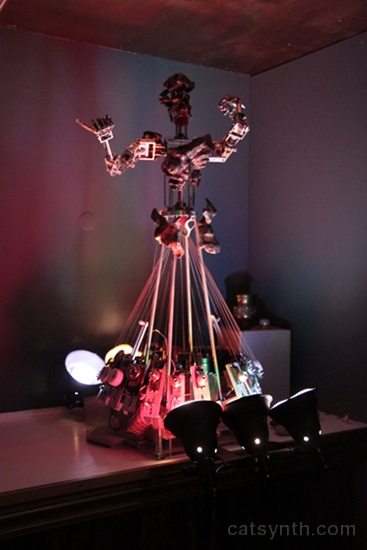
Instagon 543 and Richard Bonnet, Luggage Store Gallery

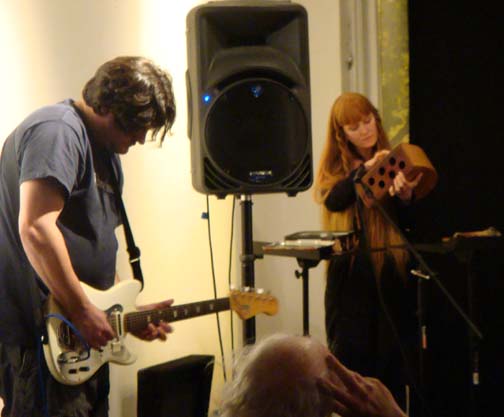
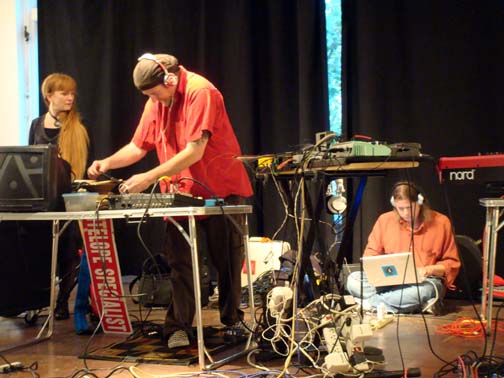
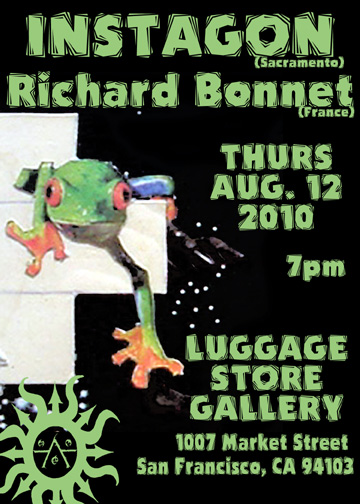
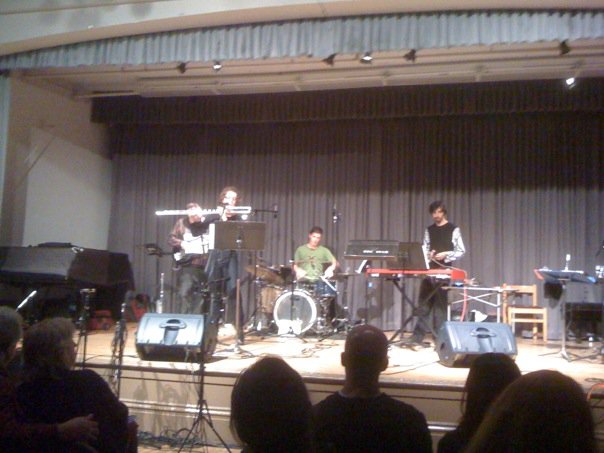
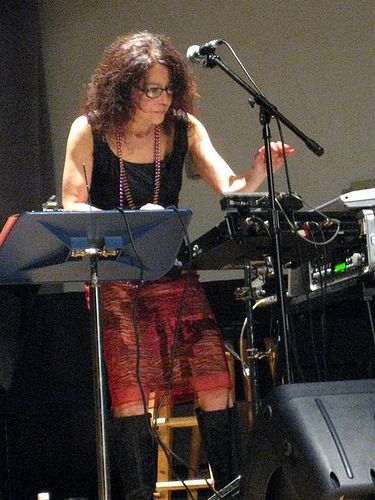
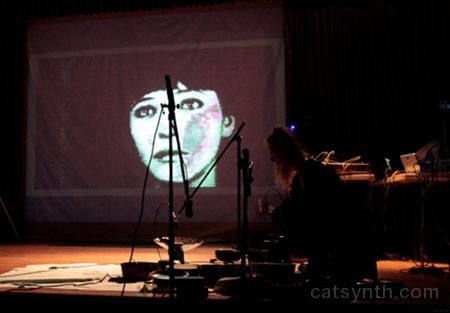
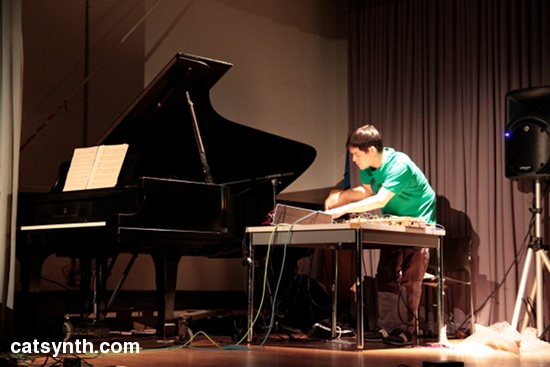
Last Thursday I participated in Instagon 543 at the Luggage Store Gallery in San Francisco. Instagon is an improvising ensemble where the personnel change every time, i.e., no two performances contain the same group of people. In addition to myself and Lob, the group’s founder, this version included Lena Strayhorn, Mark Wilson (aka “Conure”), Alan Herrick, Martin of Vernian Process, and Blancahillary (aka Hillary Fielding).

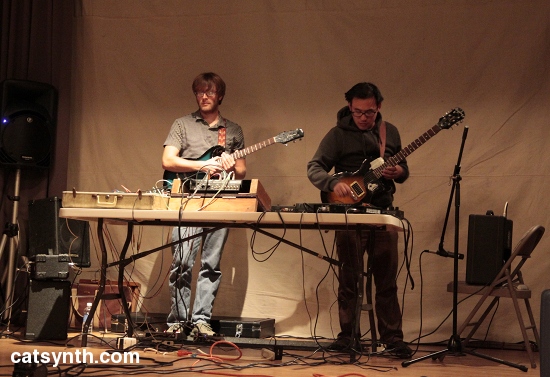
I had brought instruments from opposite ends of the size spectrum: the Nord Stage and the iPhone 4, on which I played the Smule Ocarina and Leaf Trombone apps, as well as Bebot and Nlog which I have used in previous performances. Lena Strayhorn had acoustic instruments (to be played into a microphone) including a flute and a large one-of-a-kind kalimba-like instrument. Mark Wilson had a large array of electronic sound sources and effects, Alan Herrick performed via laptop, Martin and Blancahillary played guiltar; and Lob played bass and the main mixing board.

[Photo by Yvette Lucas, via Lob]

Basically, everyone was improvising independently, with Lob controlling levels via the mixing board. As he brought performers in and out of the mix, everyone was (presumably) listening and adapting their performances, which turn may or may not be presented in the mix. Thus there was a complex feedback loop with the live mixing and the instrumental improvisations.

Musically, the overall the theme was “drones and creepy.” As such there were lots of long, drawn-out tones from everyone, with periods of noise and static, heavy distortion or large tone masses. I used the electric piano on the Nord to contribute to the “creepy” theme, with augmented chords and effects that resembled a 1970s horror-film soundtrack. It was in fact hard to sometimes hear who was performing what, although Lena Strayhorn’s acoustic instruments were quite distinctive, and Blancahillary’s guitar playing was more staccato. I found that the Ocarina iPhone app was picking up and responding to the ambient sound from the speakers, so I spent a fair amount of time with it, bring the iPhone closer to the speaker to manipulate the sound. Its output was of course then fed back into the overall mix.

[Photos by Yvette Lucas, via Lob.  Click images to enlarge.]

An additional level of “chaos” was Blancahillary’s “performance” with aluminum foil. She unrolled a large sheet, first using it as an acoustic sound source by shaking and crumpling it. She then tore off pieces which were lobbed at audience members and at other musicians, and finally she fashioned a large piece into a mask (covering her nose and mouth) that matched her silver pants.

As one might expect from a complex non-linear feedback system, there was quite a bit of chaos, relatively controlled chaos. There were many moments there in fact quite loud, and the overall texture was quite dense. But there was still a lot of variation and an overall structure to the set.

At the very end, Lob introduced each of the musicians and provided an opportunity for everyone to play a momentary solo so that the audience could hear his or her contribution to the overall performance.


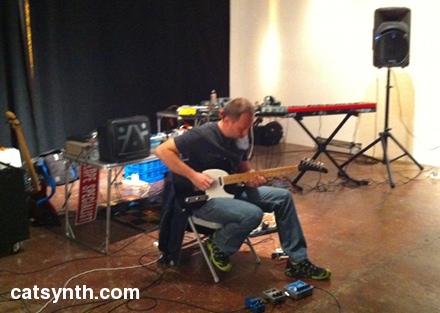
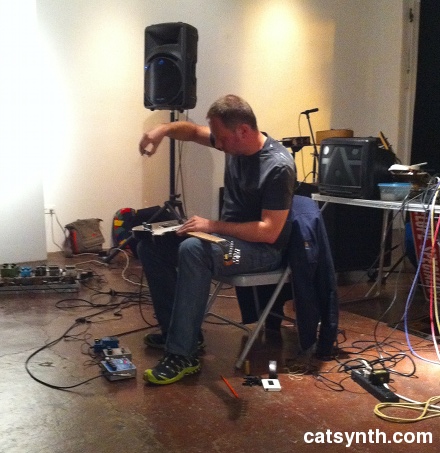
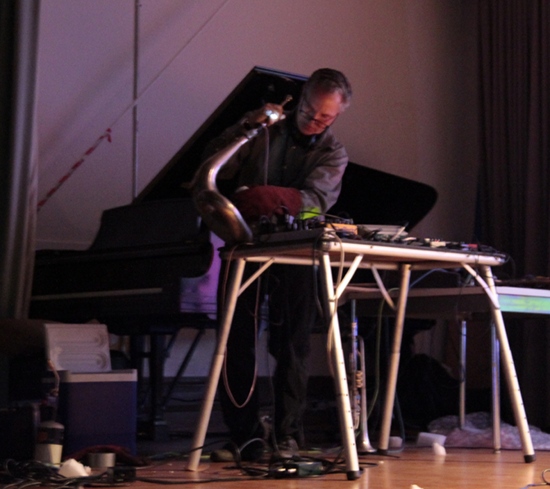
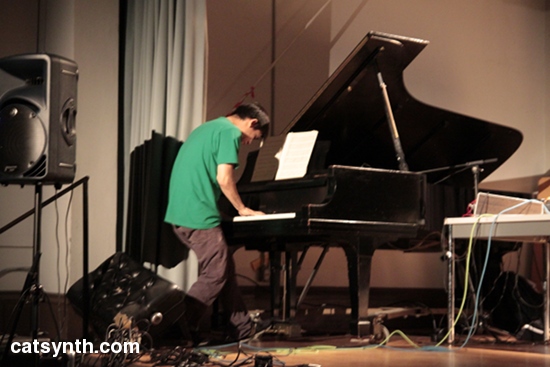
We were preceded on the program by a solo performance by aris-based guitarist Richard Bonnet.

[Click image to enlarge.]

The first pieces in his set were based on more conventional musical techniques, but very well done. He opened with a series of percussive and harmonic tones that moved between more dissonant (seconds, tritones) and consonant harmonies. He used some delays that produced rhythmic patterns that gradually disintegrated. From these pieces, he built up a big cloud of sound that narrowed to a lone almost pure high tone. The second piece was more virtuosic in terms of finger work. It felt “bluesy” in terms of slide technique and vibrato, but the harmonies were very different from any standard blues. The third piece was more of a minor ballad with lots of melodic material and implied harmonies. It resolved into something that sounded more latin but then suddenly became more abstract with back-and-forth between fingerwork and chords.

In the remainder of the set, Bonnet brought in more experimental techniques. The next piece was darker, with lots of low tones and real-time manipulation of the tuning pegs, and use of an e-Bow for long drones. The overall tone with more “electric” between the use of the e-Bow and distortion. The melodic lines were more abstract and interspersed with sustained lines, timbral effects and harmonies. Some of the sounds seemed more synthesizer-like, but his conventional guitar technique continued at the same time. The piece ended with darker and grainier sounds, a long high note coming out of a dark cloud, and then fading out.

[Click image to enlarge.]

The final piece explored “prepared guitar”, in which various objects are placed in and around the strings to alter the sound and behavior of the instruments. Some of the objects included a bottle, a metal slinky that produced very scratchy sounds, and a chopstick under the strings. This was combined with delays and other electronic effects. The overall sound was eerie and haunting with sliding notes, like an old suspense film, with percussive and scratching sounds that not surprisingly reminded me of a prepared piano. From the delay lines and loop emerged that became a background jazz riff, but some buzzing and other complex sounds. This was probably the most fun piece of the set, and a good conclusion.

Reconnaissance Fly at Luna’s Cafe, Sacramento

This is the “official CatSynth report” from our Reconnaissance Fly show at Luna’s Cafe in Sacramento last Monday.

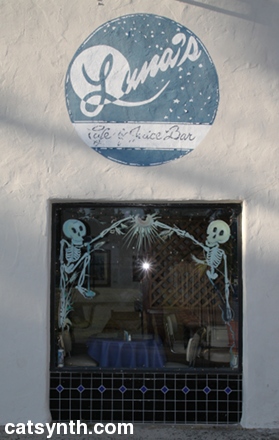
Luna’s Cafe is in downtown Sacramento, within a couple of blocks of the large park that surrounds our State Capitol.

[click to enlarge]

I had stopped in during then In the Flow Festival back in may, so everything was quite familiar.

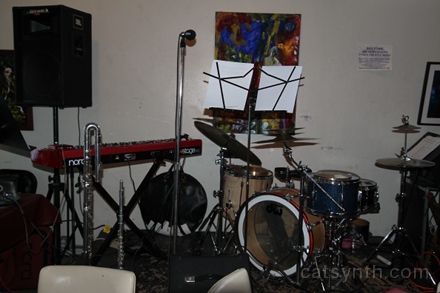
Inside, the stage was…well…a bit cozy.

[click image to enlage]

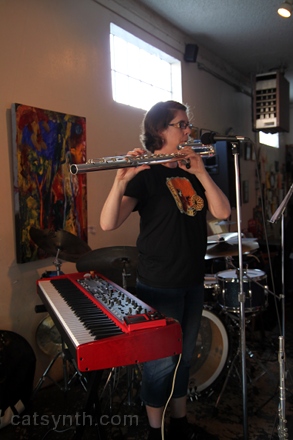
We managed to fit ourselves on in an odd arrangement of angles and overlapping. Polly was in this small triangle of space bounded by the stage front, the keyboard and the drum set.

[click image to enlarge]

The painting behind the stage is David and the Giant Under the Blue Moon, by Bill Carr. All of Carr’s paintings on the wall had a moon theme, which was rather apropos of the venue (although “Luna’s” actually refers to the name of the proprietor of the cafe and not directly to the moon or to any cats we may know).

I felt like we did not play as well as we did at the Outsound Music Summit, but it was still a fun experience, and we got a warm reception from the audience (including the other musicians)

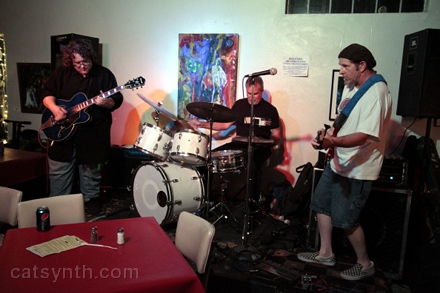
We were followed by the Garage Jazz Architects, with Lob Instagon on bass, Chad E Williams on guitar and Mark Halverson on drums.

[click image to enlarge]

They played a mix of covers and originals. After an original piece called “Butter”, they moved into a series of including an interesting version of the Simpson’s theme with alternate harmonies, and several other classic TV shows. One of the originals was a surf-style piece entitled Surf Orangevale. From what I am told, Orangevale is a completely landlocked area east of of Sacramento. Lob also recited a poem that he composed on August 9, 1995 after hearing of the death of Jerry Garcia – a poem he only reads on August 9 – with musical accompaniment by the rest of the band.

Lob also leads the group Instagon, which has a different lineup every time it performs. After the show he invited me to join in the next Instagon performance, which just happened to be at the regular Outsound Thursday night series at the Luggage Store Gallery in San Francisco. That took place last Thursday, so look for an upcoming report soon.

Thanks to Ross Hammond for inviting us to play, and Art Luna for hosting us at the cafe

More Upcoming Shows: Instagon at the Luggage Store Gallery, and Mini-Woodstockhausen at Camp Happy

No sooner had concluded my recent performance with Reconnaissance Fly at Luna’s Cafe in Sacramento than I find myself with two more shows before next Monday.

Tomorrow, I will be performing with Instagon at the Luggage Store Gallery in San Francisco. Instagon is an interesting group whose membership changes for every performance. In addition to founder and core member Lob Instagon, I will be joined by Mark Wilson (Conure), Lena Strayhorn, Martin from Vernian Process, and Alan Herrick (Nux Vomica). I think this description from the group’s bio sums things up well:

INSTAGON is a term coined to describe the SPONTANEOUS FACTOR, the essence of Chaos Theory… everything that happens in this universe changes instantaneously upon its creation… nothing stays the same… everything changes, and is gone in an instant… hence INSTAGON.

And then on Sunday afternoon (1PM-4PM), it’s off to Boulder Creek in the Santa Cruz mountains for a miniature revival of the Woodstockhausen. Woodstockhausen was the “tiny festival of esoteric music” that took place every year in the Santa Cruz mountains and then at the University of California Santa Cruz until its last year in 2003. We did plan a revival in 2007, which ended up getting rained out. This time we are having a more modest performance as part of the annual Camp Happy Boulder Creek, which will be going all weekend before and after the couple of hours where we take over with our “weird music.”

Mission Arts and Performaning Project (MAPP), August 2010

Yesterday I attended the August Mission Arts and Performaning Project (MAPP), where various arts venues, businesses and private homes open themselves up to present artists in the community. This month was actually a lot smaller than the June MAPP, but there was still more than I could see in my brief visit.

I started, as usual, at the Red Poppy Art House, which serves as the hub for MAPP. Here, Red poppy Resident Artist Hersalia Cantoral from Chiapas, Mexico, was holding court in an informal discussion. Some of her drawings were on display alongside other artists.

We then wandered down Folsom Street to the “Blue House” and saw singer/singwriter Vanessa Valencia perform some of her songs. She was particularly focused on an ear infection she was suffering through, and even improvised a song about it with strong encouragement from the audience.

[Bhi Bhiman at L’s Cafe.]

Later, we found ourselves at L’s Cafe listening to another singer songwriter, Bhi Bhiman. His performance was very polished and fun to listen to. I particularly liked his “White Man’s Burden Blues” (or “Rudyard Kipling Blues”), in which he wove references to various peoples around the world who have had…well, “challenging” experiences with Western colonialism into an up-tempo traditional blues song, much to the delight of the audience.  (I am not sure what the deal was with the red clown noses that several people were wearing.) He was giving away free CDs that I was eager but too slow to get – but someone was generous enough to offer me hers, so she gets a big “CatSynth thank you.” By coincidence, there were two paintings by Melisa Phillips on the wall.

[Melisa Phillips at L’s Cafe.  (Click image to enlarge.)]

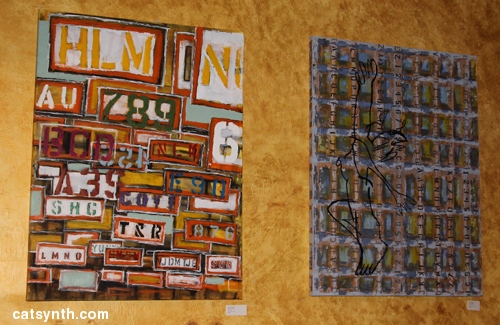
I have reviewed her work from previous Open Studios, and would be remiss if I did not mention her again. Her works incorporates text, and in more recent pictures, body images into a unified space. Also on display was the work of RUBYSPAM, which I also recognized from a previous event.

Enrique Chagoya at Galería de la Raza. (Click image to enlarge.)

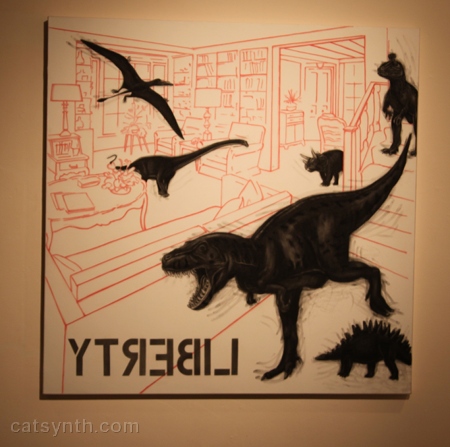
There was overall a good mix between performing art and visual art this time. Our next stop was Galería de la Raza, which was exhibiting YTREBIL, a solo exhibition featuring prints and drawings by Enrique Chagoya. Chagoya has quite an interesting biography, birn in Mexico City in the mid-1950s, studying at the San Francisco Art Institute, and now a professor at Stanford. His works on display included a mix of political, pop culture, cartoon and mythological references, often in surprising combinations. There were numerous caricatures of George W Bush (and at least one of Condoleeza Rice), as well less quickly recognizable references. The iconic image of the exhibit featured the title, here clearly visible as “Liberty” spelled backwards, with dinosaurs running amok in an otherwise comfortable looking living room. I particularly liked some of his longer works that combined mytholigical imagery with cartoon images and narrative structure that one might find in comics. This was featured in his “Illegal Aliens Guide” series, such as the Illegal Alien’s Guide to Critical Theory in which stereotypically attired figures from the US-Mexico border region discuss issues from academic critical theory beneath a large figure with that looks like a Central American mythological figure wearing a white T-Shirt and jeans lying on a platform. There is also the Illegal Alien’s Guide to Relative Surprise Value (maybe I should read that, given my general lack of interest in economics).

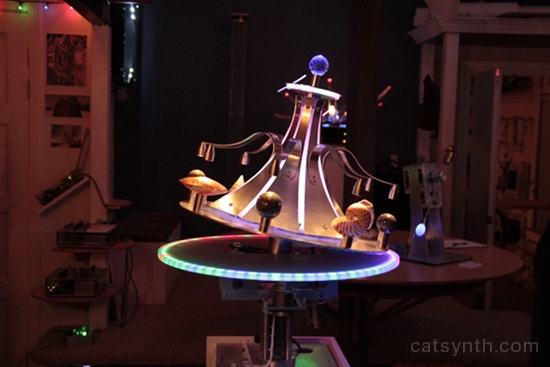
Our final stop was Area 2881 to see the latest incarnation of the robotic sculptures and “lumino-kenetic art” by Carl Pisaturo that I had seen at a previous MAPP in 2009. The robots and rotating mechanical pieces of light and motion were on display once again, and this time I got great photographs.

[Robotic and lumino-kinetic art at Area 2881. (Click images to enlarge.)]

There was at least one new piece, a sci-fi-ish floating contraption that was both fish-like and spacecraft-like. I was not able to get a good image of it. Overall, the objects were all impressive in terms of the technical expertise and discipline that went into their creation – it requires not only an understanding of electronics but mechanical and industrial design – as well as the mesmerizing aesthetic quality that kept us viewing them for quite a while when enjoying Area 2881’s signature cocktail. They also had a series of 3D photographs on view. Like a more advanced version of the 3D viewmasters I remember from the late 1970s, one could peer in and see scenes with depth and detail, such as a party in the Castro, and an organist sitting down to begin her performance, and a church with stained glassed windows and vaulted ceilings moving out into the distance.

Reconnaissance Fly At Luna’s Cafe, Sacramento. Monday, August 9

Our next Reconnaissance Fly show will this Monday at Luna’s Cafe in Sacramento, CA.

We will be sharing the bill with the Garage Jazz Architects. The show is part of the weekly Nebraska Monday’s jazz series hosted by Ross Hammond. Our spong cycle Flower Futures should be an interesting contrast.

Sacramento may be a bit of a distance for a Monday night show, but there is no way I could turn up playing at a place called “Luna’s Cafe”!

Outsound Music Summit: MultiVox

Today we at CatSynth conclude our series from the recent Outsound Music Summit with my own report from the MultiVox program that featured Reconnaissance Fly, the Cornelius Cardew Choir, and Amy X Neuburg. We did feature a guest review by Joe McMahon last week, which covers the same show from an outside perspective. My own perspective is anything but outside, given that I was in two of the three groups performing at night.

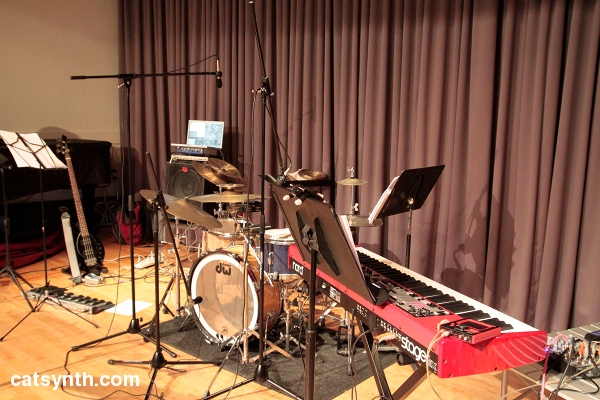
This was a professional show, with formal load-ins, sound checks, and staging. Reconnaissance Fly features a full rhythm section, so we had a lot of equipment to set up:

[click image to enlarge]

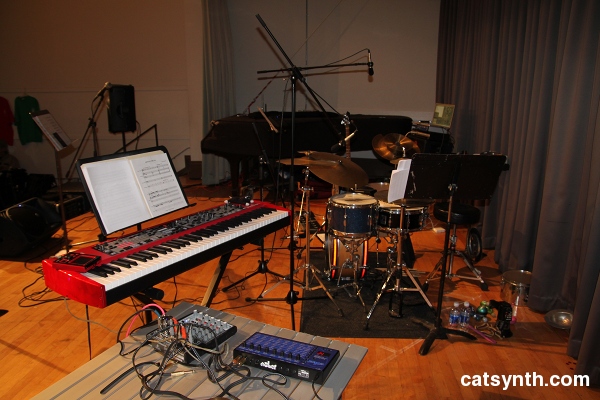
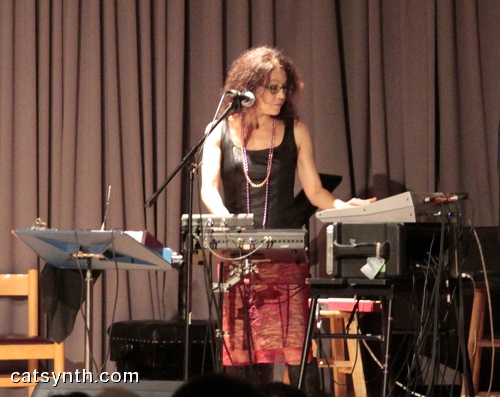
On the left is Tim Walters’ bass and Macbook running SuperCollider. In the middle is Moe! Staiano’s drum set, and on the right is my own keyboard+electronics setup featuring the Nord Stage, the trusty Korg Kaoss Pad, and the little stuffed cat for good luck. Here is another perspective with more detail:

[click image to enlarge]

The Evolver was actually for the Cardew Choir, but I set up everything at once. One can also see Moe!’s toys and other support percussion instruments.

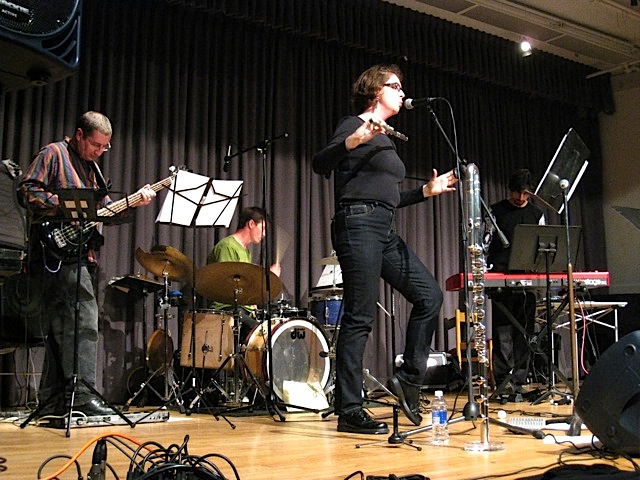
Onto the show itself. Here is the full band on stage, with myself, Polly Moller (flute/vocals), Tim Walters (bass), Moe! Staiano as our special guest “concussionist”.

[Photo by Michael Zelner.  Click image to enlarge.]

We performed a full nine-piece set from Flower Futures, our “spong cycle” featuring music set to spam poetry. The set now has an eclectic mix of styles, from experimental avant-garde to prog rock, along with latin and jazz influences. We as always with Small Chinese Gong and ended with An Empty Rectangle – we always like playing that last one, but it’s even better with Moe!’s drums! I particularly enjoyed playing the medley of Electric Rock Like a Cat and Sanse is Credenza – the end of the first piece, with free-improvisation on flute set against B-diminished chords, elides into an early 1970s jazz fusion jam on the same chord (think “Chameleon” from Herbie Hancock’s Head Hunters album). This is a relatively high-energy and somewhat challenging piece, and while it was fun to play, it also felt good to then return to the relative calmness of Oh Goldfinch Cage, which featured samples of “human calls” for training birds to speak, with phrases like “Hello, how are you?” and “pretty bird”, processed with ring modulation and turntable effects.

[Photo by Bill Wolter.  Click image to enlarge.]

Overall, it was a great performance with a lot of energy. It’s easy to lose sight of that in the midst of playing, where one focuses on mistakes and challenges – personally, I forgot to check that patches for the Nord were all queued up at the start of the performance, and the heat from the lighting and large crowd added unexpected challenges. But it was received well by the audience (a full house), and it seemed like they were asking us for an encore!

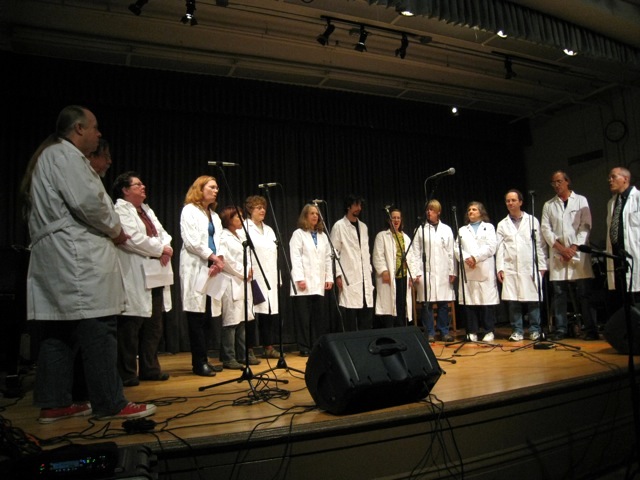
The Cornelius Cardew Choir was a stark contrast to Reconnaissance Fly in terms of form and energy. Our first piece, Joe Zitt’s “That Alphabet Thing” was a cappella with a freeform structure. Basically, it unfolds by each singer intoning the sounds of the letters of the alphabet, starting with A and gradually working his or her way to Z. Everyone moves at a separate pace but mindful of others not to get too far ahead or behind, and there were a lot of fun moments of interplay among different choir members, such as back-and-forth with “Hi!” for H-I or “why?” for Y.

[Photo by Michael Zelner.  Click image to enlarge.]

We wear white lab coats.

This was followed by “El Morro” by choir director and co-founder Tom Bickley. The piece was inspired by a trip to the El Morro monument in New Mexico and featured the text from inscriptions on a rock spanning carved messages from two centuries of Spanish, Mexican and American passers by, soldiers as well as other travelers. Each of us had a set of inscriptions to recite on a single pitch per inscription, set against an electronic background of rocks, birds of prey and highly processed vocal incantations. This was a rather complex piece conceptually, though not difficult to perform. Because we were so involved in the performance and the conceptual nature, it is hard to know how it was received in the audience.

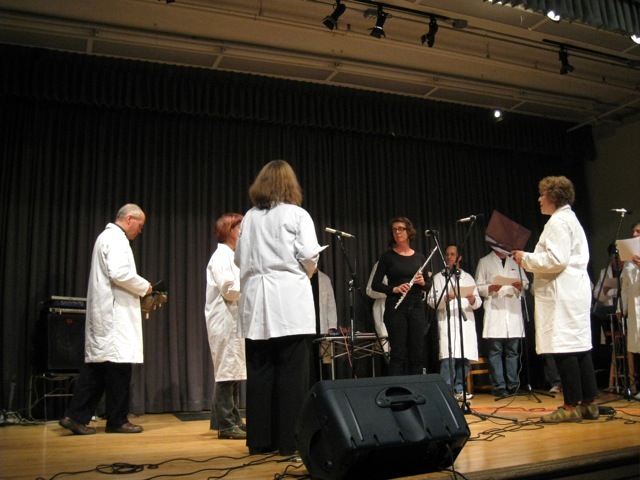
The set concluded with a performance of Polly Moller’s Genesis. We had seen a previous performance of Genesis at the Quickening Moon Concert. The previous performance was entirely instrumental. This time, the parts of the spatial and higher dimensions were voice. I performed part of “universal time”, using the sequencer on the Evolver as the time-keeper and performed various modulations of the tempo and timbre. Polly played the role of the “new universe” with a flute solo featuring multiphonics and other techniques. Tom Bickley conducted the piece by walking around the stage and carrying chimes.

[Photo by Michael Zelner.  Click image to enlarge.]

This was a very meditative performance, with the chimes, the flute multiphonics, the ever changing electronic rhythm and timbre, and the vocalists singing their respective dimension numbers in different languages.

The final set of the evening featured Amy X Neuburg. As always, her “avant cabaret” set was very polished and spoke well to both her technical expertise with her instruments and her versatility as a performer. She employs several styles of singing, often in a single piece, moving from classical to cabaret/jazz to experimental vocalizations. Her synchronization with looping electronics is very tight, seemlessly adding and subtracting samples and recordings within the rhythms and phrasings of the song.

[click image to enlarge]

There were pieces familiar from past performances, such as “Life Stepped In” where she deftly mixes looping technology and theatrical vocals. She also did a few improvisational pieces, the first of which featured the Blippo Box. This is an instrument with chaotic oscillators that never quite sounds the same twice, but she always manages to control it quite well – in this performance she made it sound like a voice, to which she responded with her own voice. She also performed an improvisation with a Skatch Box which she made at the “build your own Skatch Box” presentation earlier in the week (and which I unfortunately missed). It’s hard to make a skatch box sound like a voice, but she could make her voice sound like the growls and scrapes that it produced.

[Photo by Michael Zelner.  Click image to enlarge.]

She ended her set with a tribute to Kim Flint, who was very active in the looping and electronic-music communities, and the founder of Loopers Delight, and who passed away after a tragic accident in Berkeley in June. He was someone I knew as well from both music and social events. Amy’s tribute was a performance of the first piece she ever created using the Echoplex, which he co-invented.

Outsound Music Summit: SoundScapes

We resume our reports from the 2010 Outsound Music Summit after a brief break. In this article I review the last night of the festival, titled “SoundScapes” and featured musicians whose music focuses on noise and sound textures. While this is often from electronic sound sources such as effects pedals or DIY synthesizers, many were from acoustic sources such as metal objects or conventional instruments like piano.

The evening was framed by the theatrical announcements of the artists by guest emcee Cy Thoth, a regular DJ on KFJC 89.7 FM.

[click image to enlarge]
The concert began with Phog Masheeen, a trio featuring Mark Soden, Jr, Dr. Francene Laplan and William Almas. They presented a single large-scale work for electronic and acoustic sound plus video called “Anthroscopic Tourism.” I was not quite sure how the medical term “anthroscopic” related to the sounds and images in the piece, which focused on the interplay of Kaplan’s pots and pans set against electronic sounds and loops and Soden’s electronically enhanced performance on trumpet and a large pipe from a Yamaha motorcycle. Soden had demonstrated some of the techniques he was using with the trumpet during the Touch the Gear event. But he added to the the performance techniques Soden used with his instruments rubbing dry ice against them. As most readers know, dry ice is extremely cold (and difficult to handle); and this it can have a strong effect on the shape and behavior of metal tubes. At one point, he smashed a block of dry ice before picking up pieces to use. He also had a blowtorch. The music often involved loops (sample based or otherwise) against which Kaplan played rhythms and timbres on the pots and pans – this was offset by the more freeform sections with Soden’s trumpet and pipe. Almas’ visuals included a variety of urban and industrial scenes, text, and footage of old musicians, which were mixed with live video of Soden’s performance.

[click images to enlarge]

Next up was Headboggle (aka Derek Gedalecia). The tone was set from the beginning both in terms of sound and slapstick comedy by his stepping on bubble wrap that happened to be placed behind the table with his electronics, and then slipping on the way to the grand piano. Actually, the comedic timing of his various slips, slides, tripping over his own feet and double-takes was expertly done, as in an old silent film or Vaudeville act. There was a bit of a scare for several of us in the audience when it appeared he had broken the bench of the piano, but I was assured this was all part of the act, this particular bench was found broken, and that no pianos were actually harmed in the making of this performance. Musically, he combined chaotic oscillators from Ciat Lombarde synthesizer – a reminder to finally put together my Ciat Lombarde kit – with classical and ragtime piano phrases, loops and deep bass sounds from a Micromoog. The piano and electronics are of course quite contrasting, but every so often the sounds and phrases (and physical humor) converged quite well.

[click images to enlarge]

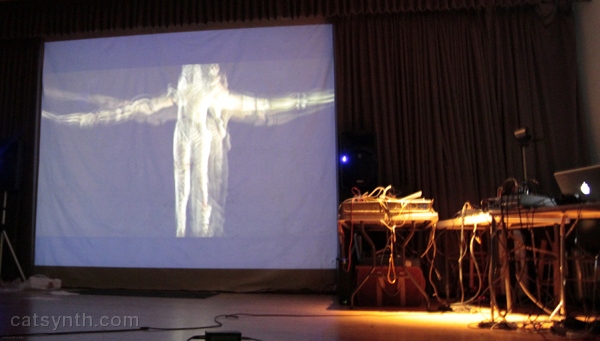
Headboggle was followed by Kadet Kuhne, who presented video and live-music piece Fight or Flight, described by our emcee Cy Thoth as “space madness.” In fact, it was a very polished live electronic performance, very dark and ambient (although interestingly Kadet Kuhne talked in the pre-concert Q&A session about her desire to perform “lighter” ambient music). It began with low frequency sounds and a rumbling buzz, and included doors opening and closing and various sounds of machinery, with electric hums, blips and glitches. It was quite captivating and easy to get lost in. At one point, arpeggios and then beats emerged from the combination of noise percussion and more harmonic sounds, which got progressively louder as the piece built up to a climax and then faded to nothingness. The music was set against a video that focused entirely on a cloth-encased figure suspended in mid-air. It wasn’t clear at first whether this was a cloth figure or an actual person, though as the video progressed it became clear that it was the latter. The frequent shot and angle changes gave the video a glitchy quality which matched many of the electronic sounds in the music.

[click image to enlarge]

The final set featured Chen Santa Maria, the duo of Steve Santa Maria and George Chen. Both members of the group played electric guitar and a variety of electronic effects. The set began with a guitar drone set against high squeaking humming sounds. These sounds were soon joined by full guitar chords with heavy distortion and undulating raspy sounds from synthesizers or effects units. There were bursts of noise distortion and high shrieking. This was definitely a loud set. But there were still details to listen to (with appropriate ear protection). The harmonic patterns of the distorted guitars created rhythms, which was set against a more formal triplet rhythm from the electronic sound sources. This rhythmic pattern essentially continued for the remainder of the set, with periods of driving guitar, bursts of noise and more high shrieking tones which then decayed into a low rumbling noise. As the set drew to a close, the sounds became more “digital” with lots of blips and choppy sounds, but then this was replaced by a loud square wave. The square wave started out at a moderate pitch, but got lower and lower until it became a series of audibly distinct pulses, and then came to an abrupt stop.

Although this was the last performance of the festival, I will be presenting one more article, where I return to the MultiVox night which included my own performance with Reconnaissance Fly and the Cornelius Cardew Choir…

Guest post: Friday at Outsound: Reconnaissance Fly, Cornelius Cardew Choir, Amy X Neuburg

[While I work on the reviews for the Friday and Saturday shows at the Outsound Music Summit, we have a guest review from Joe McMahon, ambient music/soundscapes – pemungkah.com. Given that I was a performer in two groups on Friday, his review provides an interesting outside perspective.]

Friday at Outsound: Reconnaissance Fly, Cornelius Cardew Choir, Amy X Neuburg

An interesting evening of word (and other vocalization) related music. Reconnaissance Fly led off with their songs based on “spam poetry” – the sometimes strangely numinous texts randomly generated to try to evade spam filters. RF can, and does, play in a massive variety of styles, from samba and tango through pop, prog rock, and jazz, all the way to full-on avante-garde improv. These wildly disparate styles and surreal text are combined in pop song structures into catchily mind-bending conceptual smoothies. It appeared that the audience was ready for an encore, but time was short. The piece which included what seemed to be samples from a “teach your bird to talk” record and Polly Moller’s exceptional flute multiphonics and extended techniques was particularly fascinating, and Moe!’s drumming lent serious propulsion and quirky humor as well.

The Cornelius Cardew Choir did three pieces: the first was based on the alphabet and reminded me a bit of “In C”, as the choir started at “A”, both reciting the letters and making their sounds, the individual members determining the speed at which they moved through the alphabet. Charming and fun. The second piece was based on rock inscriptions; very dense and almost surflike; I had a little trouble spotting a structure in this one, but that’s probably more the result of a long day on my part. The last piece added electronics and flute; a very evocative, ritualistic piece – fascinating textures and quite wonderful.

Last on the bill was Amy X Neuburg, who wowed the crowd as always, performing, among others, several pieces from her _Residue_ album; her performances of these have evolved interestingly. In addition, she improvised a new piece on the spot using her Blippo Box and her just-built Scatchbox, and a tribute to Kim Flint the late founder of the Looper’s Delight mailing list.

A very enjoyable evening; looking forward to hearing more from all the performers.

Preparing for tonight’s performance

This week has all been about the Outsound Summit, either attending programs or rehearsals, including two rehearsals for Reconnaissance Fly and one for the Cornelius Cardew Choir.

For Reconnaissance Fly, We now have our full Flower Futures set:

1. Small Chinese Gong
2. One Should Never
3. Neat As Wax
4. Emir Scamp Budge
5. Seemed to be Divided in Twain
6. Electric Rock Like a Cat
7. Sanse is Credenza
8. Oh! Goldfinch cage
9. An Empty Rectangle

There is actually a tenth movement, but we had to leave it out of this performance for timing reasons. One of the pieces, “Electric Rock Like a Cat”, was first premiered on KFJC last weekend. And three others are brand new that we only read and rehearsed in the past week. This included a final rehearsal last night. Sadly, it means I was not able to attend last night’s performance, but the extra rehearsal time paid off and I think we are going to play a great set tonight!

Technologically, things are relatively simple compared to the solo shows like the Quickening Moon Concert. I will primarily be using a Nord Stage keyboard for classic Fender Rhodes and organ models and acoustic piano, with support from the Korg Kaoss pad on several pieces and a loop/sample playback application on the iPhone. Tim Walters will be using SuperCollider for signal processing alongside bass guitar. Moe! Staiano will probably have toy instruments along with his drum set. We don’t have any live processing of Polly Moller’s flute or vocals in this particular set. I like the way our music has evolved to require less feats of technology and more musicianship.

For the Cardew Choir, I will be performing the role of “Universal Time” in Polly Moller’s Genesis using a combination of “space like” and “drum like” patches on the DSI Evolver. Other than that, the set is all vocals.

For those in the Bay Area who would like to attend, the show is 8PM at the Community Music Center, 544 Capp Street in San Francisco. You can get full schedule and ticking info here.

Outsound Music Summit: Blurred Lines

Last night was the first full concert of the Outsound Music Summit. “Blurred Lines” focused on the combination of music and visual media, i.e. film and video.  The pieces were more of a collaboration between film and music rather than one serving the other per se, although in each case the music making and film/video making were done independently .

The first half of the concert featured films by Martha Colburn with live piano improvisation by “local Bay Area pianist impresario” Thollem McDonas. Colburn’s films employ stop animation with original artwork and found images, as well as found footage. The overall look reminded me of Terry Gilliam’s animations (e.g., from Monty Python), though the material was generally much darker. Several of the films dealt with death and violence, particularly in U.S. history and current events. Destiny Manifesto in particular juxtaposed images of western settlers in conflict with Native Americans alongside contemporary looking soldiers and scenes that could have been from the Middle East or Central Asia. Images of people being killed and dismembered abound in these films. Other films, such as Meet Me in Witchita with its images inspired by the Wizard of Oz, but here again things turned dark with Osama Bin Laden’s head superimposed on the Wicked Witch and then being killed and collapsing in a mess of bloody body parts. There were lighter images in some of the films, such as figures that seemed influenced by South Asian shadow puppets and even abstract graphic squares reminiscent of a disco dance floor.

[click image to enlarge]

McDonas’ piano veered between more classical or film-score inspired music and more percussive prepared piano. The music did not follow each film structurally per se (i.e., in the manner of a film score), but did evolve over time and present a particular character in each film. Initially, it started off lighter with fast runs and anxious chords, later on being more percussive and employing prepared piano or plucked strings. As the set progressed, the piano music became dense and darker, with large clusters of fast patterns and arpeggios in lower registers, every so often punctuated by more percussive and plucked elements. Overall the music had an aggressive feel which both showed of McDonas’ piano skills and fit with the violent nature of the films.

The second half of the program featured the 2009 60×60 international compilation. This is a set of 60 one-minute compositions that were selected and ordered into a continuous hour-long performance. For this program, each piece was set to a one-minute video) by Patrick Liddel. I had actually heard the 2009 60×60 compilation before (without the videos) at the Long Night’s Moon Concert last December, and recognized several of the pieces from that performance. Many of the videos were abstract graphics, such as the pixelated images that accompanied the opening pieces by Halsey Burgund and Matthew Dotson, or the abstract kaleidoscopic images set to Polly Moller’s “Abdominal Cyclist Ultra”. Others had more representational images. #16 by Jane Wang featured toy piano and was set to footage of a toy piano being played.

[click image to enlarge]

Some were less directly representational and more evocative of the music, such as the scenes from 1950s television commercials set to Gregory Yasinitsky’s jazz piece. Although it was far more abstract, I would put the constantly moving gray rectangles against Patrica Walsh’s electronica dance music in the same category.

Among my favorite of the combined video+music pieces were Brian Lindgren’s music set to a slowly moving film of a woman in a black dress in front of a brick wall; and Enrico Francioni’s sounds featuring strong resonance and feedback that were set to a beautiful film of forward motion in a dark industrial hallway. Also of note were Jay Batzner’s music (which reminded me of Xenakis) set to geometric views of industrial girders, perhaps power lines; and the intricate grid (along with spiders) set to Anton Killin’s metallic sounds.

Overall, with 60 sets of constantly changing visuals and music, and my attempt to take at least few notes on each, the experience became one of sensory overload. Looking back on the notes, it is interesting in looking at my previous review of the 2009 60×60 mix how different pieces stood out more in the mix without the visuals while others seemed more prominent in the music+visuals mix.