Category: Music

  • Matthew Sperry Festival: Tag Team Trio Shift

    Last Thursday I attended and performed in the Tag Team Trio Shift at the Luggage Store Gallery. This event was part of the Eighth Annual Matthew Sperry Memorial Festival, a festival held every year in honor of local composer and bassist Matthew Sperry since his tragic death in 2003.
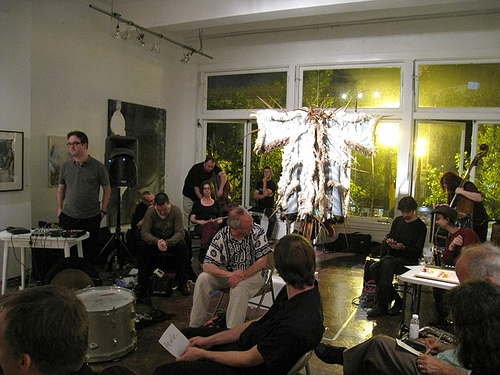
    The event featured a large cast of characters from the Bay Area new music scene, improvising three at a time, with John Shiurba acting as referee.
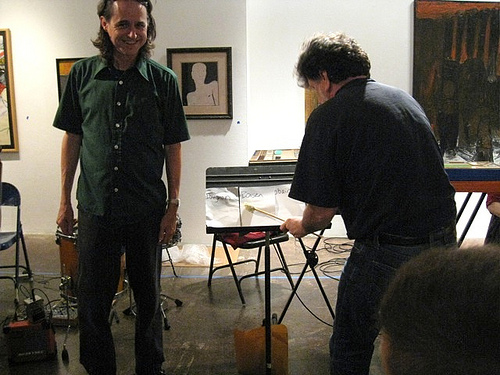

    [John Shiurba as referee, with Gino Robair entering a trio.]

    Each of us was given a name card. At any given moment, three musicians would be performing. Anyone could hand in their card at any time and replace one of the three current musicians. Thus, there was an ever changing set of trios. For the most part, musicians entered and exited individually, but in the second half of the program we could submit three cards at once as a planned trio. The music ranged from trios of synthesizers and electronic noise, to purely vocal trios, to free-jazz improvisation (saxophones and bass), and all combinations in between.
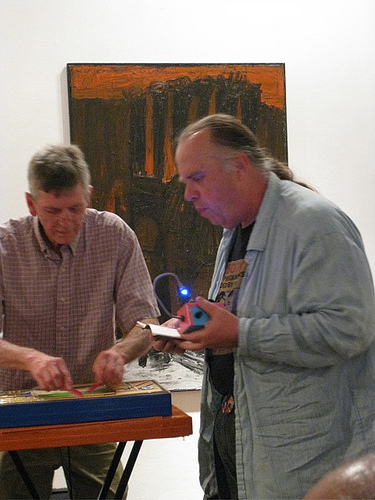

    [Tom Nunn on skatch box and Tom Duff with Bleep Labs Thingamagoop.]
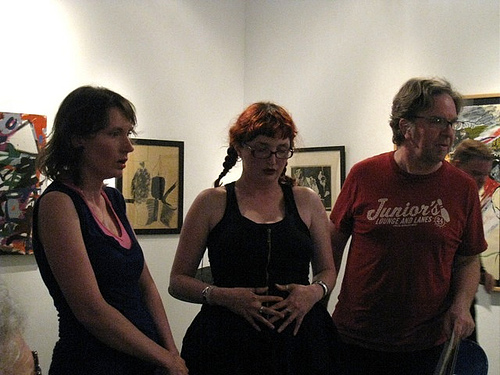

    [Vocal trio of Agnes Szelag, Aurora Josephson, and Myles Boisen.]

    There were many strategies one could use for deciding when to hand in his or her card and replace someone. For me, I timed my card to coincide with others with whom I wanted to play, or moments where I thought my sounds would work well with the texture.
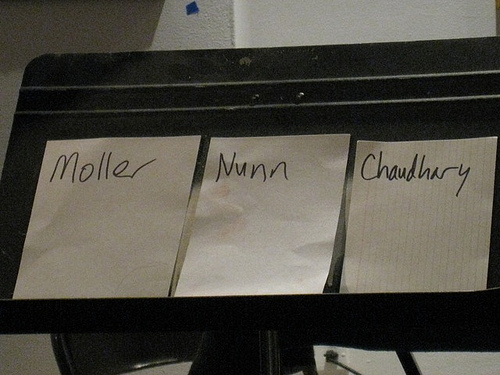
    One could also be competitive and “cut” someone else’s improvisation (as one might do in a traditional jazz-improvisation setting). I can’t say that anyone did that, but there were certainly some playful back-and-forths with people replacing each other.

    I brought the trusty Kaos Pad as well as my iPhone, with the BeBot app and a looping/playing app that I used for the Pmocatat ensemble. The latter (which featured variable-speed sounds of Luna and my Indian instruments) got some attention from the other musicians. Scott Looney, who was sitting next to me, and an interesting new instrument that used Reactable icons on a surface with a keyboard, to create a sort of “electronic prepared piano”:


    [Scott Looney’s new control surface (photo by catsynth).]

    There were some fun moments. One of Philip Greenlief’s improvisations involved his attempting to balance his saxophone in the palm of his hand, constantly moving and shifting in order to keep it from falling. He was clearly hoping for someone to replace him quickly, but we actually let him keep going for quite a while.
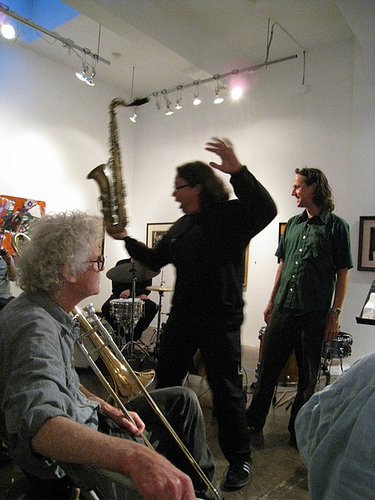

    [Philip Greenlief’s balancing act.]

    The sounds from busy Market Street outside contributed to the music at various times – indeed, the street should have gotten its own card.

    Among the attendees were Matthew Sperry’s wife and daughter, who appropriately closed out the second set with the sound of shaking keys fading out.

    The full roster of participating musicians included: Myles Boisen, Amar Chaudhary, Matt Davignon, Tom Duff, Tom Djll, Phil Gelb, Lance Grabmiller, Philip Greenlief, Ron Heglin, Jacob Felix Heule, Ma++ Ingalls, Travis Johns, Aurora Josephson, Scott Looney, Bob Marsh, Lisa Mezzacappa, David Michalak, Polly Moller, Kjell Nordeson, Tom Nunn, Dan Plonsey, Garth Powell, Jon Raskin, Gino Robair, Tom Scandura, Damon Smith, Moe! Staiano, Agnes Szelag.

    [Unless otherwise indicated, all photographs in this article are from Michael Zelner. You can see a full set of photos from the performance at his flickr page.]
  • Quickening Moon Concert

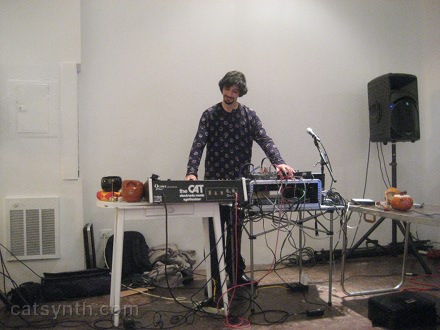
    Sometimes things linger undone for a quite a while. And that is the case with reviewing the Quickening Moon Concert, which I am finally getting around to doing as the next Full Moon concert is about to happen. Basically, the process goes like this. I wait a few weeks to look at the video of my own performance with a fresh perspective. I review the videos. Then post them online. Then a few more weeks pass as life intervenes. So here were are, finally getting to it many “moons” later. Memories of course fade over time, but even going by my own recollections, there is much to recall fondly. Bottom line is that it was a really good performance, in fact I would consider it one of my best solo electronic sets to date. This was in no small part to the advance preparation, but also to the audience, which filled to the Luggage Store Gallery to standing-room only capacity!

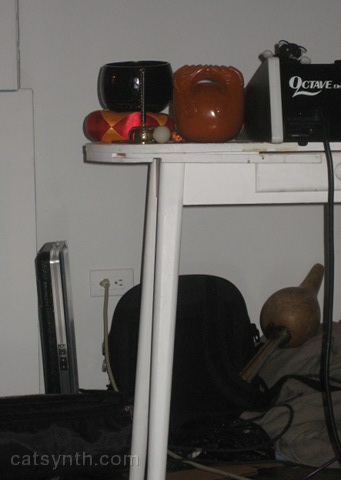
    This was also one of the larger setups, featuring the Octave CAT vintage analog synthesizer, E-MU Proteus 2000, DSI Evolver, Korg Kaoss Pad, a Mac laptop running Open Sound World and Max/MSP, and the Monome controller, along with an array of my folk instruments from China and India. Even the iPhone made an appearance as an instrument.


    [Click images to enlarge.]

    Of course, the highlight of the set was the premier of 月伸1, featuring improvised electronic music set against a video of Luna. Musically, I focused on the Octave CAT (seemed appropriate) with the other electronic instruments in a supporting role. You can see a full video of the performance of this piece below:

    The music was improvised live, with some prepared guidelines. In this way, it was reminiscent of the live music performances from old silent films. I kept the music relatively sparse and maintained the focus on the visual elements, which moved back and forth between clips of Luna and abstract visual elements (you can read more about the video production here). The audience clearly responded to the video of Luna and the music, and their laughter at very points reminded just how funny a piece this was. It was easy to lose sight of that in the hours of very detailed and very technical preparation, and one of the delights of playing in front of a live audience. I also heard from people that could tell they were able to sense the affection for Luna that came through in the video, though the long shots and the breaks in the otherwise silent video where her voice came through.

    The balance of the set leading up to 月伸1 featured various combinations of electronic and acoustic instruments. The monome was my main controller in several of the other pieces, including the opener that focused and live sample loops and patterns from the folk instruments.

    I played the instruments live, and then replayed the samples in various patterns on the monome to create complex timbral and rhythmic patterns. I also used the monome in a later piece to control some very simple but musically interesting sound synthesis, as can be seen in this video.

    The lights on the monome are visually compelling, but also provide a link for the audience between the actions (which are really just button pressing) and the music.

    Several of the pieces including strong rhythmic elements, which helped propel the set forward – I even saw at least one person “grooving out” to one piece.

    I replayed several of the pieces (but not the video) in another performance a few days later at the Meridian Gallery. I certainly hope I will have an opportunity to the video again as well.


    My performance was followed by the premier of Polly Moller’s Genesis. Genesis is “a musical experiment in which the M-theory of the 11-dimensional universe combines with the inward and outward spiral of the Western magical tradition.” The 11 member ensemble represent the 11 dimensions (which include Universal Time, the three spatial dimensions, and seven others) who combine to bring the “New Universe” into being, as portrayed by Matt Davignon on drum machines.


    [Photo by Tom Djll.]

    Polly Moller conducted the piece, not from the traditional podium in front of the ensemble, but rather by walking in an inward and outward spiral among the performers. As she walks by, wind chimes in hand, different performers enter or exit. As the New Universe comes into being, Matt Davignon’s electronic performance emerges, culminating in an extended solo as the 11 performers representing the “parent dimensions” fade out.

    Quite fortuitously, someone turned my video camera to face the ensemble, so I was able to capture some video of the performance. In the clips below, one can see the conducting by walking in a spiral, as well as parts of the New Universe solo.

  • Report from the In The Flow Festival

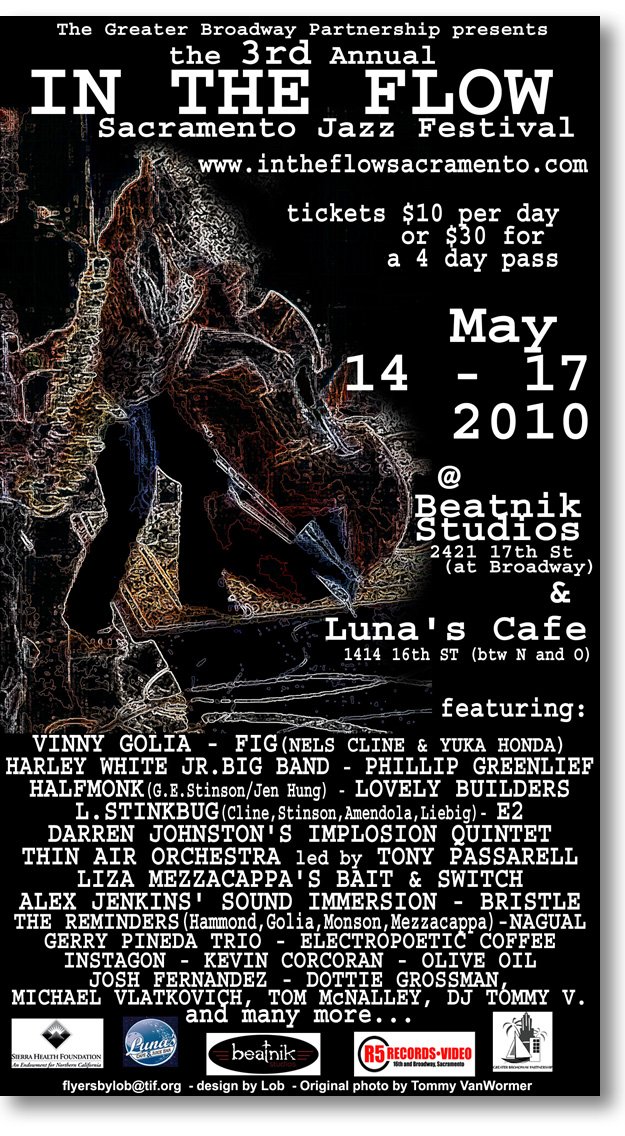
    As I prepare for my next performance with Reconnaissance Fly tonight (details here), it seems like a good time to look back at last week’s In The Flow Festival in Sacramento.

    My roadie friend and I arrived in Sacramento around 12:30 to the rather calm and rather pleasant jazz-guitar sounds of the Nahum Zdybel Trio. As we wandered off for a quick bite to eat, I was thinking how much of a contrast our own set would be. When I returned to set up, the ensemble on the other stage lead by Henry Robinette was harder and more driving – with much stronger drum, bass and rhythm guitar – but still straight ahead jazz.

    [Reconnaissance Fly: (Tim Walters, Polly Moller, Amar Chaudhary).  Photo by Jen Hung.  Click to enlarge.]

    So then it was time for us to perform. Our set begins with my graphical improvisation piece Small Chinese Gong, a complete 180 degree turn from the previous sets, though it does feature a short section of tongue-in-cheek early 1970s lounge jazz amongst the free improvisation and noise. We also did both of our rock-inspired pieces One Should Never and An Empty Rectangle (written by Tim Walters); a more refined version of The Animal Trade in Canada with both a bluesy “Ca-na-da” rock-out and an Afro-beat jam; and an abridged performance of our epic Ode to Steengo. All the pieces feature spoetry, i.e., spam messages that rise to the aesthetic level of poetry.

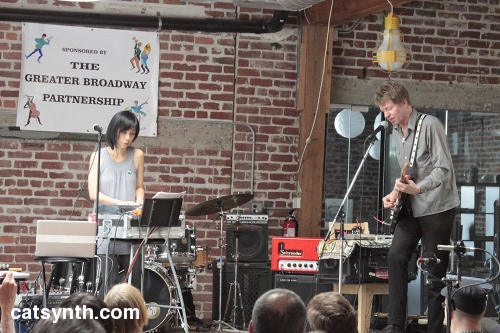
    Our set was followed by Fig, the duo of Nels Cline and Yuka Honda. Their set started relatively calmly and quietly, but by the time I finished packing and had a chance to wander over to the other stage, things began to get a bit louder.

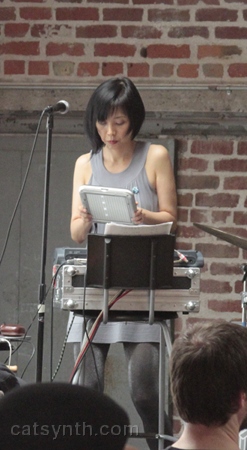
    [Fig (Nels Cline and Yuka Honda). Click images to enlarge.]

    Nels Cline alternately set driving heavily processed guitar rhythms and long virtuosic lines against Honda’s beats, which featured highly synthetic percussion sounds. Often, she was playing a Tenori-on, as featured in the second photo. Overall, the set moved back and forth between beat-based sections and “skronking” (i.e., arhythmic and often noisy performance with fast runs of ntoes), ending with an extended guitar-and-drum-machine jam with a more techno feel.

    The next set (back in previous room) was Ambi, a duo of Stuart Liebig and Andrew Pask. As the name suggested, the music had an “ambient” quality to it in that the sounds created an environment for the listeners more than individual lines and riffs to focus on. The set opened with lots of one-off percussion samples with pauses of varying length, some notes being very isolated and others coming in small clusters. On top of the percussion hits were layered long “space-like” sounds, liquidy bass notes and saxophone. Gradually, beats emerged from the ambient mix, but the patterns were regularly broken by other off-tempo sounds. I did notice they were using a Monome, a complement to Honda’s Tenori-on from the previous set. After a while, the beats become stronger and more stable, but were again interrupted by the sound of a thunderstorm that gave way to analog-sounded filtered arpeggios. Towards the end, the set, which unfolded as one long piece, evolved into a jam between bass (Leibig) and saxophone (Pask).  It concluded with a driving funky bass riff, which stopped suddenly in mid-motion, an ending I found quite effective.

    After this set, we took a break from the festival to explore a bit of Sacramento, including the immediate neighborhood and some of the downtown. This excursion inspired last weekend’s Fun With Highways: Sacramento Edition article.

    We arrived back at Beatnik Studios in time to L Stinkbug, featuring GE Stinson, Nels Cline (again), Scott Amendola and Steuart Liebig (again). There was certainly a lot of “double-dipping” in the lineup of the festival, but that seems appropriate for an event focused on improvisation, and the performances among the different combinations of musicians can be quite different. L Stinkbug was, if nothing else, loud. Certainly, these are all very technically adept musicians, and the combination of driving beats and skronking should be relatively loud, but perhaps a little less so in this particular space. We moved back and forth between the main stage and the adjacent room to avoid the full affects of the volume.

    If there was one overall regret from my abbreviated experience at the festival, it is that it was an abbreviated experience. I missed a few sets that I would have liked to see, including Vinny Golia, whom I had heard at last year’s Outsound Music Summit, and the Thin Air Orchestra, featuring many familiar wind players.

  • Wind Moon Concert

    At the end of April, I attended the Wind Moon Concert, the latest installment of the Full Moon Concert series at the Luggage Store Gallery. As the name implies, the theme of the evening was “the wind, and its moonlit travels through tubes”. Both sets featured wind instruments, but also wind-like sounds on other instruments, and an attempt to bring the disciplines of wind performance to all the instruments, as described in program notes for the second set by Sabbaticus Rex:

    The instruments themselves are treated with reverence and are given as much if not more command over the path that the music takes. Inasmuch as metal particles or stalks of bamboo want to become instruments, at the point at which we discover them, the gongs and shakuhachi themselves are approached in a highly collaborative manner, i.e. letting sounds emerge from them, guiding rather than forcing, generally unifying with the instrument as much as possible.

    Tom Nunn and his musical inventions. Click to enlarge.

    The first set featured Ghost in the House performing the Wind Moon Suite, an “elemental arrangement” of pieces. It began with a procession led by Karen Stackpole on a hand drum, followed by Tom Nunn with a conical metal instrument called a waterphone, Kyle Bruckman and David Michalak with wind instruments. Upon reaching, the performers added their other instruments, Stackpole on gongs, Michalak on lap steel and Nunn on his various musical inventions. Nunn’s skatch box opened with long “angry wind” sounds howling and moaning, with more ethereal sounds from the others filling the spaces in between. Sounds gradually entered the mix with slowly moving pitch bends that sounded more “electronic” to me (perhaps even like samples with pitch bends). The metallic and wind sounds began to coalesce around a harmonic structure with minor chords. Within the structure, the lap-steel guitar emerged with its own minor chords and softly moving pitch bends. This was followed by a piece featuring an expressive solo by Bruckman (oboe and english horn) set against long tones on the gongs and the skatch box. Eventually, the melodic line of the reeds gave way to more long tones.

    The next piece, which had the memorable title “I killed someone in my dream last night”, began with a strong “growly” note. The sounds of the reeds were set against bowed gongs, and it seemed that both instruments began to sound quite similar despite their obvious physical and acoustical differences. In this section, Nunn played an interesting instrument called the Crustacean, featuring wires on a metal plate set atop orange balloons, another allusion to the combination of metal and air. This was followed by multiphonics on the oboe or english horn set against the skatch box and distorted guitar tones, which eventually gave way to long tones on the gong and high pitched notes from the reeds. Scratching guitar tones added roughness. The piece then built to a strong climax before fading into metallic sounds.

    For the final pieces, the group was join by Cornelius Boots on bass clarinet. His featured role in the piece described as the “Alfred Hitchcock” piece included long notes set against long low drones from the ensemble. This gave way to higher, shorter notes, loud harmonics and resonances. The final piece began with a melody on the bass clarinet. The sounds that entered from the skatch box at first reminded me of waves and then of gently moving sand, both of which are shaped by their interaction with the wind. Low drum sounds and a spinning “whirly” reinforce to the return to the elemental theme of wind. The music became more animated as more sounds are added to the mix, metal rods and wires, shakers and whistles. At one point, Cornelius Boots blew into the mouthpiece of the bass clarinet without the body, and then alternately into the body of the instrument without the mouthpiece. These sounds were set against the waterphone played by Nunn. As the piece drew to a close, the performers returned to their original instruments and departed the stage in a procession just as they had entered.


    Mark Deutsch on bazantar. Click to enlarge.

    The second set featured Sabbaticus Rex, a trio of Cornelius Boots on shakuhachi, taimu-shakuhachi, and throat-singing, Karen Stackpole on overtone gongs, and Mark Deutsch on bazantar, an upright bass with sympathetic strings, much as one might find on Indian stringed instruments. It began with a solo on the bazantar by Deutsch, with lots of bent notes and excitations of the sympathetic strings. Soon he moved to bowed bass, which was set against bowed gongs. Once again, neither instrument was a wind instrument per se, but the long bowed tones gave the impression of the wind that set the stage for Boots’ entry on the shakuhachi. The three performers combined together in long drones. The bass moved gradually between standard pitched tones and harmonics, while the shakuhachi played against the longer droning sounds. The overall feel of the music was quite contemplative. This was followed by a louder, more percussive section where the strings of the bass were scraped and struck with mallets, and rubber mallets were rubbed against the gongs. The effect of the rubber on the gong was very resonant and loud intense rises and a wealth of harmonies. At moments, they almost sounded like loud voices singing. Throughout the remainder of the set, there were lots of expressive moments with throat singing and wind-instrument playing that resembled talking, set against continued drones. The bazantar floated freely between low bass tones and harmonics. There was lots of space, harmonically and temporally, with opening and closing and sounds emerging in between. The music became stronger and louder and more rhythmic, with the bass acting as a drum, before drawing to a close.

  • Liveblogging of In the Flow Festival for WFMU

    Our performance yesterday at the In the Flow Festival in Sacramento has come and gone. There lots of other interesting music during the day as well, ranging from very straight jazz to screeching noise that could only safely be heard from an adjacent room.

    You can experience the festival vicariously via our friend Tom Djll’s live blogging for WFMU. Do check out his post, especially as gig reviews on CatSynth are anything but live.

  • Weekend Cat Blogging: Getting ready for today’s performance

    We present a rather short Weekend Cat Blogging, as I get ready to head to Sacramento for my performance with Reconnaissance Fly at the In The Flow Festival. As you can see, we’re all packed and ready to go:

    Luna was fascinated by the case for the Nord keyboard, as opposed to the keyboard itself in which she has shown no interest whatsoever.


    By coincidence, this edition of Weekend Cat Blogging is being hosted by our friends LB and breadchick at The Sour Dough. We know they will appreciate that we are once again featuring audio gear this weekend!

    The Carnival of the Cats will be up this Sunday at When Cats Attack!.

    And the Friday Ark is at the modulator.

  • Reconnaissance Fly at In The Flow Festival, May 15, Sacramento

    Our next Reconnaissance Fly gig will be here on May 15.

    We will be performance in the festival on Saturday, May 15, at 1PM at Beatnik Studios, 2421 17th Street @ Broadway, in Sacramento. Too bad we’re not at Luna’s Cafe.

    This is the debut of our new quartet lineup, featuring myself, Polly Moller, Tim Walters on bass and electronics, and Noah Phillips on guitar.  We have been perfecting our “Flower Futures” cycle featuring spoetry (poetry based on spam messages) and taking advantage of the sonic and musical options of our expanded lineup.

    So if you are in the Greater Sacramento Metropolitan Area (?) on the 15th, do come check it out.

  • Double Vision: Hysteresis

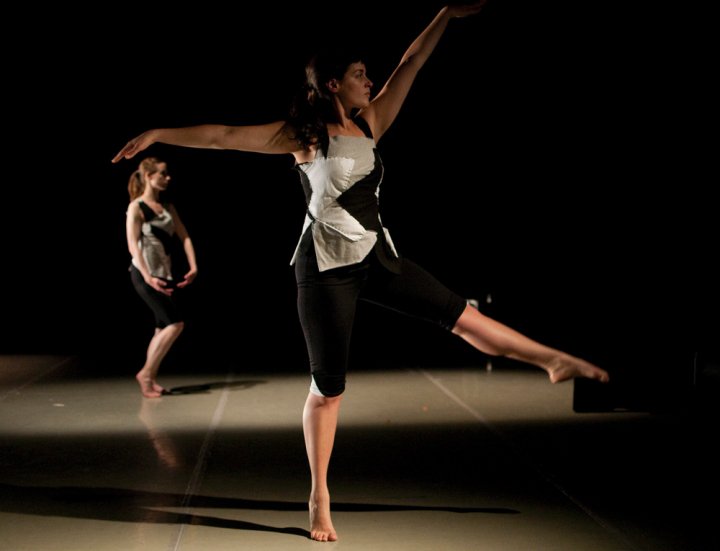
    A couple of weekends ago, I attended the premier of Hysteresis, a performance described as “70 minutes of non-stop, innovative dance, sound, lights, and costumes informed by a residency at the Museumsquartier in Vienna, Austria.” It was a production of Double Vision, a group known for performances combining dance, music and technology, and took place at Dance Mission Theater here in San Francisco.


    [Photo courtesy of Double Vision. Click to see larger version.]

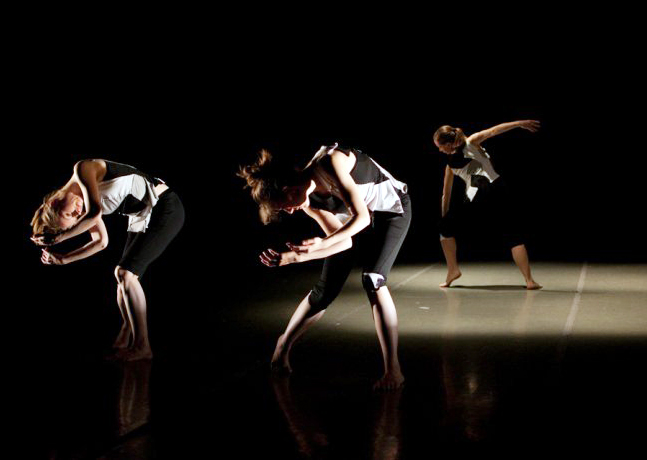
    Hysteresis explored the theme of “being alien or observing that which is alien to oneself.” However, for me the performance did not feel alien at all. Indeed, each of the artists’ approach to alien-ness via dance, music, choreography and lighting ended up creating something that felt familiar for me and comforting in its sparseness. The choreography had a feel of individuals going about their business in a city environment, sometimes moving about in wildly different directions, sometimes very static. The lighting had a very geometric and architectural feel. The dancers’ costumes also had an architectural or industrial quality and consisted of simple tunics stitched together from geometric gray and black swatches of cloth and black leggings.

    The music held together these elements with industrial and percussive sounds punctuated by references to popular music idioms, as one might hear passing buildings and cars in between traffic and construction. It started with short percussive notes, mostly struck metal and block. At first the sounds were very sparse but later on they formed into complex polyrhythms, sometimes with more standard percussion instruments like kick drums and snare drums mixed in. The sparse texture was interrupted by other sections of music, such as short samples from big-band music, classical (or classically inspired) string music, and passages that sounded like show tunes or brass bands. It was not clear these were found musical objects or composed from sratch. Towards the climax of there piece, there were more sounds that one might consider more “electronic”, such as noise, synthesizer sweeps and sub-bass tones. However, even as the idioms and timbres changed and the music became quite dense, the sparse rhythmic texture from the beginning of the piece kept going, like machinery of a city that never stops. Or almost never stops – there were a few moments where it cut out entirely, and the silence was quite startling.


    [Photo courtesy of Double Vision. Click to see larger version.]

    The often sparse texture of the music allowed one to focus more on not only the movements of the dancers, but also the sounds they made in terms of the movement of their bodies and breathing. After one particularly loud section everything fell silent, the dancers moved off stage, and one rectangular patch of light kept flickering. This light seemed to be of particular significance (it was the only one that cast a rectangular shape) and appeared occasionally throughout the piece.

    The final section began with what sounded like machine or car sounds and moved towards what sounded like an elegant party with piano music, and the faded to silence. It was a strange ending after the very industrial sound throughout the rest of the piece, but it provided an interesting contrast.

    Choreography for the piece was by Pauline Jennings, music by Sean Clute, lighting design by Ben Coolik, and costume design by Andrea Campbell.

  • resonant world: John Cage and Morris Graves

    This past Sunday I attended resonant world: an afternoon of music by John Cage for the exibit The Visionary Art of Morris Graves at the Meridian Gallery here in San Francisco.

    Morris Graves was an influential artist in the 20th century, based primarily in the Pacific Northwest. The exhibition features about 50 works spread over several decades of his career and two floors of the gallery. Many of his works, which were mostly on paper, had a very simple quality, but often with some recognizable object or concept at its core. I was particularly drawn to a few of his works, including Minnow, Irish Animal, Waning Moon and Roadside Plants and Machine Age Noise. Graves’ work is often described as having Asian and mystical influences, which were apparent in Minnow and many others, but in works like Irish Animal a noticed a humorous quality, something approaching graphic art.

    John Cage became a longtime friend and admirer of Graves after the two met in 1935. He described Graves’ work as “Invitations”, or invitationals to attend to the ordinary details that are “ordinarily ignored”. Although the pieces in the program were not directly a response to Graves’ art, they do fit the spare nature of some of his works, and the focus on simple details, as well as the space of the gallery in which those works were presented.

    [Raskin, Greenlief and Adams.  Photo by Michael Zelner.  Click to enlarge.]

    The first piece, Atlas Eclipticalis featured the saxophone trio of Philip Greenlief, Jon Raskin and Steve Adams. The title refers to the path of the Sun through the constellations of the zodiac, which Cage used as a source for the score of the piece, using tracing paper to determine the placement of dots and then adding a five-line music staff. The trio’s performance was derived entirely from this score. The result was a very sparse musical texture, with large areas of silence punctuated by individual isolated notes from each of the saxophones. There were also moments where the performers played together, forming interesting beating patterns as the simultaneous tones interacted with the room as well as perfect octaves and minor chords that were a bit startling (but quite effective) within the context of the whole piece.

    Atlas Eclipaticalis was followed by a performance of Three for “three players having a variety of recorders.” Conveniently, we happened to have three players who each had a variety of recorders, the Three Trapped Tigers (David Barnett and Tom Bickley with special guest Judy Linsenberg). The recorders ranged in size from the familiar C soprano recorders and alto and tenor sizes seen in renaissance ensembles, to very “modernist” F contra-bass recorders composed of wooden rectangular sections with black buttons and levers – I am guessing these were Paetzold recorders.

    [Three Trapped Tigers (Bickley, Lindsenberg, Barnett). Click image to enlarge.]

    The piece unfolded as a series of chords – the timing of individual notes was left up to the performers – with frequent pauses and changes of instruments. The large number of recorders and frequent changes suggested a solo pipe organ performance as much as a wind ensemble.

    [David Cowen reading.  Photo by Michael Zelner.  Click to enlarge.]

    Throughout the afternoon, simultaneous to an in between the musical performances, there was a reading of Series RE: Morris Graves, a “long poem derived by John Cage from his own recollections, conversations with Graves and friends” and other sources as described in the program notes. The poem was read by Dave Cowen. I did follow the recommendation to explore the space during the musical performances, including viewing the artwork with the music resonating down the stairs from the floor above, and pausing at partitioned area where the reading occurred. (Note: in the above photo featuring Cowen’s reading, one can also see Graves’ Roadside Plants and Machine Age Noise.)

    [Fischer and Binkley enjoying tea and snacks. Click to enlarge.]

    The final performance featured selections from Cage’s Song Books (Solos for Voice 3-92) interpreted by members of the Cornelius Cardew Choir. The songs derive from a variety of written sources, with some using graphical-score notation (a current favorite technique of mine) or text-based instructions. From these scores, performs are free to interpret and improvise their actual performances. Some of the songs were purely vocal and melodic, others were more theatrical, while others combined electronics with other elements. Among the moments that stood out were Tom Bickley and Brad Fischer enjoying tea, Sarah Rose Stiles pouring a cognac into a glass with contact microphones, projection of slides “relevant to Thoreau” behind a theatrical performance, a graphical score directing the pressing of keys on an amplified manual typewriter (performed by Eric Theise), and the use of the text from that typewriter in another song. There was also a large orange stuffed fish on a table.

    [Sarah Rose Stiles.  Photo by Michael Zelner.]

    [Sandra Yolles, Marianne McDonald, Brad Fischer and Tom Bickley.  Projection of “drawings related to Thoreau”. Click to enlarge.]

  • Moldover, Celeste Lear and Nonagon at Control Freq

    Last Wednesday I attended Control Freq at the Hotel Utah here in San Francisco. Of course, that is a fantastic name for a show, being a play on words for electronic music controllers, audio signal processing, and the tendency of many of us to be in fact “control freaks.” The overall theme among the three groups who performed was use of Ableton Live! with various controllers.

    The evening opened with Celeste Lear (guitar, vocals, electronics) and her band, including Adam Willis (drums) and Ian Montgomery (bass).

    Lear has quite a pedigree in music and audio, and her music and band is quite technologically sophisticated (I did see the iPhone as a controller on the bassist’s strap). Nonetheless, they manage to combine technology with popular music idioms. I heard various funk, house, and reggae influences in her music – I had a soft spot for the final song which sounded like a classic house/disco track in a minor key. Though most of the music was very rhythmic, there were some free-form moments as well with guitar effects, etc. For much of the set, they were joined by trumpeter John Gibbons.

    Celeste Lear was followed by Nonagon [along with guests]. The group had an impressive array of gear, arranged as multiple stations with laptops and controllers, including offerings from Akai and Albeton+Novation and of course a Monome. There were also two glowing globes in between the performers that emitted an ever changing color of light. Musically, the set began with complex ambient sounds, quite different of the Celeste Lear Band. Gradually, beats and recognizable chords emerged, with the beats eventually becoming quite strong and pronounced. Over the course of the set, they seamlessly moved through various beat-based soundscapes, with various resonances, vocal pads, pianos and other sounds filling in.

    Moldover concluded the evening with a very impressive, high-paced and virtuosic performance with his Mojo controller, guitar and voice. We had last seem Moldover at LoveTech.

    His performance on the controller was strong and rhythmically tight and fun to watch. He played the various buttons and sliders as if he was playing guitar or drums. Even though the Mojo was being used to bring in out various loops, recordings and processed sounds, the end result were new rhythms, chords and even melodies. This can be best seen in a video clip rather than in words: