Category: Reviews

  • Big City Music at NAMM

    No visit to NAMM is complete without a stop at the booth of Big City Music. There were familiar faces and instruments, but a few new things as well.

    The Mellotron micro is the latest in the Mellotron series. It’s small and compact, and with an expected price $800-$1000 USD it’s more affordable than the others in the series (although still quite pricey).

    Mellotron micro

    Metasonix is at it again. The big yellow box that Big City Music always brings to the show sported some new modules in silver.

    Metasonix modules

    Among them was the RK2 XSVCA. It’s not just a VCA, but has distortion, feedback and out-of-phase outputs among other features. The marketing material is everything we have come to know and love from Metasonix.

    Horsecock

    There are always some odd and unusual pedals. These pedals from Indu Trielectric were quite visually intriguing.

    Indu Trielectric

    The maker’s descriptive text – much less colorful than Metasonix’s – suggested that this was a bit of a Swiss Army Knife with lots of features, including “chaotic reverb” but it also came with the admonition to the user to expect weirdness and imprecision, traits that can be quite useful for music. I wasn’t able to hear it at the time, but might get a chance to later.

  • Rossum Electro-Music synthesizer modules at NAMM

    Rossum Electro-Music

    We at CatSynth have long been fans of E-MU Systems’ synthesizer. The Proteus 2K and Morpheus remain vital parts of my music studio – and some long-time readers may recall that I used to work for E-MU many years ago. So it was excited to see the new Eurorack modules from Rossum Electo-Music, the new project of E-MU founder and synthesizer inventor Dave Rossum.

    Rossum Electro-Music

    The main module available is the Evolution, a Moog-style ladder filter with some unique twists. It allows the user to switch among topologies, from 3 to 6 poles, in real time. And of course this function is controllable via CV for some interesting effects. The filter itself sounds great, with signal conditioning to allow resonant sweeps while maintaining strong bass tones from the original signal. The Morpheus module is a Eurorack implementation of the legendary E-MU Z-Plane filter, which allows interpolation on three axis between different 14-pole filter configurations. All of the parameters for the Z-Plane filter are CV controllable. Unfortunately the Morpheus wasn’t ready for me to hear, but I certainly looking forward to it.

  • Booth 5000 (Modular Synths) at NAMM, Part 1

    Our friends in the modular-synth world are moving up at NAMM, with a collective booth at the front of the show right near giants like Moog and Dave Smith Instruments.  It’s a bit much to take in all at once, as modules and module-makers continue to proliferate.  This will be the first of a few articles covering just this booth.

    One new set of modules, and perhaps the oddest, comes from BASTL Instruments.

    BASTL Instruments

    In addition to the wood texture, there are modules that can control motors, solenoids and other outboard electronic elements.  It does bring to mind some ideas for sound installations and live performances.  You can hear a bit of these modules in this video.

    Soulby presented Eurorack modular versions of 8-bit processing modules more messing with voice and other input signals.

    Soulby

    Delays and looping seem to be a thing this year. 4ms had a new looper and delay module whose novel feature is audio rate control of the functions for unusual flange delays and other continuous effects.

    4ms

    While the 4ms Spectral Multiband Resonator is not new for this year, it is still one I am excited about.

    QuBit Electronix has a new sequencer module with a circular pattern; and a new polyphonic oscillator with individual controls and VCAs. You can see and hear both of them in this short video.

    @qubitelectronix polyphonic oscillator in action! #namm

    A video posted by CatSynth / Amanda C (@catsynth) on

    Synthrotek is focusing on full systems, including a MIDI-CV converter that supports bi-directional clocks. One can use heavily modulated CV clocks to control time-based elements on MIDI synthesizers with this feature.

    Synthrotek

    And KOMA Elektronik returned with their massive sequencer, looking more refined. And it has a lot of lights!

    KOMA Electronik Sequencer

    More from this both and beyond in coming articles.

  • Ellsworth Kelly (1923-2015)

    Ellsworth Kelly (1923-2015)

    We lost another of our art heroes yesterday. Ellsworth Kelly, known for his iconic works composed of color fields, passed away.

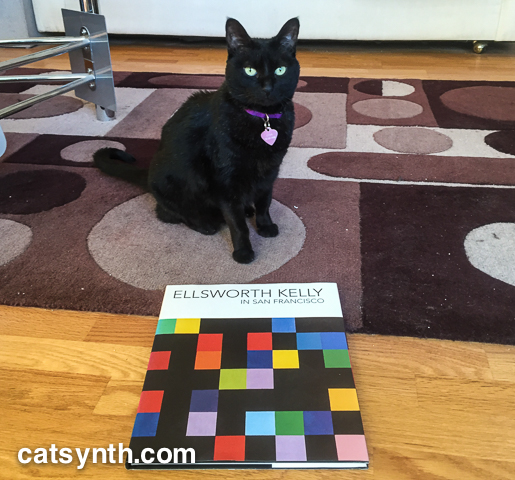
    Luna with Ellsworth Kelly book

    The above photo features the catalog from his large-scale solo show at SFMOMA in 2002-2003. The exhibition was a bright spot, both aesthetically and emotionally, in an otherwise depressing period of time and made quite an impression. I kept intersecting with his work during my numerous art adventures in California. His paintings featured large color fields, sometimes combined together into a single whole, while other times separated, as in Blue Green Black Red (1996) on display as part of the Fisher Collection at SFMOMA. I had the opportunity to see a large retrospective of his prints and paintings at LACMA in Los Angeles a couple of years ago. This, too, was revelatory as it showed other aspects of his work, including black-and-white pieces and connections of his abstract style to nature.


    [Installation view. Ellsworth Kelly: Prints and Paintings. January 22-April 22, 2012. Los Angeles County Museum of Art. Photo (c) 2012 Museum Associates/LACMA]


    [Installation view. Ellsworth Kelly: Prints and Paintings. January 22-April 22, 2012. Los Angeles County Museum of Art. Photo (c) 2012 Museum Associates/LACMA]


    It is still, however, the color fields that I most instantly recognized as his.


    [Installation view. Ellsworth Kelly: Prints and Paintings. January 22-April 22, 2012. Los Angeles County Museum of Art. Photo (c) 2012 Museum Associates/LACMA]

    Kelly himself resisted being described as “abstract” or “minimal” or any other label that intersected with his career.  But I think this statement quoted in the New York Times obituary describes his art very well, and is a fitting conclusion.

    “My paintings don’t represent objects,” he said in 1996. “They are objects themselves and fragmented perceptions of things.”


  • Music by Lindsay Cooper, Mills College

    Music by Lindsay Cooper, Mills College

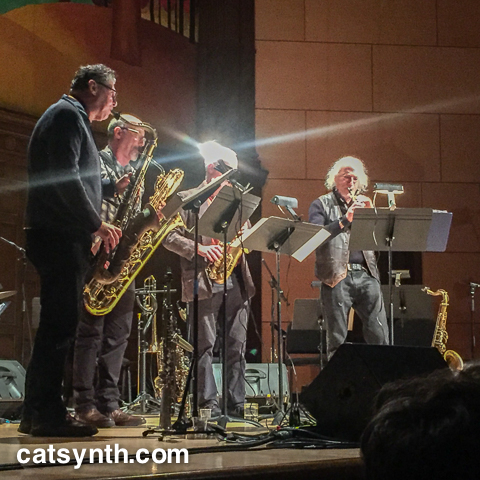
    Earlier this month, the Mills College music department dedicated an entire concert to the music of Lindsay Cooper. It was an extraordinary event, not only for bringing her work together in one setting, but for the cast of talented musicians who made up the ensemble.

    Ensemble performing the music of Lindsay Cooper
    [Ensemble performing the music of Lindsay Cooper]

    Lindsay Cooper is perhaps best known for work with the experimental rock group Henry Cow, but her musical career spans a variety of other styles and disciplines before and after. And while her instrumental first love remained the bassoon, she also played many other wind instruments, and had a very distinctive haunting voice that could be heard on many of Henry Cow’s recordings. Her compositions, including her time with the band and her later projects including News from Babel up to her retirement while suffering from MS, are not often heard in concert calls. The concert on this evening was a step towards rectifying that.

    Musically the concert was a high-speed tour through Cooper’s music. Many of the pieces were short an energetic. Some carried the energy and rhythm of experimental rock, with driving lines on keyboard, guitar and drums; others were quite abstract with longer sounds. There was an anxiety and restlessness that permeated the music, with a need to move forward, sometimes almost tumbling. It was also full of intricate details and contrapuntal lines, which were brought out especially in the horn parts. There were moments which had the grand style and fast-moving details of a classic film score, particularly reminiscent of a closing “The End” from a film for which the ending may not have felt quite so final.

    Evelyn Davis, Kate McLoughlin, Fred Frith
    [Evelyn Davis, Kate McLoughlin, Fred Frith]

    The main ensemble featured two of Cooper’s longtime collaborators, Fred Frith (guitar, keyboard) and Zeena Parkins (harp). Rounding out the ensemble was a group of familiar faces in Steve Admans, Rachel Austin, Beth Custer, Evelyn Davis, Jordan Glenn, Jason Hoopes, Kasy Knudsen, Kate McLoughlin, Emily Packard, and Andy Strain; with Miles Boisen on sound. The performances felt easy and flawless (no doubt the result of countless rehearsals), and with a relatively light texture despite the ensemble’s size. The concert’s sole departure was a performance by the Rova Sax Quartet of Face in the Crowd, a piece they had commissioned from Cooper in 1996. Judging from her biography and the date, it may have been one of her last compositions.

    Rova Saxophone Quartet
    [Rova Saxophone Quartet]

    In addition to the performers on stage, the audience too was a cast of familiar faces and influential musicians from the Bay Area music scene. It seems that Lindsay Cooper had quite an influence on artists her; and thus this was a concert not to be missed. I am glad that I was able to be there.

  • Bronx Museum of the Arts: Martin Wong, (DE) (RE) CONSTRUCT, Transitions

    This winter the Bronx Museum of the Arts has three exhibitions to bring forth different aspects of life and art in New York City: a gritty and intimate solo exhibition, reflections on the urban landscape from the permanent landscape, and a view of a little understood country through the camera lens.

    Martin Wong: Human Instamatic is a large posthumous retrospective of Chinese-American painter Martin Wong. There have been several exhibitions highlighting his role as collector and muse for contemporary artists, but this one is the first to bring together his work as a painter since his death in 1999. It starts with his early works as a street artist in Eureka, CA but mostly focuses on his time in New York, especially his years on the Lower East Side in the early 1980s.

    Martin Wong
    [Martin Wong]

    The Lower East Side of that era was a notoriously gritty neighborhood, as exemplified in the painting above. But there was a vibrant multi-ethnic community of artists and musicians living among the dilapidated buildings. Wong’s work documents the artistic and daily life of the area, but does so in a way the is deeply personal and internal at the same time.

    Attorney Street (Handball Court With Autobiographical Poem by Piñero),” dated 1982-84
    [“Attorney Street (Handball Court With Autobiographical Poem by Piñero),” dated 1982-84.]

    Sign language abounds in his work along with urban scenes. The sign language in the piece shown above, Attorney Street, Handball Court with Autobiographical Poem by Piñero, features a short poem by Miguel Piñero, the playwright and actor who was co-founder of the Nuyorican Poets Café. The piece and its subject also show the immersion of Wong, a Chinese American, in the Latino culture of the neighborhood, and his expression of his identity as a homosexual man – Piñero was both his collaborator and lover. The latter theme repeats frequency is works – most prominently in images of firemen – along with the sign language.

    In contrast to his depictions of the Lower East Side, his paintings of Chinese American people and culture have a more quaint and nostalgic quality, whether illustrating Manhattan’s Chinatown or San Francisco. In these works, we see women for the first time. One particularly prominent piece featured a cheongsam-clad woman reminiscent of the sexually charged images of Asian women from the early 20th century. He did, however, marry his heritage to the contemporary urban world. In the piece shown below (and a much larger companion), the Chinese symbolism and astrology are combined with the brick facade of the urban landscape and an ominous black hole, perhaps a nod to the rising AIDS epidemic that eventually took his life.

    Martin Wong
    [Martin Wong]


    (DE) (RE) CONSTRUCT brings together pieces from the museum’s permanent collection around the topic of design. Design covers a lot of territory, and there are pieces that explore both its small and large aspects. Liliana Porter’s Bird, Drawing, Model, Painting, Rip, Hand, 1982 deals with small objects and figures. The start white background gives it a somewhat lonely but simultaneously tender quality.

    Porter_Liliana_300dpi1
    [Liliana Porter. Bird, Drawing, Model, Painting, Rip, Hand, 1982. Acrylic, pencil, silkscreen, collage. Gift of the artist]

    Vito Acconci’s Building Blocks for a Doorway, goes in the other direction by focusing on architecture. The lettering is a fun detail, though, and I leave its interpretation as an exercise to the ready.

    Vito_Acconci1
    [Vito Acconci. Building Blocks for a Doorway, 1983-85. Five color etching. Each half 93 7/8″ x 47 1/4″. Edition of 8]

    Acconci’s architectural spoke to me on a personal level, as did the far more minimalist Black Road by Glen Goldberg. Fun with highways…

    20151122-IMG_7085
    [Glen Goldberg. Black Road]

    And the most minimal of all was Elizabeth Jobim’s Red.

    Elizabeth Jobim
    [Elizabeth Jobim. Red]


    Transitions: New Photography from Bangladesh brings together works from nine Bangladeshi and Bangladeshi-American photographs to interpret a country that is rapidly changing country that defies many long-held stereotypes. The Bronx happens to be home to a large community of Bangladeshi Americans. Many of the photographs were just portraits and landscapes, as well as some striking similarities with India. On the subcontinent, pointing out the similarities between the two countries would be politically charged, but as South Asian Americans we can freely observe them. Most of the portraits were relatively prosaic, but one that I particularly liked was Arfun Ahmed’s Olympia Burka which featured the artists’ wife and a relative is Muslim does. It a very timely statement given the conversation we are having in this country around Muslim-American identity and prejudice. Plus, it features a cat!

    Arfun_Ahmed1
    [Arfun Ahmed. Olympia Burka, 2014]

    Debashish Chakrabarty’s photographs featuring streaks of light are abstract and energetic. The figures, when visible at all, are very much obscured in the dark background.

     Debashish Chakrabarty


    The Bronx Museum of Arts has become a regular stop on my visits to New York, and I’m proud to see this institution grow and thrive in the borough to which I am most deeply connected. I look forward to more exhibitions in the future. Dare I even hope to play a show there someday?

  • MoMA: Pollock, Picasso, and Making Music Modern

    MoMA: Pollock, Picasso, and Making Music Modern

    No visit to New York is complete without a stop to the Museum of Modern Art (MoMA). Today we look back at three exhibitions that stood out during my most recent trip.

    7.1968
    [Jackson Pollock (American, 1912-1956). One: Number 31, 1950. 1950. Oil and enamel paint on canvas, 8′ 10″ x 17′ 5 5/8″ (269.5 x 530.8 cm). The Museum of Modern Art, New York. Sidney and Harriet Janis Collection Fund (by exchange), 1968. © 2015 Pollock-Krasner Foundation / Artists Rights Society (ARS), New York]

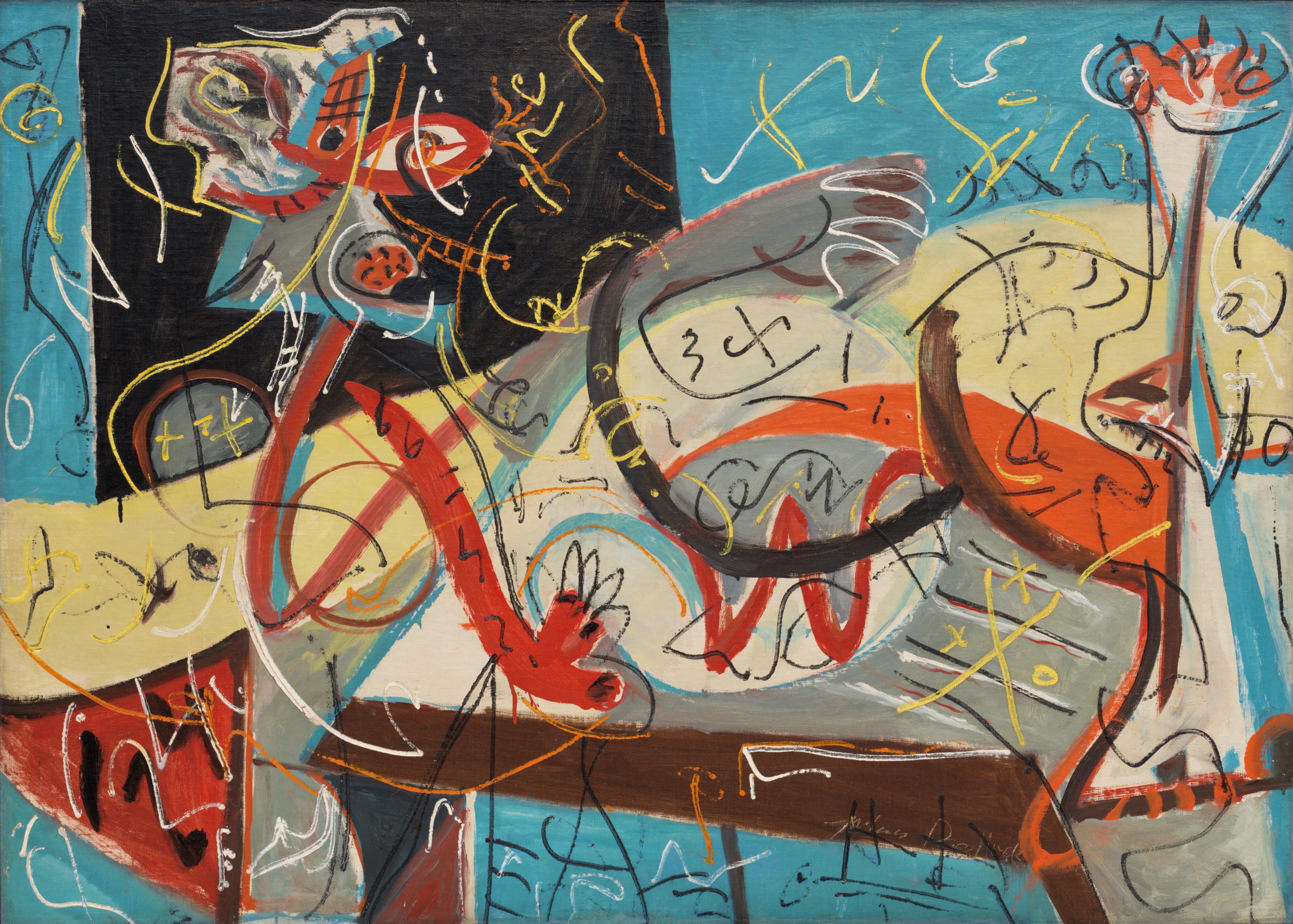
    Jackson Pollock: A Collection Survey, 1934–1954 is a small but powerful exhibition tracing the artists’ career and development using pieces from MoMA’s extensive collection. There were of course the massive drip paintings such as the iconic One: Number 31, 1950, but also quite of few of his earlier works from the 1930s and 1940s that while abstract made extensive and overt use of mythological and folk elements. Indeed, one can even see figures in some of the earlier pieces.

    428.1980
    [Jackson Pollock (American, 1912-1956). Stenographic Figure. c. 1942. Oil on linen, 40 x 56” (101.6 x 142.2 cm). The Museum of Modern Art, New York. Mr. and Mrs. Walter Bareiss Fund, 1980 © 2015 Pollock-Krasner Foundation / Artists Rights Society (ARS), New York]

    One of the earliest paintings was quite reminiscent of Míro, another favorite of mine.

    Seeing the works side by side in the compact two-room exhibit, it is easier to see the connections between the earlier and later works. Although the techniques and ideas are radically different, some of the shapes and other elements can be similar at times. Densely packed canvases with layered curving forms of color abound throughout his work.

    One of the treats of this exhibition (which I don’t recall from the huge 1999 retrospective) were some of Pollock’s lesser-known drawings, sketches, and prints. Many of them date from the 1930s and 1940s, so have more in common with his paintings of those decades. But seeing Pollock writ small is in itself interesting given his association with paintings of monumental scale.

    12.1958
    [Jackson Pollock (American, 1912-1956). Untitled (Animals and Figures). 1942. Gouache and ink on paper, 22 ½ x 29 7/8” (57.1 x 76 cm). The Museum of Modern Art, New York. Mr. and Mrs. Donald B. Straus Fund, 1958 © 2015 Pollock-Krasner Foundation / Artists Rights Society (ARS), New York]

    Jackson Pollock ink on paper
    [Jackson Pollock. Untitled.1950. Ink on paper. The Joan and Lester Avnet Collection]

    The exhibition was just opening at the time (indeed, we saw it as part of a members’ preview), and will remain on display through March 13, 2016.


    Picasso Sculpture is a large and comprehensive survey of the artists’ sculptural works. While primarily known for his painting, Picasso was quite a prolific sculptor, and his sculptures can be seen as three-dimensional projections of his unique and instantly recognizable style of painting.

    649.1983
    [Pablo Picasso (Spanish, 1881–1973)
    Bull. Cannes, c. 1958.
    Plywood, tree branch, nails, and screws. 46 1/8 x 56 3/4 x 4 1/8″ (117.2 x 144.1 x 10.5 cm).
    The Museum of Modern Art, New York. Gift of Jacqueline Picasso in honor of the Museum’s continuous
    commitment to Pablo Picasso’s art.
    © 2015 Estate of Pablo Picasso / Artists Rights Society (ARS), New York.
    ]

    In pieces like Bull, shown above, one can see the direct analogs to his cubist paintings. His figurative sculptures also often feature bulbous and exaggerated interpretations of the human body. Some of them border on caricature, with others are graceful and almost abstract.

    MoMA - Pablo Picasso Sculpture 2015
    [Installation view of Picasso Sculpture. The Museum of Modern Art, New York, September 14, 2015–February 7, 2016. © 2015 The Museum of Modern Art. Photo: Pablo Enriquez]

    The curving forms in both his human and animal were quite a contrast to the linear forms of the New York City skyline.

    Picasso Sculpture
    [Pablo Picasso, Spanish, 1881–1973
    Maquette for Richard J. Daley Center Sculpture
    1964
    Simulated and oxidized welded steel
    41 1/4 x 27 1/2 x 19″ (104.8 x 69.9 x 48.3 cm)
    The Art Institute of Chicago. Gift of Pablo Picasso
    ]

    There were several pieces that I recognized from my visit to the Musée Picasso in Paris, including this absolutely darling sculpture of a cat.

    Picasso Cat

    The exhibition, which covers all of the fifth floor of the museum, will be on display through February 7, 2016.


    The exhibition on display in the design gallery was particularly appropriate for our interests at CatSynth. Making Music Modern: Design for Ear and Eye brought together a large collection of aesthetically beautiful objects used for both the creation and enjoyment of music.

    Perhaps the simplest way to stage such an exhibit would be a linear progression of designs from earlier record players to iPods, but instead this exhibit branches off in multiple directions at once. We do see several of Dieter Rams’ iconic music players and a particularly beautiful and modernist radio by Michael Rabinowitz released in 1942 – and of course an iPod.

    205.1958
    [Dieter Rams, Hans Gugelot. Radio-Phonograph (model SK 4/10). 1956. Painted metal, wood, and plastic, 9 1/2 x 23 x 11 1/2″ (24.1 x 58.4 x 29.2 cm). Mfr.: Braun AG, Frankfurt, Germany. The Museum of Modern Art, New York. Gift of the manufacturer]

    But we also see more esoteric musical instruments that blend art, design and technology, such as Joe Jones’ Mechanical Flux Orchestra, as well as the more mundane Fender Stratocaster.

    Joe Jones.  Mechanical Flux Orchestra
    [Joe Jones. Mechanical Flux Orchestra. c 1964. The Museum of Modern Art, New York. The Gilbert and Lila Silverman Fluxus Collection Gift 2266.2008]

    Through the exhibit are music posters, showing distinctive designs of different eras. Brightly colored posters of the 1960s are featured along with gritty black-and-white posters for New York City punk shows in the 1970s. There are also objects that are more purely art than functional design. Among those that straddle that divide are the Chamber Works: Architectural Meditations on Themes from Heraclitus from architect Daniel Libeskind.

    2376.2001.4

    [Daniel Libeskind. Sheet from the folio Chamber Works: Architectural Meditations on Themes from Heraclitus. 1983. Ink on paper, 22 3/8 x 30 1/4″ (56.8 x 76.8 cm). The Museum of Modern Art, New York. Andrew Cogan and Rob Beyer Purchase Funds © 2014 Daniel Libeskind]

    I would love to “play” one of these pieces some day.

    One of the more perplexing objects in the exhibit was the Scopitone, a 1950s behemoth that could select, play and rewind up to 36 short films produced for songs by European and American artists. It was in essence a jukebox for the forerunners of modern music videos.

    Scopitone

    [Scopitone 1963 16mm jukebox The Museum of Modern Art, New York. Film Study Center Special Collections F2007.4]

    The Scopitone, never really caught on, but perhaps it was ahead of its time, with a medium more suited to small form factors and Internet distribution, i.e., YouTube.

    There was so much in this exhibit that I would love to post all of it, but I think it’s best to see it in person. It will remain on display through January 18, 2016. And for those who can’t see it, I recommend a visit to the exhibition’s

  • Wayne Horvitz: Some Places are Forever Afternoon.  Roulette (Brooklyn)

    While in New York, I seek out new music and sometimes new venues as well. This past week I visited Roulette in Brooklyn to see an ensemble piece by composer and keyboardist Wayne Horvitz.

    Wayne Horvitz and ensemble at Roulette

    The evening featured Some Places are Forever Afternoon a single suite of twelve pieces by Horvitz based on eleven poems by Northwest poet Richard Hugo. Each musical piece was preceded by a reading of one of Hugo’s poems. The words dealt with a variety of settings, from the natural landscape to quasi-religious stories of journeys and temples (it immediately brought to mind Mormonism, though we can find no official connection there) to bars and taverns. The subject matter appeared to follow largely that progression of concepts, though it was a mixture and also interspersed with abstract text. Musically, there was a continuity among all the pieces, blending contemporary composition and jazz idioms, with occasional phrases that evoked the words in the preceding poem. Most of the music was quite rhythmic anchored by Horvitz on piano, Kenny Wollesen on drums, and Ted Luntzel on bass.. There was quite a timbral spread with Sara Shchoenbeck featured prominently on bassoon and Riley Mulherkar on trumpet lending more of the jazz sound. Familiar faces Marika Hughes on cello and Nels Cline held together the middle.

    Overall, it was a good show and well performed, and left me with a bit of curiosity. I look forward to hearing more at Roulette on future visits to New York.

  • Whitney Museum: New Building, Frank Stella, Archibald Motley and more

    Whitney Museum: New Building, Frank Stella, Archibald Motley and more

    Since my last visit to New York, the Whitney Museum opened its new building in the Chelsea neighborhood of Manhattan, and so it was of course a high-priority stop on this visit.

    The first work of art on encounters is the building itself. The overall style neither attempts to mimic the warehouses of the Meatpacking District nor projects the dissonance of some of the other intriguing buildings along the High Line. But it does open up to the neighborhood and the city, making that part of the show along with the formal art.

    Whitney Museum sculpture terrace

    The main exhibition was a massive retrospective of works by Frank Stella which took up the entire 5th floor of the museum and featured his iconic large and colorful paintings as well as more recent works that veered towards the sculptural. One of the major themes is how over his long career he has shifted his focus and come up with new ways of working in the medium he still refers to as “painting.”

    Installation view.  Frank Stella

    His most recognizable works are the large-scale colorful cutout paintings. The earlier examples contain elements of abstract expressionism and the emerging minimalism, but then modified by cutting out the shapes to make irregular canvases, freeing panting from being simply “colors spread onto a rectangular surface”. Nonetheless, my favorite examples of this phase are still geometric and stark.

    Frank Stella - Chocorua IV
    [Frank Stella. Chocorua IV]

    From straight lines, we move to curves, which further modify the boundaries of a painting. And then came the radical step of taking a painting outside of the flat plane by cutting, bending, and layering pieces.

    Gobba, zoppa e collotorto
    [Frank Stella. Gobba, zoppa e collotorto]

    While the placement and combinations of shapes may be complex, the shapes themselves remain simple and the whole composition abstract. I found this phase of Stella’s work to achieve its most refined form in La penna di hu.

    La penna di hu
    [Frank Stella. La penna di hu, 1987-2009. Mixed media on etched magnesium, aluminum and fiberglass.]

    It seems natural to ask whether such works are paintings or sculptures. Stella himself comes down squarely on the side of viewing them as paintings. This is true even for his most recent series of work that feature large metal constructions without color.

    Frank Stella metal constructions

    Stella has also embraced technology throughout his career including new materials and machines. Most recently that includes 3D printing.

    It was great to see both his most famous paintings alongside the more surprising elements of his constantly evolving work in this large exhibition. As Stella is still alive, there may be more to come.


    The top floor of the museum features a retrospective of works by Archibald Motley. Motley was a prolific and influential painter who came to prominence in the first half of the 20th century. The exhibition focuses on his works portraying African Americans in serious portraits and lively cultural scenes from the Jazz Age and Harlem Renaissance in the 1920s and 1930s. While the portraits are detailed and striking, it was his scenes of colorful musical spaces that most resonated with me.

    Archibald Motley.  Blues
    [Archibald J. Motley Jr. (1891–1981), Blues, 1929. Oil on canvas, 36 × 42 in. (91.4 × 106.7 cm). Collection of Mara Motley, MD, and Valerie Gerrard Browne. Image courtesy the Chicago History Museum, Chicago, Illinois. © Valerie Gerrard Browne]

    Motley was well known in his time, but faded later compared to other painters of American life and scenes (think Edward Hopper). Because his work depicts an American community often overlooked and his style is more modern and pushing away from realism, it is great to see him getting reintroduced through exhibitions such as this.


    The galleries featuring pieces from the permanent collection were also “new” in the new space. Among the themes that permeates the museum’s collection are scenes of the city and industry. There is Joseph Stella’s Brooklyn Bridge (a poster of which hangs at CatSynth HQ) but also John Marin’s less-well known Region of Brooklyn Bridge Fantasy with a very different take on the same subject.

    Joseph Stella, Brookyln Bridge
    [Joseph Stella. Brooklyn Bridge]

    John Marin
    [John Marin. Region of Brooklyn Bridge Fantasy, 1932.]

    In terms of industrial imagery, among the strongest were Kay Sage’s surrealist piece and Elsie Driggs’ Pittsburgh. Both pieces, at least to me, have a very optimistic view of the city and progress even if others of our current time would see them as bleak.

    Kay Sage
    [Kay Sage. No Passing, 1954]

    Elsie Driggs - Pittsburgh
    [Elsie Driggs. Pittsburgh, 1927]

    It’s also worth noting that some of the strongest images of these themes were done by women, something that inspires me in my own work into this subject.


    The 6th floor featured works from the collection of Thea Westreich Wagner and Ethan Wagner, some of which will be come part of the Whitney’s permanent collection and some of which will go to the Centre Pompidou. It focuses American and international art from the 1960s to the present, and demonstrates the wide variety of media and concepts employed during this period. Minimalist works abound, such as Sean Paul’s series featuring arrangements of black shapes on a white background with implied complexity.

    Sean Paul
    [Sean Paul. Arrangement 17, 2011]

    There are also many works featuring technology. Some are the obligatory works with the light (that I do quite enjoy), but one of the more confounding pieces was by Aaron Flint Jamison. It featured two wooden boxes with multiple computers and a shelf of printed sheets. Were the computers the art, or were they just functional elements to support the concept?

    Half Matrix Vessel (part of "Manifold to Half Matrix" installation)
    [Aaron Flint Jamison. Half Matrix Vessel (part of “Manifold to Half Matrix” installation), 2013]

    There was of course more traditional modernist painting, such as Charline von Heyl’s piece Boogey.

    cvh-04_012_forweb_764_764_764
    [Charline von Heyl (b. 1960), Boogey, 2004. Acrylic, oil, and charcoal on canvas. 82 1/16 × 78 1/8 (208.4 × 198.4)
    Promised gift of Thea Westreich Wagner and Ethan Wagner P.2011.472. Courtesy of the artist and Petzel, New York
    ]


    Whitney sculpture garden.

    Overall, this was a great visit and a chance to see a new museum in a favorite neighborhood of mine. One question that I had was what would be the fate of the old midtown Brutalist building that housed the museum for decades. Fortunately, it appears that it will survive, and the Metropolitan Museum of Art plans to use it for some special exhibitions. I hope to be able to see one in the future.

    [Images without “catsynth.com” watermark courtesy of the Whitney Museum of American Art.]

  • New False Gods &The Xman, LSG Creative Music Series

    It’s been a while since I have been able to attend Outsound’s regular weekly music series at the Luggage Store Gallery, but I was finally able to do so a week ago. The show featured two very different sets focused on electronics.

    First up was the New False Gods, a “supergroup” of sorts featuring Eli Pontecorvo , Jack Hertz, Doug Lynner, Tom Djll, and R Duck.

    New False Gods

    I am quite familiar with all the artists and count them all as friends, but this is the first time I heard them together as this unit. Musically, this was an improvised set, but Jack Hertz’s rhythmic percussion helped provide a structural foundation for the other sounds, which varied from sparse and light to thick noisy pads. Doug Lynner provided intricate sounds on his Serge modular, and Tom Djll had an intriguing setup with trumpet driving a modular synth.

    Doug Lynner, Tom Djll

    Next up was Charles Xavier, aka The Xman performing a solo set with electronics and small sound makers. The central instrument in his setup was a malletKAT, an electronic MIDI mallet percussion instrument.

    The Xman (Charles Xavier)

    The Xman was musically quite different from the New False Gods. In addition to presenting a series of composed pieces as opposed to a set-length improvisation, his music was centered on standard tonal pitches, albeit sometimes in more atonal arrangements. There was a gentle and playful quality to many of the pieces.

    Overall, it was a good night to come back to the series. Hopefully it won’t be so long before I attend again.