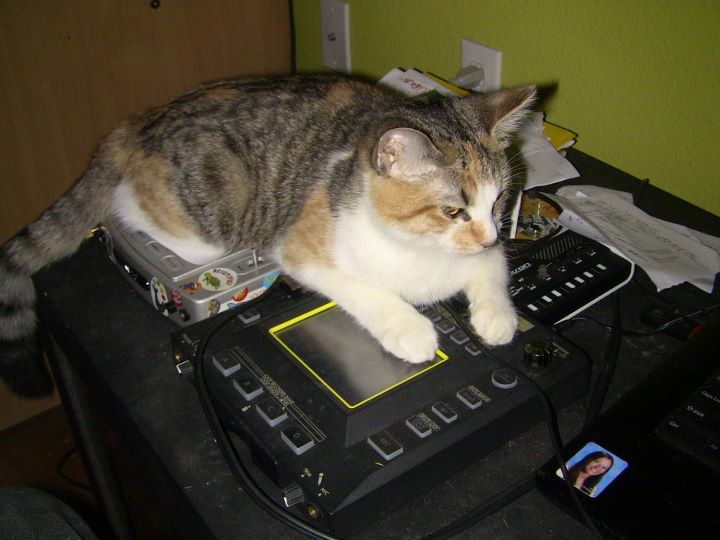
Another from The Wiggly Tendrils via our Facebook page.
Rocking out with my cat “Video.” She likes to chase my head phone and guitar cables while I dance around. There’s a Korg Mono/Poly in the background.

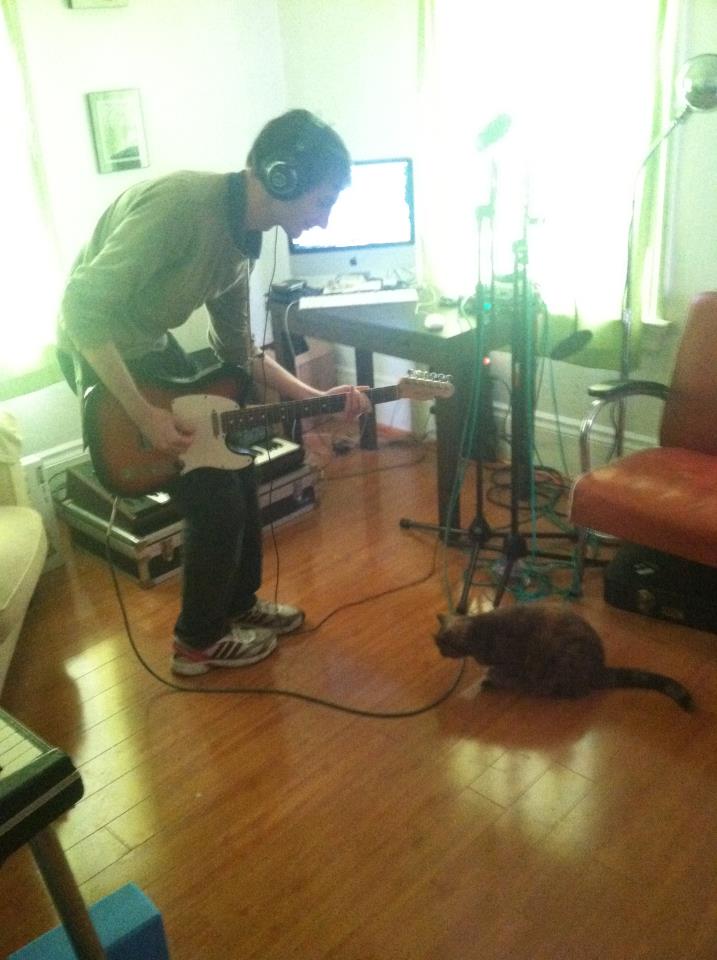
Another from The Wiggly Tendrils via our Facebook page.
Rocking out with my cat “Video.” She likes to chase my head phone and guitar cables while I dance around. There’s a Korg Mono/Poly in the background.


“Video” the Cat takes a stroll on a Wurlitzer 200e electric piano. Submitted by The Wiggly Tendrils via our facebook page.
One may argue that a Wurlitzer electric piano isn’t a “synthesizer” per se. But electromechanical pianos (Wurlitzer and Rhodes) are among my favorite instruments and feline pictures with them are always welcome here!
Me too. I bought this one in Oshkosh Wisconsin years ago at the music store that time forgot. The guy was renting them out to piano students who didn’t have pianos at home. (their original purpose) I eventually talked him into selling me one. I love it. I also briefly had a Yamaha CP-70 but had to sell it when I moved from Philly to Berkeley.


Another from Sawa Masaki featuring Taro.
If you would like to have your own cat-and-music pictures appear on the blog, you can submit it via Facebook, Twitter @catsynth, or contact us.
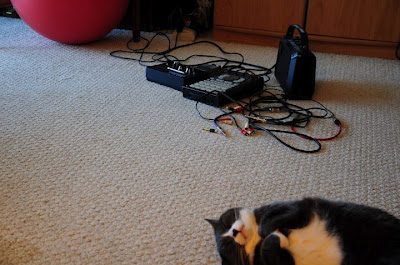

Via matrixsynth.
If you have your own cat-and-gear or cat-and-music picture you would like to see on the blog, you can share it with us via Facebook, via Twitter @catsynth, or contact us.

From our friends at polynominal.com, another video featuring images of Mimi. The modulated sounds are quite interesting as well – lots of rich noisy timbres.
“For more info, longer demo and more, please visit the arp odyssey page at this URL:
http://www.polynominal.com/site/studio/gear/synth/Arp_odyssey/index.html”
By KidsAtMidnight on YouTube, via matrixsynth.
PHOENIX – Love Like A Sunset Sound (nearly)
Was supposed to be working on new track (and feeding the cat) but got sidetracked by the MoogerFoogers. Found a sound a bit like the mad glissando CS80 at the start of Love Like A Sunset so tried to work out the part a bit. Stole the Marimba-like bit from the Multitrack they put online.
Arthur (cat) was just hungry and attention seeking. He’s not normally too bad a chewer. Mind you, I did find all but one knob from my Digi002 in the hallway once. Bad boy …
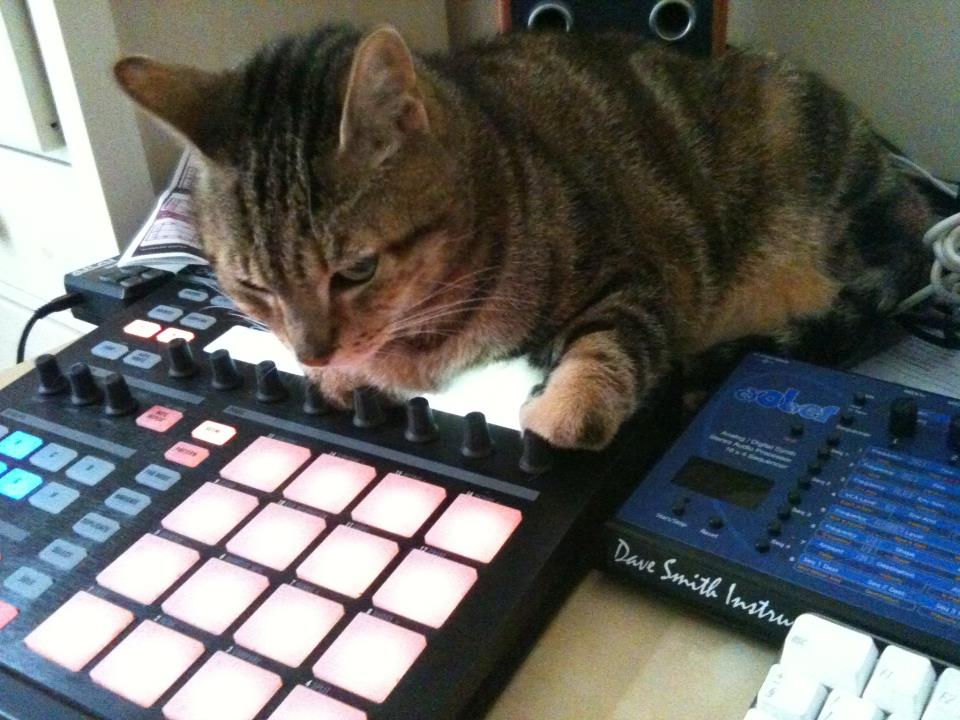

Submitted by Alessandro Automageddon on our Facebook page.
The Evolver is a particular favorite here at CatSynth. Always great to see it make an appearance with the cats.
Moog Little Phatty and the Scanimate
From experimentalsynth on YouTube, via matrixsynth where you can read more and see more images. A cute black cat makes a cameo appearance during the video 🙂
“The first attempt at controlling analog video animation with control voltage created by a Moog synthesizer. Learn more at www.scanimate.com and www.experimentalsynth.com”
“Scanimate is a 100% analog video animation system in use form the late 60s to early 80s. It was used on a number of popular films & TV shows including, Star Wars, Logan’s Run, Sesame Street & NBC Sports. Only eight were built and they originally sold for around $1,000,000.”
It’s interesting to consider in the context of the recently released LZX analog video modular synthesizer.
The first Thursday of this month featured an impressive performance by Andrea Centazzo together with Gino Robair at the Luggage Store Gallery in San Francisco. I had missed an earlier performance of theirs at another Bay Area venue earlier the week, but glad I was able to make this one.
The evening opened with solo sets by Trevor Dunn on upright bass and Travis Laplante on saxophone. Dunn’s set unfolded as a single piece, which had just started when I arrived. It was a combination of long bowed notes that are part of traditional bass practice along with timbral effects and more percussive extended techniques. The low tones filled the room nicely and provided a more meditative start to the evening.

Laplante’s solo saxophone set was quite a contrast in terms of energy and dynamics. It was nearly all extended technique with fast runs of notes. And it was quite loud. Given the acoustically active nature of the Luggage Store Gallery, this made for some interesting effects. I think the combination of the two sets worked well. Dunn and Laplante were touring the west coast of the United States and Canada together, so I suspect their contrasting styles played into their other performances as well.
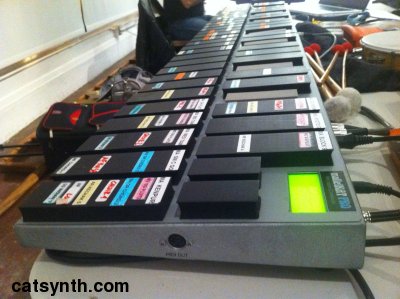
Afterwards, the audience shifted 90 degrees towards the front of the gallery, where two tables festooned with a variety of percussion and electronic gear awaited the start of the second set. Andrea Centazzo’s table was dominated by the MalletKAT, a marimba-like electronic controller.

He also had a variety of small acoustic percussion, as well as this toy that he said was from a previous visit to San Francisco in the 1980s.

Gino Robair had his usual assortment of percussion, noisemakers and electronics, including the Blippo Box and his signature broken cymbals.
The set began in either a dramatic fashion, nor in an especially subtle way. It was well timed and well balanced and drew one quickly into the music. As I have said on previous occasions, a masterly improvisation performance will balance rhythm, dynamics and timbres into a cohesive whole, and this performance was no exception. Even with the “noisy” source instrumentation, I felt like the interaction of the performers created a harmonic structure of sorts to go along with the rhythms. And the electronic and acoustic elements blended well in this context. You can hear a short excerpt in this video:
Overall, this was a great performance, and I sat quietly and intently in full absorption of the music, foregoing the note-taking I sometimes do during experimental-music concerts. And it was a perfect conclusion to what had been a long day of not only experimental music but art-gallery openings. But that is another story.