Demo.
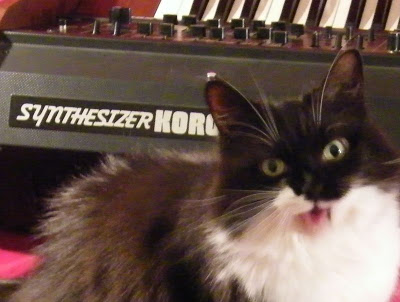
The Koma pedal has a gate and a very short delay.
At the end of the delay range the Koma gets in a kind of a bit-crusher sounding effect.
This is not often found at a analog pedal.
This is because Koma has modded the chip!
Also on matrixsynth, where you can see more videos and find out about the KOMA Elektronik “YouTube yourself!” Competition. They are going to be at NAMM next week.
via KOMA: “By the way, we love cats in videos! ;-)”
From Appliancide, where you can read more about the project.
I ordered some knobs and switch covers for the Doepfer modules, so they will blend in with my DIY stuff better. I am working on a second case and the modules to fill it. I will try to do a start-to-finish pictorial on one the modules this coming year. We’ll see. I like to build slow and rock out to music. Taking pictures cramps my style.
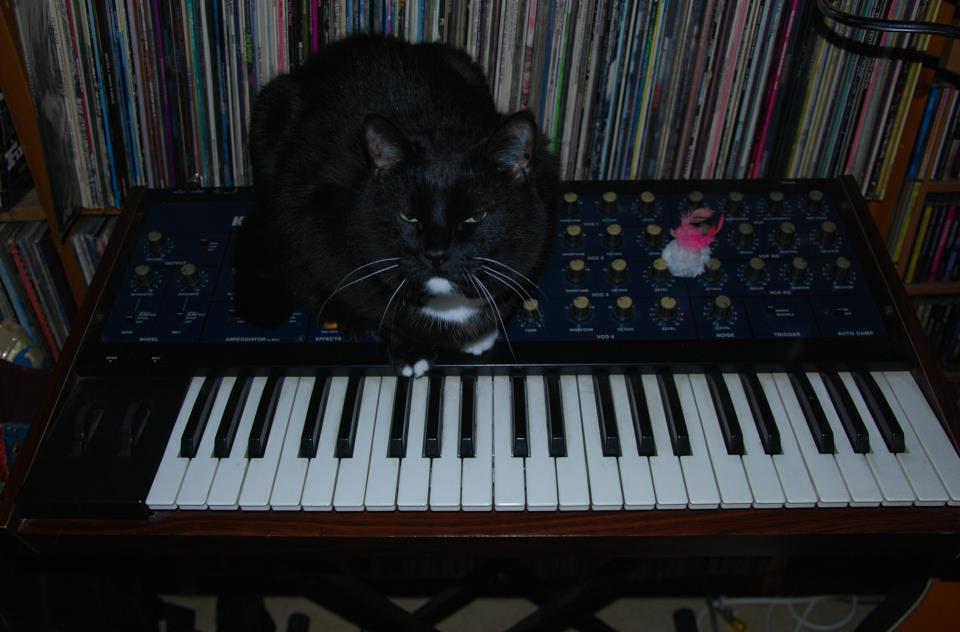
For our first Weekend Cat Blogging of 2012, we reprise the original photo that launched this site. Here is Luna with the Novation keyboard on the beanbag chair near the turn of the new year.
Luna is all grown up compared to the youngster in the original photo in 2006, but she still has the same fur and eyes. And she still favors this particular beanbag chair as her own. Indeed, it’s a favorite napping spot here in the studio area:
I didn’t realize until looking at the original against these photos how similar the windows look, even though the original was in a completely different place.
The studio is a currently a focus of attention here at CatSynth HQ in that I am trying to further make it into a better organized laboratory for musical and visual creativity. And it also has to continue to double as the office, the place where the computers sit and where I pay the bills. I expect that Luna will continue to spend lots of time here as well.
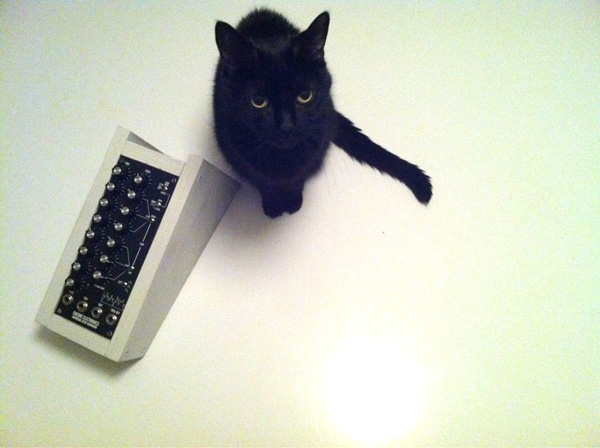
Passive dual diode ring modulator with internal connections that can be break by inserting audio plugs.
When only input 1 and 2 are used, output 1 is the ring modulation output, output 2 is the singal of output 1 being modulated again by input 2 (de-modulation output).
When input 1, 2, 4 are used, output 1 is the ring modulation output, output 2 is the singal of output 1 being modulated by input 4.
When all 4 inputs are used, it can be 2 totally indepented ring modulators.
Very versatile!”
I received some sad and sudden news this past Saturday that Richard Lainhart had passed away on December 30. It was only the day before that I had posted about our show in November at TheaterLab, in which I had played in the his project, the “Orchestra of the Future” that improvised a score to his film “The History of the Future.” I don’t know whether this was his last performance, but I am honored to have had the chance to share it with him. My condolences go out to his family.
Richard Lainhart had a long history in electronic music as well as more traditional jazz and rock idioms. He was deeply involved in the resurgence of analog synthesizers in contemporary electronic music, and I had seen him bridge old and new technologies with a Buchla synthesizer, Haken Continuum keyboard and laptop. His music had a richly textured minimal feel to it, but with a lot of timbral detail that comes from practice with electronic musical instruments. (Listen to (soundcloud tracks for examples.) He also was involved in animation and filmmaking, combining his electronic music and animated films at major festivals.
Below, are two videos. First, his duo with Lucio Menegon at the TheaterLab performance, and in 2010 at the Omega Sound Fix.
We had first met in person at the Omega Sound Fix. He was friendly and open, and has been supportive of my music and of this site. He will be missed. His Facebook page continues to receive messages from friends and admirers. And matrixsynth has a full article in remembrance of him and electronic musician Mel Morley (midimel) who also passed away recently. Of Lainhart, he says “Rest in peace, Richard, you were one cool cat.” I think that statement would apply here, too.
As has become a tradition here at CatSynth, we present our end-of-year image.
[Click to enlarge.]
It was a bit of a challenge to decide what to put in, as there were so many this time. But I think these are particularly representative. And it’s also significant that it is more colorful than previous end-of-year images.
The first few days of this year were quiet and a bit dark. That changed quickly, with tumultuous events around the world, and new experiences close to home. It’s the year I finally had a photography show, and by the end of the year I had several. There were new surprising types of performances and the costumes to go with them. I deepened my connections back in New York with friends, music, art and the landscape. And I no idea what I would have the chance to participate in something like the Occupy movement . There were many sad moments as well, with the loss of friends.
In all, 2011 has been particularly rich and productive, if sometimes a bit chaotic. If one had told me at the end of 2007 or 2008 (or 2001 for that matter) that this is what life would be like now, I would have been pleasantly surprised. There is a sense, however, that the patterns of this past year are not sustainable. This will have to be part of the plan for 2012, in particular getting organized, staying healthy and trying to make good choices. We will see how that unfolds as the new year progresses…
Happy New Year and thank you for all the support and warmth from those who read these pages!
Earlier this month, I participated in a show at the Luggage Store Gallery in San Francisco called Space Music Night that turned out to be quite memorable. So what exactly is “space music”? It is not straightforward to come up with a definitive answer, except that it should reflect some sense of “outer space” as one might imagine it. Or, perhaps more accurately, as people might have imagined it in the 1960s and 1970s. The music that we performed that evoke “space rock” that one might associate with early Pink Floyd or Gong, but also more freeform ambient soundscapes. The latter comes closer to ambient music one might hear on NPR’s “Hearts of Space” program but without crossing over that dangerous line into New Age. The music was certainly contemplative at times, but retained an edge to it and often veered back to rock and jam idioms, and moved back and forth between defined harmonies and more abstract timbres. The “space” effect was also heightened by having a dark room with abstract video projections by Tim Thompson.
The show was divided into two sets with four musicians each. Although many of us were familiar to one another, this was the first each each set of four played together as a group. The first set featured Matt Davignon on drum machines and effects, Kristen Miltner on electronics, Karl Evangelista on guitar, and Andrew Joron on theremin. Musically, this set had a very thick electronic texture with a soft beat from the drum machines that came in and out of presence. The electronics and heavily processed guitar provided anxious harmonies, and the theremin seemed to be narrating a space story with warbles and slides that approached the rhythm of human speech. At moments, the rhythm dropped out altogether, while at others it came closer to an extended jam. You can hear a bit of the set in the following video:
In the second set, I performed with iPad and the Dave Smith Evolver, along with David Leikam, Sheila Bosco on drums, and Steve Abbate on guitar. Perhaps it was the instrumentation of the set, or the musical leanings of the performers (including myself) towards strong rhythm, but we very quickly gelled into a steady rock jam rhythm that extended for most of the length of the set except for avery deliberate breaks. I mostly used Sunrizer on the iPad to provide ethereal harmonies to set again Leikam’s Moog Rogue and his “electric bass cello” and provide structure for melodic improvisation. This was definitely approaching the “space rock” idiom that inspired the evening.
I was quite happy with how well we able to play together despite having not played together before, and indeed a few people afterwards expressed some surprise that we hadn’t. But perhaps we will get a chance to play again.