We at CatSynth are always happy to get submissions of new pics from friends. If you discover or create any cat-and-music pictures, you can submit them via our handy submission form, or on facebook or twitter @catsynth.
Today I specifically wanted to post some cat-and-iphone-music videos. While these don’t quite rise to the level of iggy investigating the iPad, they do make use of the popular “cat piano” app for iPhone.
The black cat in this video looks a bit like Luna.
I do of course have this particular iPhone app, and have even used it in some shows. Luna has shown very little interest in it, however. She is clearly jaded from gadgets making strange sounds (even cat-like sounds)
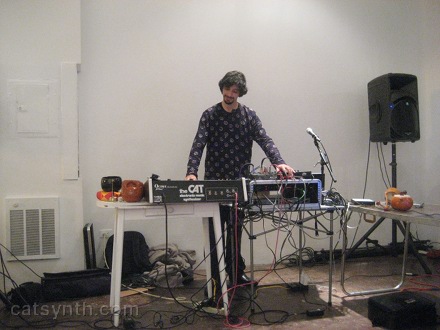
Sometimes things linger undone for a quite a while. And that is the case with reviewing the Quickening Moon Concert, which I am finally getting around to doing as the next Full Moon concert is about to happen. Basically, the process goes like this. I wait a few weeks to look at the video of my own performance with a fresh perspective. I review the videos. Then post them online. Then a few more weeks pass as life intervenes. So here were are, finally getting to it many “moons” later. Memories of course fade over time, but even going by my own recollections, there is much to recall fondly. Bottom line is that it was a really good performance, in fact I would consider it one of my best solo electronic sets to date. This was in no small part to the advance preparation, but also to the audience, which filled to the Luggage Store Gallery to standing-room only capacity!
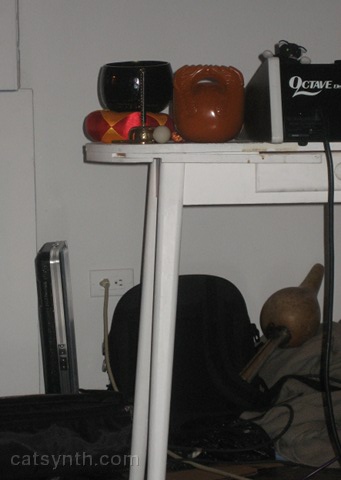
This was also one of the larger setups, featuring the Octave CAT vintage analog synthesizer, E-MU Proteus 2000, DSI Evolver, Korg Kaoss Pad, a Mac laptop running Open Sound World and Max/MSP, and the Monome controller, along with an array of my folk instruments from China and India. Even the iPhone made an appearance as an instrument.
[Click images to enlarge.]
Of course, the highlight of the set was the premier of 月伸1, featuring improvised electronic music set against a video of Luna. Musically, I focused on the Octave CAT (seemed appropriate) with the other electronic instruments in a supporting role. You can see a full video of the performance of this piece below:
The music was improvised live, with some prepared guidelines. In this way, it was reminiscent of the live music performances from old silent films. I kept the music relatively sparse and maintained the focus on the visual elements, which moved back and forth between clips of Luna and abstract visual elements (you can read more about the video production here). The audience clearly responded to the video of Luna and the music, and their laughter at very points reminded just how funny a piece this was. It was easy to lose sight of that in the hours of very detailed and very technical preparation, and one of the delights of playing in front of a live audience. I also heard from people that could tell they were able to sense the affection for Luna that came through in the video, though the long shots and the breaks in the otherwise silent video where her voice came through.
The balance of the set leading up to 月伸1 featured various combinations of electronic and acoustic instruments. The monome was my main controller in several of the other pieces, including the opener that focused and live sample loops and patterns from the folk instruments.
I played the instruments live, and then replayed the samples in various patterns on the monome to create complex timbral and rhythmic patterns. I also used the monome in a later piece to control some very simple but musically interesting sound synthesis, as can be seen in this video.
The lights on the monome are visually compelling, but also provide a link for the audience between the actions (which are really just button pressing) and the music.
Several of the pieces including strong rhythmic elements, which helped propel the set forward – I even saw at least one person “grooving out” to one piece.
I replayed several of the pieces (but not the video) in another performance a few days later at the Meridian Gallery. I certainly hope I will have an opportunity to the video again as well.
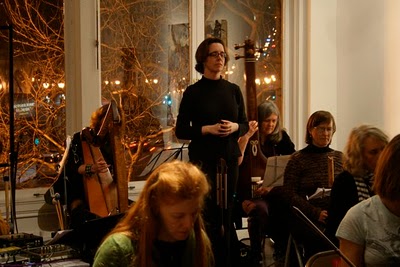
My performance was followed by the premier of Polly Moller’s Genesis. Genesis is “a musical experiment in which the M-theory of the 11-dimensional universe combines with the inward and outward spiral of the Western magical tradition.” The 11 member ensemble represent the 11 dimensions (which include Universal Time, the three spatial dimensions, and seven others) who combine to bring the “New Universe” into being, as portrayed by Matt Davignon on drum machines.
[Photo by Tom Djll.]
Polly Moller conducted the piece, not from the traditional podium in front of the ensemble, but rather by walking in an inward and outward spiral among the performers. As she walks by, wind chimes in hand, different performers enter or exit. As the New Universe comes into being, Matt Davignon’s electronic performance emerges, culminating in an extended solo as the 11 performers representing the “parent dimensions” fade out.
Quite fortuitously, someone turned my video camera to face the ensemble, so I was able to capture some video of the performance. In the clips below, one can see the conducting by walking in a spiral, as well as parts of the New Universe solo.
As I prepare for my next performance with Reconnaissance Fly tonight (details here), it seems like a good time to look back at last week’s In The Flow Festival in Sacramento.
My roadie friend and I arrived in Sacramento around 12:30 to the rather calm and rather pleasant jazz-guitar sounds of the Nahum Zdybel Trio. As we wandered off for a quick bite to eat, I was thinking how much of a contrast our own set would be. When I returned to set up, the ensemble on the other stage lead by Henry Robinette was harder and more driving – with much stronger drum, bass and rhythm guitar – but still straight ahead jazz.
[Reconnaissance Fly: (Tim Walters, Polly Moller, Amar Chaudhary). Photo by Jen Hung. Click to enlarge.]
So then it was time for us to perform. Our set begins with my graphical improvisation piece Small Chinese Gong, a complete 180 degree turn from the previous sets, though it does feature a short section of tongue-in-cheek early 1970s lounge jazz amongst the free improvisation and noise. We also did both of our rock-inspired pieces One Should Never and An Empty Rectangle (written by Tim Walters); a more refined version of The Animal Trade in Canada with both a bluesy “Ca-na-da” rock-out and an Afro-beat jam; and an abridged performance of our epic Ode to Steengo. All the pieces feature spoetry, i.e., spam messages that rise to the aesthetic level of poetry.
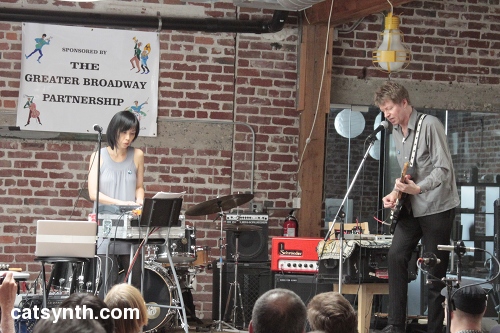
Our set was followed by Fig, the duo of Nels Cline and Yuka Honda. Their set started relatively calmly and quietly, but by the time I finished packing and had a chance to wander over to the other stage, things began to get a bit louder.
[Fig (Nels Cline and Yuka Honda). Click images to enlarge.]
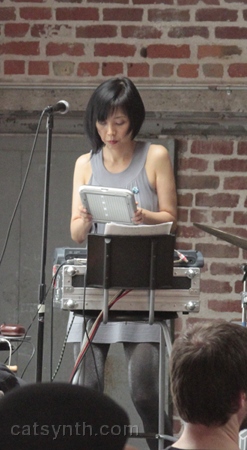
Nels Cline alternately set driving heavily processed guitar rhythms and long virtuosic lines against Honda’s beats, which featured highly synthetic percussion sounds. Often, she was playing a Tenori-on, as featured in the second photo. Overall, the set moved back and forth between beat-based sections and “skronking” (i.e., arhythmic and often noisy performance with fast runs of ntoes), ending with an extended guitar-and-drum-machine jam with a more techno feel.
The next set (back in previous room) was Ambi, a duo of Stuart Liebig and Andrew Pask. As the name suggested, the music had an “ambient” quality to it in that the sounds created an environment for the listeners more than individual lines and riffs to focus on. The set opened with lots of one-off percussion samples with pauses of varying length, some notes being very isolated and others coming in small clusters. On top of the percussion hits were layered long “space-like” sounds, liquidy bass notes and saxophone. Gradually, beats emerged from the ambient mix, but the patterns were regularly broken by other off-tempo sounds. I did notice they were using a Monome, a complement to Honda’s Tenori-on from the previous set. After a while, the beats become stronger and more stable, but were again interrupted by the sound of a thunderstorm that gave way to analog-sounded filtered arpeggios. Towards the end, the set, which unfolded as one long piece, evolved into a jam between bass (Leibig) and saxophone (Pask). It concluded with a driving funky bass riff, which stopped suddenly in mid-motion, an ending I found quite effective.
After this set, we took a break from the festival to explore a bit of Sacramento, including the immediate neighborhood and some of the downtown. This excursion inspired last weekend’s Fun With Highways: Sacramento Edition article.
We arrived back at Beatnik Studios in time to L Stinkbug, featuring GE Stinson, Nels Cline (again), Scott Amendola and Steuart Liebig (again). There was certainly a lot of “double-dipping” in the lineup of the festival, but that seems appropriate for an event focused on improvisation, and the performances among the different combinations of musicians can be quite different. L Stinkbug was, if nothing else, loud. Certainly, these are all very technically adept musicians, and the combination of driving beats and skronking should be relatively loud, but perhaps a little less so in this particular space. We moved back and forth between the main stage and the adjacent room to avoid the full affects of the volume.
If there was one overall regret from my abbreviated experience at the festival, it is that it was an abbreviated experience. I missed a few sets that I would have liked to see, including Vinny Golia, whom I had heard at last year’s Outsound Music Summit, and the Thin Air Orchestra, featuring many familiar wind players.
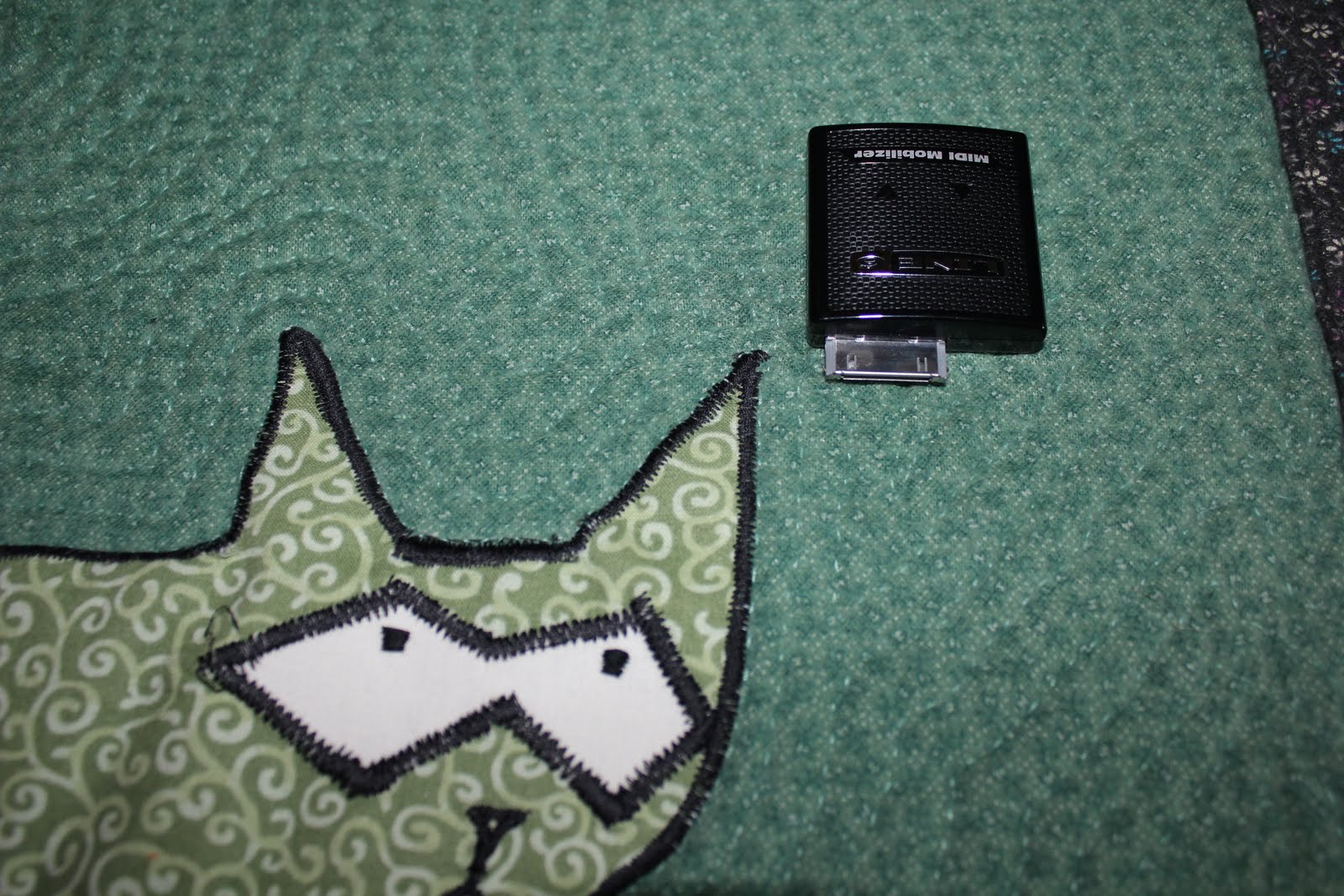
As an iPhone (and probably iPad) user, this was definitely of interest to me, and I encourage anyone else who is interested to read the full review. For now, I am reposting because of the cool pictures, including the backdrop sheet with the cat 🙂
“YAMAHA DX7 SYNTH EXTRAS. Original list price $2195 EXTRAS(see pics)3 CARTRIDGES, PADDED “PROTECT” CASE, YAMAHA VOLUME/MODULATOR/SUSTAIN 3 PEDALS, MIDI CORD.”
How the mighty have fallen! When I first got into synthesizers back in the mid 1980s, the Yamaha DX7 was the instrument to have – and at that list price out of reach for most teens. Now they go for about $250 on eBay. And they are no longer all that interesting. I do have a TX802 but have rarely used it.