Submitted by Jon Kull (no website given):


Looks like someone found a comfy spot in front of the Moog…
Submitted by Jon Kull (no website given):
Looks like someone found a comfy spot in front of the Moog…
 I quite liked this closeup of Luna with the white stripes. It's actually a color photo, but the subjects and lighting make it appear grayscale.
Zooming out, we can see that Luna is actually tracking a bird outside on the patio.
While Luna continues to enjoy her hunting games through the window, Sundance takes his first trip outside, complete with harness. He is also hosting Weekend Cat Blogging #96 along with Upsie and Sher. Check out their photos and all the other WCB fun when they post the roundup.
Actually, there is one more photo in this series. What is that big bubble-wrap thing behind Luna? It's actually quite appropriate for this forum:

Synthesizer fans might recognize the faint logo of an Octave CAT. It just arrived yesterday, but will remain wrapped until I bring it into the office for a little repair work. I'm sure we'll be seeing a bit more of “Octave The CAT” on these pages in the near future…
This one was submitted by both elba (who enjoys one of my favorite activites: not shopping at WalMart) as well as brrer:

A bengal with the “very analog” instrument: a classic Jaymar toy piano. My parents found one of these on someone's curbside several years ago – it's amazing what people throw out. When I tried it out, I immediately recognized it as the instrument used in recordings of John Cage's Suite for Toy Piano.
Thanks to everyone who has been submitting photos in the past week or so. I'm a little backlogged at the moment, but I will get to posting them all, among all the other articles I want to write for this forum.
 Well, this is a first! From experimental artist brrer, we have a cat-and-synthesizer tatoo:

At br'rer's myspace page is a processed photo of the same cat and synth (or at least it appears as such), but it's a bit on the blinky side…
A prolific week for catsynth pics.
Two more photos via matrix:
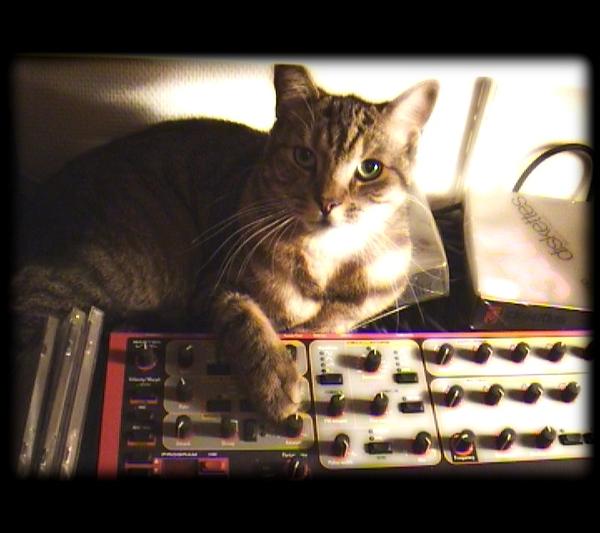
“Cat and Nord” (the original title) sounds to me like it should be expressed in French: Le Chat et Nord.
Next, we have another photo of Bob from Maggie Osterberg:


Remember Mimì? Well, it looks like she's graduated from sleeping on synthesizers to programming them.
Thanks again to polynominal for submitting the photo and his continued support of this site.
Via our friend matrix, we have a trio of recent photos of cats and synths.
First we have Scooter and Bob (Moog, that is.), originally from Maggie Osterberg at flickr:

Next, we have a big fluffy cat with an Anywhere modular, originally from sequencer.de:

And finally, and quite appropriately, the “Matrix Cat” laying claim to an Oberheim Matrix-6r. Originally from synx508, whose cats have appeared here before:

Thanks to matrix for collecting and posting these photos, and for putting up with a lot of cranky comments in response to them. In particular, “Matrix Cat” seems to have generated a lot of harsh comments about how cats and synthesizers should not mix. Lighten up, folks!
From sendling we have this video of artist (co)sine. Great stuff, and it's at Luna's Cafe! How could I not repost.
 Scrolling down one post earlier at sendling, we see a familiar face. Remember Mimì? Well, it seems that she's been making the rounds since her debut here at CatSynth, popping up at sendling and matrix. Go Mimì!
cat
synthesizers
cosine
electronic music
noise
luna
cafe
mimi
 A special treat for listeners of my podcast this Sunday! I am releasing a full-length (but lower fidelity) track from my RPM Challenge album, 2 1/2.
“Four Days” is a piece in the style of musique concrete, and fits into the overal narrative theme of the album 2 1/2. It has a really captivating and eerie quality, perhaps even a little spooky.
Enjoy!
(and please check out the current recordings available if you like it)
Well, it's been a pretty intense few days finishing up the RPM challenge, but we made it! Finished recording on Feburary 27, did some very cursory mastering and CD artwork on Feburary 28, and today, March 1, assembled the finished goods:


The final title was indeed “2 1/2”, and the final track list was as follows:
01 Prologue – Jerry Gray (1951)
02 Fragments in Gray
03 Twista Dilemma
04 Trieste 116
05 Four Days
06 ghanaplasticity
07 microkitty
08 RPM Filler Track
09 pique
10 Happy Machine
11 Epilogue – Count Basie (1953)
Musically, it's a fairly mixed result, some tracks were exceptional, others need a fair amount of work, which I can do at my leisure outside of the RPM challenge. But it is still a fairly good result for what was really just 2 1/2 weeks of solid work amidst the various other dramas of this past February…
At 11:30 this morning, I mailed it out from the post office in Scotts Valley, California. And with this simple act, it is done.
You can read some more detail of the last week on my rpm blog. As for me, it is time to rest.