Fun with Emulator X: Bohlen 833 cents scale and harmonics

I have been experimenting lately with alternate tunings and scales. A couple that have particularly piqued my interest are the Bohlen-Pierce scale and the much-less-used Bohlen 833 cents scale. The latter is intriguing in that it is based on properties of the fibonacci sequence and the golden ratio (although Bohlen admits he did not have those concepts in mind when he stumbled upon this scale).

Based on the golden ratio (1.618034…), one can construct a harmonic series as multiples of 833 cents that has a very distinct timbre. This can be easily implemented in Emulator X as a series of sinewave voices (or voices of any other harmonic single-wave sample) tuned multiples of 833 cents above the fundamental:

The series above consists of a fundamental, three golden-ratio harmonics, followed by the octave above the fundamental (traditional first harmonic 2:1 ratio), and the three-golden-ratio sub-harmonics of the octave.

Using these and other harmonics, Bohlen was able to construct the following seven-step scale between the tonic and the tone 833 above.

Step
Ratio (dec.)
Ratio (cents)

Diff. to previous step (cents)
0
1.0000
0
1
1.0590
99.27
99.27
2
1.1459
235.77
136.50
3
1.2361
366.91
131.14
4
1.3090
466.18
99.27
5
1.4120
597.32
131.14
6
1.5279
733.82
136.50
7
1.6180
833.09
99.27

Emulator X does not have editable tuning tables, although it does have a 36ET tuning (36 divisions of the octave). Bohlen suggests that playing specific steps out of the 36ET scale yields a good appoximation of the 833 scale:

Step (just)
Cents (just)
Step (36/octave)
Cents (36/octave)
0
0
0
0
1
99.27
3
100.00
2
235.77
7
233.33
3
366.91
11
366.67
4
466.18
14
466.67
5
597.32
18
600.00
6
733.82
22
733.33
7
833.09
25
833.33

Combining the Bohlen 833 scale and harmonic series, which are both based on the golden ratio yields a new tonality. Although it is quite different from the traditional Western tonality based on integer ratios, it is nonetheless “harmonic” with respect to its own overtone series. This is perhaps a simple counter-example to to the Monk's Musical Musings from an earlier article.

But how does it sound? To that end, I provide the following audio example consisting of the scale played on the 833-timbre in Emulator X, along with some additional intervals. Because this is only an approximation using 36ET, things aren't perfectly “harmonic,” but I think one can get a feel for the tonality. I particularly like the “tri-tone” (600 cents above fundamental) here.

The next steps are to come up with a more musical timbre based on the harmonic series, as well as short composition using the scale…

Preparing for tomorrow's performance

My upcoming performance at the the plug.dos headphone festival provides some special challenges. Because the audience, both at the venue and online, will be using headphones, I need make sure my sounds and processes are headphone-safe, i.e., low volume with no clipping, glitching or large volume-spikes. More positively, I can take advantage of a uniform stereo listening environment with deliberate pan and positioning effects.

The need for steady volume and stability rules out the use of feedback and high-resonance filtering that I use in a lot of my recent music. Thus, the Evolver is out. Many of my Open Sound World patches are probably not approrpriate, though stable-volume patches are certainly doable.

I am focusing on Emulator X controlled with a MIDI keyboard (E-MU Xboard25). Thus, my preparations have focused on selecting existing sounds from the E-MU sound library that meet my technical and aesthetic requirements, and creating some new sounds. One preset that I spent a lot of time building is a modification of my additive synthesizer for Emulator X, consisting of eight independently controllable sinewaves. In addition to MIDI control of amplitude and frequency, I use a function generator to add amplitude modulations do the sinewave components of the timbre. Additionally, each “note” played has an independent pan position, spreading the sound across in the stereo field. I have also modified some existing sounds to include stable amplitude-modulation effects. The end result is a highly-controllable pallete of sounds from which I plan to make an ambient but punctuated sound scape, with a few rhythmic elements for good measure.

Logistically, this will be a very simple performance to travel and set up, just my laptop, the E-MU 1616m sound module, and the keyboard. I am looking forward to a relaxed, simple and enjoyable experience.

I'm not posting any advance examples, so you'll have to listen online to the show to hear what I'm describing. Hopefully I will be able to post a recording after the fact.


performance

Amar @ plug:dos headphone festival in SF, Saturday 9/9, 7:40PM

I will be performing live at 992 Paralta St. in San Francisco at 7:40PM on Saturday. Mostly experimental, “lowercase” (i.e., soft) electronic music. This is intriguing because it is a “headphone” event where people live at the venue as well as those listening online will be using headphones.

For those who are interested, you can also listen live online on Saturday. visit http://www.deletist.info/plugdose.html or
http://www.leplacard.org for more info.

Official press release below:

SAN FRANCISCO'S 2ND ANNUAL HEADPHONE FESTIVAL
AUG 5-6 2006
5LOWERSHOP COLLECTIVE WAREHOUSE
992 PERALTA AVE., SF
http://www.deletist.info

a festival within a festival, transmitting 48 live performances for 48 hours in participation with the worldwide interaural experiment known as LE PLACARD #9 – a self-organized nonstop streaming festival that migrates from city to city broadcasting headphone conterts to headphone people around the world from june-october 2006.
http://leplacard.org

admission is free
B.Y.O. HEADPHONES

[:] p l u g [:] 2005
last year, a constant flow of over 300 people plugged their headphones in at the 5lowershop warehouse on peralta ave to hear 48 headphone-only performances from the likes of beth custer, swoondoll, bunnyphonic, jeff ray, justino, neighborhood bass coalition, skullcaster, nullspace, sky sosa, toshio hirano, 666 gangsta, dj crackhouse, heartworm, members of subarachnoid space, ryan of slidecamp, mono, halcyon high, things falling apart, aaron x of the quiet american, viola-cello improv victor lowrie, sodium channel, useless unknown facts, tina butcher, the deletist, and many more..
a simultaneous pirate radio broadcast was heard at 104.1 fm, and untold numbers of listeners were plugged in at various listening rooms in LE PLACARD's global network. a live irc chat also allowed listeners to communicate during the event.
Wired magazine praised the festival, and LE PLACARD organizers in paris
dubbed [:] p l u g [:] “the best transmission of the year”

p l u g [:] dos 2006
this year, we return with 2 days of sound experimentation, continuing the diverse mix of acoustic, experimental, electronic, and non-genresfrom underground artists all across california. again, we will transmit a simulltaneous pirate radio broadcast at 104.1 fm, include the live chat for listeners, stream live audio through LE PLACARD's global network, and
due to popular demand, a live video stream will be added to this year's festival.

everyone is invited to listen, participate and experience this unforgettable event.

there will be food, drinks, merchandise, and more!


catsynth pic: Reed Ghazala Tape Canvas Device

I was reviewing Get LoFi for yesterday's circuit-bending article, and came across a reference not only to Reed Ghazala, whom I also referenced, but a catsynth pic to boot!

Who knew the “father of circuit bending” was also a cat person? Then again, perhaps I shouldn't be surprised…

The tape canvas (illustrated above) itself is interesting as well, allowing expressive control of a device and process that is traditionally linear. It inspires me to revive my interest in musical reading of barcodes using a CueCat, which has the added advantage of continuing the feline theme.


The CueCat has proved a difficult device to work with, however. I have a modified version that gets beyond some of the proprietary issues and shows up as an HID device that can be read in OSW, but I have yet to make it work properly.

Adventures in Circuit Bending: Vtech Tiny Touch phone

Last evening I embarked on a circuit-bending project, and this forum provides me a unique opportunity to document the experience.

For those who are not familiar with circuit bending, it basically the process of modifying the electronics in existing audio devices, usually simple analog circuits in musical toys. In the process, one can add new expressive controls to create a unique, albiet “lo fi”, instrument. A great introduction on circuit bending can be found at Reed Ghazala's Art of Circuit Bending. Additionally the blog Get LoFi has a wealth of information and circuit bending projects and instruments.

This experiment involves the Vtech Tiny Touch phone. It plays a few simple phrases relating to numbers and colors as the buttons on the phone are pressed. You can listen to an example here. Vtech toys are good circuit-bending fodder, and I've tried the phones before. During my first attempt, I shorted out the integrated circuit (oops), which ended that effort. The second time I did a simple bend across a timing circuit that allowed me to alter the speed and pitch of the sound with a potentiometer. I had this instrument open for kids to play with during the my show at Zeum in San Francisco this past spring, which turned about to be a death sentence for it. One kid happily showed his parents and me the capacitor he managed to pull off the circuit board. This time I'm going more slowly and methodically, with the goal of a more interesting and robust instrument.

First, we open up the phone to reveal its guts (i.e., circuitry):

Now grab a test wire (i.e., with clips on the ends) and start looking for interesting “bends” by shorting different points in the circuit. In general, this is a hit or miss process and experimentation is the rule of the game. However, care should be taken to avoid shorts that could damage the audio circuits. In particular, stay clear of anything that connects directly to the batteries.

A rather effective short is opposite corners of the IC board, as illustrated by the pink dots in the closeup below:

Shorting these leads, which essentially drops the resistance to near zero, slows down a timer and thus the speed and pitch of the audio, as can be heard in this audio clip. Note the slower version of the telephone ring. From this result, one can conclude that varying the resistance changes the timing and pitch of the sound, in particular highwer resistance yields higher pitch, with infinite resistance (i.e., open circuit) restoring the original behavior. Such a bend is a good opportunity for a potentiometer to mechanically change the pitch, or a photocell to use light as a pitch control. For now, I am attaching a photocell using alligator clips:


Cupping my hand over the photocell and moving it closer and further while pressing buttons yields variable-pitch sound and beginnings of a new circuit-bent instrument.

I could stop here and make this bend permanent, but I would to continue with other options, including switching between photo, mechanical, and null modulation, as well routing other signals over this bend to create FM synthesis. I will continue to document this project here as I find more time to work on it.

catsynth pic: Gingerbread

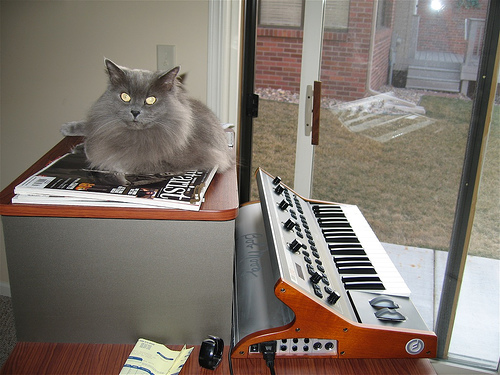
MIT Media Lab assistant professor Dr. Joseph A. Paradiso includes the above photo of his old Himalayan cat Gingerbread atop a synthesizer cabinet as part of his web page documenting his modular synthesizer. His collection of modules and writings about synthesizers are quite impresesive, and I've spent a bit of time looking through them. That is one of the fun things about looking for these pictures of cats and synths: it often leads to something more interesting.

Dr. Paradiso's synthesizer has received note in Keyboard magazine, and he had a synth rig featured at the 2004 PrixArs Electronic festival. He has some great photos of synth rigs from the 1970's as well.

Little Sound Dj and "lo-fi" synthesis

I came across some interesting resources while visiting Ouroboros Complex the other day, in particular references to lo-fi synthesizers for small devices, such as Nanoloop for the GameBoy. Unfortunately, there was no free demo that I could run on my VisualBoyAdvance emulator, but I did find another synthesizer/sequencer that did: Little Sound Dj. It is set up like an old-style tracker application:

One can assign notes within a phrase (or larger structures called songs and chains) to various instruments. The instruments can be pulse tones, noise, built-in drumkits (emulating several classic lo-fi drum machines like Roland TR and even a “drumulator”), and custom waves that you can hand edit:

Although it is cute and fun to play around and see what one can do with such a limited but nonetheless interesting pallette, I think it falls short for actual musical work because of the interface and lack of interoperability with my other software and hardware instruments. Much of the lo-fi synthesis can be easily accomplished with OSW (check out the lo-fi and swiss_cheese tutorials) or several freely-available VST isntruments – and Ableton Live! remains a much more usable system for quick real-time pattern editing. I will be looking into some other lo-fi synthesizer plug-ins or algorithms to use in OSW and post more in a future article…

Actual Cat Synth

jfm3 of Ouroboros Complex posts about as literal a “CatSynth” pic as you can get, featuring his cat Kona and accoutrements as part of his rig. Cat aside, the rig and website include a wealth of personal experiences with analog synthesizer hacking as well as circuit bending (note the mod'ed Speak&Spell). Please give jfm3 and Kona a “catsynth welcome” by visiting their site.

fun with Emulator X and filter response

I have been experimenting lately with Emulator X as a synthesizer rather than a sampler, i.e., using only primitive sources (impulse, noise, etc.) and generating new timbres based on the filter section and other features of synth engine.

In one such experiment, I have built several patches based purely on the impulse responses of filters. By setting the Q of each filter (or each section in the Morph Designer), a highly tuned impulse response is produced. The center frequency can be controlled by keyboard input, thus creating a primitive but “playable” instrument. The following example uses a cascade of tuned two-pole filters on a single voice:

click here to play example

The more complex Z-plane filters can also be used to generate interesting impulse responses, though they are more difficult to control in terms of pitch:

click here to play example

In each of the examples above, the responses decay very quickly, yielding short percussive timbres. Longer decays require narrower-band filters, and even though the E-MU filters have very high Q (resonance), most are not narrow enough when compared to the filters used in resonance modeling The exception is the rarely used Contrary Bandpass filter:

The impulse response of this filter is a nearly pure exponentially-decaying sinewave. Combining several voices with different center frequencies, complex resonance models can be generated.

click here to play example.

Of course, these examples are far less efficient than the resonance-modeling tools Open Sound World, but by combining the models with Emulator X's modulation features, effects and voice management, some more interesting instruments can be created.