A soothing ambient track by George on his trusty Casio keyboard. Check out his Instagram for more performances.
He seems to really be relaxed and enjoying himself, too.

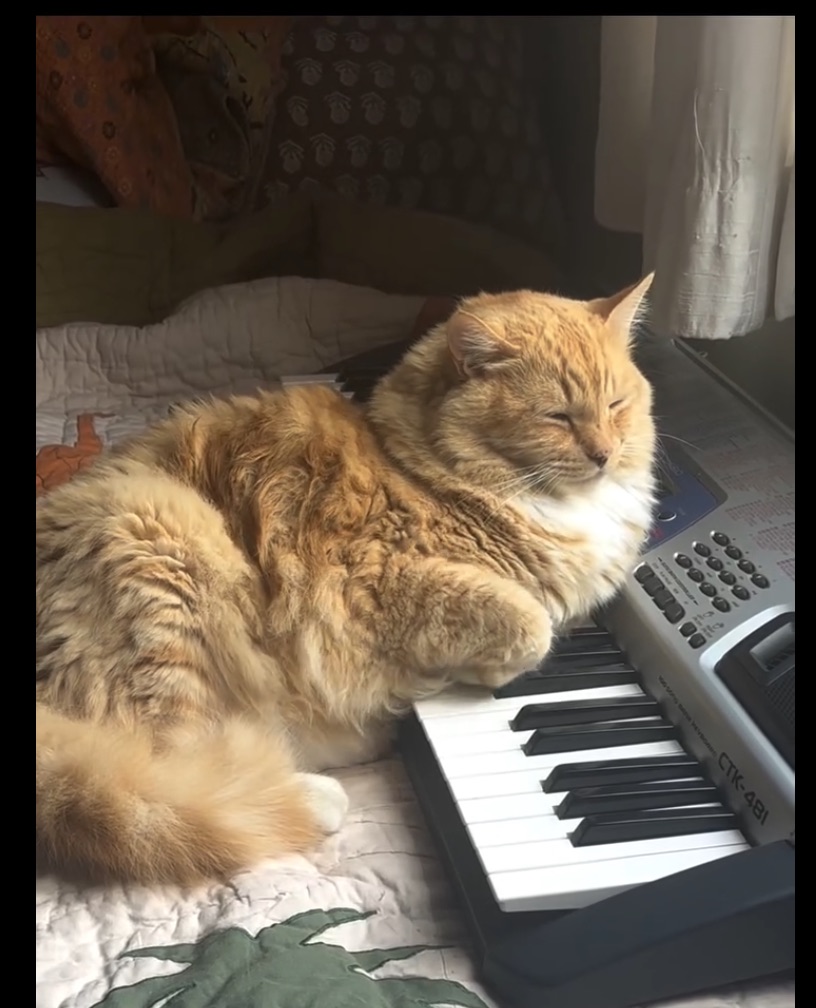
A soothing ambient track by George on his trusty Casio keyboard. Check out his Instagram for more performances.
He seems to really be relaxed and enjoying himself, too.
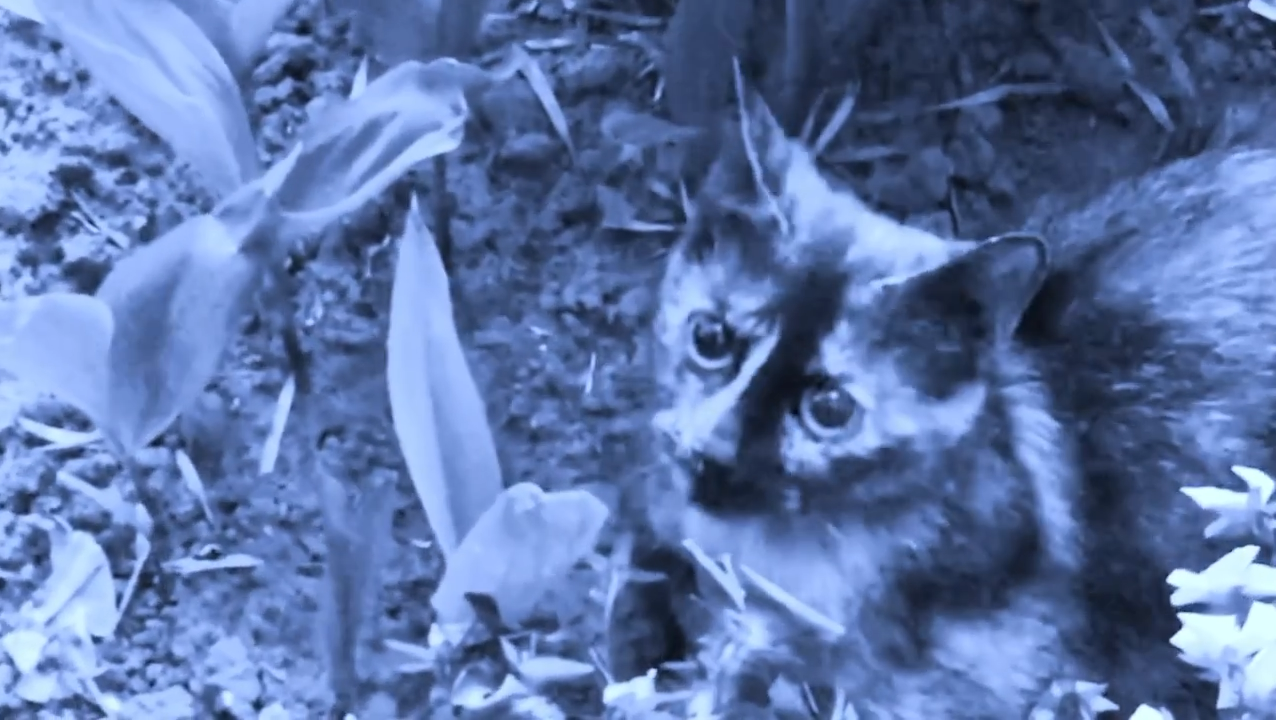
A beautiful video from Le Verger starring a tortie cat, along with abstract design and architecture – two other interests of ours here at CatSynth. Based on the tags, I am guessing the music is done with Korg instruments.
Two weeks ago, I participated in the 2010 edition of the Droneshift at the Luggage Store Gallery here in San Francisco.
The Droneshift has become an annual event, though this year it was part of the Full-Moon Concert Series, approximately coincident with the Long Nights Moon.
Droneshift is a collaborative concert of improvised drone music. Between 15 and 25 musicians will gather to contribute to a continuous 2 hour drone, each adding their acoustic or electronic instruments here and there, and weaving their sounds together to create gradually shifting tapestries of music. The performance will most likely shift back and forth from completely acoustic music to electric ambiance and post-industrial noise.
Basically, the two hour performance is one continuous ever-changing sound. No individual notes, rests, phrases, breaks, etc. That doesn’t mean it is at all monotonous – there are continuous changes in timbre, dynamics and expression, both within individual parts as various musicians enter and exit the sound.
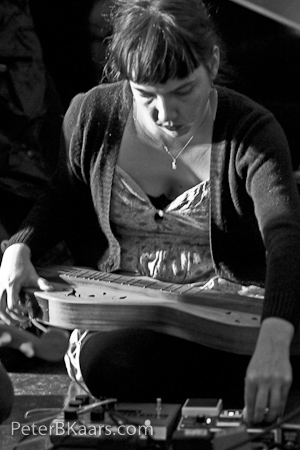
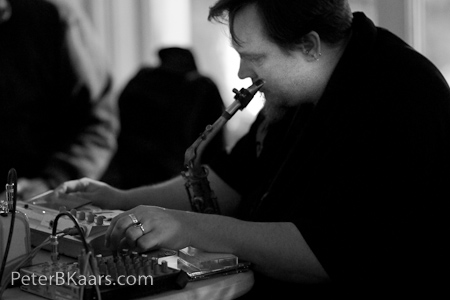
[Rachel Wood-Rome, Rent Romus. Photo: PeterBKaars.com. (Click images to enlarge.)]
There were actually close to (if not more than) 30 performers participating this year. The performers were arranged along periphery of the gallery with the audience situated in the middle looking outward. So between the audience and musicians, things got quite crowded. I was able to stake out some chair space for myself my minimalist setup:
I just had the iPad and an amplifier, and I was primarily running the Smule Magic Fiddle throughout my allotted time. It is a good instrument for droning, as one can linger on the strings pretty much forever, and play subtle pitch and dynamic changes. It’s easy to gradually fade out, and then fade in very slowly another pitch, which will change the overall sound of the performance without causing a distinct note break.
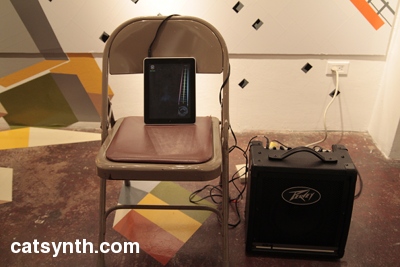
Because the nature of overall drone sound and the large number of participants, it was often difficult to focus on what any one other musician was playing. I mostly shifted between focusing on my own part and getting lost in the overall sound, which was quite meditative at times. I was able to take in some details, such as Matt Davignon’s distinctive glass-vase performance:
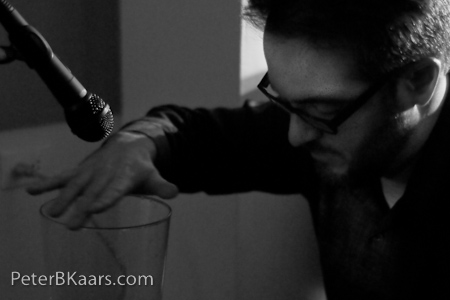
[Matt Davignon. Photo: PeterBKaars.com. (Click image to enlarge.)]
David Michalak’s Omnichord and Joe McMahon’s plastic-tube “didgeridoo” were also quite distinctive (particularly because they were sitting near me):
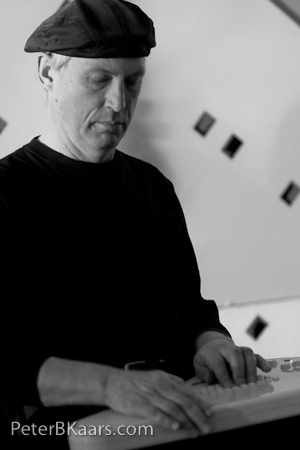
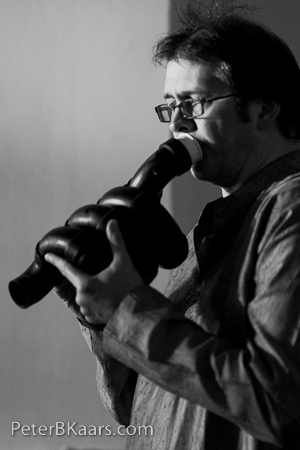
[David Michalak, Joe McMahon. Photo: PeterBKaars.com. (Click images to enlarge.)]
I was sitting across from Adam Fong on upright bass. There were moments when I took cues from him and other string players to re-enter the mix on Magic Fiddle. I was also trying to take cues from purely electronic musicians, such as Kristen Miltner on laptop or Andrew Joron’s theremin:
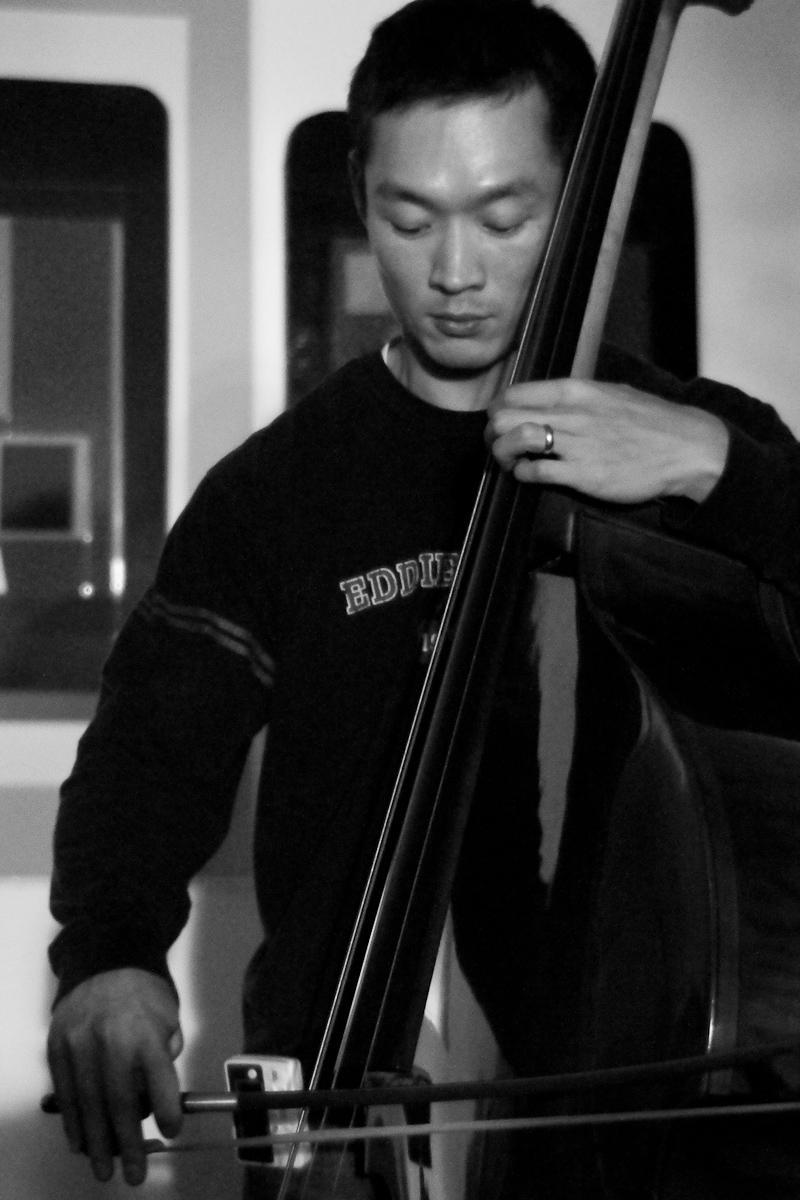
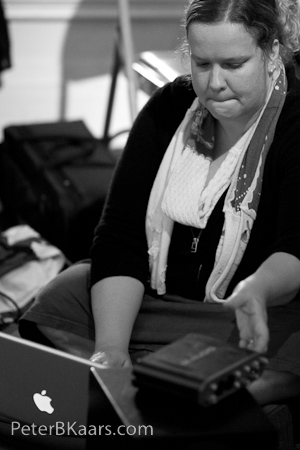
[Adam Fong, Kristen Miltner. Photo: PeterBKaars.com. (Click images to enlarge.)]
Overall, the instrumentation was quite varied and there was a balance between winds, strings, percussion and electronic, although there were a few moments were it seemed some low-frequency analog electronics were overpowering everything else. It was interesting to hear how the textures and orchestration evolved. Sometimes similar instruments (e.g., strings) would cluster together, sometimes the texture became more scratchy and granular with lots of noise elements – something which is pushing the boundaries of what might be considered a continuous “drone” sound. At times, traditional harmonies emerged, e.g., minor or diminished chords, while at other times the timbres themselves were purely inharmonic. There were very sparse sections with only one or two participants, and others that seemed to include much of the ensemble. All of these elements just happen organically, based on how the musicians hear one another and are inspired to layer on their own parts.
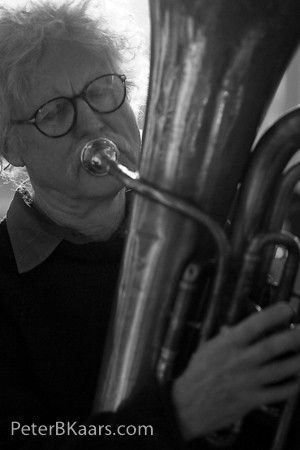
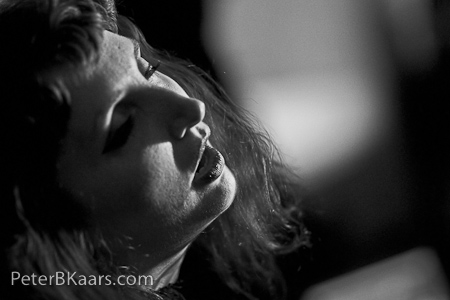
[Ron Heglin, Aurora Josephson. Photo: PeterBKaars.com. (Click images to enlarge.)]
You can listen to a ten-minute excerpt of the full performance in this video, courtesy of Matt Davignon:
As one can hear, the emergency vehicles that inevitably come down Market Street with sirens blaring during Luggage Store Gallery shows became part of the overall tapestry in this performance.
My personal sense of the performance as being meditative, perhaps even more so than previous Droneshifts, was echoed by members of the audience with whom I had spoken.
In addition to reflecting on the music, I would like to call out the photography of Peter B Kaars, which is featured in this article Those who have followed my own interest in photography know I tend to like very sharp, high-contrast black-and-white images. Additionally the monochrome fits with the full-moon theme and overall quality of the music they document. I wish I had space for more, or to call out more individual musicians. A full list of performers appears below:
Tom Bickley – wind controller
CJ Borosque – trumpet
Bob Boster – processed voice
Amar Chaudhary – iThings
Matt Davignon – wine glasses/vessels
Tony Dryer – bass
Adam Fong – bass
Phillip Greenlief – sax/clarinet
Ron Heglin – trombone/trumpet
Jeff Hobbs – bass, clarinet or violin
Travis Johns – electronics
Andrew Joron – theremin
Aurora Josephson – voice
Sebastian Krawczuk – bass
David Leikam – Moog rogue synthesizer
Cheryl Leonard – viola
Brian Lucas – electric bass / tapes
Melissa Margolis – accordion
Bob Marsh – voice
Marianne McDonald – didgeridoo
Chad McKinney – supercollider/guitar
Joe McMahon – didgeridoo
David Michalak – Omnichord
Kristin Miltner – laptop
Ann O’Rourke – bowed cymbal
Ferrara Brain Pan – sopranino saxophone
Rent Romus – sax/tapes
Ellery Royston – harp w/effects
Lx Rudis – electronics
Mark Soden – trumpet
Moe! Staiano – guitar
Errol Stewart – guitar
Lena Strayhorn – tsaaj plaim / wind wand
Zachary Watkins – electronics
Rachel Wood-Rome – french horn
Michael Zelner – analog monophonic synthesizer, iPod Touch
We resume our reports from the 2010 Outsound Music Summit after a brief break. In this article I review the last night of the festival, titled “SoundScapes” and featured musicians whose music focuses on noise and sound textures. While this is often from electronic sound sources such as effects pedals or DIY synthesizers, many were from acoustic sources such as metal objects or conventional instruments like piano.
The evening was framed by the theatrical announcements of the artists by guest emcee Cy Thoth, a regular DJ on KFJC 89.7 FM.

[click image to enlarge]
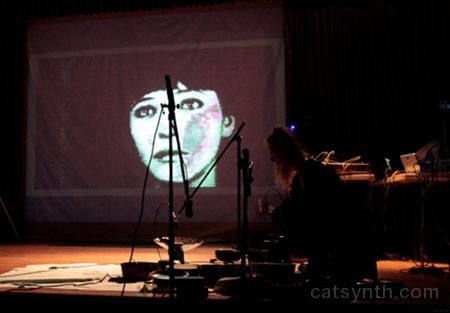
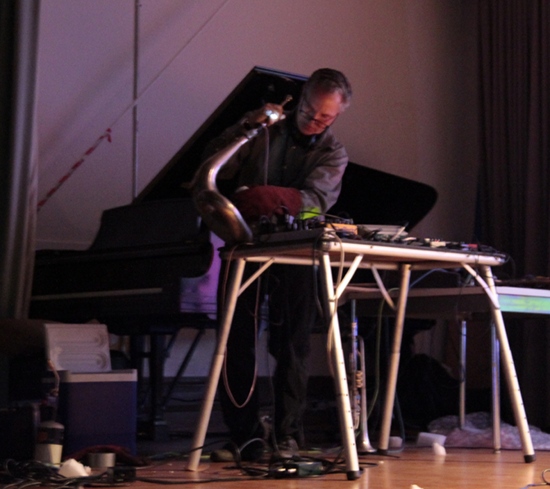
The concert began with Phog Masheeen, a trio featuring Mark Soden, Jr, Dr. Francene Laplan and William Almas. They presented a single large-scale work for electronic and acoustic sound plus video called “Anthroscopic Tourism.” I was not quite sure how the medical term “anthroscopic” related to the sounds and images in the piece, which focused on the interplay of Kaplan’s pots and pans set against electronic sounds and loops and Soden’s electronically enhanced performance on trumpet and a large pipe from a Yamaha motorcycle. Soden had demonstrated some of the techniques he was using with the trumpet during the Touch the Gear event. But he added to the the performance techniques Soden used with his instruments rubbing dry ice against them. As most readers know, dry ice is extremely cold (and difficult to handle); and this it can have a strong effect on the shape and behavior of metal tubes. At one point, he smashed a block of dry ice before picking up pieces to use. He also had a blowtorch. The music often involved loops (sample based or otherwise) against which Kaplan played rhythms and timbres on the pots and pans – this was offset by the more freeform sections with Soden’s trumpet and pipe. Almas’ visuals included a variety of urban and industrial scenes, text, and footage of old musicians, which were mixed with live video of Soden’s performance.
[click images to enlarge]
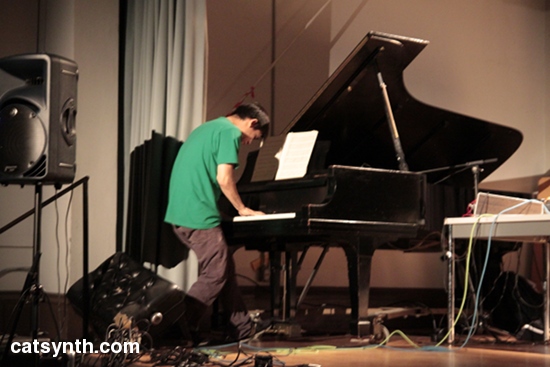
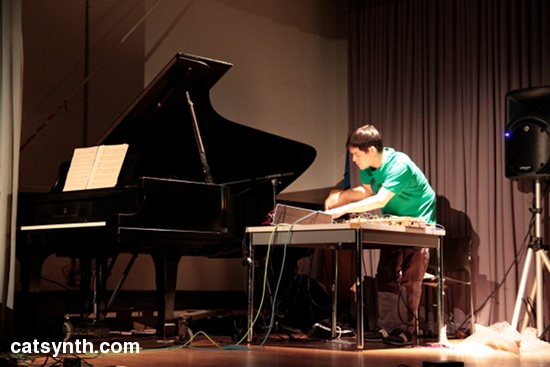
Next up was Headboggle (aka Derek Gedalecia). The tone was set from the beginning both in terms of sound and slapstick comedy by his stepping on bubble wrap that happened to be placed behind the table with his electronics, and then slipping on the way to the grand piano. Actually, the comedic timing of his various slips, slides, tripping over his own feet and double-takes was expertly done, as in an old silent film or Vaudeville act. There was a bit of a scare for several of us in the audience when it appeared he had broken the bench of the piano, but I was assured this was all part of the act, this particular bench was found broken, and that no pianos were actually harmed in the making of this performance. Musically, he combined chaotic oscillators from Ciat Lombarde synthesizer – a reminder to finally put together my Ciat Lombarde kit – with classical and ragtime piano phrases, loops and deep bass sounds from a Micromoog. The piano and electronics are of course quite contrasting, but every so often the sounds and phrases (and physical humor) converged quite well.
[click images to enlarge]
Headboggle was followed by Kadet Kuhne, who presented video and live-music piece Fight or Flight, described by our emcee Cy Thoth as “space madness.” In fact, it was a very polished live electronic performance, very dark and ambient (although interestingly Kadet Kuhne talked in the pre-concert Q&A session about her desire to perform “lighter” ambient music). It began with low frequency sounds and a rumbling buzz, and included doors opening and closing and various sounds of machinery, with electric hums, blips and glitches. It was quite captivating and easy to get lost in. At one point, arpeggios and then beats emerged from the combination of noise percussion and more harmonic sounds, which got progressively louder as the piece built up to a climax and then faded to nothingness. The music was set against a video that focused entirely on a cloth-encased figure suspended in mid-air. It wasn’t clear at first whether this was a cloth figure or an actual person, though as the video progressed it became clear that it was the latter. The frequent shot and angle changes gave the video a glitchy quality which matched many of the electronic sounds in the music.
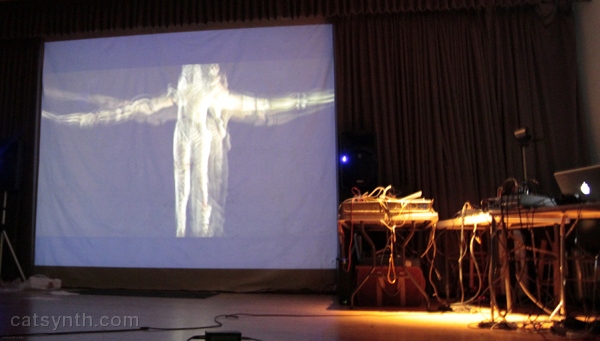
[click image to enlarge]
The final set featured Chen Santa Maria, the duo of Steve Santa Maria and George Chen. Both members of the group played electric guitar and a variety of electronic effects. The set began with a guitar drone set against high squeaking humming sounds. These sounds were soon joined by full guitar chords with heavy distortion and undulating raspy sounds from synthesizers or effects units. There were bursts of noise distortion and high shrieking. This was definitely a loud set. But there were still details to listen to (with appropriate ear protection). The harmonic patterns of the distorted guitars created rhythms, which was set against a more formal triplet rhythm from the electronic sound sources. This rhythmic pattern essentially continued for the remainder of the set, with periods of driving guitar, bursts of noise and more high shrieking tones which then decayed into a low rumbling noise. As the set drew to a close, the sounds became more “digital” with lots of blips and choppy sounds, but then this was replaced by a loud square wave. The square wave started out at a moderate pitch, but got lower and lower until it became a series of audibly distinct pulses, and then came to an abrupt stop.
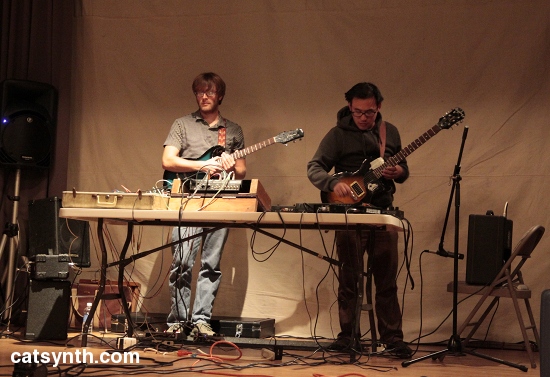
Although this was the last performance of the festival, I will be presenting one more article, where I return to the MultiVox night which included my own performance with Reconnaissance Fly and the Cornelius Cardew Choir…
An announcement for upcoming show in the city:
Thursday, May 8, 8PM
Luggage Store Gallery
1007 Market St.
@ 6th Street
San Francisco, California
Admission $6-10 sliding scale.
I will be performing a live electronic set, with two laptops, standalone
synths, “circuit-bent” toys and my collection of Indian instruments.
Mostly ambient and experimental, with bits of rhythm, beats and familiar
sounds thrown in.
I might even pull out the old graphics tablet, which I haven't really used
in the last year and a half!

Regular readers may recognize the Luggage Store Gallery from previous articles, including music reviews and my show w/ Polly Moller and Company in Feburary.
There's a lot going into this show, which is my first solo in a while. Watch for some more details during the week…
Our friend jellypizza posted this wonderful video of Taboo from 1997, peeking out from inside a drawer.


I haven't embedded the video, but I do encourage readers to go see it (you can click on the photo or the “related link” below). In a way, it is also a posthumous “CatSynth Video” for Taboo, featuring the very ambiet/electronic/synthetic track “Mother” from the soundtrack of the award-winning film Code 46. (The soundtrack is also available at iTunes .) 
I had not heard of Code 46 before JellyPizza's recommendation, but did get a chance to see it last week. The ambient music is a backdrop to a tale in the near future where technology is more advanced but still very recognizeable. In the film, the world seems to be separated into a very high-tech “inside” world that includes major developed cities (e.g., in Asia, Europe, North America, etc.) and “outside.” People carry genetic IDs and bio-tech permits to travel. Additionally, the goverment or governments of the “inside” have genetically driven limits on who can and cannot have children together. This is all meant to sound very sinister, I'm sure, but I think the folks in this near-future world might have a point on the reproduction/population issue. And the world painted by the visuals and the music seems very inviting, both futuristic and very familiar at the same time. There is also an interesting take on fusion among “inside” languages (e.g., English, Chinese, Spanish).
Check out the soundtrack or the movie if you have a chance, and then re-watch Taboo's video.
I was searching for track to feature tonight in honor of the Music and Cats theme of the Bad Kitty Chaos Festival, and eventually settled on this selection from Bast Babylone by zlknf:

lknf: free noise from an autonomous organism.
territory of new sonic landscapes in permanent questioning and mutation, quasi-silence purity to gliding noisaural imensitudes.
Bast Babylon EP available through Merzbau.
In this case, I am interpreting the theme as more “inspirational” than literal, i.e., music inspired by cats rather than created from cat sounds. Certainly, the references to Bast suggest a feline connection, as do the following quotes from the credits:
bast babylone is dedicated to bosch and sybilla.
zlknf thanks the electric masters for their gates are open,
her cats for their love is unconditional, merzbau for the immediate
cooperation and sympathy, and the Friends – AGAPE
Musically, this track reminds me a lot of the piece I did for Dorian Grey's Box, as well as several works in 2 1/2. Disturbingly so. Most likely it is common elements inspired by listening to computer music (ala ICMC and SEAMUS), but perhaps there is also a common element of the cats…
For subscription and listening options, click the “CatSynth Channel” icon in the upper right or the subscription link at the top of this post. And as always, enjoy!
 My sound art installation described in previous posts is now on display at the Pajaro Valley Arts Council as part of the current exhibition “The Human Condition: The Artists’ Response.” The exhibition is “an artistic articulation of the connection between
the individual and world challenges, the exhibit
brings together artists responding to political and social tensions in today?s world”, and features 22 artists (according to my best count). The pieces in the exhibi are all of great quality when compared to recent gallery exhibits I have visited. Many are overtly political or social, dealing with many of darker subjects in current events and recent history. Some are quite realistic, others more abstract.
Dorian Grey’s Box, the piece on which I collaborated with local artist Michael Carson, is one of the more abstract in the exhibition. The main element is a large black cube with newspaper clippings in various patterns and sections of redder coloring. Surrounding the main cube are several small wooden “alphabet blocks”, some of which have also been painted black.


The sound (my contribution to the piece) is on a continuous loop that visitors can hear via headphones. The material is primarily ambient noise, gitches, percussive effects and sounds that only “hint” at speaking voices, arranged in a collage inspired by the sculptural part of the piece.
 ]The exhibition continues through March 4, and I strongly encourage anyone in the greater Bay Area during this time to check it out. It’s great to see such quality contemporary art locally (Santa Cruz-Watsonville-Monterey area).
I have posted an excerpt from the sound installation on the podcast for those who are interested in the piece but unable to visit in person.
art
contemporary
pajaro valley
watsonville
music
experimental
electronic music
ambient
installation
sculpture
Looks like things are good to go for the upcoming art installation at the Pajaro Valley Arts Council. We took the sound track that I produced last saturday as is ( see part 1) and the entire piece is being installed the gallery today. It's nice when something comes together without a lot of stress or last-minute scrambling and compromise. It's also a welcome change to have something that “presents itself” via pre-recorded matieral – again, no stress, no preparing for live computer problems, etc.
The exhibition, entitled The Human Condition: The Artists' Response will be at the PVAC gallery in Watsonville, CA from January 10 through March 4.
I have uploaded a new podcast entry: a guided improvisation I did last night using my DSI Evolver synth. The idea was to focus on soft, high-pitched timbres but with unstable states that can easily produce more chaotic signals. This of course lots of fun, and I was quite pleased with the results except for a couple of loud “thumpy” sounds around two minutes into the piece. I am considering this an actual piece, even a composition of sorts, but I am still looking for a good title. Feel free to suggest you own in the “Comments” section.
As always, click here to subscribe to the podcast, or contact me if you have trouble with it. Enjoy!
music
mp3
podcast
experimental
ambient
noise
electronic music
evolver

