
Tag: architecture
-
Wordless Wednesday: 5436 (Angular Landscape)

You can find this photo on flickr, as well as others (including previous Wordless Wednesday photos).
-
Angular and Architectural (901 Market Street, San Francisco)
A couple of weeks ago, I went to the opening for an exhibit entitled Angular and Architectural in downtown San Francisco. The title itself features elements that reappear in my own photography as well as my viewing and appreciation of art. Plus it was conveniently on the way home from work.
901 Market Street is one of those typical older office buildings one sees downtown (this building dates back to 1912). It is an imposing stone building, a bit heavy and a bit ornate. The inside, however, features an open modern atrium, very clean, full of light and space, and a perfect “canvas” for an art exhibition, particularly one whose theme is architecture and geometry.
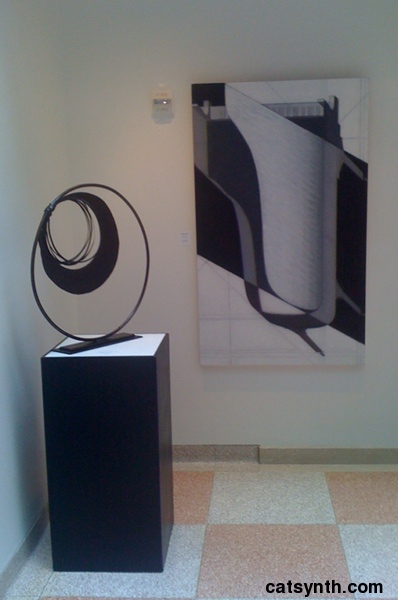
What made this particular exhibit stand out was the pairings and combinations of different artworks, among the best combination arrangements I have seen in a while. Many of these combinations involved paintings by John Haag paired with sculptures by Rebecca Fox and Yong Han. We have seen Fox’s and Han’s metal sculptures before at Open Studios and elsewhere, but Haag was a new discovery. Here is one of his paintings, Midnight Seranade, coupled with one of Fox’s sculptures:

[Click to enlarge image.]
The black-and-white of the painting matches the dark color of the sculpture against the white background, along with the thick bands of black and gentle curves.
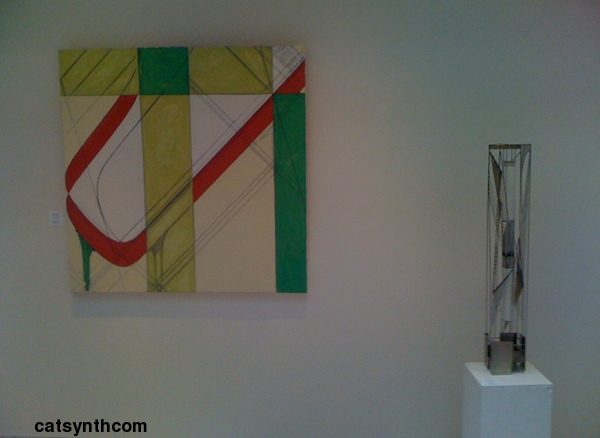
Here we see another painting, this time coupled with one of Han’s sculptures, last train of thought:

[Click to enlarge image.]
In this painting, the strong angles and thin lines in the painting match the sculpture, and both have a somewhat Art-Deco quality.
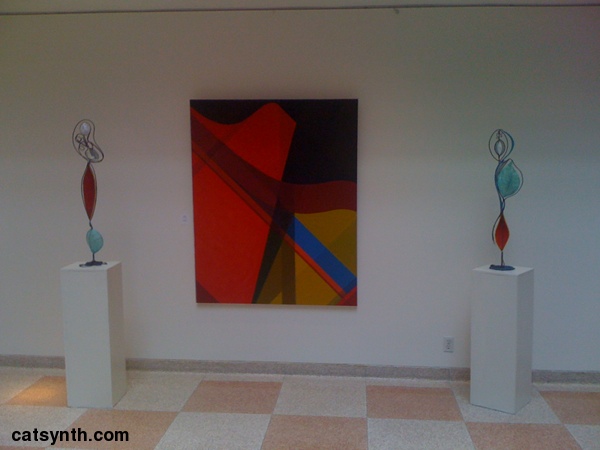
Here is one more set, with the sculptures framing the painting from either side:

[Click to enlarge image.]
The curved shapes and bright red in the last painting bring up the red elements in the two sculptures to either side.
This exhibit reminds us how the placement of disparate works in exhibition is itself a creative act, finding elements across artists and media that somehow work together.
-
Sonja Navin and Mike Kimball
I recently visited two openings for artists I met at Open Studios last fall and whose work reflects my interests in highways, architectural images and the urban landscape. The artists take very different approaches, and the shows were in very different parts of the city – but having both openings on the same night was a great opportunity to see them together and simultaneously reflect upon the city itself.
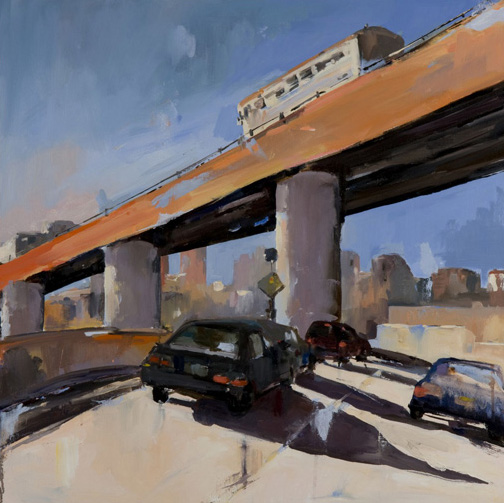
First, I stopped in the relatively quiet West Portal neighborhood for a show at the Greenhouse Cafe featuring Sonja Navin. Navin draws on her architectural background to capture familiar images of the city in her paintings. Perhaps the most “familiar” image was the King Street off-ramp from I-280 in her large painting entitled 280.

[Sonja Navin. 280. Photo courtesy of the artist. (click to enlarge)]
Navin experienced this interchange the way many of us do, i.e., being stuck in traffic, and thus had the opportunity to visualize it in detail. She also had a painting East on N which featured a familiar view along the N-Judah metro line in the Sunset district.
Although her subject matter is often architectural in nature, her painting style features large brush strokes and irregular areas of color rather than the straight lines and precision of architectural drawings. She also had several figurative paintings, and some such as In The Haight combine both character and street elements.
Navin’s exhibition, which also features artist Kacie Erin Smith, will be on display at The Greenhouse Cafe, 329 West Portal Avenue in San Francisco through April 30.
After brief ride over Twin Peaks, I found myself descending into the Mission district for an opening at City Art Gallery, where I was particularly interested to see new works by Mike Kimball.
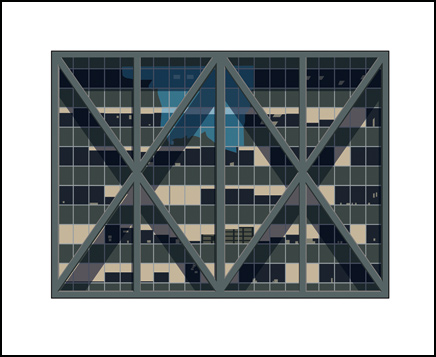
Like Navin, Kimball’s interpretation of the urban landscape distills it down to basic elements, but his prints and paintings feature very clean lines and simple geometric shapes. One example is his Maritime Plaza, which I immediately recognized (it is a favorite out lunch spot of mine).

[Mike Kimball. Maritime Plaza. Image courtesy of the artist. (click to enlarge.)]
Like the building it represents, the image is framed by the triangules and X-shapes of the seismic bracing. This was one of the first buildings to use this technique, which is now a familiar site on buildings in the Bay Area.
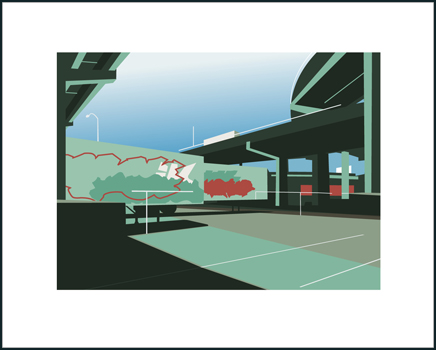
In Division Street, Kimball represents another familiar sight from daily life, the interchange of I-80 and US 101 that sits above Division Street in SOMA. The image is composed of very simple curves and lines and solid colors, from which one can distinguish the elevated structures of the highway and the shadows they cast, as well as details such as the markings (and probably graffiti) on the sides of the trailers.

[Mike Kimball. Division Street. Image courtesy of the artist. (click to enlarge.)]
Trucks and trailers also feature prominently in Kimball’s work. His “Truckograph” series features a similar graphic quality to Division Street. His larger work Meditations on a port looks at the stacks of trailers at the port as an abstract collection of boxes. Kimball bridges the industrial and abstract in this work – close up, one can see the writing and metal texture, but from a distance one simply sees the colored squares.
Kimball’s current exhibition will be on display at City Art Gallery, 828 Valencia Street, through March 28.