Tag: joe jones

  • MoMA: Pollock, Picasso, and Making Music Modern

    MoMA: Pollock, Picasso, and Making Music Modern

    No visit to New York is complete without a stop to the Museum of Modern Art (MoMA). Today we look back at three exhibitions that stood out during my most recent trip.

    7.1968
    [Jackson Pollock (American, 1912-1956). One: Number 31, 1950. 1950. Oil and enamel paint on canvas, 8′ 10″ x 17′ 5 5/8″ (269.5 x 530.8 cm). The Museum of Modern Art, New York. Sidney and Harriet Janis Collection Fund (by exchange), 1968. © 2015 Pollock-Krasner Foundation / Artists Rights Society (ARS), New York]

    Jackson Pollock: A Collection Survey, 1934–1954 is a small but powerful exhibition tracing the artists’ career and development using pieces from MoMA’s extensive collection. There were of course the massive drip paintings such as the iconic One: Number 31, 1950, but also quite of few of his earlier works from the 1930s and 1940s that while abstract made extensive and overt use of mythological and folk elements. Indeed, one can even see figures in some of the earlier pieces.

    428.1980
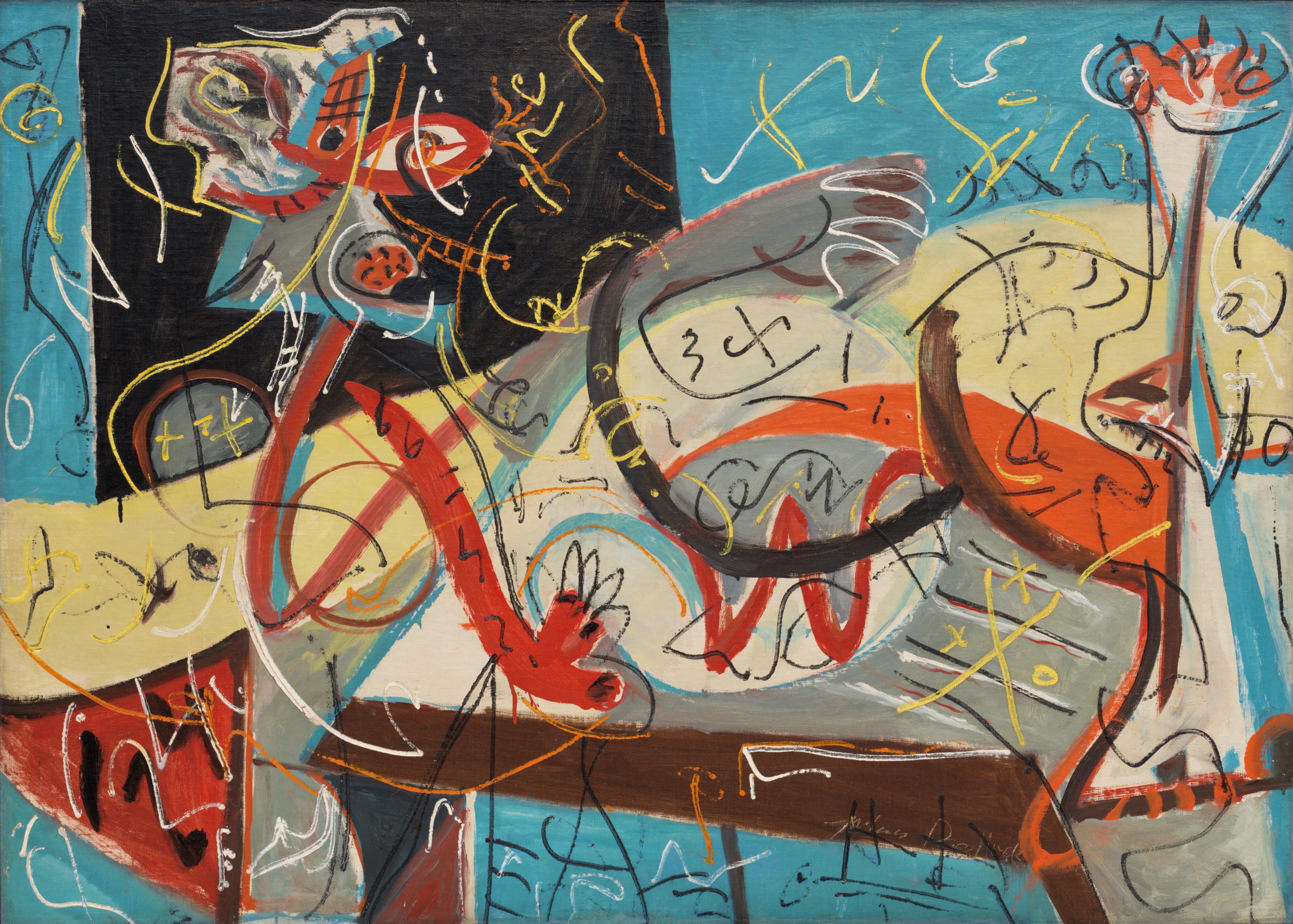
    [Jackson Pollock (American, 1912-1956). Stenographic Figure. c. 1942. Oil on linen, 40 x 56” (101.6 x 142.2 cm). The Museum of Modern Art, New York. Mr. and Mrs. Walter Bareiss Fund, 1980 © 2015 Pollock-Krasner Foundation / Artists Rights Society (ARS), New York]

    One of the earliest paintings was quite reminiscent of Míro, another favorite of mine.

    Seeing the works side by side in the compact two-room exhibit, it is easier to see the connections between the earlier and later works. Although the techniques and ideas are radically different, some of the shapes and other elements can be similar at times. Densely packed canvases with layered curving forms of color abound throughout his work.

    One of the treats of this exhibition (which I don’t recall from the huge 1999 retrospective) were some of Pollock’s lesser-known drawings, sketches, and prints. Many of them date from the 1930s and 1940s, so have more in common with his paintings of those decades. But seeing Pollock writ small is in itself interesting given his association with paintings of monumental scale.

    12.1958
    [Jackson Pollock (American, 1912-1956). Untitled (Animals and Figures). 1942. Gouache and ink on paper, 22 ½ x 29 7/8” (57.1 x 76 cm). The Museum of Modern Art, New York. Mr. and Mrs. Donald B. Straus Fund, 1958 © 2015 Pollock-Krasner Foundation / Artists Rights Society (ARS), New York]

    Jackson Pollock ink on paper
    [Jackson Pollock. Untitled.1950. Ink on paper. The Joan and Lester Avnet Collection]

    The exhibition was just opening at the time (indeed, we saw it as part of a members’ preview), and will remain on display through March 13, 2016.


    Picasso Sculpture is a large and comprehensive survey of the artists’ sculptural works. While primarily known for his painting, Picasso was quite a prolific sculptor, and his sculptures can be seen as three-dimensional projections of his unique and instantly recognizable style of painting.

    649.1983
    [Pablo Picasso (Spanish, 1881–1973)
    Bull. Cannes, c. 1958.
    Plywood, tree branch, nails, and screws. 46 1/8 x 56 3/4 x 4 1/8″ (117.2 x 144.1 x 10.5 cm).
    The Museum of Modern Art, New York. Gift of Jacqueline Picasso in honor of the Museum’s continuous
    commitment to Pablo Picasso’s art.
    © 2015 Estate of Pablo Picasso / Artists Rights Society (ARS), New York.
    ]

    In pieces like Bull, shown above, one can see the direct analogs to his cubist paintings. His figurative sculptures also often feature bulbous and exaggerated interpretations of the human body. Some of them border on caricature, with others are graceful and almost abstract.

    MoMA - Pablo Picasso Sculpture 2015
    [Installation view of Picasso Sculpture. The Museum of Modern Art, New York, September 14, 2015–February 7, 2016. © 2015 The Museum of Modern Art. Photo: Pablo Enriquez]

    The curving forms in both his human and animal were quite a contrast to the linear forms of the New York City skyline.

    Picasso Sculpture
    [Pablo Picasso, Spanish, 1881–1973
    Maquette for Richard J. Daley Center Sculpture
    1964
    Simulated and oxidized welded steel
    41 1/4 x 27 1/2 x 19″ (104.8 x 69.9 x 48.3 cm)
    The Art Institute of Chicago. Gift of Pablo Picasso
    ]

    There were several pieces that I recognized from my visit to the Musée Picasso in Paris, including this absolutely darling sculpture of a cat.

    Picasso Cat

    The exhibition, which covers all of the fifth floor of the museum, will be on display through February 7, 2016.


    The exhibition on display in the design gallery was particularly appropriate for our interests at CatSynth. Making Music Modern: Design for Ear and Eye brought together a large collection of aesthetically beautiful objects used for both the creation and enjoyment of music.

    Perhaps the simplest way to stage such an exhibit would be a linear progression of designs from earlier record players to iPods, but instead this exhibit branches off in multiple directions at once. We do see several of Dieter Rams’ iconic music players and a particularly beautiful and modernist radio by Michael Rabinowitz released in 1942 – and of course an iPod.

    205.1958
    [Dieter Rams, Hans Gugelot. Radio-Phonograph (model SK 4/10). 1956. Painted metal, wood, and plastic, 9 1/2 x 23 x 11 1/2″ (24.1 x 58.4 x 29.2 cm). Mfr.: Braun AG, Frankfurt, Germany. The Museum of Modern Art, New York. Gift of the manufacturer]

    But we also see more esoteric musical instruments that blend art, design and technology, such as Joe Jones’ Mechanical Flux Orchestra, as well as the more mundane Fender Stratocaster.

    Joe Jones.  Mechanical Flux Orchestra
    [Joe Jones. Mechanical Flux Orchestra. c 1964. The Museum of Modern Art, New York. The Gilbert and Lila Silverman Fluxus Collection Gift 2266.2008]

    Through the exhibit are music posters, showing distinctive designs of different eras. Brightly colored posters of the 1960s are featured along with gritty black-and-white posters for New York City punk shows in the 1970s. There are also objects that are more purely art than functional design. Among those that straddle that divide are the Chamber Works: Architectural Meditations on Themes from Heraclitus from architect Daniel Libeskind.

    2376.2001.4

    [Daniel Libeskind. Sheet from the folio Chamber Works: Architectural Meditations on Themes from Heraclitus. 1983. Ink on paper, 22 3/8 x 30 1/4″ (56.8 x 76.8 cm). The Museum of Modern Art, New York. Andrew Cogan and Rob Beyer Purchase Funds © 2014 Daniel Libeskind]

    I would love to “play” one of these pieces some day.

    One of the more perplexing objects in the exhibit was the Scopitone, a 1950s behemoth that could select, play and rewind up to 36 short films produced for songs by European and American artists. It was in essence a jukebox for the forerunners of modern music videos.

    Scopitone

    [Scopitone 1963 16mm jukebox The Museum of Modern Art, New York. Film Study Center Special Collections F2007.4]

    The Scopitone, never really caught on, but perhaps it was ahead of its time, with a medium more suited to small form factors and Internet distribution, i.e., YouTube.

    There was so much in this exhibit that I would love to post all of it, but I think it’s best to see it in person. It will remain on display through January 18, 2016. And for those who can’t see it, I recommend a visit to the exhibition’s
  • Fluxus in New York (MoMA and NYU, November 2011)

    Fluxus in New York (MoMA and NYU, November 2011)

    There have been numerous events this year marking the 50th anniversary of the Fluxus, including two exhibitions that I visited while I was in New York last month.

    Fluxus was first named by George Maciunas in 1961, and involved a small network of artists in the United States, Europe and Japan who were already exploring some of the new movement’s ideas. Fluxus art generally involved event scores, or series of text or visual instructions that could be used by other artists to perform the works in the manner of a musical score, and the combination of instructional pieces into “Fluxkits” or “Fluxboxes”, collections of printed cards, games and ideas packed into boxes. Although much of this art was meant to be performed live at Fluxus events that ranged from formal concerts to spontaneous street performances and happenings – Fluxus events “could be performed by anyone, anywhere, at any time” – it also created durable works in the form of films, musical instruments, sculptures, and the Fluxkits themselves.

    These ideas are not unique to the formal Fluxus moment of the 1960s and 1970s. Certainly, many of the ideas were present in Dada several decades earlier, as well as John Cage’s experiments with nondeterminacy in the 1950s. And the elements of Fluxus and its precedents are deeply embedded in contemporary art – the DIY sensibilities are present in many of the exhibitions I attend around San Francisco, for example. As such, the exhibitions are at least as much a historical snapshot of a particular time as they are examples of a particular artistic style and practice.


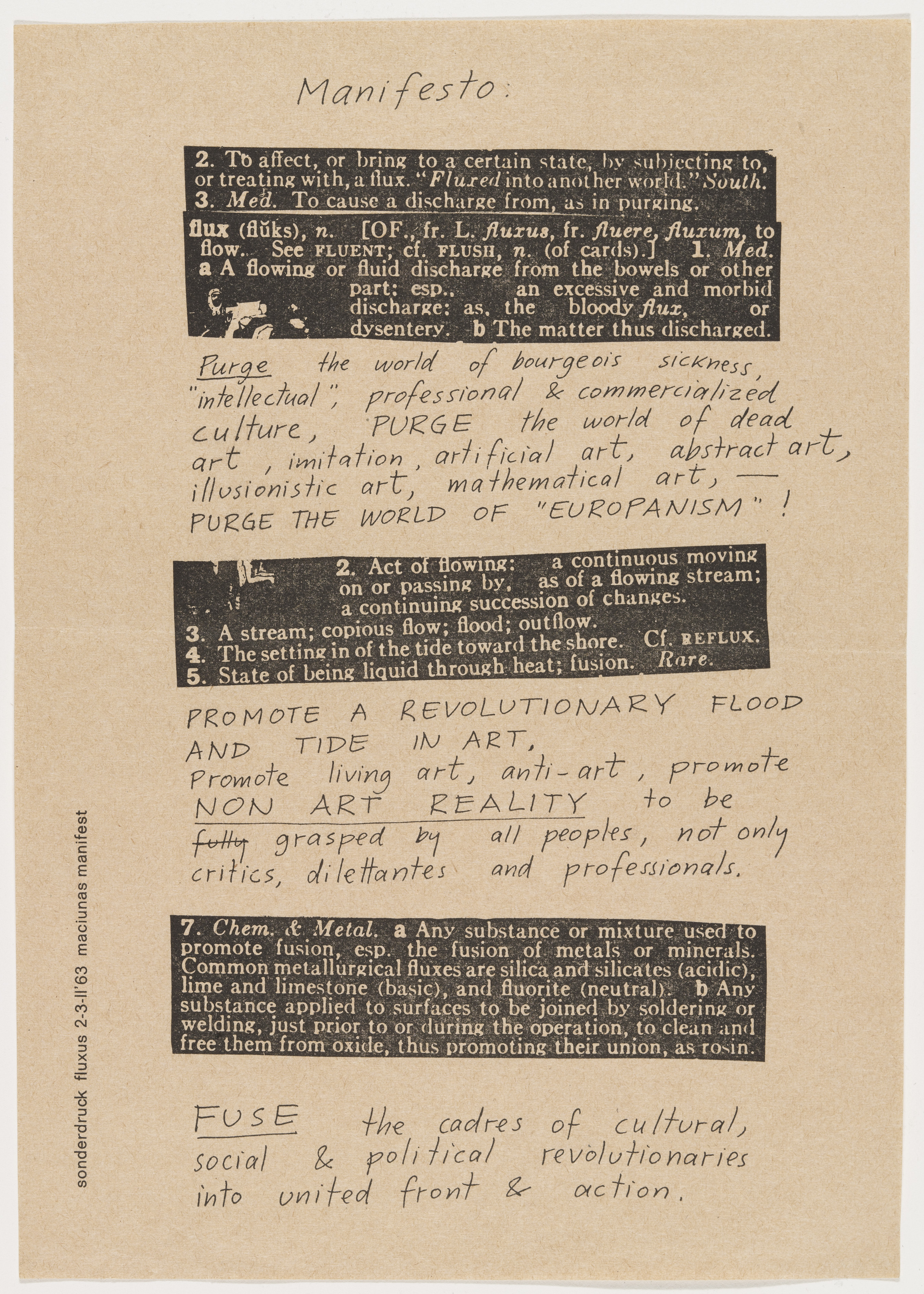
    Thing/Thought: Fluxus Editions, 1962–1978 at the Museum of Modern Art (MoMA), presents works from the Gilbert and Lila Silverman Fluxus Collection, which was acquired by the museum in 2008. It was one of the largest collections of its kind and contains over 8,000 artworks and artifacts, including Maciunas’ 1963 Fluxus Manifesto.

    [Fluxus Manifesto. 1963. Offset. Edited, designed, and produced by George Maciunas. 8 3/16 x 5 11/16″ (20.8 x 14.5 cm). The Gilbert and Lila Silverman Fluxus Collection Gift, 2008.  Image courtesy of the Museum of Modern Art. (Click image to enlarge.)]

    The manifesto itself contains many of the elements associated with Fluxus, the “do-it-yourself” appearance with combinations of found material, personal notes (typed or handwritten), and declarations of spontaneous activity and a break with the traditional media and practices of art.

    The duality of an object being at once instructions for a spontaneous artistic expression and itself a work of art appeared throughout the exhibition. This can be seen in the event scores as well as the flux kits.

    [Fluxkit. 1965-66, Fluxus Edition announced 1964. Vinyl-covered attaché case containing objects in various mediums. Assembled by George Maciunas. 11 x 44 x 28″ (27.9 x 111.8 x 71.1 cm). The Gilbert and Lila Silverman Fluxus Collection Gift, 2008.  Image courtesy of the Museum of Modern Art.]

    FluxKit 1965-6 is at once a practical and portable collection of objects for generating performances. But the individual pieces, such as the cards with their lettering and geometric shapes, and even the arrangement of the elements into the kit box itself, are quite elegant pieces of design. In particular, the cards seem to embody both the do-it-yourself aesthetic and the prevalent tenets of industrial modernist design in the 1960s.

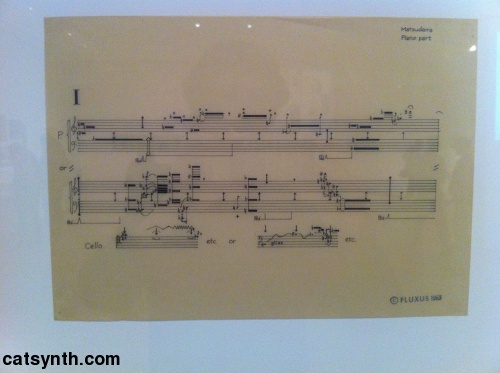
    The score for Yoriaki Matsudaira’s Co-Action for Cello and Piano is at once a recognizable extension of traditional music notation and a visual piece with great deal of symmetry and geometry. I have not had a chance yet to try out the piano part myself, but will do so at some point.

    [Yoriaki Matsudaira. Co-Action for Cello and Piano I. 1963, Fluxus Edition announced 1963. (Click image to enlarge.)]

    The scores of John Cage fit naturally into this context as well, and were included in some of the displays in the exhibition (indeed, it seems like I always encounter at least one Cage piece during every MoMA visit). How closely Cage was involved in any of the Fluxus productions is unclear. He was however a major inspiration for the movement, and several of the prominent artists including George Brecht and Dick Higgins attended his classes

    Perhaps the most intriguing of all the pieces were the instruments in Joe Jones’ Mechanical Flux Orchestra.

    [Joe Jones. Mechanical Flux Orchestra. c. 1966, Fluxus Edition announced 1966.]

    Each of these instruments, such as the Mechanical Violin and Mechanical Bells incorporate electrical motors and strikers that allow them to be self playing. Although these instruments were created in 1966, they still look contemporary with many of the electromechanical musical installations created today, although the electronic elements have improved. Similarly, Metal Zitar #4 has a striking minimalist appearance that could be part of a contemporary installation.

    The contributions of Nam Jun Paik to the exhibition also explored the musicality of Fluxus, including it in his “essay” The Monthly Review of the University for Avant-Garde Hinduism! (Postmusic). In this piece, typewritten bits of the text are scattered at odd angles with the same DIY aesthetic as Maciunas’ manifesto and begins with the words “I am tired of renewing the form of music. – serial or aleatoric, graphic or five lines, instrumental or bellcanto, screaming or action, tape or live …”. Yet the art for which he is most known, his beautiful analog video compositions, are quite musical, and indeed he was quite directly influenced by Cage and Stockhausen to produce this body of work.

    I primarily know Paik and his video art external to any experience with Fluxus. The same can be said for Yoko Ono, who was not formally a member of the group around Maciunas but was a friend and he admired and promoted her work. Her piece Eyeblink (Fluxfilm no. 9) was part of the Silverman collection and included in the exhibition.

    It’s hard not to notice the way the term “Fluxus” and the prefix “Flux-” permeate so much of the work and any attempt to discuss it. Fluxus spawned, Fluxscores, Fluxkits, Fluxboxes, Fluxfilms (as in the previous piece by Yoko Ono), and even Fluxshops.

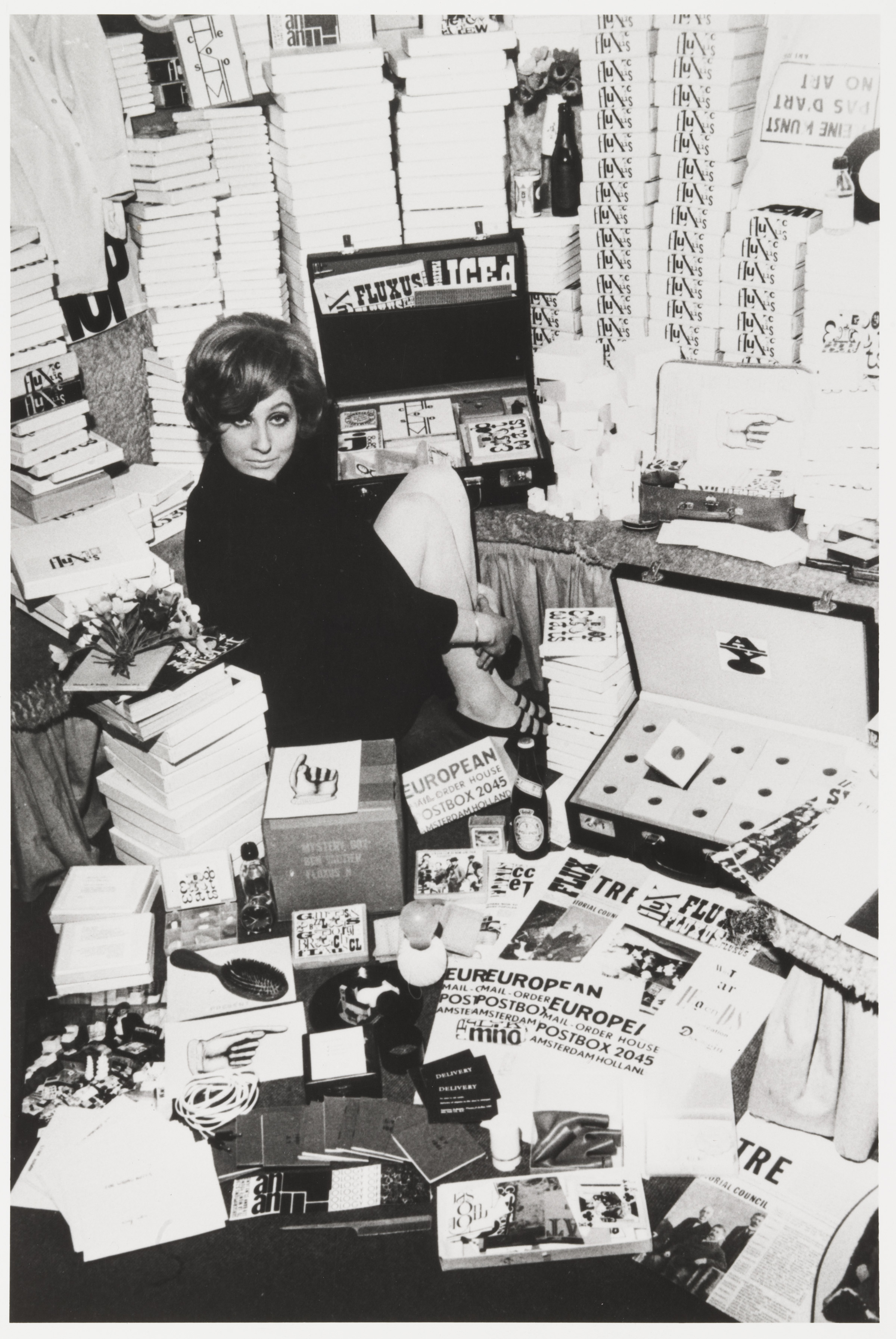
    [Willem de Ridder. European Mail-order Warehouse/Fluxshop. Winter 1964-65. Photo: Wim van der Linden/MAI. The Museum of Modern Art. The Gilbert and Lila Silverman Fluxus Collection Gift. Image courtesy of the Museum of Modern Art.]

    Willem de Ridder’s European Mail-order Warehouse/Fluxshop from the winter of 1964-1965 contains a jumbled array of Fluxus editions and kits. A reproduction of the Fluxshop by Jon Hendricks and Larry Miller was featured in the exhibition.

    [Jon Hendricks and Larry Miller.  Construction of European Mail-Order Warehouse/Fluxshop, 1984.  (Click image to enlarge.)]

    As much as any piece of the exhibition, it is a snapshot back into the time that this art was originally made.

    The exhibition will remain on display through January 16, 2012.


    A concurrent exhibition Fluxus and the Essential Questions of Life at the NYU Grey Art Gallery presented still more original works and artifacts, this time arranged as a series of “essential themes of human existence”, including “Happiness”, “Health”, “Who am I?” and “Freedom”.

    The arrangement around the themes rather than chronology, medium or artist, gave the presentation a rich multi-media feel. For example, below we see a variety of works for “Happiness”, including a film by Yoko Ono, her conceptual object piece A Box of Smile in the cabinet, as well as others including Nye Ffarrabas’ rather prescient Rx: Stress Formula, a pill bottle with capsules with photocopied bits of paper.

    [Yoko Ono, A Box of Smile, 1971/1984 ReFlux Edition,plastic box inscribed in gold: “a box of smile y.o. ’71.”Hood Museum of Art, Dartmouth College: AcquisitionsFund; GM.989.12.5.]

    The wry sense of humor permeates much of the work in the exhibition, such as Ben Vautier’s glass bottle with a handwritten label “God” affixed to its side as answer to the question “God?” The arrangement by themes and the particular selections of pieces bring out this quality more than in the presentation at the MoMA, even though many of the same artists and types of work were featured.

    Artists central to Fluxus, including Maciunas and Brecht, were well represented here. In contrast to the musical scores, some of Brecht’s event scores were quite minimalist, with the most extreme example being Exit which consists only of the single-word instruction “exit” and was featured (again with a bit of dry humor) under the theme of “Death?”

    I did also get to see one of Nam Jun Paik’s pieces for modified television set, Zen for TV, which consists of a simple linear pattern crossing the middle of the screen with little or no change.

    Paik’s process of modifying television sets to produce new analog video art is a direct forerunner of the circuit bending that many of us in the electronic-music community do today.

    In addition to this exhibition, the gallery featured both historic and more contemporary works created at NYU and the Downtown art scene in the show Fluxus at NYU: Before and Beyond. On display were more scores from John Cage as well as a rather large score by Earl Browne. Numerous posters, books and photographs rounded out this presentation of work that, like the original Fluxus group, pushed the boundaries of their media. I regret that I wasn’t around a couple of weeks early when Larry Miller presented a special gallery tour in conjunction with Performa 11, but I am glad I got to see both exhibitions at the Grey Art Gallery before they closed on December 3.


    Both exhibitions described above were quite inspiring, and it is interesting to note how much both the concepts of Fluxus and some of the artifacts intersect with my own music and performance work several decades later. I expect to have at least as strong an influence on the new work I am planning for next year. It also opens up an idea of whether or not this website can serve as a source for a piece inspired by Fluxus? Any and all ideas are welcome.