Tag: Music

  • Farewell to 2015: Annus Asper

    Farewell to 2015
    [Click to enlarge.]

    2015 was a rough year. There is no other way to put it. We looked over the precipice at some of the worst possibilities becoming reality. But we came through. Luna stared down an extremely dire diagnosis and is once again thriving. For that I am truly grateful. I rebounded strongly from my own health issues as well. And there were many other beautiful moments this year, a few of which are included in our graphic.

    This was a year of many endings as well, most notably in the personal and musical domains. But new doors are opening for 2016 as a result, and there are some new projects and opportunities for which I am excited. 2015 left a lot of questions unanswered, some of which are also depicted in the graphic and some of which are beyond the scope of this site.

    So we are excited for 2016, but also extremely anxious and apprehensive. There are more big challenges coming up; and if I have learned anything, it is that I have no idea how things will ultimately turn out. It’s just a matter of doing things one at a time incrementally – but also continuing even more than ever to speak my truths and accept the risks and consequences that come with doing so.

    Meanwhile, we at CatSynth will continue to do what we do here, bring music, art, culture and cats to the world. Thank you for all your support in 2015, and especially all your support for Luna and me. We are truly humbled and look forward to sharing this new year whatever it brings.

  • Music by Lindsay Cooper, Mills College

    Music by Lindsay Cooper, Mills College

    Earlier this month, the Mills College music department dedicated an entire concert to the music of Lindsay Cooper. It was an extraordinary event, not only for bringing her work together in one setting, but for the cast of talented musicians who made up the ensemble.

    Ensemble performing the music of Lindsay Cooper
    [Ensemble performing the music of Lindsay Cooper]

    Lindsay Cooper is perhaps best known for work with the experimental rock group Henry Cow, but her musical career spans a variety of other styles and disciplines before and after. And while her instrumental first love remained the bassoon, she also played many other wind instruments, and had a very distinctive haunting voice that could be heard on many of Henry Cow’s recordings. Her compositions, including her time with the band and her later projects including News from Babel up to her retirement while suffering from MS, are not often heard in concert calls. The concert on this evening was a step towards rectifying that.

    Musically the concert was a high-speed tour through Cooper’s music. Many of the pieces were short an energetic. Some carried the energy and rhythm of experimental rock, with driving lines on keyboard, guitar and drums; others were quite abstract with longer sounds. There was an anxiety and restlessness that permeated the music, with a need to move forward, sometimes almost tumbling. It was also full of intricate details and contrapuntal lines, which were brought out especially in the horn parts. There were moments which had the grand style and fast-moving details of a classic film score, particularly reminiscent of a closing “The End” from a film for which the ending may not have felt quite so final.

    Evelyn Davis, Kate McLoughlin, Fred Frith
    [Evelyn Davis, Kate McLoughlin, Fred Frith]

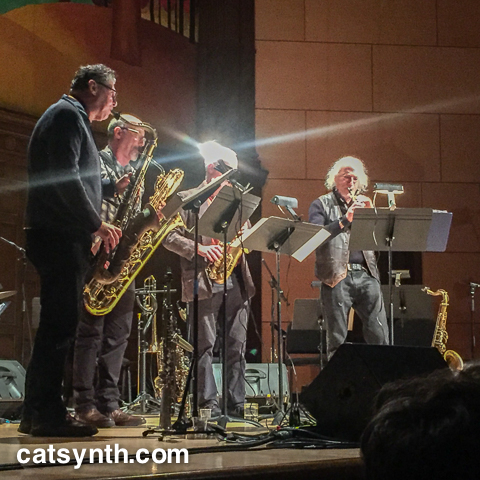
    The main ensemble featured two of Cooper’s longtime collaborators, Fred Frith (guitar, keyboard) and Zeena Parkins (harp). Rounding out the ensemble was a group of familiar faces in Steve Admans, Rachel Austin, Beth Custer, Evelyn Davis, Jordan Glenn, Jason Hoopes, Kasy Knudsen, Kate McLoughlin, Emily Packard, and Andy Strain; with Miles Boisen on sound. The performances felt easy and flawless (no doubt the result of countless rehearsals), and with a relatively light texture despite the ensemble’s size. The concert’s sole departure was a performance by the Rova Sax Quartet of Face in the Crowd, a piece they had commissioned from Cooper in 1996. Judging from her biography and the date, it may have been one of her last compositions.

    Rova Saxophone Quartet
    [Rova Saxophone Quartet]

    In addition to the performers on stage, the audience too was a cast of familiar faces and influential musicians from the Bay Area music scene. It seems that Lindsay Cooper had quite an influence on artists her; and thus this was a concert not to be missed. I am glad that I was able to be there.

  • Mensa Cat Monday: Django Fett

    Django Fett

    By J.B.. This one seemed appropriate for this week…

  • MoMA: Pollock, Picasso, and Making Music Modern

    MoMA: Pollock, Picasso, and Making Music Modern

    No visit to New York is complete without a stop to the Museum of Modern Art (MoMA). Today we look back at three exhibitions that stood out during my most recent trip.

    7.1968
    [Jackson Pollock (American, 1912-1956). One: Number 31, 1950. 1950. Oil and enamel paint on canvas, 8′ 10″ x 17′ 5 5/8″ (269.5 x 530.8 cm). The Museum of Modern Art, New York. Sidney and Harriet Janis Collection Fund (by exchange), 1968. © 2015 Pollock-Krasner Foundation / Artists Rights Society (ARS), New York]

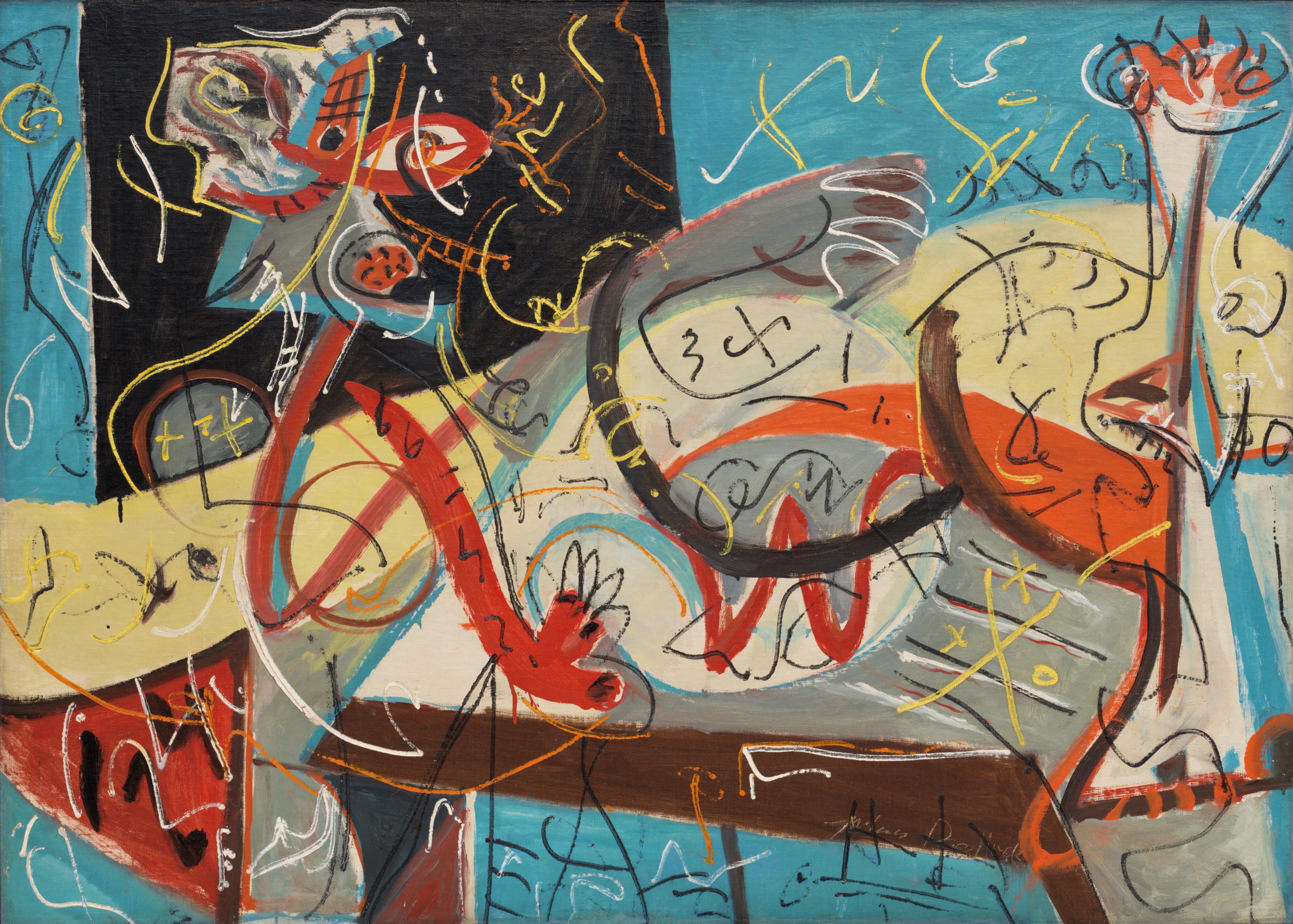
    Jackson Pollock: A Collection Survey, 1934–1954 is a small but powerful exhibition tracing the artists’ career and development using pieces from MoMA’s extensive collection. There were of course the massive drip paintings such as the iconic One: Number 31, 1950, but also quite of few of his earlier works from the 1930s and 1940s that while abstract made extensive and overt use of mythological and folk elements. Indeed, one can even see figures in some of the earlier pieces.

    428.1980
    [Jackson Pollock (American, 1912-1956). Stenographic Figure. c. 1942. Oil on linen, 40 x 56” (101.6 x 142.2 cm). The Museum of Modern Art, New York. Mr. and Mrs. Walter Bareiss Fund, 1980 © 2015 Pollock-Krasner Foundation / Artists Rights Society (ARS), New York]

    One of the earliest paintings was quite reminiscent of Míro, another favorite of mine.

    Seeing the works side by side in the compact two-room exhibit, it is easier to see the connections between the earlier and later works. Although the techniques and ideas are radically different, some of the shapes and other elements can be similar at times. Densely packed canvases with layered curving forms of color abound throughout his work.

    One of the treats of this exhibition (which I don’t recall from the huge 1999 retrospective) were some of Pollock’s lesser-known drawings, sketches, and prints. Many of them date from the 1930s and 1940s, so have more in common with his paintings of those decades. But seeing Pollock writ small is in itself interesting given his association with paintings of monumental scale.

    12.1958
    [Jackson Pollock (American, 1912-1956). Untitled (Animals and Figures). 1942. Gouache and ink on paper, 22 ½ x 29 7/8” (57.1 x 76 cm). The Museum of Modern Art, New York. Mr. and Mrs. Donald B. Straus Fund, 1958 © 2015 Pollock-Krasner Foundation / Artists Rights Society (ARS), New York]

    Jackson Pollock ink on paper
    [Jackson Pollock. Untitled.1950. Ink on paper. The Joan and Lester Avnet Collection]

    The exhibition was just opening at the time (indeed, we saw it as part of a members’ preview), and will remain on display through March 13, 2016.


    Picasso Sculpture is a large and comprehensive survey of the artists’ sculptural works. While primarily known for his painting, Picasso was quite a prolific sculptor, and his sculptures can be seen as three-dimensional projections of his unique and instantly recognizable style of painting.

    649.1983
    [Pablo Picasso (Spanish, 1881–1973)
    Bull. Cannes, c. 1958.
    Plywood, tree branch, nails, and screws. 46 1/8 x 56 3/4 x 4 1/8″ (117.2 x 144.1 x 10.5 cm).
    The Museum of Modern Art, New York. Gift of Jacqueline Picasso in honor of the Museum’s continuous
    commitment to Pablo Picasso’s art.
    © 2015 Estate of Pablo Picasso / Artists Rights Society (ARS), New York.
    ]

    In pieces like Bull, shown above, one can see the direct analogs to his cubist paintings. His figurative sculptures also often feature bulbous and exaggerated interpretations of the human body. Some of them border on caricature, with others are graceful and almost abstract.

    MoMA - Pablo Picasso Sculpture 2015
    [Installation view of Picasso Sculpture. The Museum of Modern Art, New York, September 14, 2015–February 7, 2016. © 2015 The Museum of Modern Art. Photo: Pablo Enriquez]

    The curving forms in both his human and animal were quite a contrast to the linear forms of the New York City skyline.

    Picasso Sculpture
    [Pablo Picasso, Spanish, 1881–1973
    Maquette for Richard J. Daley Center Sculpture
    1964
    Simulated and oxidized welded steel
    41 1/4 x 27 1/2 x 19″ (104.8 x 69.9 x 48.3 cm)
    The Art Institute of Chicago. Gift of Pablo Picasso
    ]

    There were several pieces that I recognized from my visit to the Musée Picasso in Paris, including this absolutely darling sculpture of a cat.

    Picasso Cat

    The exhibition, which covers all of the fifth floor of the museum, will be on display through February 7, 2016.


    The exhibition on display in the design gallery was particularly appropriate for our interests at CatSynth. Making Music Modern: Design for Ear and Eye brought together a large collection of aesthetically beautiful objects used for both the creation and enjoyment of music.

    Perhaps the simplest way to stage such an exhibit would be a linear progression of designs from earlier record players to iPods, but instead this exhibit branches off in multiple directions at once. We do see several of Dieter Rams’ iconic music players and a particularly beautiful and modernist radio by Michael Rabinowitz released in 1942 – and of course an iPod.

    205.1958
    [Dieter Rams, Hans Gugelot. Radio-Phonograph (model SK 4/10). 1956. Painted metal, wood, and plastic, 9 1/2 x 23 x 11 1/2″ (24.1 x 58.4 x 29.2 cm). Mfr.: Braun AG, Frankfurt, Germany. The Museum of Modern Art, New York. Gift of the manufacturer]

    But we also see more esoteric musical instruments that blend art, design and technology, such as Joe Jones’ Mechanical Flux Orchestra, as well as the more mundane Fender Stratocaster.

    Joe Jones.  Mechanical Flux Orchestra
    [Joe Jones. Mechanical Flux Orchestra. c 1964. The Museum of Modern Art, New York. The Gilbert and Lila Silverman Fluxus Collection Gift 2266.2008]

    Through the exhibit are music posters, showing distinctive designs of different eras. Brightly colored posters of the 1960s are featured along with gritty black-and-white posters for New York City punk shows in the 1970s. There are also objects that are more purely art than functional design. Among those that straddle that divide are the Chamber Works: Architectural Meditations on Themes from Heraclitus from architect Daniel Libeskind.

    2376.2001.4

    [Daniel Libeskind. Sheet from the folio Chamber Works: Architectural Meditations on Themes from Heraclitus. 1983. Ink on paper, 22 3/8 x 30 1/4″ (56.8 x 76.8 cm). The Museum of Modern Art, New York. Andrew Cogan and Rob Beyer Purchase Funds © 2014 Daniel Libeskind]

    I would love to “play” one of these pieces some day.

    One of the more perplexing objects in the exhibit was the Scopitone, a 1950s behemoth that could select, play and rewind up to 36 short films produced for songs by European and American artists. It was in essence a jukebox for the forerunners of modern music videos.

    Scopitone

    [Scopitone 1963 16mm jukebox The Museum of Modern Art, New York. Film Study Center Special Collections F2007.4]

    The Scopitone, never really caught on, but perhaps it was ahead of its time, with a medium more suited to small form factors and Internet distribution, i.e., YouTube.

    There was so much in this exhibit that I would love to post all of it, but I think it’s best to see it in person. It will remain on display through January 18, 2016. And for those who can’t see it, I recommend a visit to the exhibition’s

  • Wayne Horvitz: Some Places are Forever Afternoon.  Roulette (Brooklyn)

    While in New York, I seek out new music and sometimes new venues as well. This past week I visited Roulette in Brooklyn to see an ensemble piece by composer and keyboardist Wayne Horvitz.

    Wayne Horvitz and ensemble at Roulette

    The evening featured Some Places are Forever Afternoon a single suite of twelve pieces by Horvitz based on eleven poems by Northwest poet Richard Hugo. Each musical piece was preceded by a reading of one of Hugo’s poems. The words dealt with a variety of settings, from the natural landscape to quasi-religious stories of journeys and temples (it immediately brought to mind Mormonism, though we can find no official connection there) to bars and taverns. The subject matter appeared to follow largely that progression of concepts, though it was a mixture and also interspersed with abstract text. Musically, there was a continuity among all the pieces, blending contemporary composition and jazz idioms, with occasional phrases that evoked the words in the preceding poem. Most of the music was quite rhythmic anchored by Horvitz on piano, Kenny Wollesen on drums, and Ted Luntzel on bass.. There was quite a timbral spread with Sara Shchoenbeck featured prominently on bassoon and Riley Mulherkar on trumpet lending more of the jazz sound. Familiar faces Marika Hughes on cello and Nels Cline held together the middle.

    Overall, it was a good show and well performed, and left me with a bit of curiosity. I look forward to hearing more at Roulette on future visits to New York.

  • New False Gods &The Xman, LSG Creative Music Series

    It’s been a while since I have been able to attend Outsound’s regular weekly music series at the Luggage Store Gallery, but I was finally able to do so a week ago. The show featured two very different sets focused on electronics.

    First up was the New False Gods, a “supergroup” of sorts featuring Eli Pontecorvo , Jack Hertz, Doug Lynner, Tom Djll, and R Duck.

    New False Gods

    I am quite familiar with all the artists and count them all as friends, but this is the first time I heard them together as this unit. Musically, this was an improvised set, but Jack Hertz’s rhythmic percussion helped provide a structural foundation for the other sounds, which varied from sparse and light to thick noisy pads. Doug Lynner provided intricate sounds on his Serge modular, and Tom Djll had an intriguing setup with trumpet driving a modular synth.

    Doug Lynner, Tom Djll

    Next up was Charles Xavier, aka The Xman performing a solo set with electronics and small sound makers. The central instrument in his setup was a malletKAT, an electronic MIDI mallet percussion instrument.

    The Xman (Charles Xavier)

    The Xman was musically quite different from the New False Gods. In addition to presenting a series of composed pieces as opposed to a set-length improvisation, his music was centered on standard tonal pitches, albeit sometimes in more atonal arrangements. There was a gentle and playful quality to many of the pieces.

    Overall, it was a good night to come back to the series. Hopefully it won’t be so long before I attend again.

  • Wayne Shorter Quartet at SFJAZZ

    Last month I had the privilege of seeing the Wayne Shorter Quartet at the SFJAZZ Center.

    Wayne Shorter Quartet at SFJAZZ

    Over the years, many of his compositions have become standards in the jazz world, and he has had a long and illustrious career with Art Blakey, Miles Davis Quintet, Weather Report, and more. In each case he has reinvented and reinvigorated his music, most recently with an all acoustic quartet featuring Danilo Pérez (piano), Brian Blade (drums), and John Patitucci on bass. It was this band that we saw on this occasion.

    This band took a very original approach to Shorter’s compositions, some of which were very recent (there was a suggestion some the material was even new for the show). What made it most interesting was how subtle and sparse the music was, rarely did we hear a head or chord pattern in its entirety. The music was nonetheless extremely intricate and tight. There weren’t defined roles of a rhythm section and solo instrument in a traditional sense, but everyone took on every role, including Brian Blade’s drums. Especially when Wayne Shorter was playing, it affects the whole tenor of the proceedings (no pun intended). He would only play a few notes and then pause for a time, but those few were enough to take command of the direction of the song. But each musician had a role that transcended their instrument. Blade’s drumming could be at times quite forceful and his use of vocalizations quite curious, but these were moments of punctuation and in between he was very metric and even quiet at times with just enough hint of time to keep things moving. Danilo Pérez was a force of nature on the piano, and his pouring through reams of sheet music as he played was a reminder that these were fully formed compositions and not simply free improvisations.

    The complexity and subtlety made it challenging even for seasoned fans to pick out the individual tunes. But we are pretty sure we heard an extended workout on Sanctuary (best known version appears on the B side of Bitches Brew); Aung San Suu Kyi (timely given the elections in Myanmar); and we thought that encore was an acoustic and distilled version of Joyrider. It was a perhaps funkier and more accessible way to send the audience off for the evening.

  • APAture 2015: Music and Comics

    APAture 2015: Music and Comics

    Kearny Street Workshop’s APAture 2015 festival continued this past weekend with more showcases in multiple fields. I was able to attends parts of two of them, and share these brief notes.

    The Music Showcase took place last Friday at Bindlestiff Studio in the SOMA neighborhood of San Francisco (it’s our home neighborhood at CatSynth). There was a wide range of musical styles present.

    The evening opened with reggie-infused sounds and rhythms from Iridium.

    Iridium

    Next up was ebolabuddha, an intense metal band that featured reading of books in addition to the playing of instruments (quite loudly).

    ebolabuddha

    The band featured some familiar faces, including Eli Pontecorvo on bass/vocals and Mark Pino on drums with Steve Jong on guitar and vocals.

    ebolabuddha

    Combination of the forceful and physically driving music with the book readings (in addition to guest performers, everyone was invited to come up and read) was quite fun.

    The tone and energy changed abruptly with MC a.K.aye (aka Ahmed Kap Animo), whose words with both playful and at times featured strong messages that resonated with many in the audience.

    20151009-IMG_6598

    Next was The Vibrant Things featuring Amy Dabalos on vocals. Dabalos had a fantastic and inspiring voice that worked well the group’s mixture of jazz, R&B and cabaret sounds. I also always enjoy seeing other groups with Nord keyboards.

    20151009-IMG_6599


    One of the more unique showcases of APAture is the Comics and Illustration showcase, which took place on Saturday at the main branch of the San Francisco Public Library.

    Comics and Illustration showcase

    At first glance, the event has a nerdy vibe and many familiar styles and tropes of popular Asian comics. But many of the artists also featured strong messages in their work. Artist Bo explores queer and transgender identities in his comics. Pixelated follows the experience of a biological female passing as a male and suddenly being assumed to have strong technical skills, poking fun at gender stereotypes around technology.

    Featured artist Thi Bui presented meticulously drawn art including her graphic novel The Best We Could Do, an “immigration epic” about her family. She also made drawings of visitors to the event as a fundraiser for Kearny Street Workshop.

    12068901_10153804044461802_4816062874629616421_o
    [© Kearny Street Workshop/ Shuntaro Ogata]

    I particularly enjoyed Cecilia Wong’s colorful illustrations, many of which featured cats. I of course had to purchase a copy of one. I look forward to seeing more of her work in the future.

    Cecilia Wong

    Wong also gave a presentation of color, with tips on both theory and practice. It gave me a few thoughts for color in future graphic designs to complement my usual black&white styles.

    Also present at the event was the Comic Book Legal Defense Fund, a “non-profit organization dedicated to the protection of the First Amendment rights of the comics art form and its community of retailers, creators, publishers, librarians, and readers.” I was not familiar with them, but on reflection I’m not surprised that many comics artist may need such defense, especially when the challenge traditional norms and authority (something that we at CatSynth wholeheartedly support).

  • Optical Sounds: Dementia (Frith, Custer, Stanley)

    Optical Sounds is a monthly series at the Center For New Music in San Francisco, curated by Tania Chen with Benjamin Ethan Tinker featuring live improvisation to soundless films. We had the opportunity to attend the most recent installment, which featured a trio of Fred Frith, Beth Custer and Christina Stanley interpreting the 1955 dialogue-less film “Dementia” by John Parker.

    DementiaWe at CatSynth often enjoy unusual films, but “Dementia” is weird even among weird films, though the Variety description “May be the strangest film ever offered for theatrical release” seems a bit hyperbolic. The film follows the inner thoughts and actions of a woman as she wanders through dark corners of Los Angeles with even darker characters, while recalling violent events of her childhood. The film is part psychological thriller, part film noir, and part surrealist experiment, constantly jumping between the tropes of all three.

    The original soundtrack featured music by George Antheil and a section with Shorty Rogers and his band who also appeared in the film. For this performance however, the original soundtrack was absent with Frith, Custer and Stanley providing the music. The constantly-changing nature of the film was reflected in the music, with eerie vocals by Beth Custer, percussive hits by Custer and Fred Frith, and a mixture of processed violin and analog synthesizer by Stanley. Overall, the music was energetic, with moments of chaos, but also some mellower pads by Stanley on synth. They did blend some film-score tropes into the performance, such as eerie sounds for the internal memories and thoughts of the main character, tense bits of sound for the dark streets of the city, and jazzy cabaret style riffs for the night-club scenes – the latter were definitely my favorite parts of the music.

    The dialog-less nature of the film does facilitate such an improvised score, but the oddness of its structure must have made it challenging. But the trio pulled it off. I am glad to have been able to attend the performance and look forward to more in this series.