Tag: Synthesizers

  • NAMM 2019: Arturia MicroFreak (First Look)

    NAMM 2019: Arturia MicroFreak (First Look)

    One of the most talked-about releases at NAMM (at least within our circles) was the new MicroFreak from Arturia. So, of course, we at CatSynth had to check it out.

    It is a unique-looking instrument. The panel is etched with a variety of iconography; and then there is the flat PCB in place of the traditional keyboard. No moving parts here. But it is quite expressive, including polyphonic aftertouch.

    Beyond its looks and keyboard, the main feature of the MicroFreak is its digital oscillator. There are several different “types” for the oscillator, including wavetable, sampling, physical modeling, virtual analog, and something called “texturizer”. Within each there are selections for parameters labeled wave, timbre, and shape, that do different things in different types. These can be selected in real time via the knobs, and wave and timbre can also be destinations for modulation.

    The digital oscillator followed in the signal chain by an analog filter, specifically an Oberheim SEM-style filter, which sounds quite good when the oscillator is set to a rich source. There also the usual array of modulators, including envelope (one-shot and cycled), LFO, and arpeggiator. The sequencer includes a bunch of compositional functions with cute names like “Spice” and “Dice” to help build and modify patterns, which then can be routed via the modulation matrix.

    It is quite a powerful instrument, but attempting to play it was a bit intimidating at first. Unlike the MiniBrute (analog) or even the Sequential Prophet 12 (hybrid), the knobs weren’t quite as intuitive for someone used to a lot of subtractive or semi-modular synthesizers, especially the oscillator with its various modes and the composition functions. I suspect it was an easier first-experience for those who use beat and sample boxes like those from Elektron. Indeed, I was able to get more out of it by turning on the arpeggiator and then turning knobs. You can see a bit of my initial attempts in our recent video.

    In order to really understand what this little beast has to offer, a deep dive in the studio would be required. We at CatSynth hope to be able to arrange that in the not-to-distant future, and will report back here and on CatSynth TV.

  • CatSynth Pic: Jazz in the Studio

    CatSynth Pic: Jazz in the Studio

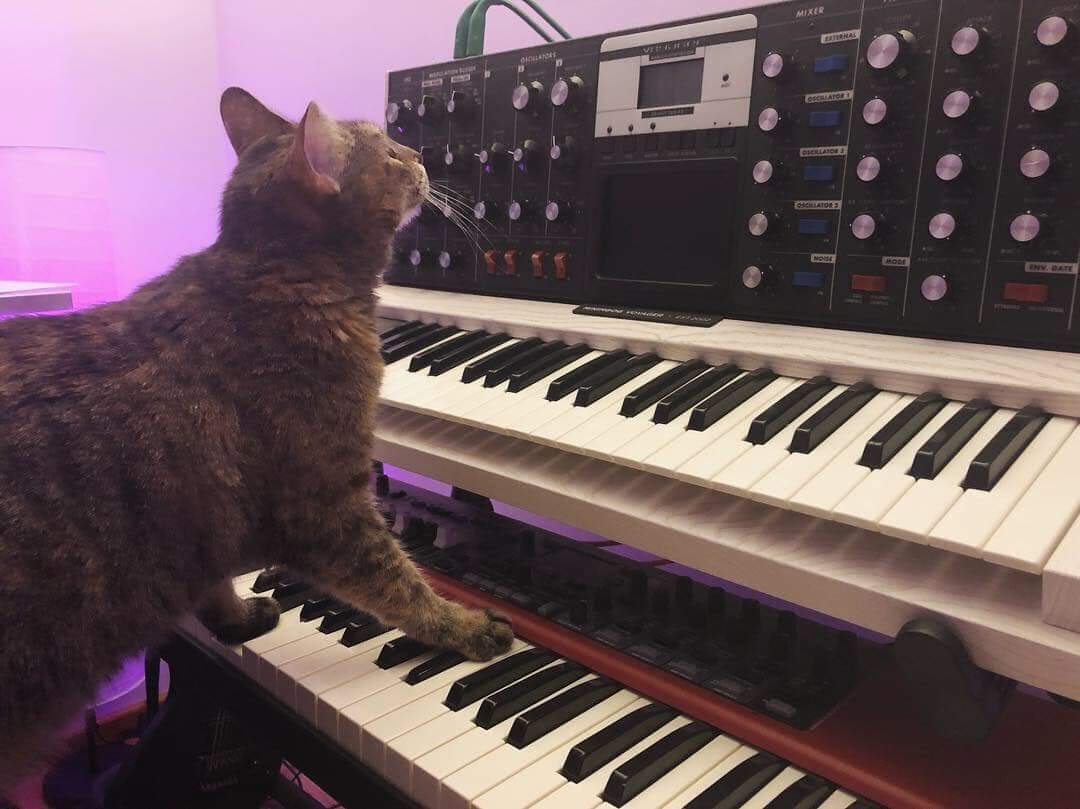
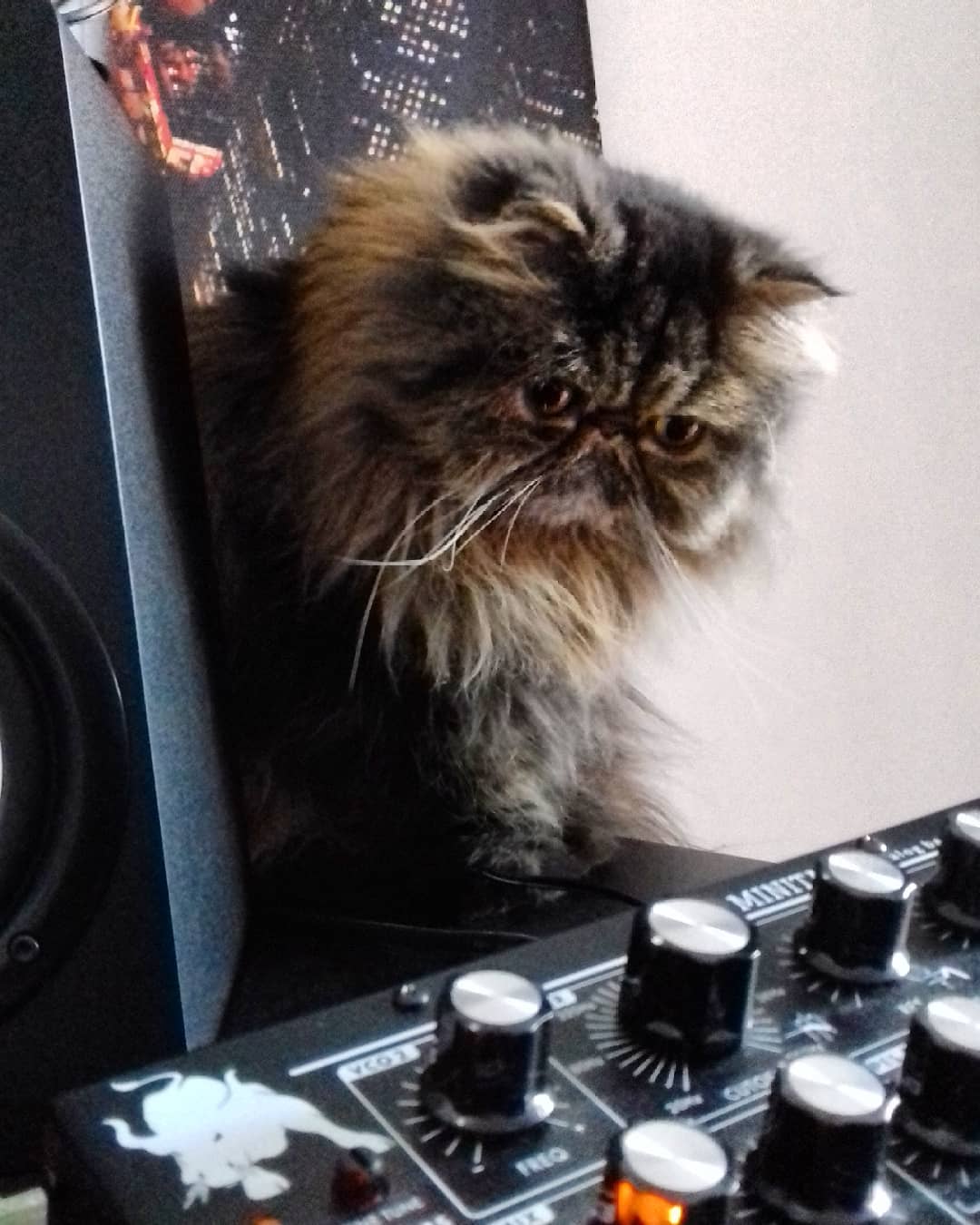
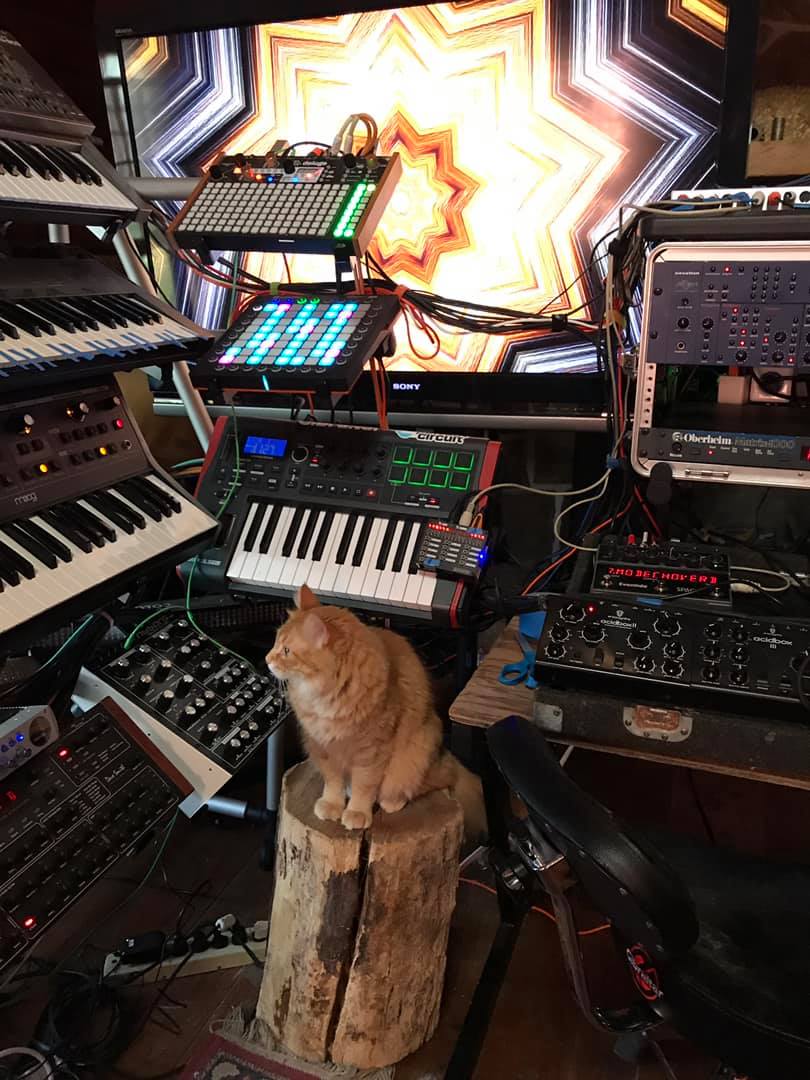
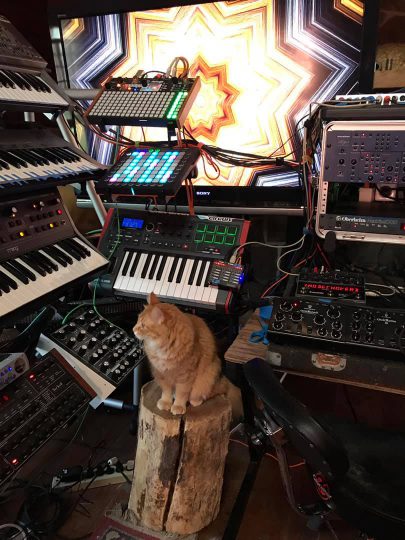
    Meet Jazz the cat, who presides over a studio with Roland AIRA, Elektron, and modular synthesizers. From Border One on Instagram.

    In the #studio with #jazzthecat

  • CatSynth Pic: Prophet 12 and MOTIF XF-7

    CatSynth Pic: Prophet 12 and MOTIF XF-7

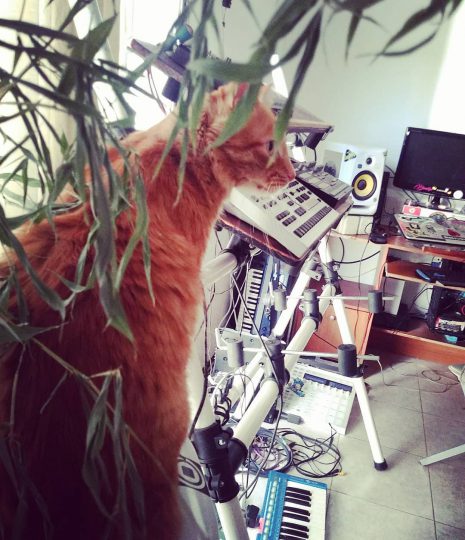
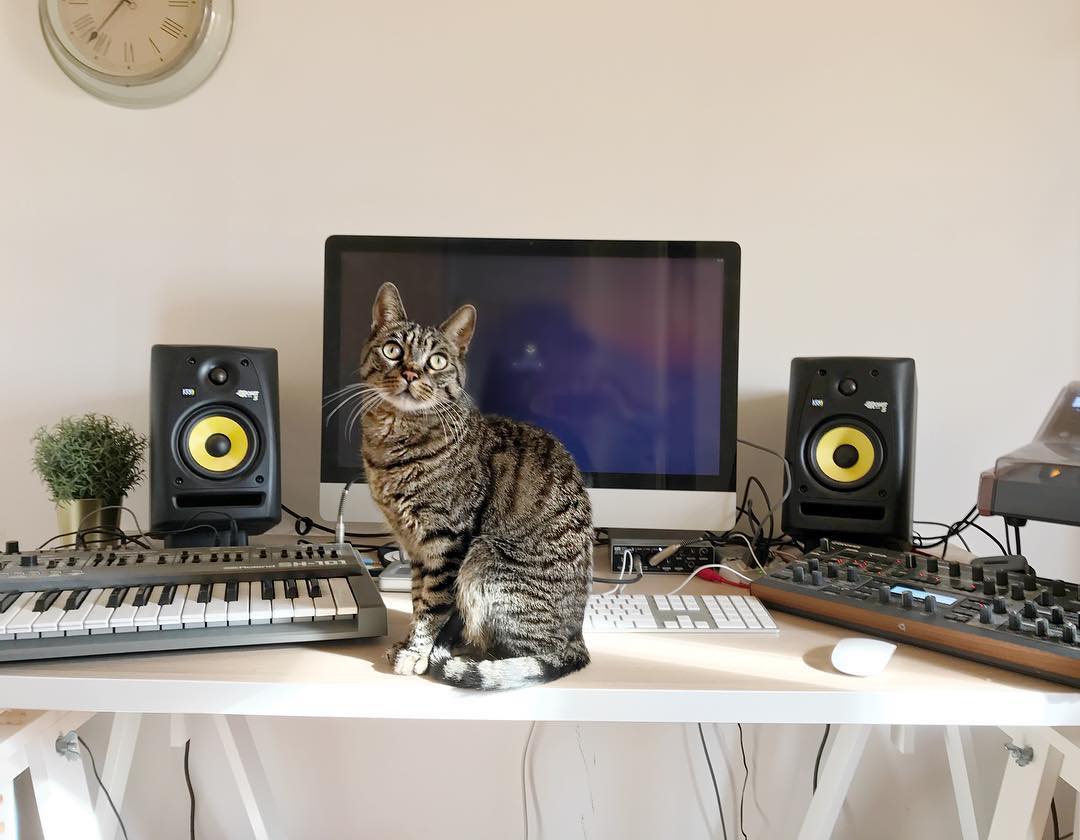
    A noir-ish photo of a cat atop a Yamaha MOTIF XF7 synthesizer, along with a Sequential Prophet 12. From Pete Dolan via Facebook.

    Here’s my dark boy in an arty shot

  • NAMM 2019: New Modules from 2hp

    NAMM 2019: New Modules from 2hp

    We at CatSynth are fans of 2hp, and not just The Cat. They’ve given us so many things to put in those pesky little spaces left in our modular systems, from highly useful VCAs (you can never have too many VCAs), to more exotic offerings like physical modeling.

    At this year’s NAMM show, the debuted four new modules covering both utilitarian and creative terrain. The one that most intrigued me was the Bell, a physical modeling voice that brings metallophone sounds. It can do vibraphone-like sounds, wine glasses, bowls, and of course, bells. With the main mallet and bar parameters (indicating that is likely based on modal synthesis), one can get a variety of combinations with CV modulation. This looks like a lot of fun – I already on the Pluck – and look forward to its release.

    At the other end of the spectrum is the DC module. It offers three different DC offsets along a -5v, +5v, and 10v scale. These are useful utilities when crafting specific CV signals. I could see this pairing nicely with a Make Noise Maths for more precise control, or for tuning 1v/Oct controls.

    Next up is the Sine, which is more than a simple sinewave generator. It does have a pure sine wave, but also a sub that allows blending of the fundamental, one octave below, and half an octave above. It also includes a wave folder function for rich harmonics. Essentially, this is another harmonic oscillator.

    Finally, there is the Grain, a granular processor that buffers incoming signals and allows them to be output using granular synthesis. This is a bit different from a sample-based granular module like the original Nebulae from Qu-bit which works on stored samples (the v2 of the Nebulae does allow processing of live input). The buffers can then be mangled and stretched by setting the density and periodicity of grains, along with the overall pitch. The demo we saw had this hooked up to The Cat.

    The result of the new modules plus the Cat and percussion made for a delightful demo as you can see and hear from our video.

    For more information about these upcoming modules from 2hp, including estimated release dates, please visit http://www.twohp.com/soon/.

  • CatSynth Pic: Coco and Modular

    CatSynth Pic: Coco and Modular

    Meet Coco, who presides over an impressive modular-synth setup. From cary_crank via Instagram.

    This is my longtime studiopartner in the background. Please give a big welcome to Coco.

  • CatSynth Pic: Lilli and Teisco 110f

    CatSynth Pic: Lilli and Teisco 110f

    Beautiful Lilli sits atop a Teisco 110f synthesizer. Submitted by Edda Hill via our Facebook page.

    Our Lilli is holding an arpegio down on the Teisco 110f 😍

    I confess I am not that familiar with Teisco synthesizer line, let alone the 110f. Here is a bit from Vintage Synth Explorer.

    In the beginning of the 80’s Kawai began manufacturing synthesizers under the company name of Teisco. Their early designs resulted in synths like the S110F above. The Synthesizer 110F is an upgraded S60-F, with dual analog VCO’s and an updated look. It has a small but usable 37 note keyboard. Classic analog sawtooth, square, and triangle waveforms plus noise are on-board and can be mixed with external sounds run through the 110F’s filters and envelopes. The oscillators can be de-tuned for duophonic textures or phatter leads and bass sounds.

    http://www.vintagesynth.com/misc/110f.php

  • Owlsynth Pics for Superb Owl Day

    Owlsynth Pics for Superb Owl Day

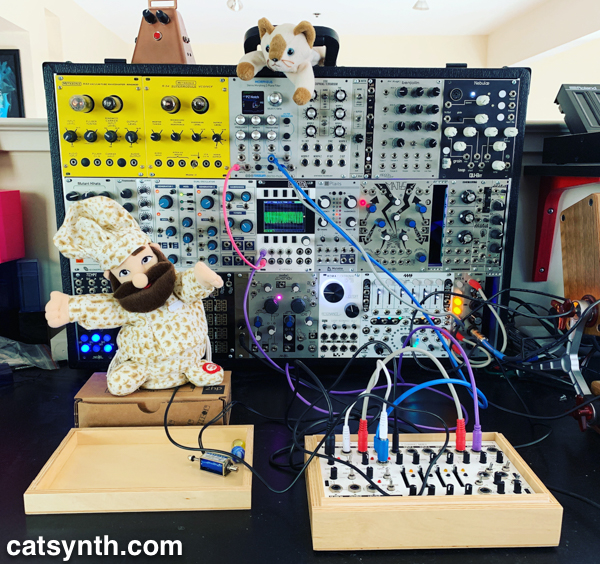
    We at CatSynth feel there is no better way to celebrate Superb Owl Day than with “owlsynth pics”. Here is our stuffed owl atop our main modular system.

    And with our trusty Roland Boutique VP-03 vocoder.

    And with our Arturia MiniBrute 2.

    (Definitely need to tidy up a bit there.)

    Owls are quite captivating as they are so different from other birds, even from other birds of prey. We all know their unique front-facing faces and nocturnal behavior. But they also have amazing auditory capabilities.

    Both the cat and the Barn Owl have much more sensitive hearing than the human in the range of about 0.5 to 10 kHz. The cat and Barn Owl have a similar sensitivity up to approximately 7 kHz. Beyond this point, the cat continues to be sensitive, but the Barn Owl’s sensitivity declines sharply.

    Some Owl species have asymmetrically set ear openings (i.e. one ear is higher than the other) – in particular, the strictly nocturnal species, such as the Barn Owl or the Tengmalm’s (Boreal) Owl. These species have a very pronounced facial disc, which acts like a “radar dish”, guiding sounds into the ear openings. The shape of the disc can be altered at will, using special facial muscles. Also, an Owl’s bill is pointed downward, increasing the surface area over which the sound waves are collected by the facial disc. In 4 species (Ural, Great Grey, Boreal/Tengmalm’s & Saw-whet), the ear asymmetry is actually in the temporal parts of the skull, giving it a “lop-sided” appearance.

    Owls and Hearing – The Owl Pages

    We at CatSynth hope you all have a fine and enriching Superb Owl Day!

  • CatSynth Pics: Mr. Maximillion in the Studio

    CatSynth Pics: Mr. Maximillion in the Studio

    Mr. Maximillion is napping peacefully in the middle of the studio. Identification of the synths left as an exercise to the reader.

    From our friend Charles Whiley via Facebook.

    I can leave him down here. In fact he finds peace in this room. The others…not so much.

    Sam Sam can be found napping in our studio as well. It is, of course, part of her territory, but she sees it as a safe space. If she is particularly anxious, she sometimes hides behind the mixer and equipment rack.

  • NAMM 2019: Qu-Bit Electronix

    NAMM 2019: Qu-Bit Electronix

    One of our first stops at NAMM 2019 was to visit our friends at Qu-Bit Electronix. This year they had three new modules to share.

    The first of the three was the Prism (center in the picture above). It combines three audio processors that are mapped to a three-dimension “prism” control space. One axis controls a comb filter, another a bit crusher, and the third is time/speed control. The audio processors operate on a buffer, which can either be continuously updated from audio input or “frozen” in time and looped. Finally, there is a multi-state filter that can either operate at the beginning or end of the signal chain. Of the three, this one perhaps intrigued me the most with the possibilities of mapping these different functions to CV input (e.g., from a Maths or a sequencer) in ways that push traditional music. You can hear a bit of it, along with the other two modules, in our video which features all three modules.

    The second module was the Chord, or rather the new incarnation of the chord. It’s a four-voice polyphonic oscillator with both traditional waveforms (continuously morphable) and a new set of wavetables. The oscillators can be stacked into chords, or in this new version each controlled separately for polyphony in the music-theory sense of the word – yes, with the right sequencer, this module can do four-voice counterpoint. The chord mode includes a variety of standard western four-voice chords (i.e., with a seventh degree), but also the ability to add custom chords that include microtones or dense tone clusters. It’s also more compact than the original, slimmed down to just 14hp.

    The final module was the Bloom, a sequencer that could generate variations on the fly using a proprietary fractal algorithm. The amount of variation, from none to completely random, can be controlled dynamically via CV, as can the number of steps in the sequence, for quite a range of variety. And with two channels, it would seem to pair nicely the Chord.

    As always, it’s fun to visit with Qu-Bit and see what they up to, especially as they are CatSynth superfans. And we look forward to seeing these modules out in the wild over the course of the year. The Prism is due in March, the Chord in late spring, and the Bloom in the fall.