Among the countless riffs based on “Sh%t girls say”, these two seem quite appropriate for CatSynth:
From iloveanalogue, via matrixsynth:
And from CreativeTime via Hyperallergic:
Sh*t Art World People Say from creativetime on Vimeo.

Among the countless riffs based on “Sh%t girls say”, these two seem quite appropriate for CatSynth:
From iloveanalogue, via matrixsynth:
And from CreativeTime via Hyperallergic:
Sh*t Art World People Say from creativetime on Vimeo.
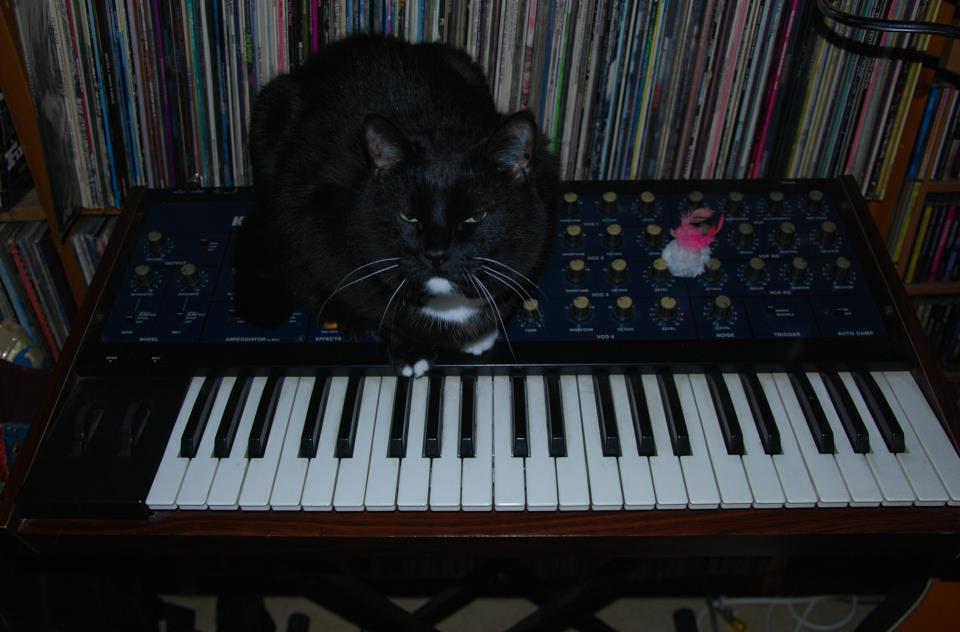

Submitted by Roar Sørensen via our Facebook page.
While you’re here, please check out my Fun with Highways: Florida article. I worked really hard on that one. And it has cats 🙂
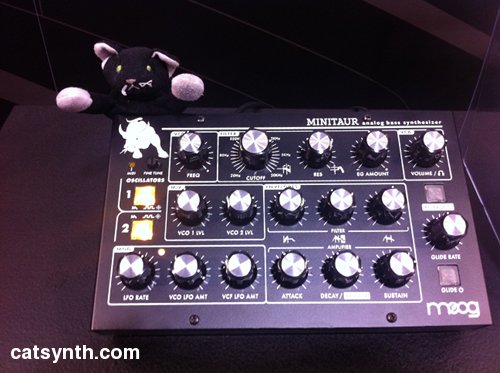

I have consolidated all of the NAMM 2012 posts in the list below. Lots of photos with our stuffed cat, and also a few videos.
NAMM: Waldorf Zarenbourg and Blofeld
Korg’s Little Instruments at NAMM
Battle of the iPad Docks at NAMM. Behringer iStudio and Alesis iO Dock
Dave Smith Instruments Tempest and Mopho at NAMM
Keith McMillen Instruments QuNeo (NAMM)
Dr. Lonnie Smith, Hammond Sk2 (NAMM)
Lunar Experience modular, Noisebug (NAMM)
Teenage Engineering OP-1 and Oplab
IK Multimedia iRig MIDI and iRig Cast (Good for OWS?)
Trash Audio party at NAMM and Matrixsynth “Wine Bar”
Malekko Heavy Industry at NAMM
There are also several items that were only covered via Twitter @catsynth with hashtag #NAMM.


On matrixsynth, where you can read more and link to more pictures of the synth. Below are some excerpts:
via Jorge: “This is Juno my new Maine Coon Kitten sitting on my Prized Minimoog D…
…Almost 2 years ago I got this Mini From Craigslist Virginia, Funny thing though is that the guy that had it happened to go to the same High School I went to in the early 80’s.
He said he got it when he worked at Venamin’s Music in Springfield VA, working as a manager in the 80’s. This Mini Spent most of its life in his Basement studio and survived a fire that burned the entire house down except a closet that was in his basement where the Mini was stored in an Anvil case…

I often find myself spending quite a bit of time at the booth of Analog Haven at NAMM. It is an opportunity to see quite a variety of analog instruments (and a few not-quite-analog), and meet several of the small independent makers. The visit took on added significance as I cautiously wade into adding analog modular to my own arsenal of musical instruments.
We big with KOMA Elektronic, who showed off a prototype of their new Kommander, an infrared motion controller with multiple axes of control. It joins their existing effects boxes in their product line:

We also had fun with the fact the industrial design, particularly the geometric black-and-white pattern, match my own aesthetics in terms of dress and decor.
Make Noise is known for their unique and complex modules for audio processing and control. They had several new offerings, including the Echophon whose sound I quite liked.
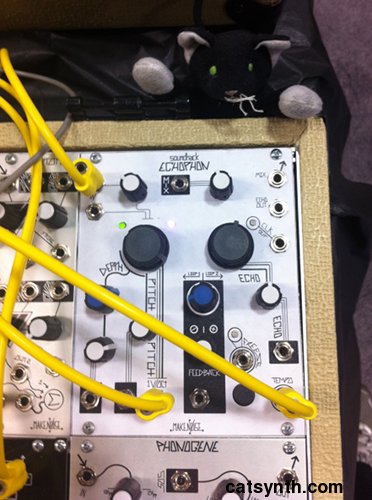
[Click to enlarge.]
The Echophon is a collaboration with Tom Erbe of SoundHack, and is a reverse of the usual trend in that digital character is re-imagined in the analog domain. Make Noise also presented their first oscillator, the DPO.
Another module that particularly caught my fancy was the Morphing Terrarium from Synthesis Technology. It is a wavetable VCO that contains numerous waveforms, but more significantly it has parameters for “morphing” or moving among the different wavetables. With the right self modulation, this can lead to very surprising and complex waveforms:

Another interesting new find was an analog modular video synthesizer from LZX Industries.
Like analog audio counterparts, the LZX modules generate, process and modulate analog video signals. Think of it as being the boxes that each do all the little pieces of an old TV studio but with creative routing and control. You can see a little bit of video below:
I did specifically ask about mixing audio modules with the video modules (LZX uses the standard Eurorack format), and was informed that yes, this can be done, though one would need to match the voltages between the two domains, and keep in mind that the frequency ranges of video are much higher.
Visual interest and catchy names are a big part of the inspiration in many of the small boutique offerings. These pedals from Audible Disease were quite creative.

Among the visual designs, this simple switcher caught my attention. It reminded me a bit of my visit to the Communist Propaganda Museum in Shanghai.

Other offerings included the ARCHANGEL, an analog sequencer with touch plate controllers, from Detachment 3.

And these pedals from Lightfoot Labs:
The Goatkeeper 3 is a tremolo pedal with analog signal path, but with a variety of waveforms (including the ability to record your own), and a sequencer for even more complex modulation.
There was a lot more at the booth, more than I can do in one article. I hope to see more of these instrument makers as I personally explore analog synthesis in greater depth.
And


Submitted by Mich Analogdevices on our Facebook page.
You can see a previous picture from Mich featuring the same cat here.
Here we see Gert Jalass of Lunar Experience tweaking a modular synth at the Noisebug booth at NAMM.
The modular had a deep sound that cut through even the hall noise. The Lunar Experience modules, however, were the controllers. Other modules (in the Synthesizers.com 5U format) were used for sound generation, but the demo should how it would be straightforward to use in a live situation.
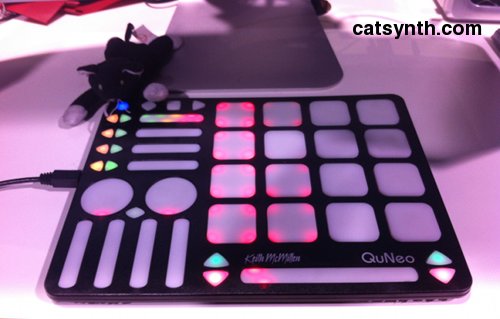

Yesterday at NAMM I had a chance to see the new Keith McMillen Instruments QuNeo. It was a prototype, so it was demo-only at the time. It was definitely designed with Ableton Live in mind, with a layout and style that would be familiar to users. I liked the use of lighting to provide feedback, and the controller had a comfortable touch. In all, it seemed more “graceful” than the other Ableton Live controllers that have proliferated in the last few years. And it is about the size of an iPad. Which of course opens up the question of how such a controller compares to using an iPad. Certainly, the tactile feedback is helpful.
I would be curious to see how it does with other software or in a custom environment.
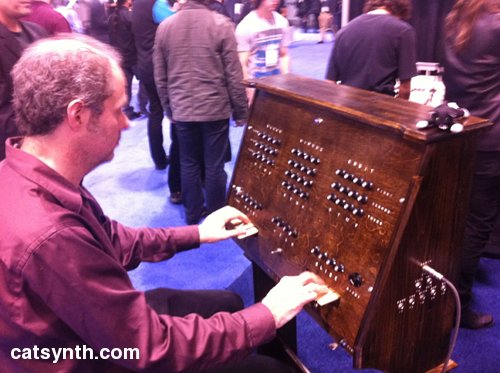
One of the perennial destinations at NAMM is the both of Big City Music. They have quite a collection of both vintage electronic musical instruments and contemporary analog electronics.
The highlight this year was a live performance with a Dewanatron by Leon Dewan:

It was hard to hear it well in the hall environment, unfortunately.
I also was looking closely at some of the analog modular offerings:

Above as a system primarily with Kilpatrick Audio modules for both sound and control. Below is a case full of Metasonix modules, distinctive with their protruding vacuum tubs and yellow color.

Big City announced a new metasonix module, the Thyratron VCO. I was able to listen to it and other modules (VCF, Waveshaper, etc.). Metasonix modules look a bit intense (and their description text can be a bit menacing), but the modules themselves had an unexpectedly subtle sound. That is, until you pick just the right modulation, then it gets more interesting. The wave shaper remains my favorite of theirs.

One of the surprises at NAMM was the Arturia MiniBrute:

The MiniBrute features a pure analog signal path (a first for Arturia). It has an oscillator bank with the usual complement of waveforms (sawtooth, square, PWM) as well as a sub-octave oscillator. As such, it reminded me a lot of the Octave Kitten, and I was able to get some similar sounds out of it when I set the cutoff on the filter low (and the resonance high). I thing it would sound great with a proper amp with bass response. It didn’t have a chance to put it through the modulation paces to see of the LFO was also similar to the Octave synths.
Others had their own comparisons. The Roland SH-101 seems to be a common comparison in terms of the sound. I think many of us who were surprised to see this instrument and happy with its USD $549 starting price all wanted to project our own analog favorites onto it.