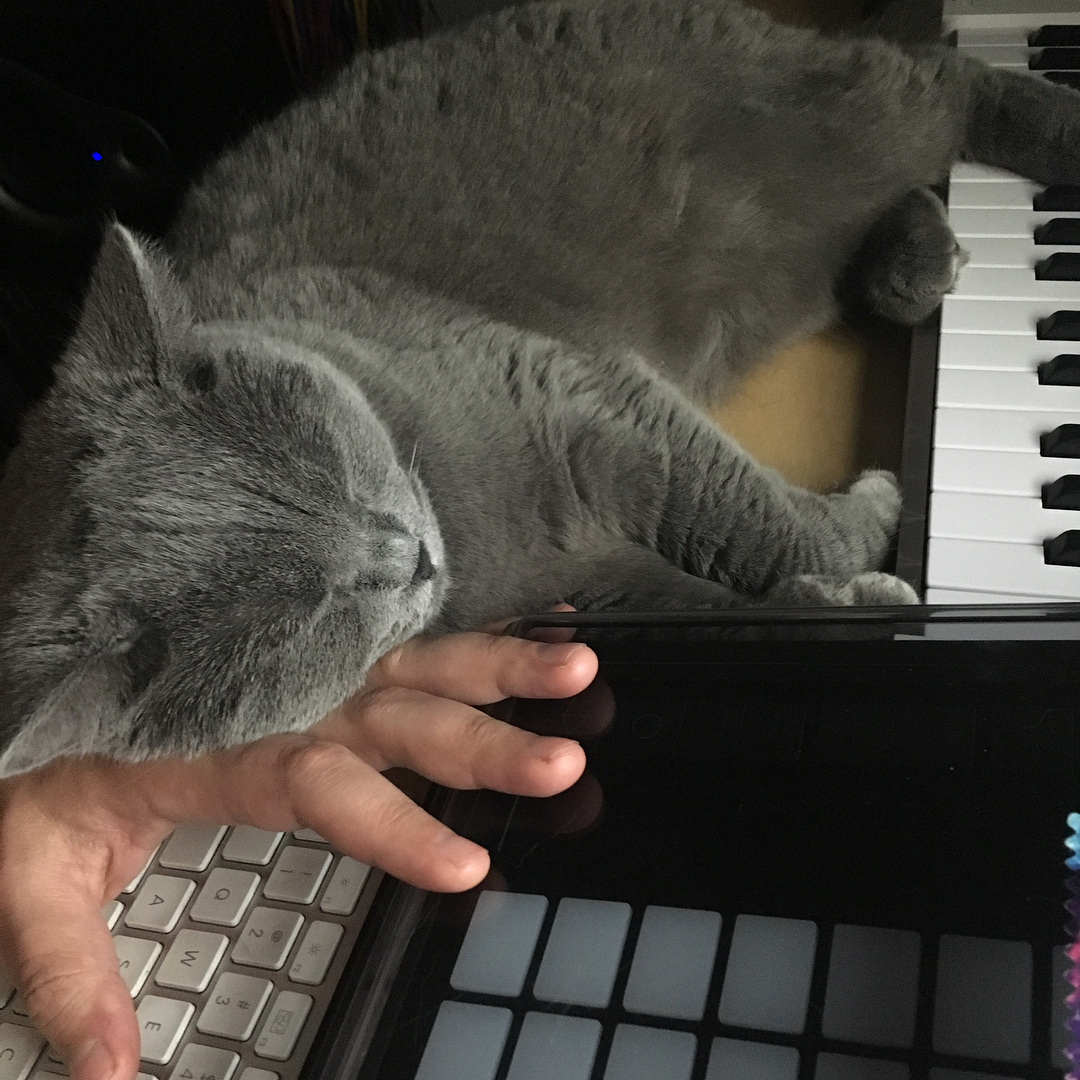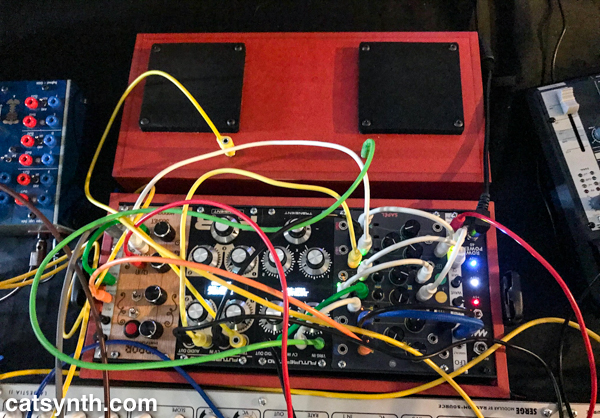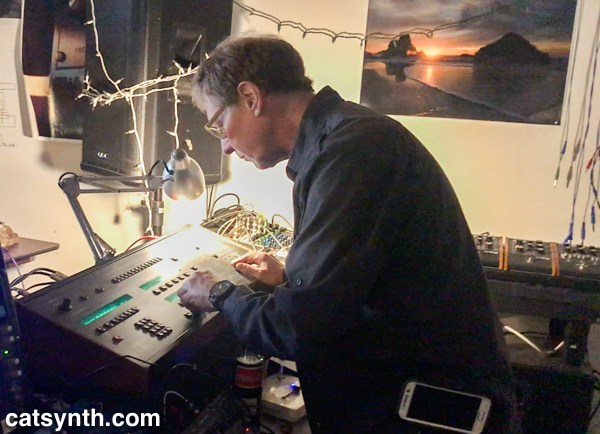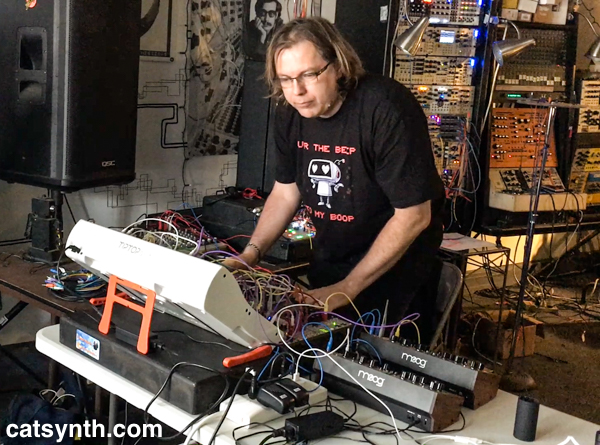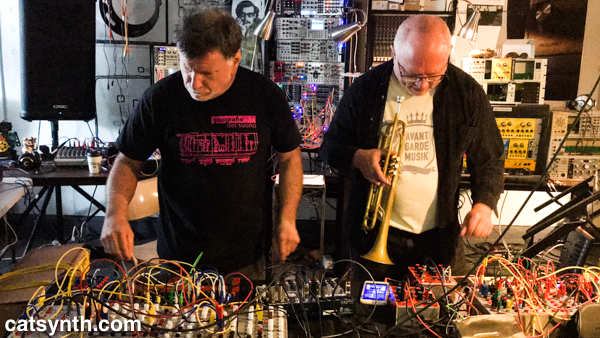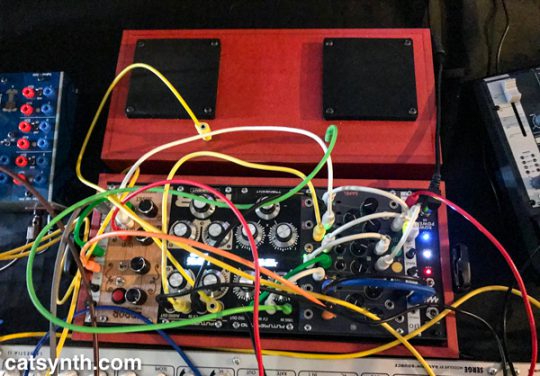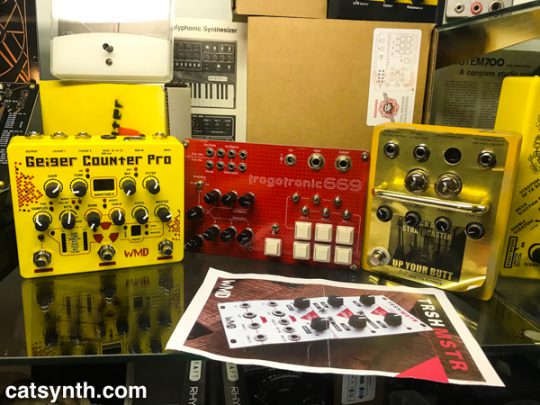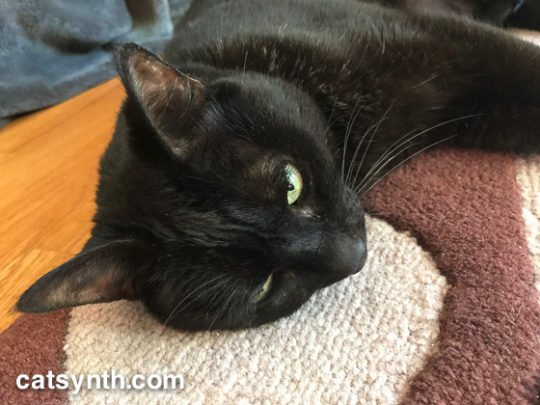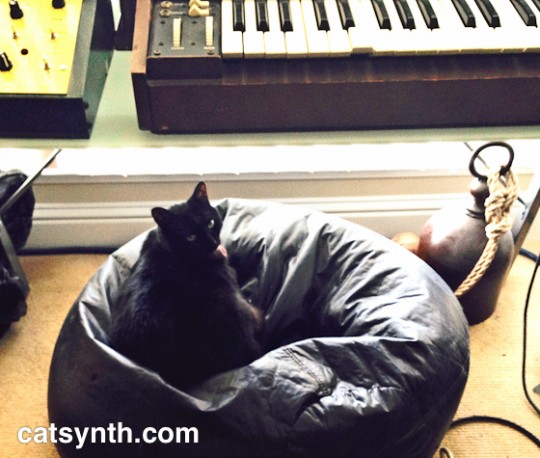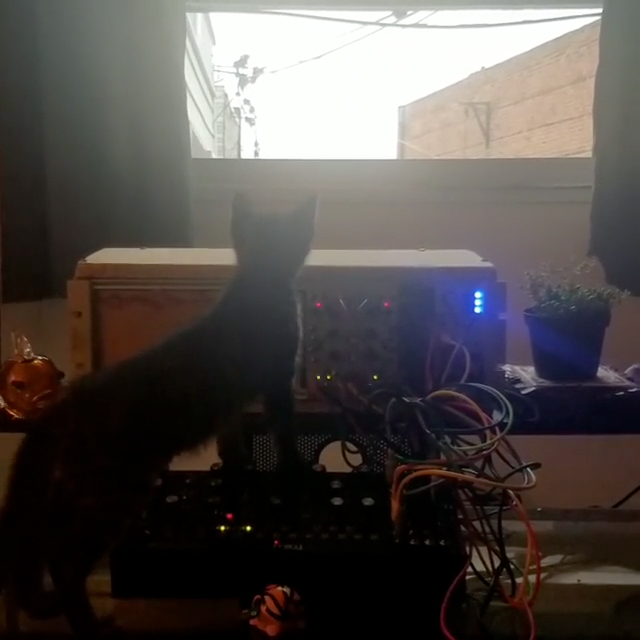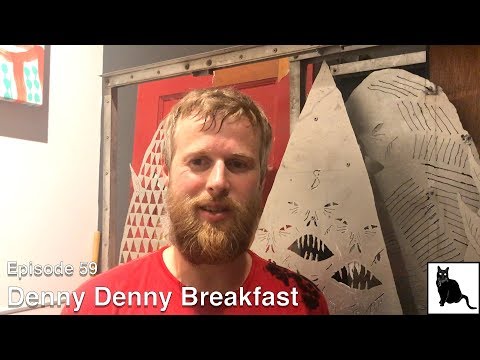
Mr. Maximillion returns, this time with his JoMoX Alpha Base and a Novation Peak synthesizers. Submitted by our friend Charles Whiley via Facebook.
Mr. Maximillion has quite the synth collection, and we always look forward to seeing more of it.


Mr. Maximillion returns, this time with his JoMoX Alpha Base and a Novation Peak synthesizers. Submitted by our friend Charles Whiley via Facebook.
Mr. Maximillion has quite the synth collection, and we always look forward to seeing more of it.

It’s been a busy season for Pitta of the Mind! We had three shows in the span of two months, beginning with our blue set at Pro Arts and culminating with ¡Voltage and Verse! at Adobe Books in San Francisco. You can get a taste for the show in our CatSynth TV video.
It was an honor to once again share a bill with ruth weiss. A Holocaust survivor and founding member of the San Francisco beat poet scene in the 1950s, she is still going strong, performing and supporting local institutions and artists.

We were glad to see that she is continuing her collaboration with our friend and synthesizer virtuoso Doug Lynner. Together with log percussionist Hal Davis, they performed a set of poetry and music that simultaneously evoked earlier eras and the latest electronic experiments. Davis’ log drum provided an expressive metronome, undulating between a trot and a gallop. Lynner’s synthesizer lines filled in the spaces, sometimes with rhythmic appeggios and at other moments with long eerie drones. The synthesizer timbres and phrases complemented the words in multiple ways, sometimes underpinning the narrative in the manner of a good film score, at other times emphasizing the rhythm of the words and making them into a musical whole.

Our Pitta of the Mind set was part of a month-long celebration for the release of Maw Shein Win’s new book of poetry Invisible Gifts. The book is divided into four sections based on different colors. This works perfectly for our use of color themes in our performances. For this night, we chose silver and performed selections from the silver section of the book. There were some familiar poems that we have performed before, and some that were new to me. There were a variety of styles and subjects in the words that inspired different musical backings, from jazzy electric piano (my favorite) to abstract synthesizer explorations. I was able to reuse some of the modular patches I had developed for my recent show in Portland and make them work with the rhythm of the texts.

Maw and I have performed together so many times now that it has become almost second nature to realize a new set; our three shows this season went off (nearly) flawlessly, and have been among the best we have done in our nearly seven years of collaboration! We have developed a toolset and pallete of instruments (including the Nord Stage and Prophet 12) and sounds that we can quickly turn to with each new text, which makes the process of learning new pieces both simple and fun. I certainly hope we can keep up the momentum in the remainder of the year, even as I turn my own attention to other musical projects.

In between our set and weiss/Lynner/Davis, we were treated to a presentation by Ramon Sender. Sender was a co-founder (along Morton Subotnick and Pauline Oliveros) of the San Francisco Tape Music Center in the early 1960s, but on this evening he regaled us with stories of his time at the Morning Star and Wheeler ranches in Sonoma County in the late 1960s and early 1970s. Morningstar, founded by Lou Gottlieb, was a radical experiment in communal living, populated by an interesting cast of characters along with folks who “commuted” between San Francisco’s Haight-Ashbury district and the ranch west of Sebastopol. It only existed in its communal form for a short period of time before being shut down by Sonoma County. Sender and others then moved to the nearby property of artist Bill Wheeler, who followed Gottlieb’s lead and opened his ranch as a commune open to all. I found myself fascinated by Sender’s stories, and would love to learn more about the history of the area and these communal experiments.
It was a fun night of music and words that lived up to its billing, and I certainly hope to have a chance to perform with everyone again. And thanks to Benjamin Tinker and Adobe Books for hosting the event! Please support your local bookstores and performance spaces.
[Photos not marked “catsynth.com” in this article courtesy of Maw Shein Win.]


Via matrixsynth, we have this announcement from ALM of a new module that was revealed at Superbooth 18.
Sadly, we were not able to attend Superbooth – hopefully next year. But we did find this video about that included an overview of ALM’s new offerings, including the Quaid Megaslope.


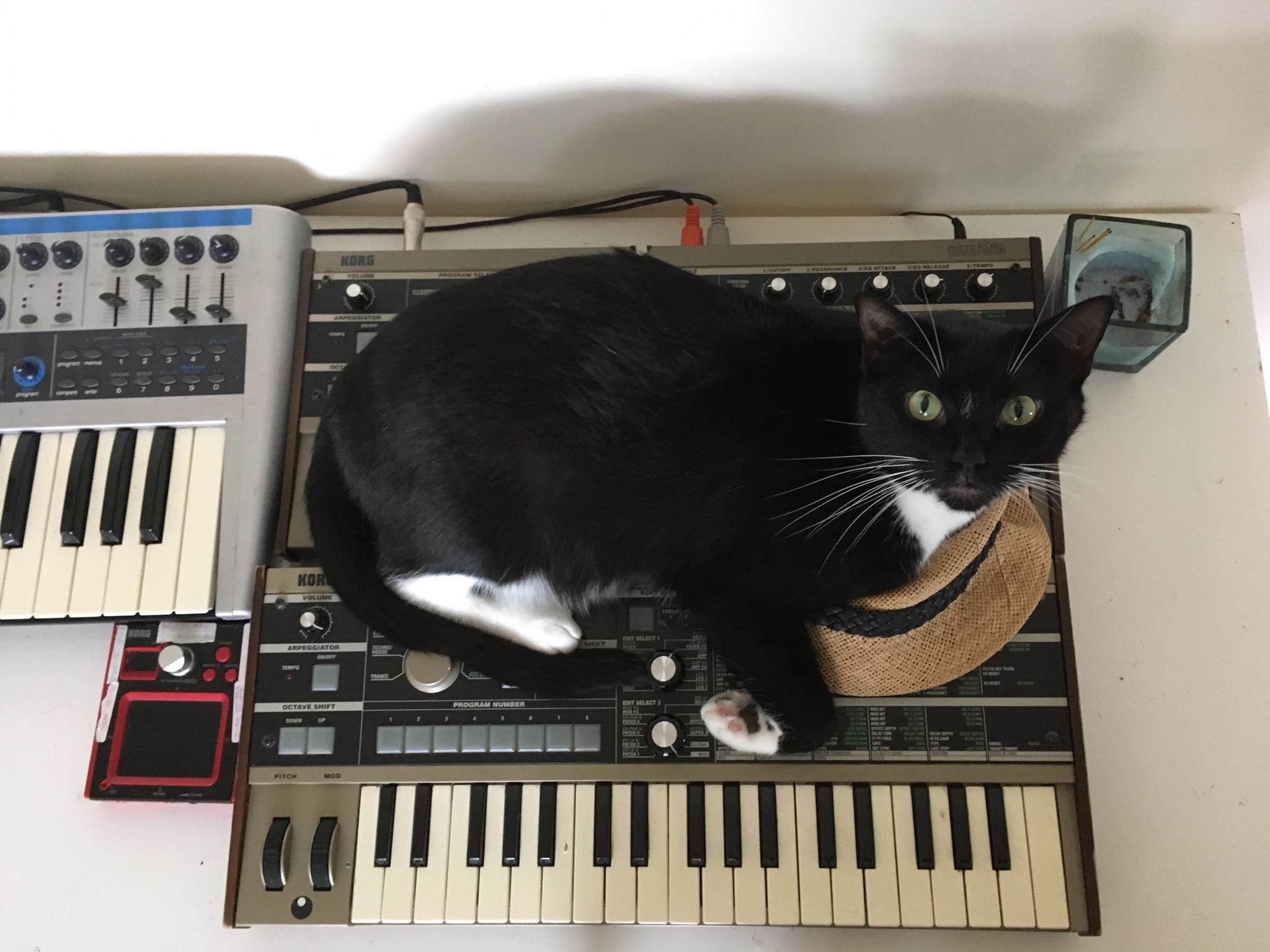
Handsome tabby cat with an Evolver from Dave Smith Instruments. From anika_or on Instagram.
I will confess I haven’t been using my Evolver as much of late as I used to. It’s probably time to take a fresh look at what it has to offer.


This is one lucky cat, with both a Sequential Prophet 6 and an OB6 from Dave Smith Instruments. And the keyboard versions at that 😻
Photo by Jon Sellers via the Facebook group Synthesizer Freaks.
The two instruments are quite similar in layout and overall architecture but have distinct sounds and other characteristics. The P6 is a classic Prophet. while the OB-6 has the distinctive sound of its Oberheim filters.
You can read our past NAMM reviews of the P6 in this post, and the OB-6 here.

The fifth of May marks a great many things. It is the birthday of Karl Marx – indeed, today marks his bicentennial! It is also a day when many Americans inexplicably get drunk and culturally insensitive in celebration of the Mexican defeat of the French Empire in the town of Puebla. And finally, it is National Cartoonists Day. And in honor of this occasion, we celebrate many noted cat cartoonists.
We begin with B Kilban. An artist originally from Connecticut, he got his start as a cartoonist here in San Francisco, drawing for Playboy. It was at Playboy where his distinctive cat cartoons were discovered by editor Michelle Urry. This led to his most well-known book, Cat. You have probably seen his cats both in formal cartoons and adorning many products. Kilban passed away in 1990, but his legacy lives on through his books and syndication of his images. You can find out more at his official website www.eatmousies.com.
Of course, an article on cat cartoonists must include Jim Davis, the creator of Garfield. Davis grew up on a farm in Indiana with his parents, brother, and 25 cats. While the main human character in Davis’ cartoons, Jon Arbuckle is also a cartoonist who grew up on a farm, the spoiled and overweight Garfield seems nothing like a farm cat. Indeed, his disdain for the concept of catching mice is a frequent topic of the strips. Many an orange male cat has been named “Garfield” in the character’s honor.
One of the best-known works of Japanese manga artist Makoto Kobayashi also features an orange cat. What’s Michael? chronicles the adventures of a shorthair tabby named Michael and his many feline friends. It was originally released in serial form in Japan’s Weekly Morning manga magazine, but it now available in the U.S. as well via Dark Horse Comics. The stories are a mix of the mundane and surreal, with Michael sometimes appearing differently than the orange shorthair title cat, and sometimes even dying in certain episodes.
New Yorker cartoonist George Booth is best known his complex doodle-like cartoons featuring befuddled humans and their pets. They are a mainstay of the magazine and synonymous with the “New Yorker style” of cartooning. While the animal most frequently featured in his work is a fat dog with big ears, there are often cats as well.
And then there is Fritz the Cat, created by the legendary R. Crumb. Fritz originally appeared in Crumb’s homemade comic book “Cat Life”. Originally based on the family cat, Fritz became anthropomorphic in later iterations, evolving into the hedonistic con-artist character that was a mainstay of underground comix in the 1960s. Fritz’s adventures in a New York-like mega-city populated entirely by anthropomorphic animals often devolved into chaos with unusual sexual escapades. In the 1970s, Fritz the Cat was made into an animated feature film by Ralph Bakshi.
Another underground comix artist Gilbert Shelton created a well-known feline character. Known simply as “Fat Freddy’s Cat”, he initially appeared in Shelton’s Fabulous Furry Freak Brothers strip about a trio of stoner characters in the 1960s before getting his own strip. A standalone series, The Adventures of Fat Freddy’s Cat was published in the 1970s and expanded in a 1980s release.
Joann Sfar is a French comics artist. Influenced by the European comics artists of the 20th century including the great Moebius (Jean Giraud), he has a distinctive style that is at once more realistic and fanciful. One of his most well-known series is The Rabbi’s Cat, first released as a comic book in 2005 and later adapted into a film in 2011, which he directed. The main feline character is a cat who has the ability to speak and lives with a rabbi and his daughter in the Jewish community of 1920s Algeria. Sfar’s Jewish heritage runs through many of his works, but no more directly than in The Rabbi’s Cat. In addition to the books, we at CatSynth recommend seeing the film (which is gorgeous) in the original French.
Another classic of feline cartoons is Krazy Kat, by George Herriman. It had a long run as a comic strip in American newspapers from 1913 to 1944 when Herriman died. The strip was based around the ostensibly simple cat-and-mouse trip, with the cat named Krazy being taunted and tormented by a mouse Ignatz who is often shown throwing bricks at Krazy’s head. Krazy speaks in a very stylized mixture of English and other languages and is of indeterminate gender – though inexplicably smitten with Ignatz.
And finally, we would be remiss if we did not include our very own J.B., author the Mensa Cats series that appears right here on CatSynth.

You can see many more episodes of the Mensa Cats on these pages via this link. We also encourage interested reads to find out more about all the artists discussed in this article and to read their comics.


The job-search and interview process is often full of strange twists and turns, and you often can’t tell in advance which company and role will end up being “the one”, and which ones won’t. Even within a single job interview, that can be the case, as in the story told in this week’s article.
The office, a loft space in an older building, was gorgeous. It was bright and minimalist, with lots of glass and metal details. The furniture in the waiting area had a mid-century modernist vibe. There was definitely an integrated aesthetic to the place – even extending into the bathrooms – and it was one that I liked. There were also some concerning signs. It was crowded, and particularly in the engineering sector, people seemed to be sitting a little too close together for my comfort. I got the sense during the interviews that collaboration was highly valued – they even seemed to be proponents of the dreaded practice of pair programming in which pairs of software engineers formally work together on a problem. Now there is nothing wrong with working together, getting an extra pair of eyes on a piece of code, but only when it’s informal and infrequent.
But the technical portions of the interview put me at ease. The questions were challenging and esoteric, but I was able to handle most of them, even surprised my interviewers in getting a couple of tough Android questions right. As a bonus, the interviewer from outside the domain asked questions about mathematics and high-performance signal processing which gave me a chance to show off a bit. So when I got the call back a day later from the recruiter that I had impressed them technically and that they wanted me to come back in for the next steps I was excited and put aside my concerns. The next steps involved having lunch with the Android team and meeting one of the co-founders. The lunch went well – it was great to see that my potential teammates included two other women – and I felt relaxed, even a bit boisterous as they asked about my music and such. The meeting with the co-founder/CTO was a more serious affair, but also positive. He had an affable but businesslike and direct manner, and at the conclusion of our conversion he said he could see me working there – he also shared that while they offered lunches, as a policy they did not offer dinners, as they wanted to encourage people to go home and spend time with their families, etc. This seemed sober and civilized, especially in comparison to where I had come from before. And a final boost of confidence came as I was leaving and ran into the interviewer from the first round who had asked me the mathematics and low-level computing questions – he said he was definitely pulling for me.
There was only one more step: meeting the other co-founder/CEO, whose main focus would be to test for cultural fit. I had some trepidation about that, but I respected their process, and I felt good enough about the previous rounds that I wasn’t too worried. As soon as he entered the conference room where I was waiting, I could tell this was going to be very different. Compared to everyone else I had already spoken to, including his co-founder, he had a very awkward manner. He seemed to avoid eye contact with me, and his voice had a very flat contour – classic characteristics of someone who is “on the spectrum”, at least in the popular imagination. It’s always a little weird for me to be more expressive one and the one who carries the energy for the conversation, but I did my best. However, when in the middle of talking about myself and my work I mentioned that I like to work “quietly and independently” his body language went from flat to sullen. He then asked what I meant by that, and I tried to answer truthfully and analytically, but it was clear this was the wrong thing to have said. “Quiet and independent” was not going to be a cultural fit. And a few days later, I got the notice that I was turned down. They did not cite a reason or give any feedback, but it was clear in my mind that it most likely came down to those three little words “quiet and independent” in that last interview.
The question remains why? Why would a culture of hyper-collaboration, proximity, and interaction trump getting things done? I don’t have the answer to that, but I suspect they saw my professed independence as a liability for their organization. A bit more sinister, I was left wondering if my response was seen more negatively because I was a woman. I have observed that cultures that put a premium on teamwork and collaboration seem to expect women to be “even more so”; and that women are treated more severely for being contrarian or pushing back. Again, I don’t know whether that played a role in this instance, but there were other instances where it most certainly did, and I will share in a subsequent article.
As for this particular job search, the same day I was notified that I was turned down for this position, I had an interview for another that led to an offer that turned out to be one of the best overall work experiences I have had. As I said at the start, you never know how things will turn out.

Last year on May the Fourth, we shared a bit about felines in the Star Wars universe. In particular, the many species of tooka, a small animal with cat-like appearance and behavior that was featured in both the Rebels and Clone Wars animated series. Tookas also make an appearance in the new Forces of Destiny animated shorts. In one episode, Jyn Erso saves and befriends a tooka that has adopted by a girl as a pet.
https://www.youtube.com/watch?v=xc0O1yP9kNo&feature=youtu.be
We at CatSynth love these short videos in the Forces of Destiny series. Most of the attention has gone to their featuring of the women in the franchise, but they also cleverly weave together characters from different stories over the timeline. We will have more to say about this series in a future article. But for now, May the Fourth Be With You! (Oy vey!)