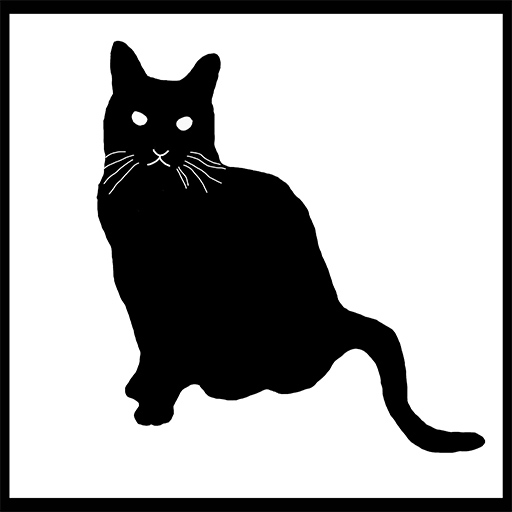
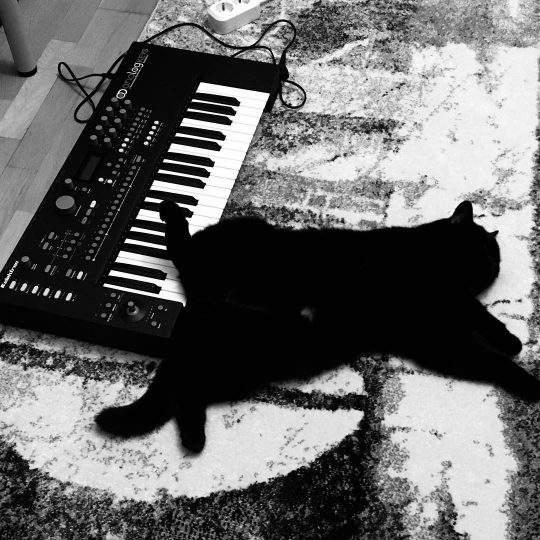
Black cat with Elektron Analog Keys. Instagram by anika_or from St. Petersburg, Russia.
The Elektron Analog Keys is a four-voice analog synthesizer that can also be used as both a MIDI and CV keyboard controller. You can read more about it on Elektron’s website.
You can find more Elektron photos and our NAMM reviews via this link.
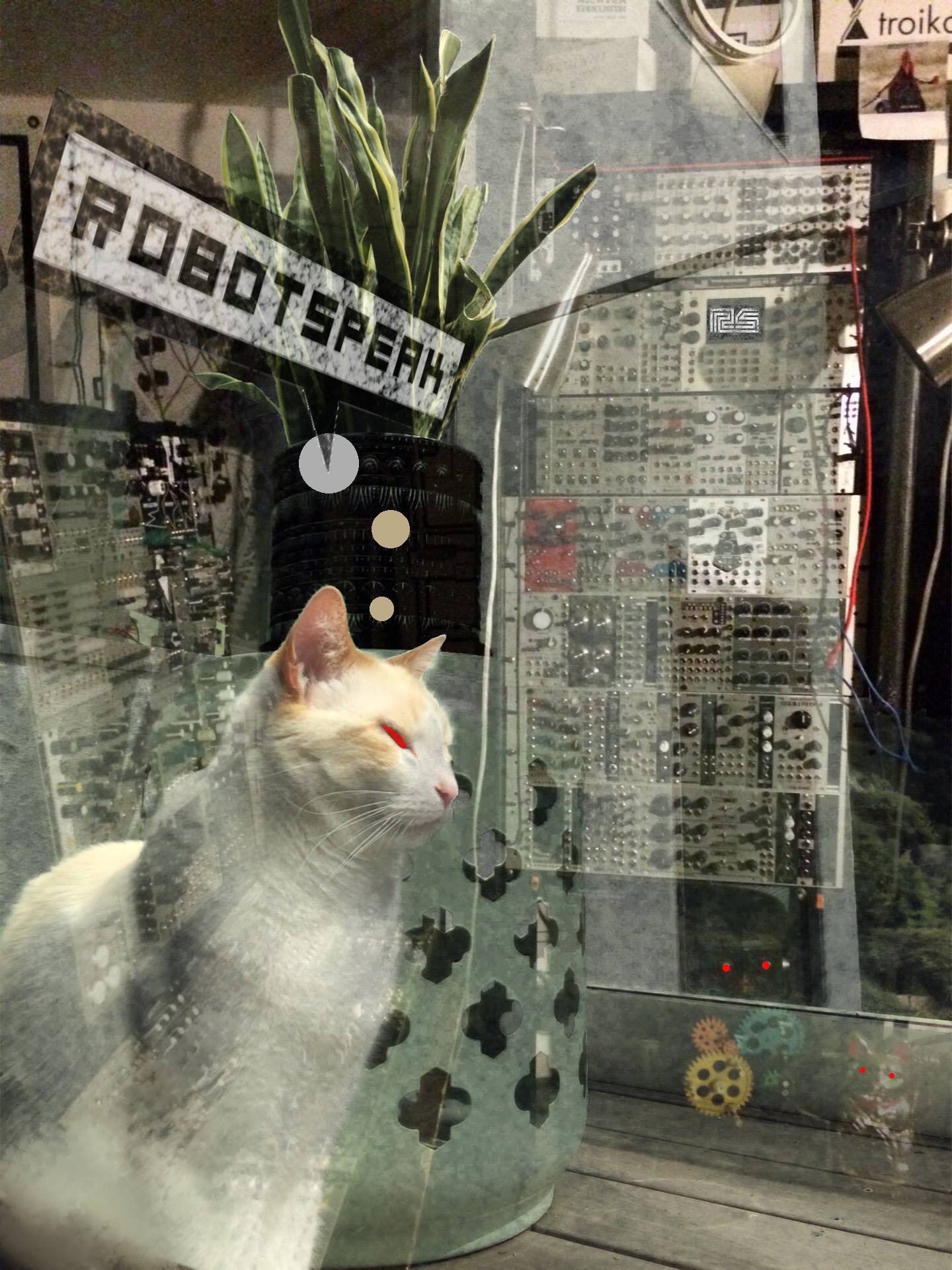
We espied this photo on the Facebook page of Robotspeak, our local synthesizer shop and informal gathering place for monthly shows here in San Francisco.
I have myself dropped quite a bit of hard-earned money there (but don’t regret any of it), and I have played there on a few occasions, including the Analog Ladies showcases. You can read about past visits to Robotspeak via this link.
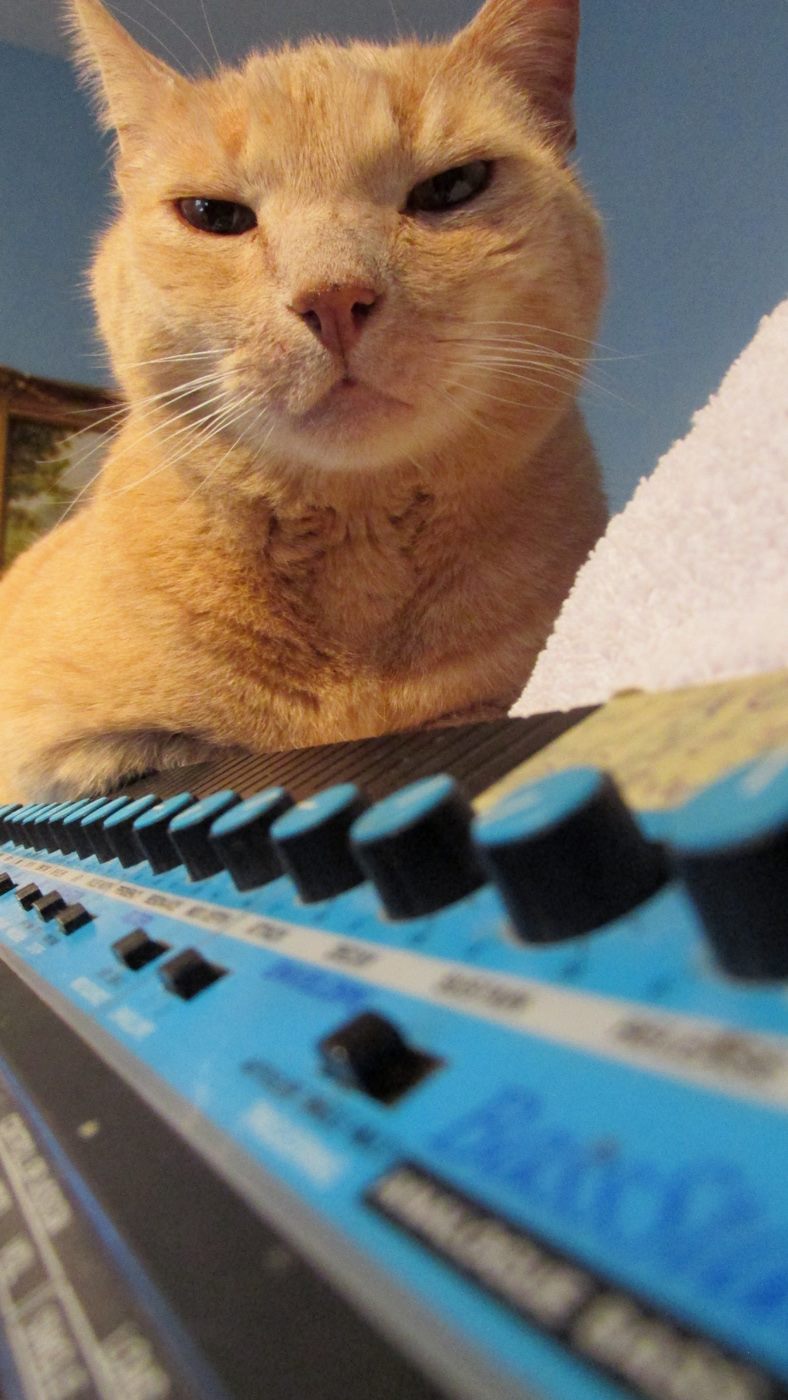
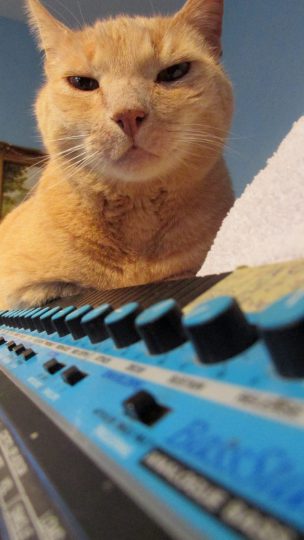
Meet Nemo! He is showing off an original Novation Bass Station keyboard synthesizer. Photo submitted by Arthur Schmitt via our Facebook page.
Many readers will be familiar with the popular Bass Station 2. The original Bass Station was released in the early 90s, first in this keyboard form and later in a more popular rack form. (It was the 90s, so we still all had collections of 1U-3U rackmount instruments and signal processors). From Vintage Synth Explorer:
Before the famous Novation Bass Station Rack module came the small and portable Bass Station keyboard! This synthesizer uses digitally synchronized analog oscillators (DCO’s) to reproduce the sounds of a monophonic dual-osc analog synthesizer with simple and intuitive controls via 17 knobs, 10 switches and 2 Moog-style pitch/mod wheels. Think EDP Wasp and ARP Odyssey.
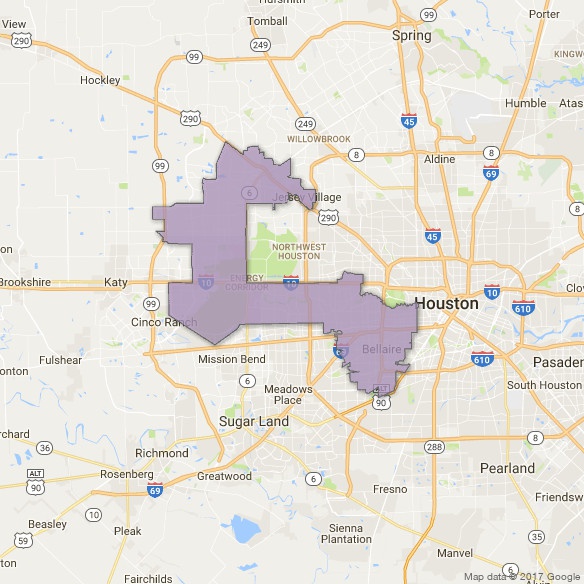
Primary election season is in full swing. In a couple weeks, we will be having one here in California (as well as an election for mayor here in SF). But tomorrow, there is a runoff in Texas’ 7th Congressional District (TX07) in which we at CatSynth are taking a keen interest. As illustrated in the map, TX07 cuts an odd shape through the western neighborhoods of Houston and the adjacent towns in Harris County. It is a diverse area and intersects with all three of Houston’s loop highways, which is no small feat. It includes several wealthy enclaves, but also middle-class neighborhoods, and areas that have been hit by serious flooding during Hurricane Harvey and preceding events.
The southeast “bulge” part of the district includes sections of Houston that lie within the I-610 loop, or “Inner Loop”. I-610 separates the downtown sections of Houston from outer neighborhoods and surrounding communities, including towns like Southside Place. It is bisected west-to-east by the new I-69 (US 59). The area where these two highways intersect would not look out of place in Los Angeles.
Heading north and west, we come to the middle section of the district, which is largely a horizontal rectangle bounded by the mighty I-10 to the north, and which extends almost to Katy in the west. Beltway 8, also known as the Sam Houston Parkway/Tollway, bisects this segment of the district. Just to the west of the beltway are the Briarforest neighborhood and the ominously named Energy Corridor. Not surprisingly, several major energy corporations have operations in this area, as do several other businesses. The Buffalo Bayou – we at CatSynth are still not entirely sure what separates a bayou from a river – cuts through the district. It was subject to major flooding during Hurricane Harvey. In addition to the bayou itself cresting at record levels above flood stage. releases from the Barker Reservoir caused severe flooding in adjacent low-lying neighborhoods. We have sources that have informed us that the floodwaters in the Energy Corridor area were most unpleasant.
The final section of the district cuts an inverted “L” between State Highway 6 and State Highway 99, the outermost loop around Houston, bounded on top by US 290. In all, the district has an odd shape indeed, but not so odd when one considers the tradition of gerrymandering, an art which has been taken to new heights by Texas’ Republican-controlled state government. Its shape has long preserved it as a safe Republican district – it has elected Republicans to Congress consistently since George H.W. Bush in 1966. But the city and surrounding area have been changing, and it is seen as vulnerable to flip to 2018.
Several Democratic candidates have vied to take on incumbent Republican John Culbertson, including Laura Moser, a progressive candidate who also just happens to be the sister-in-law of CatSynth author and founder Amanda Chaudhary. As such, we are watching her candidacy with great interest and excitement. Leading up to the main primary in March, things got a bit nasty, with the DCCC (Demoncratic Congressional Campaign Committee) throwing its weight behind another candidate, more mainstream and connected to the Democratic establishment. This was an unusual move for a suburban primary election, and some of the opposition was rather mean-spirited. But that is a long-standing part of elections, and it only served to galvanize support for Moser, who placed second in the crowded field and made to the runoff which happens tomorrow, May 22. Not having learned their lesson the first time, the DCCC has continued to attack her, including some rather nasty opposition-research-style drops (in some ways, they reminded me of some recent attacks on Jane Kim on our local mayor’s race in SF). But in this case, it was against family, and therefore personal in addition to being against my political views. So we at CatSynth are pulling strongly for Laura Moser in Texas’ 7th Congressional District tomorrow, and hope she wins both the runoff and the general election in November. You can find out more about her history and positions on her website, and if you have any friends in TX07, please encourage them to get out and vote!
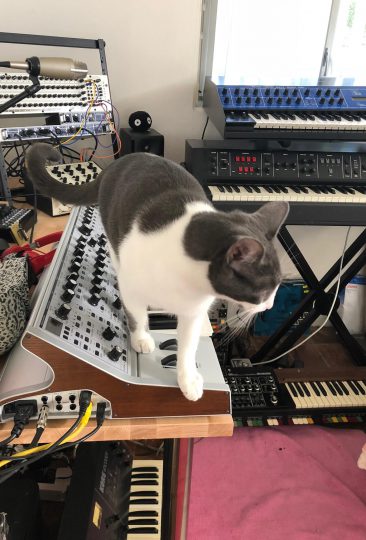
Gracie returns! This time we see her testing out one of her Moog synthesizers (a Sub37 or Subsequent 37). We also see a Korg vocoder below, and an Oberheim in the back. In the background, we see a PPG Wave, a rare DK Synergy below it, and a few other synths that we leave as exercises to the reader. Gracie always has such an impressive collection 😸
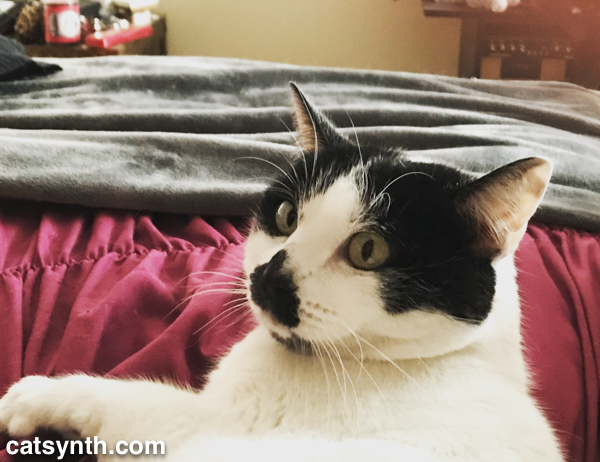
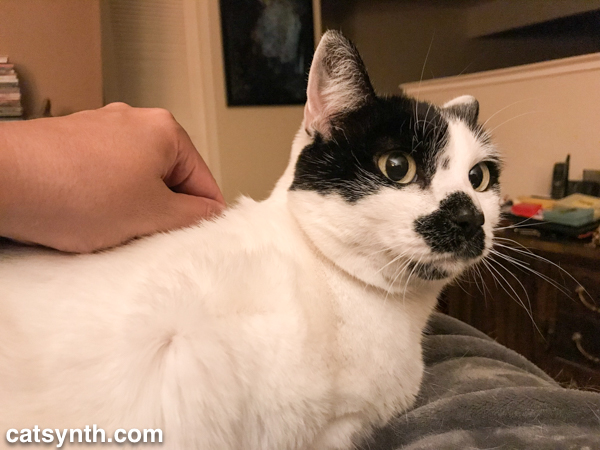
Those who follow our Instagram are regularly treated to photos and videos of Sam Sam and her adventures around CatSynth HQ. For those who don’t, we can assure you that she is doing well and is being spoiled rotten.
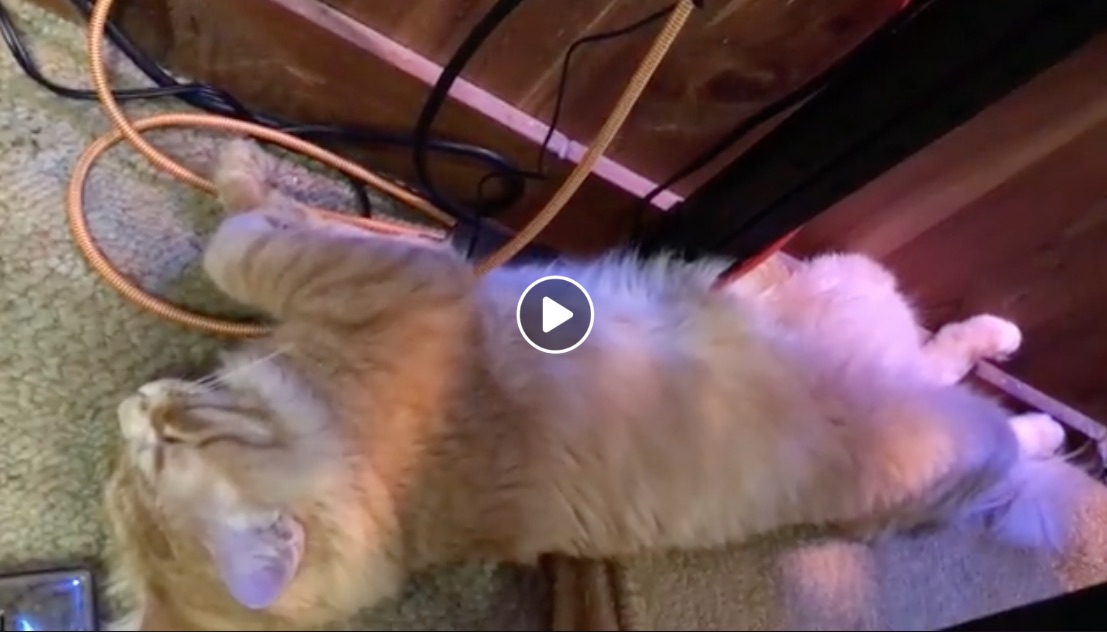
Sam Sam has made this blanket one of her favorite spots for napping and relaxing. It is quite warm and soft. In this video, we see her kneading it and purring up a storm.
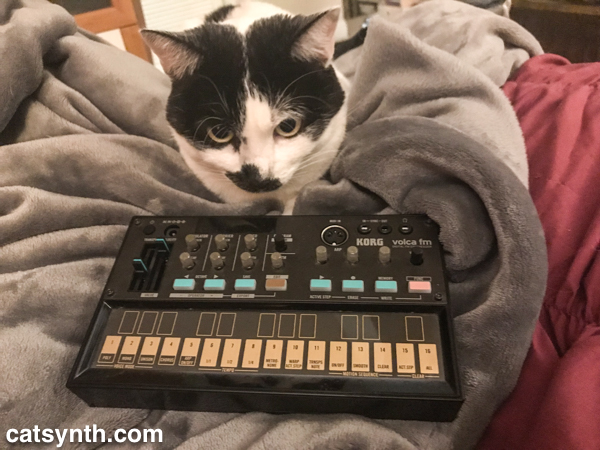
Here we see her posing with our Korg Volca FM sytnhesizer.
This photo was taken while preparing for our recent video on the Volca FM, which you can check out on YouTube. One of the nice things about these small battery-powered synths like the Korg Volcas and the Roland Boutiques is that we play them on the bed. And if I’m there playing a synth, reading, or napping, Sam Sam is likely to follow.
We hope you have a fun weekend, however you define it. And if you are Instagram, please do follow us 😻.
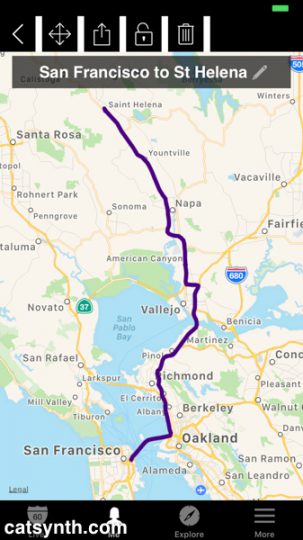
I found myself back again in Napa Valley wine country a couple of weeks ago. Specifically I was in St. Helena to meet Elsie the Library Cat. I am not a morning individual, but Elsie apparently is, so at the early hour of 7AM, I headed up from San Francisco, crossing two bridges before exiting the I-80 onto Highway 29.
I have written about traveling through the Napa Valley on Highway 29 before, specifically in a post from 2007. Once again Highway 29, multiplexed with Highway 12, was a parking lot south of the city of Napa, so I was once again able to snap a photo at almost the same exact location. It was quite theraputic to do so, chasing away some of the demons of 2007, which themselves chased out the demons of 2000. The road has been upgraded into a better expressway, and Highway 221 (just a short connector to downtown) is now signed.
The traffic thinned out north of Napa as the road narrowed north of Yountville. Here the landscape is dotted with modest vinyards and over-the-top mansions and tasting rooms. Finally, I arrived in St. Helena, my favorite town in the region. I pulled into the library parking lot around 9AM, just in time for my visit with Elsie.
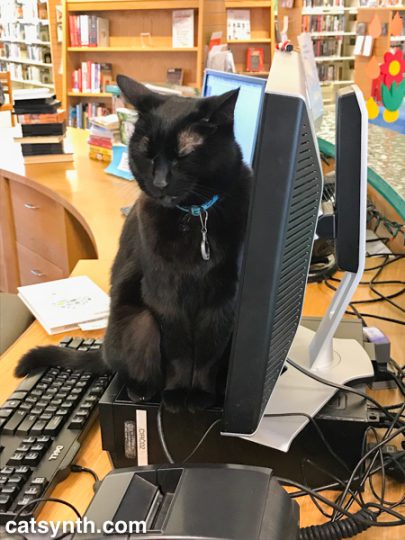
Elsie is a very sweet cat, and quite playful at times despite her advancing age. With her black coat, she reminded me a bit of Luna, though Elsie has mismatched-colored eyes compared to Luna’s emerald green. She and the staff of the St. Helena Public Library were great hosts and extremely welcoming of me and my video project. If you haven’t already seen our CatSynth TV feature on Elsie, you can watch it here.
It was still relatively early when I finished at the library, so I headed to the main street in town for brunch – a protein-heavy heuvos rancheros and some additional coffee seemed like a good idea after the morning video shoot and before heading out for wine tasting.
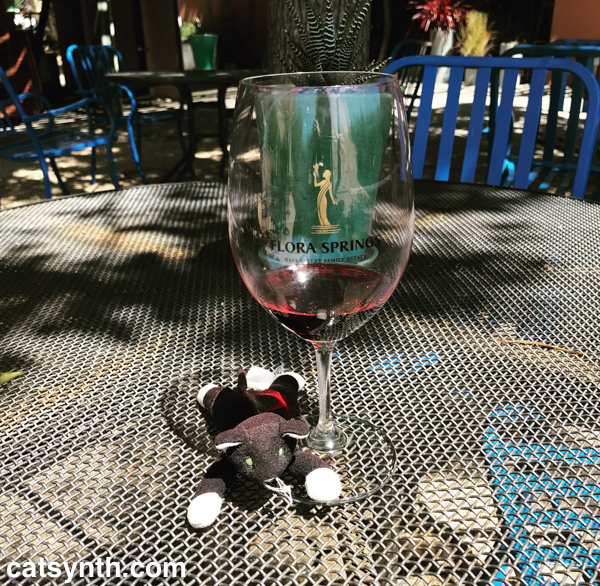
My main winery destination was Flora Springs, also in St. Helena. In 2014, I had come here for both wine tasting and a photo shoot – you can see one of the photos in this old Wordless Wednesday post. I had selected it because of the modernist architecture and interior design, but I enjoyed the spicy bold reds as well. Plus they have a patio that is lovely on a warm afternoon.
The same qualities that attracted me to this winery four years ago were in play again – the modern style and bold red wines. I particularly liked the Trilogy red blend and the Holy Smoke single-vinyard cabernet from Oakville. This visit was also featured on CatSynth TV.
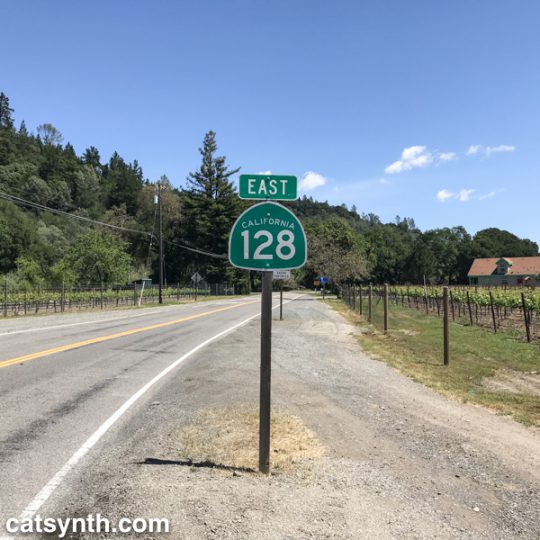
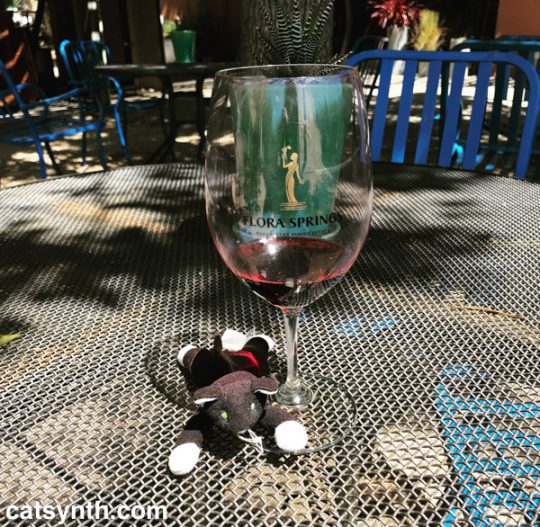
Having enjoyed a full glass of both the Trilogy and Holy Smoke along with tastings of the standards, I decided I shouldn’t do anymore tasting for a while. But I still wanted to some more exploring. So instead of heading straight back south, I turned east onto Highway 128 in Rutherford towards Lake Berryessa, with the goal of finally completing the route. (Yes, I am weird that way.)
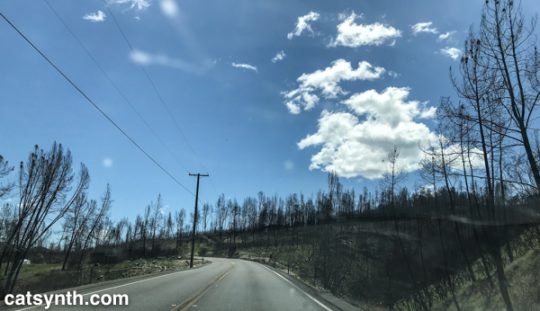
The narrow but well maintained highway took us out of the valley and into the hills to the east, winding our way through several canyons. The central towns of the Napa Valley were largely spared from last fall’s devasting fires, but here along Highway 128 one could still see some of the scars from the Atlas Fire. The green wooded hillsides were periodically streaked with bands of ashen gray and bare trees. But even within those bands, one could see bits of green. Some of these were trees that were spared during the fire, which jumps from one tree to another, as well as new growth replacing the burns. It’s amazing to see how quickly nature bounces back, especially compared to human development. It will take a bit longer to replace the homes, wineries and other businesses, and the mental and emotional scars may never heal.
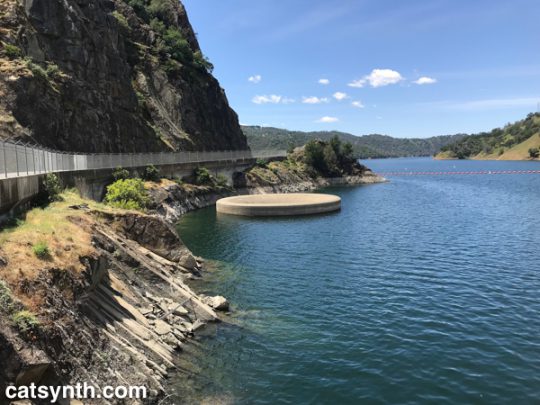
Eventually, the highway aligns to the southern shore of Lake Berryessa, an artificial lake created by damming the Putah Creek. It’s quite large and major center for water recreation. I was just there for the visual aspect – I was particularly curious to see the “Glory Hole.”
The Glory Hole, which as also featured in a recent Wordless Wednesday post, is an internal spillway for the reservoir. When the lake gets too full, the water drains out through it like a bathtub. This happened in 2017, and must have been amazing to see.
We followed the highway down from hills into the Sacramento Valley, where it ends in the town of Winters. I had stopped here on the way to Portland a few weeks earlier, so had already shot some video. But that one is still a work in progress…
See more of California’s Napa Valley Wine Country and many other fascinating places in our Highway☆ app, available on the Apple App Store and Google Play Store.
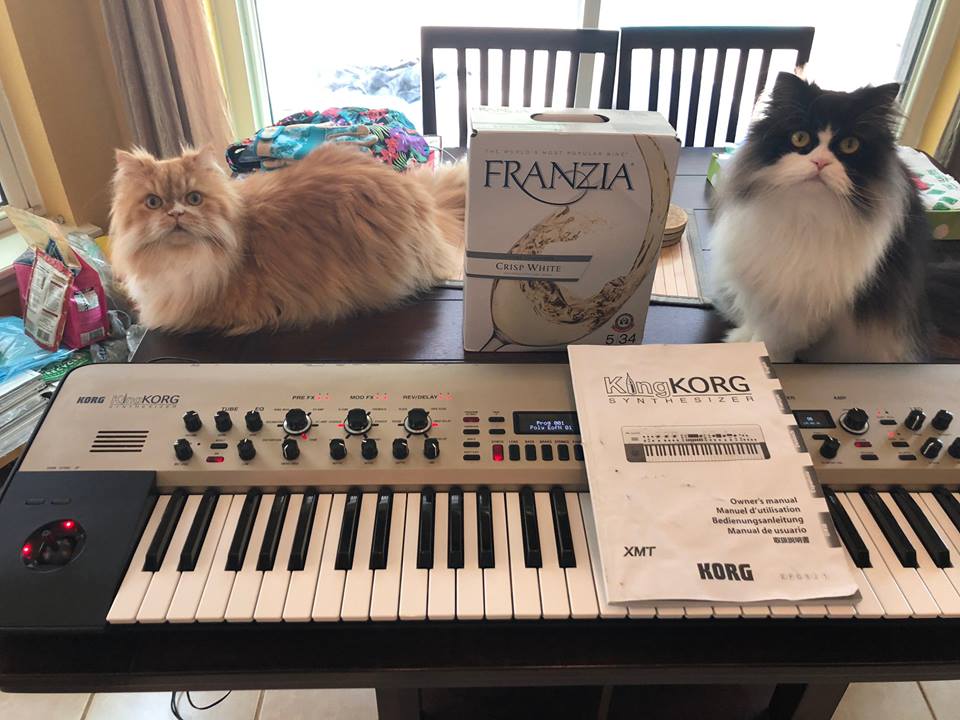
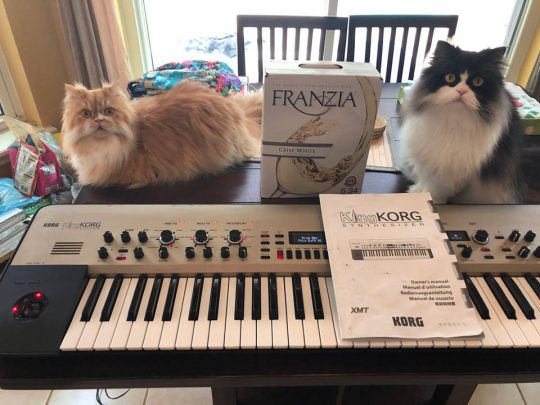
Two fluffy cats posing with a Korg KorgKorg synthesizer and a box of white wine (crisp and refreshing).
By Sayer Seely in the Facebook group Synthesizer Freaks
Just arrived… and cat approved… KingKorg!
Came up for sale locally at a great price. Just got the Novation Peak on Friday and now this. The wine in the box matches the color of the KingKorg!
I can’t resist including a link to one of my performances of my composition White Wine 😸



 The southeast “bulge” part of the district includes sections of Houston that lie within the I-610 loop, or “Inner Loop”. I-610 separates the downtown sections of Houston from outer neighborhoods and surrounding communities, including towns like Southside Place. It is bisected west-to-east by the new I-69 (US 59). The area where these two highways intersect would not look out of place in Los Angeles.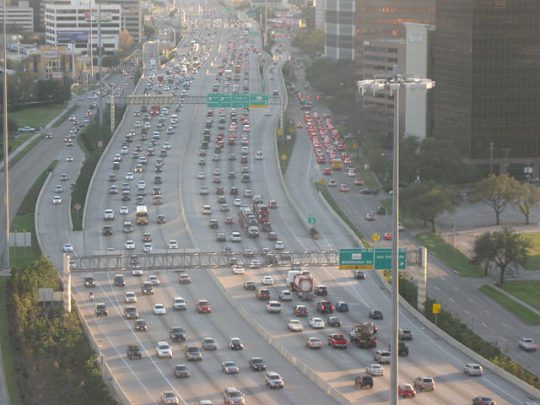

 Heading north and west, we come to the middle section of the district, which is largely a horizontal rectangle bounded by the mighty I-10 to the north, and which extends almost to Katy in the west. Beltway 8, also known as the Sam Houston Parkway/Tollway, bisects this segment of the district. Just to the west of the beltway are the Briarforest neighborhood and the ominously named Energy Corridor. Not surprisingly, several major energy corporations have operations in this area, as do several other businesses. The Buffalo Bayou – we at CatSynth are still not entirely sure what separates a bayou from a river – cuts through the district. It was subject to major flooding during Hurricane Harvey. In addition to the bayou itself cresting at record levels above flood stage. releases from the Barker Reservoir caused severe flooding in adjacent low-lying neighborhoods. We have sources that have informed us that the floodwaters in the Energy Corridor area were most unpleasant.

 The final section of the district cuts an inverted “L” between State Highway 6 and State Highway 99, the outermost loop around Houston, bounded on top by US 290. In all, the district has an odd shape indeed, but not so odd when one considers the tradition of gerrymandering, an art which has been taken to new heights by Texas’ Republican-controlled state government. Its shape has long preserved it as a safe Republican district – it has elected Republicans to Congress consistently since George H.W. Bush in 1966. But the city and surrounding area have been changing, and it is seen as vulnerable to flip to 2018.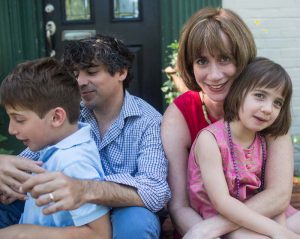



 I have written about traveling through the Napa Valley on Highway 29 before, specifically in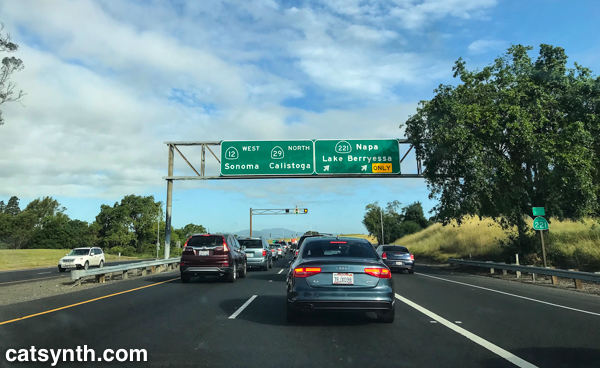
 Having enjoyed a full glass of both the Trilogy and Holy Smoke along with tastings of the standards, I decided I shouldn’t do anymore tasting for a while. But I still wanted to some more exploring. So instead of heading straight back south, I turned east onto Highway 128 in Rutherford towards Lake Berryessa, with the goal of finally completing the route. (Yes, I am weird that way.)