
Sam Sam in late-night contemplation of one of our favorite artists, Joan Miró.


Originally from stevereidell on Instagram, shared via our friends at Moog Music, Inc.
Got to cat-just the purr-ameters…
Happy #Caturday.
📸: stevereidell on IG

From our friends at Eevo Lute Music & Technology.
A new test victim has arrived.. #pioneer #pioneerdj #davesmithinstruments #toraiz Pioneer Toraiz SP-16
We hope that human and feline enjoy their new “test victim” 😸. You can read our early take on the collaboration between Dave Smith Instruments and Pioneer on this product line in our report from NAMM 2017.
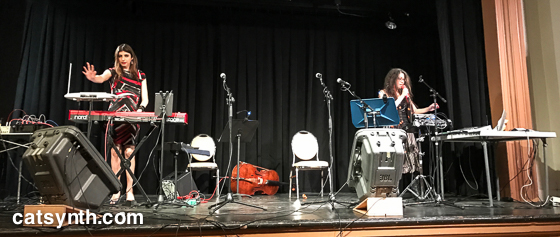
As we are in the middle of Passover, it seems like a good time to look back at a Jewish-themed show in which I participated earlier this year. The Amy X-Perience brought together a mix of artists in solo, duo and ensemble sets at the Jewish Community Center in Berkeley, California. The evening was curated by our friend and collaborator Amy X Neuburg.
The night began with a piece by Neuburg featuring electronics and potato chips. Yes, potato chips. Small vending-machine-sized bags were distributed to the audience, who were instructed to on cue open the bags and start chewing the (edible) contents loudly, as Neuburg manipulated the sounds and added additional musical layers.

I was up next. Regular readers have likely already heard part of my solo set from this show – I posted the performance of piece White Wine in this article a couple of weeks ago. I also performed a live version of my piece Donershtik (Yiddish for “Thursday”), which you can see below.
Amanda Chaudhary performing "Donershtik" at JCC East Bay from CatSynth on Vimeo.
I was quite happy with how both solo pieces came out, but the real treat was having Amy join me in a duo of my piece North Berkeley BART, humorously appropriate for the location that evening.
North Berkeley BART w/ Amy X Neuburg – JCC from CatSynth on Vimeo.
I have always been impressed with Amy’s musicianship, discipline and ability to learn songs quickly, and very much appreciated her joining me. We also performed an avant-garde rendition of the American standard All of Me later in the evening.

Between the two of us, there was quite an impressive collection of musical electronics on stage.
My solo set was followed by Alex Kelley, a veritable one-man band on cello and electronics.

His music blended jazz, klezmer and rock influences with experimental sounds. His cello acted not only as a melodic instrument, but also as the rhythm section, with Kelley striking it like a drum at times, and recording bass lines into a live looper and then riffing on top of that. His performance was both tight and humorous and a lot of fun to watch. You can hear a little bit in this video:
Next up was Solstice: A Female Vocal Ensemble. Sadly, several members of the group were unfortunately absent that evening due to illness, but that didn’t stop the remaining trio from delivering a strong performance.

Solstice’s repertoire spans a variety of styles and languages, and their set that evening included pieces from several places. I was quite impressed with their ability so sing in so many languages.
The second half of the program brought together the various artists in different combinations. I already mentioned my duo rendition of All of Me with Amy X Neuburg. She also performed show tunes with Alex Kelley, and joined Solstice for a virtuosic rendition of an Eastern European song. And finally, all of us joined together for a rousing rendition of Mein Herr from Cabaret. It was a fun and fitting conclusion to the evening.
All of the performances were well received by the enthusiastic full house. Thank you to Amy X Neuburg for inviting all of us to participate in this event, and to the Jewish Community Center of the East Bay for hosting! Please visit their website to find out about the many performances and other cultural programs hosted by the JCC.
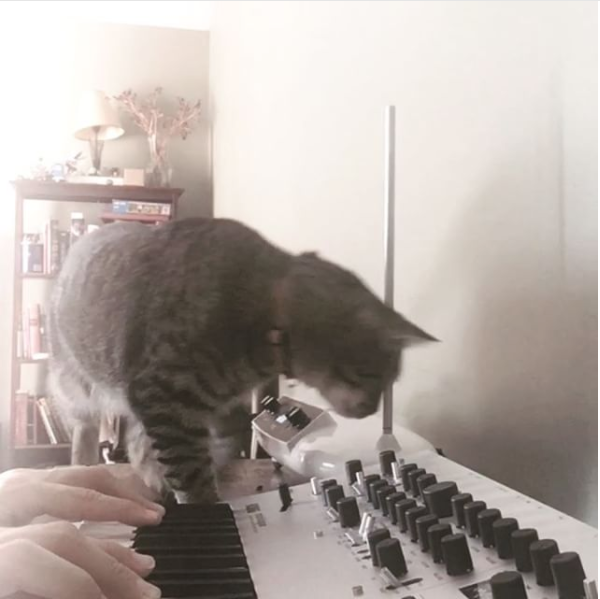
Duet between Mags the cat on Moog Theremini and her human on Korg Minilogue. This sounds delightful – the quantization function on the Theremini helps.
From nilpferd_de_la_nuit on Instagram, via our friends at Moog Music, Inc.

As dusk approaches and we at CatSynth prepare for the start of Passover, we present the Matzoh Man, now in full HD video!
For those who are not familiar with the tune, it is a version of Dayenu, which is song at many seders, including ours growing up. You can find out more here.
Chag Sameach! / !חג פסח שמח

Our friend Runkl returns with another portrait in front of the modular synth. Submitted by Jeph Nor via Facebook.

Our friend Merce the cat with a Roland SH-1000 synthesizer. Submitted via Twitter.
@matrixsynth @catsynth So interesting. I did not know about the lineage of Roland 1000 and the microKorg pic.twitter.com/Zcw4HxZVI4
— Merce (@Merce_the_cat) April 5, 2017
It was in response to a via matrixsynth, originally from Electronic Musician. It described the many years of synth innovations from Ikutaro Kakehashi, one of the visionary elders of the synthesizer world and founder of Roland. He passed away earlier this week.
We have a new version of CatSynth: The App! available on the Apple App Store. This is a tremendous update. The best version of CatSynth: The App! ever. We have rethought the user experience while preserving the distinctive style. It also happens to match Sam Sam’s markings quite nicely.


It is smoother and simpler to browse and read articles on your mobile device. And for the built-in Mystery Synths, we have added MIDI input support!

You can play the synths with an external MIDI controller or sequencer using either the network or (on iPads) a class-compliant MIDI USB device. We will have some video demos of this soon.
If you have an iOS device, please do try out the app and let us know what you think! 😺


There is a particular and peculiar state of mind that for a long time I have named the disintegration of thought. It occurs in periods of mental drowsiness, but not when falling asleep, and is characterized by thoughts becoming less coherent. One can start out with a coherent statement like “I need to clean the studio” but it will manifest only halfway before turning to nonsense, such as “I need to clean the…there goes a fish on the road next to the green eight” – not a real example, it is really hard to mimic the specific type of partial nonsense that occurs, or to remember it. Usually there is not much in the way of visualization involved. It is almost entirely thoughts consisting of words, and maybe a little bit of abstract imagery such as slowly changing colors or patterns. It does, however, involve detachment from sensory input and the external environment.
While this state can occur when sleep deprived or extremely bored, it is more interesting as a tool to manage stress or anxiety. It is particularly useful for the kind of low-level but constant anxiety associated with being trapped in a place or situation or being overstimulated – for example, spending large amount of time in the large open-floor-plan offices of tech companies over the past seven years or so. Even completely fun and positive things like NAMM can leave me very drained by the late afternoon, not so much anxious but socially exhausted. In such states, I find the best thing to do is find a quiet, safe, and solitary space, lie down or recline, and just let go of any control over thoughts. More often than not, the “disintegration of thoughts” will follow naturally, as the words become more jumbled and nonsensical, and the outside world fades. But I do not for asleep, nor do I try to. Sometimes gentle external stimuli, like the patterned noise of the freeway near CatSynth HQ, or a cat purring contentedly on my chest, can facilitate entry.
This state of being internal and having non-cohesive thoughts turns out to be incredibly pleasurable and relaxing. Perhaps even better than external drugs or alcohol for that purpose. In a sense, it is liberating, not unlike an empty stretch of desert road, even though I have retreated entirely inside my mind. It has become an almost daily practice, especially on days where there is much overstimulation. Interestingly, however, I can’t access it at night when trying to sleep.

It also appears to be somewhat associated with meditation, but not the highly concentrated type where one focus on a specific word or thought or a strict pattern of breathing, and I can’t experience the state sitting upright (lest my back become the focus of my thoughts). But a deliberate act of “letting go” or deep relaxation does work, as long as one doesn’t fall asleep in the process.
So, this state of consciousness must have a name, right? Well, that is not entirely clear, the closest phenomenon I can find is hypnagogia.
Hypnagogia is the experience of the transitional state from wakefulness to sleep: the hypnagogic state of consciousness, during the onset of sleep. Mental phenomena that occur during this “threshold consciousness” phase include lucid thought, lucid dreaming, hallucinations, and sleep paralysis. [Wikipedia]
Or perhaps a specific subset of hypnagogic phenomena. As described above, there is very little in the way of visions or auditory input, mostly just words and thoughts. So the cognitive aspects without the sensations. And there is also in my experience no correlation with creative thinking as documented in numerous cases; except of course for the fact the diminishing stress leads to greater creativity for me (perhaps for others it is the opposite).
One description of hypnogogia that particularly stuck with me is “REM intrusions into waking state”, as described in this paper. It also describes interaction with the Default Mode Network (DMN). The DMN is discussed in much contemporary psychology, but one particular aspect makes is seen relevant to this discussion.
The default mode network is most commonly shown to be active when a person is not focused on the outside world and the brain is at wakeful rest, such as during daydreaming and mind-wandering. [reference via Wikipedia]
The biological and psychological details, although quite interesting, are beyond my current skills to fully understand and discuss. But I am certainly intrigued to understand it more, even as I continue to explore and practice this “disintegration of thought.” I also invite those with their own knowledge an experience to share in the comments below.