We at CatSynth are happy to host Weekend Cat Blogging #364 this week. It is a self-selected round-up of cat-related posts from around the blogosphere. If you would like to participate, leave a link in a comment below, on our Facebook page, or tweet us @catsynth with hashtag #WCB.
And without “further ado” as they say, let us continue with the round-up.
First up, we have good news from our friends at Animal Shelter Volunteer, with several recent adult-cat adoptees. Among them is the black cat Hunny pictured above. We are happy for the her and the other cats who found their new homes.
Truffle turns 1 year old today and there is a celebration on at Sweet Purrfections. In true Southern style, they are holding a debutante ball with quite a list of illustrious attendees.
Speaking of parties, Cokie the Cat explains the upcoming BlogPaws conference. It is an annual event for pet-bloggers (or blogging pets), and cats, dogs, birds, humans and other animals of all sorts are welcome. It will be taking place about three weeks in Salt Lake City.
We will continue to add posts throughout the weekend, so please continue to send us your submissions. And thanks to those who participated!
Today we look at last week’s performance at “Tom’s Place” in Berkeley featuring vocal and piano music of John Cage. Cage is of course one of my musical heroes, and his works for prepared piano are among my favorites.
The concert opened with two of his early pieces for prepared piano performed by Janis Mercer. Waiting (1952) consisted of a long period of silence followed by a short repeated phrase, followed by more silence. It could be seen as a stepping stone of sorts between Cage’s prepared-piano music and 4’33”, which was also written in 1952. Mercer also performed Bacchanale (1940), Cage’s first piece for prepared piano. It opened with dramatic repeated tones that evolved into shorter and then longer repeated phrases. The harmonies were anxious and fit with the timbre of the prepared strings. Prepared piano is sometimes called “piano gamelan”, and the name seemed appropriate for this movement, with its polyrhythms and complex minor harmonies. The following movement was much more percussive, with something that suggested bass and hi-hat.
The concert continued with John Smalley performing Experiences No 2 for solo voice. This was the first of two pieces on the program that Cage wrote for Merce Cunningham dances. This one used a text by e.e. cummings. Musically, it had a static and yearning quality, with phrases having an “incomplete” feeling melodically.
This was followed by an untitled vocal interlude from Four Walls informally titled “Sweet Love”. It is a playful piece, both in terms of its music and text (which was written by Cunningham). The performance by Laurie Amat clearly brought out this quality.
The concert resumed after a short intermission with In a Landscape featuring Mercer again on piano. Not only was the piano of the “unprepared” variety, the piece was actually quite tonal, with a dreamlike quality and something approaching a folk melody If I was presented the piece and asked to guess the composer, I would be more likely to say Debussy than Cage.
[John Smalley and Laurie Amat. Photo by Michael Zelner.]
The final piece of the evening was Litany for the Whale, song by John Smalley and Laurie Amat. The piece consists of slow vocalization of the letters of the word “whale” in call-and-response form over an extended period of time. The length of the piece (over twenty minutes) and slow motion make it quite challenging for both the performers and the audience. For the performers it was quite an endurance test and for those of us in the audience the challenge was to keep focused on it. What worked best was to go into a meditative state and focus on some details of sound while letting others simply pass.
The show was quite well attended with a full and appreciative house. Overall, I was glad I made the trip to Berkeley on a Wednesday evening to hear it.
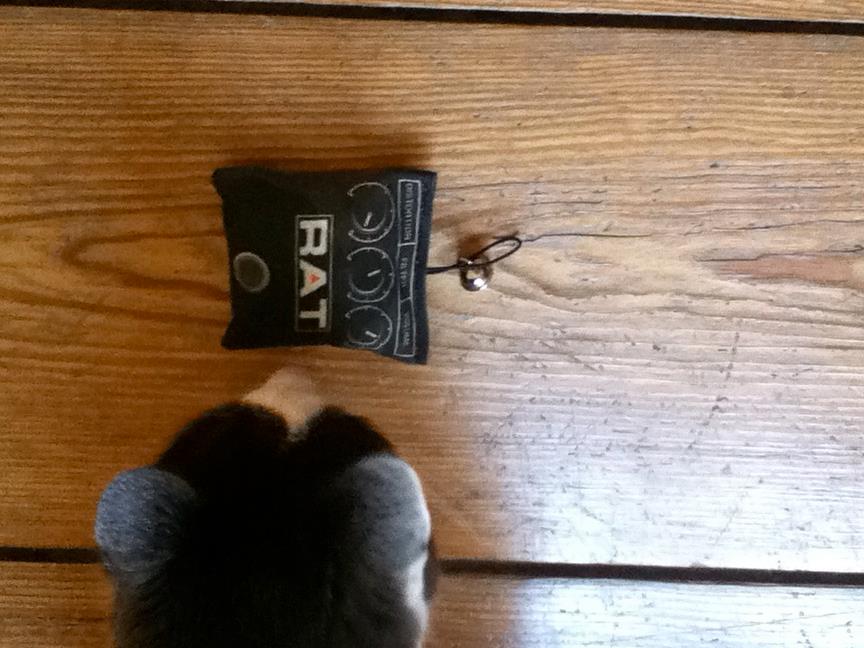
“Nearing three years after her first appearance, Uni meows at CatSynth, this time on the OMG-1!”
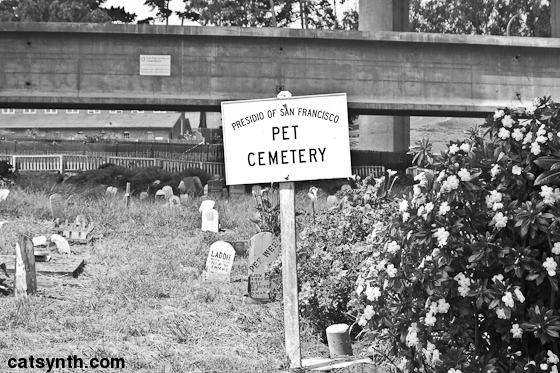
If you haven’t yet seen it, please check out my article on the Presidio Pet Cemetery in San Francisco, part of our weekend featuring the Golden Gate Bridge and vicinity.
On this Memorial Day we pay a visit to Presidio Pet Cemetery. It is the final resting place of many beloved animal companions of the military families that lived in the San Francisco Presidio.
Most of the grave markers in the site date back to the 1950s when “the Presidio was home to over 2,000 military families.” It was surrounded by a white picket fence (which still exists today) and shaded by Monterey pines (which do not still exist). The site fell into disrepair in the 1970s and continued to deteriorate, but has been preserved. Today, it sits underneath the reconstructed Doyle Drive / Presidio Parkway that leads up to the Golden Gate Bridge.
The construction on the Presidio Parkway is continuing around the site, indeed one large concrete beam sits inside the area of the cemetery. It is currently closed to visitors while the construction progresses, but it is quite visible from the nearby pathway. Indeed, it seems like it may in better shape now than it was preceding the construction, even if the vegetation is a bit overgrown in places.
Many of the markers are still clearly visible, and speak to the love and warmth these animals brought to their human companions on the base. Some are very specific, some are more generic like “A G.I. Pet. He did his time.” but are touching nonetheless. There are dogs, birds, hamsters, reptiles, and of course cats.
Thinking about the pets buried here and the bonds they had with their human companions helps one to feel empathy for both human and animal alike.
I hope the site continues to be preserved and re-opens after the highway is completed. I am sure I will be back here again.
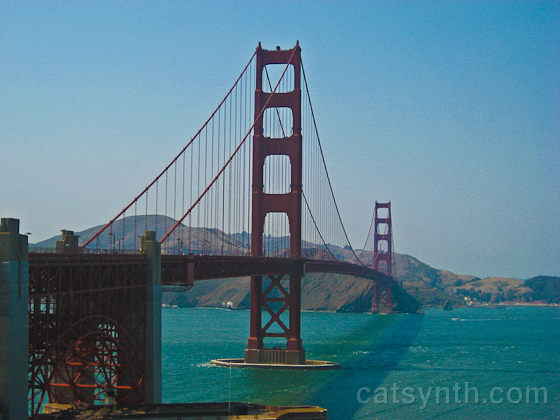
Today we at CatSynth and countless others celebrate the 75th Anniversary of the Golden Gate Bridge.
The tallest suspension bridge in the United States, the second longest, and painted in International Orange, it is instantly recognizable. In a sense, the Golden Gate Bridge is San Francisco’s “Empire State Building”. Both are iconic architectural centerpieces that represent their respective cities, and both date back to the 1930s and feature the distinctive Art Deco elements of the era. Both are often present in the background during everyday life of the cities. And (at least for me), they are also places rarely visited except when hosting out-of-town visitors.
But the Golden Gate Bridge is an important practical part of the city. It is a busy transportation carrying US 101 and California Highway 1 north from San Francisco into Marin County and points beyond on the north coast. It is very unusual for a modern roadway in that the opposing lanes are separated only by short poles that are moved to adjust the number of lanes in each direction. It seems a bit quaint, in fact. On the city side, the highway split into a boulevard carrying CA 1 south and Doyle Drive (US 101) until this past month when the latter was demolished. From these points, travelers are dispersed onto the city streets of San Francisco. There is no easy highway or rail connection between my part of the city (near the Bay Bridge) and the Golden Gate Bridge, owing to the city’s hilly geography and quirky political history. As such, I find myself not near the bridge very often except when I need to be. But when I am nearby it is worth stopping to take notice.
This is what we most often see when we look at the bridge, the orange structure partially shrouded or occasionally completely enveloped by another of our famous landmarks, the San Francisco fog. But the interplay of the fog, the bridge structure, and the other natural and human elements of landscape can make for interesting compositions.
With the anniversary upon us, much attention is being paid to the history of the bridge, its engineering as well as the politics and economics surrounding its construction. For me, the most interesting part of the history is the work of Charles Ellis, a senior structural engineer and mathematician. In many ways (including his early academic credentials), he was more mathematician than engineer, and did much of the theoretical work on the design of the bridge with large amounts of detailed mathematics, along the way publishing highly cited works such as “Williot Equations for Statically Indeterminate Structures” in Transactions, American Society of Civil Engineers, 1935. Indeed, he is now recognized as a principal designer of the bridge, but at the time he was not given any credit after being fired by Joseph Strauss, chief engineer of the bridge project. He was only officially given credit in 2007 (as described in this San Francisco Chronicle article).
This film from the time chronicles the building of the bridge, but also exemplifies the mythology that Strauss created around himself.
Nonetheless, the bridge itself opened to huge fanfare, as seen in this Prelinger Archives film:
The festivities for this year’s 75th anniversary began about a month ago with the demolition of Doyle Drive, the elevated highway connecting to the bridge.
The old highway had elements such as metallic beams in the International Orange color that connected it to the bridge, and it definitely looked to be of the same vintage. It is being replaced by the new Presidio Parkway that will more gracefully connect to the surrounding parkland but also contain the iconic orange color and architectural elements to connect it to the bridge.
Today’s festivities include a planned fireworks display at the bridge. Perhaps most notably there is an ongoing art exhibit at Fort Point called International Orange in which several prominent artists present works inspired by the bridge. I am hoping to see this exhibit soon (perhaps on a quieter day when I can observe the pieces in detail). I did see a preview recently at one of last weekend’s art fairs where Anandamayi Arnold wore one of her dresses for the exhibit, appropriately colored in International Orange. I am also inspired by the concept of this project and the mathematical work of Ellis described above to try my own hand at a creative piece in honor of this occasion.
Please join us in wishing the Golden Gate Bridge a happy 75th Anniversary!
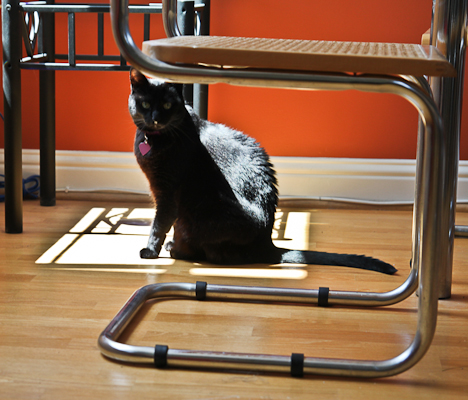
Luna always loves the patches of sunshine that pour into CatSynth HQ in the morning. On this particular morning we see her posing regally in an Art-Deco-patterned sunshine spot. The shadow is cast by the table just behind her, a piece that dates back to my graduate-student days in Berkeley but still fits the overall style of our current pad in the city.
On a sad note, we learned that our friend and fellow cat-blogger has passed away. We send her family our thoughts.
Today we look at STILL, a solo exhibition of video and animation works by Pia Maria Martin at The McLoughlin Gallery in San Francisco. It is the first US solo media exhibition for Martin, who hails from Stuttgart, Germany. Martin’s work involves elaborate stop-motion films assembled meticulously from countless photographs. Stop-motion animation assembled from photographs is currently a strong interest of mine and an art-form that I have been exploring in my own recent work with silent video and live music, so I was quite excited to see this show and meet the artist. Upon entering the gallery, one is greeted by a large triptych featuring a procession of plastic red chairs.
The piece, entitled Zum Appell!, can be a little jarring with its inanimate objects marching in lock stop, but it is also playful for the exact same reason. I also like the mid-century modern chairs against the weathered concrete interior. The surreal animation of the chairs and design elements are both enhanced by the nearly life-size presentation.
[Pia Maria Martin, Zum Appell! Image courtesy of The McLoughlin Gallery.]
The elements of both play and unexpected animation are apparent in many of the other pieces as well. Für Olga tends towards the more abstract with mechanical and industrial elements that defy gravity, as do her most recent pieces such as Scherzo with brightly colored ribbons curling and “dancing” in a stark white industrial space.
[Pia Maria Martin, Scherzo. Image courtesy of The McLoughlin Gallery.]
Kalekeitos takes the animation of fish in a more playful (albeit morbid) direction.
[Pia Maria Martin, Kalekeitos. Image courtesy of The McLoughlin Gallery.]
As someone who tends to anthropomorphize animals, I found the dancing fish in Kalekeitos quite endearing. But of course the fish (which are in fact already dead) are ultimately dancing towards their destruction as part of a soup or stew. Death and decay appear as subjects in several of Martin’s animations, with natural elements falling apart or becoming reanimated. It also plays into her piece XI which features a house demolition in progress. The simple geometry and gray quality made it more captivating than a simple chronicle of demolition and gave it the more abstract quality found in some of the other pieces such as Scherzo. This particular work was also great example of pairing music with the silent animation. Music plays an important role in Martin’s work, not only as an accompaniment to the visuals but as an organizing principal. XI featured Arnold Schoenberg’s Die Jakabsleiter performed by Pierre Boulez and the BBC Orchestra and Singers, which reflected the geometric nature of the visuals. In Scherzo, the second movement of Anton Bruckner’s Symphony No. 9 is used as a “non-audible score”, although the actual music is performed by the artist friends (as described here). Once again, my own artistic interest in the silent-animation medium intercedes as I would love to do a live musical performance to one of her films someday.
Pia Maria Martin was able to be in San Francisco for the opening. In addition to introducing her work, she participated in a more general discussion of video and animation.
The lively and far-ranging discussion included the artist’s techniques and inspiration, as well as more general topics such as what it means to “collect video art” in this day and age. On a practical level, the pieces in this and other video shows are authoritative limited editions, much like photographic prints. Some of them are also objects that include the means of display (e.g., a flat panel screen and DVD player). But for a local art collecting community that tends to be a bit more conservative in its acquisitions, the idea of an art piece to be displayed on a TV screen or projected onto a wall and which requires media intervention to perceive is a new one. But we hope video art continues to make its way into collections.









 But the Golden Gate Bridge is an important practical part of the city. It is a busy transportation carrying US 101 and California Highway 1 north from San Francisco into Marin County and points beyond on the north coast. It is very unusual for a modern roadway in that the opposing lanes are separated only by short poles that are moved to adjust the number of lanes in each direction. It seems a bit quaint, in fact. On the city side, the highway split into a boulevard carrying CA 1 south and Doyle Drive (US 101) until this past month when the latter was demolished. From these points, travelers are dispersed onto the city streets of San Francisco. There is no easy highway or rail connection between my part of the city (near the Bay Bridge) and the Golden Gate Bridge, owing to the city’s hilly geography and quirky political history. As such, I find myself not near the bridge very often except when I need to be. But when I am nearby it is worth stopping to take notice.