Cordelia, Theatre of Yugen

Cordelia is a Noh adaptation of Shakespeare’s King Lear presented by Theatre of Yugen at NOHspace. The play is a combination of old and new. It draws its structure and performance elements from the tradition of Noh and its source text from Shakespeare, both centuries old. But the actual text by Erik Ehn, music by Suki O’Kane and production directed by Jubilith Moore are wholly contemporary. They draw heavily from the traditional sources, but are in no way limited by them. Enh’s text is a rearrangement of lines from the original Shakespeare but focused on the point of view of Cordelia (King Lear’s youngest daughter) minimized to fit within the constraints of Noh. Polly Moller performs on standard concert and bass flutes and a bagpipe chanter, but expertly invokes the attacks, pitch bends and timbral shifts of traditional Japanese music. Sheila Berotti plays the tradition role of the chorus, but as a single voice with a shruti box (a drone instrument usually found in Indian classical music). The main element of the set, a bridge that folds into to descending segments, seems very contemporary and industrial – but it is in fact an adaptation of the traditional hashigakari from Noh theater.

In the first act, Cordelia (played by Moore) appears as a member of a royal court and recounts her refusal to flatter her father, the king, with words, which leads to her being disowned and exiled. In the second act, she returns in the form of a warrior, reflecting her return to England at the end of the play in an attempt to save her father that ultimately ends tragically. In the interlude, we meet the Fool (played by Lluis Valls), who both recites lines from the original play and provides a synopsis of the story. He serves as a comic counterpoint, and as a practical guide for those either unfamiliar with the original King Lear or new to structure of Noh theater. (One particularly fun moment was when he relates the marriages of Cordelia’s sisters, he pauses with a slight look and sound of disgust for the rather creepy Duke of Cornwall.)


[Click to enlarge.]

Overall the elements of the performance, the music, the set design, the text, the movement all have a very minimalist quality. There is a lot of empty space in the slow and deliberate movements of Moore as Cordelia and chanting of the text. Similarly, the music is very sparse. The flute lines are composed from small sets of notes that explore timbre, dynamics and abrupt rhythmic changes. The silence between the flute, text and motion is occasionally punctuated by loud hits on the snare drum (performed by Anna Wray). The space left me ample opportunity to escape from the narrative of the play and instead focus on specific details, such as qualities of the flute performance, the text on wall of the set, the occasional harmonic swells of the shruti box, or details of the lighting.

The main exception to the overall minimalism was the costume design by Risa Dye. Cordelia’s two costumes are both quite elaborate. They combine the multiple layers often found in Noh costumes with rather ornate and highly textured elements reminiscent of Elizabethan England (at least as seen in paintings from the time). The costume of the Fool was something else again, a hooded suit covered entirely in text (taken from another play by Ehn). It helped to emphasize the character of the Fool as a “word artist”, and also contribute to his more frenetic character in contrast to the rest of the performance.

The words were also present on the wall of the set (designed by Joshua McDermott). The wall was inspired by memorial walls, in particular from the genocides in Rwanda and the Balkans in the 1990s. Phases from Ehn’s plays were used in place of names. In addition to its direct meaning, the wall evoked for me a sense of urban space with graffiti, which is central in my own visual work.

It is interesting to reflect on how easily the minimalist and non-linear elements of Noh seem to translate into a contemporary work of art, and also provide opportunity for reflection and meditation. At the same time, the structure provides enough space for contemporary visual and musical elements to poke through. As such, it provides some ideas and inspiration for future work.

Cordelia continues with additional performances at Theatre of Yugen tonight (May 5) through Saturday May 7.

[All photos in this article courtesy of Theatre of Yugen.]

ReCardiacsFly at Cafe Du Nord

I have been busily preparing for the next show, coming up this weekend:

Members of Rennaissance Fly (myself, Polly Moller, and Tim Walters) are teaming up with Moe! Staiano, Chris Broderick, Marc Laspina and Suki O’Kane as “ReCardiacs Fly”, a tribute cover of the UK band Cardiacs.

It is been a bit of a challenge to learn our four pieces, approximately note for note and also capture the energy of the originals.

One fun bit to re-create was the synthesizer line from “Hello Mr. Sparrow.” We found this video on YouTube, featuring a Mellotron and Sequential Circuits Pro One:

Well, I don’t have either of those devices, but I can approximate the Pro One with the Dave Smith Evolver (it is essentially the successor to the Sequential Circuits instruments):

The most challenging song we are doing is R.E.S., you can get an idea of what we are up against in this Cardiacs’ video:

It has been great to hear things coming together in our rehearsals, and it should be a good show next weekend. Polly photos from our most recent rehearsal.

Official info below:

Sunday, May 8. 6PM-10:30PM
Cafe Du Nord
2170 Market Street

San Francisco, CA
$10 donation at the door

This is a benefit for Tim Smith, leader and founder of the UK band Cardiacs. From Wikipedia (http://en.wikipedia.org/wiki/Cardiacs):

Cardiacs are an English alternative rock/psychedelic pop band formed in 1977 and led by Smith. Noted for their complex, varied and intense compositional style and for their eccentric, theatrical stage shows, they have been hailed as an influence by bands as diverse as Blur, Faith No More and Radiohead.

In 2008, Smith suffered a stroke, and has not been able to perform or finish the new Cardiacs record. From the official website (http://www.cardiacs.com/):

Since the accident Tim Smith’s body has become his enemy. He is in a great deal of pain and is experiencing difficulty with the finer points of control with regard to his extremities so obviously perfected prior to the unhappy event, but Tim Smith, his family and those so called friends, (with whom he keeps counsel), all assert that his mind, however, has been sharpened by the episode. THE ALPHABET BUSINESS CONCERN can confirm that no part of YOUR favourite pop star’s intellect or personality has been found to be absent WHATSOEVER.

Last year, a tribute CD Leader of the Starry Skies was released (http://www.thegenepool.co.uk/items/597.htm), with all proceeds going directly to Smith. Our plan is for the May 8 concert to have all funds go to Tim. Our friend Kavus Torabi is the lead guitarist in Cardiacs, and he is our contact for making sure the funds reach Smith.

Performing will be Dominique Leone, Wiener Kids, Inner Ear Brigade, Grex, Amy X Neuburg, ReCardiac Fly, performing the music of Cardiacs/Tim Smith.

Weekend Cat Blogging and Photo Hunt: Square…and Rememberance

This weekend, we have another combined Weekend Cat Blogging and Photo Hunt. The theme this week is square. Geometric shapes, including squares, abound at CatSynth HQ. But with the exceptionally gorgeous weather, we turn our attention once again to the patio:

The patio is covered in square slate tiles on which Luna enjoys rolling around. We are still doing some work to fix things up for spring now the construction is in the past. New design ideas to emphasize the industrial and geometric aesthetic.


This weekend we are also joining our friends the Three Tabby Cats in Vienna ~ Kashim, Othello and Salome ~ in a Weekend of Remembrance. We participated when they hosted a similar weekend back in 2007, lighting a candle like this one.

As we have made more friends online, so we have also lost many friends. We said goodbye to Mickey only a few weeks ago. Last year, we lost DJ Kikovas, the feline companion of our friend and fellow electronic musician Vivi Pedraglio. We also said goodbye to Tali and Sniffie. It is interesting to look back and see the diverse collection of people, mixture of musicians, engineers and cat lovers, who cross paths in these stories. We have also lost many heroes in music, art and mathematics in this same period of time; and some personal friends. We remember them as well.

Our thoughts for all our friends who lost love ones (human and non-human) over the past year, and for those who are struggling in the current storms in southeastern U.S., recovering from the disaster in Japan, and living through the seemingly greater number conflicts around the world.


Weekend Cat Blogging #308 is hosted by Samantha and Clementine at Life From a Cat’s Perspective. They are dedicating their post in remembrance of Praline.

Photo Hunt #263 is hosted by tnchick. This week’s theme is SQUARE.

The Carnival of the Cats will be up tomorrow at Meowsings of an Opinionated Pussycat.

And the Friday Ark is at the modulator.

A dizzying journey through a room full of priceless synthesizers – AHNE 2011

From hamsterdunce on YouTube, via matrixsynth (I missed this one earlier).

More music on umop.com! Background music: “O Face” by Parallax.

Get a look inside Analog Heaven Northeast 2011, an annual meetup for synth enthusiasts on the East Coast. Every year we bring a selection of irreplaceable electronic gewgaws from our respective music studios (you can spot my Customsynth Rolands in there somewhere) for each other to admire. Great turnout this year! We even had a visit from the God of Catsynth, apparently.

Cameo by the infamous “cat on a keyboard in space”.

CCRMA Modulations at SOMArts

A few weeks I go, I attended CCRMA Modulations 2011, an evening of live electronic music and sound installations by CCRMA (the Center for Computer Research in Music and Acoustics at Stanford) and special guests at SOMArts in San Francisco. The event was an eight-hour marathon, though I only stayed for about half the time, seeing many of the installations and most of the live-music performances.

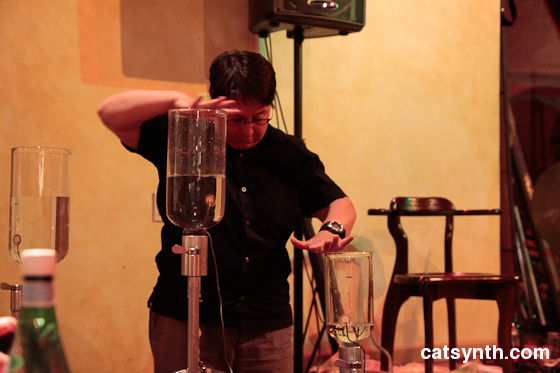
The first part of the evening featured sound sculptures from Trimpin and his students at CCRMA. This particular project, the “Boom Boom Record Player” by Jiffer Harriman stuck with me.

The output from the record player is used to drive the electromechanical instruments on the right. I thought the instruments were well crafted – but I thought it was particularly fitting to have a classic Earth Wind and Fire LP on the record player.


[Click image to enlarge.]

Trimpin’s offering featured coin-operated robotic percussion where the drums included just about every model of Apple notebook computer going back to an early PowerBook (and even earlier as I think I espied an Apple IIc).


[Click image to enlarge.]


The live-music portion of the evening with Tweet Dreams by Luke Dahl and Carr Wilkerson. Audience members with Twitter access were encouraged to live-tweet messages to a specific hashtag #modulations. The messages were then analyzed in real time and the data used to affect the music. As I was planning to live tweet from this event anyway via iPhone, I was ready to participate. Of course, inviting audience participation like this is a risky proposition for the artists, as one cannot control what people may say. I will freely admit I can be a bit snarky at times and it came out in some of my tweets. The music was relatively benign, with very harmonic runs of notes – and I exhorted them to “give me something harsh and noisy”. Inspired by another participant, I also quoted lines from the infamous “More Cowbell!” skit from Saturday Night Live, much to the delight of some in the audience. The main changes in the music seemed to be in density, rhythm and some melodic structure, but all within boundaries that kept the sound relatively harmonic and “pleasant.” I would have personally liked to see (as I suggested via Twitter), more complex music, with some noisy elements and more dramatic changes. But the interaction with the music and and the audience was a lot of fun.

The next piece, Sferic by Katharine Hawthorne, featured dance and electronics. It was described as “using radio and movement improvisation to explore the body as an antenna.” The dancers, dressed in black outfits with painted patterns, began the movement to a stream of radio static. The motions were relatively minimalist, and sometimes seemed strained. Gestures included outstretched arms and fingers pointing, with Hawthorne walking slowly as her dance partner Luke Taylor ran more quickly. Rich, harmonic music entered from the rear channels of the hall, and dancers moved to being flat on the ground. The static noise returned, but more crackly with other radio-tuning sounds, then it became a low rumble. The dancers seemed to be trying very hard to get up. Then they started pointing. The music became more anxious, with low percussive elements. The dance became more energetic and active as the piece came to a close.

This was followed by Fernando Lopez-Lezcano performing Dinosaur Skin (Piel de Dinosaurio) a piece for multi-channel sound diffusion, an analog synthesizer and custom computer software. The centerpiece was a custom analog synthesizer “El Dinosaur” that Lopez-Lezcano build from scratch in 1981.

The instrument is monophonic (but like most analog synthesizers, a very rich monophonic), multiplied for the purposes of the performance by audio processing in external software and hardware. The music started very subtly, with sounds like galloping in the distance. The sounds grew high in pitch, then descended and moved across the room – the sense of space in the multichannel presentation was quite strong. More lines of sound emerged, with extreme variations in the pitch, low and high. The timbre, continually changing, grew more liquidy over time, with more complex motion and rotation of elements in the sound space. Then it became more dry and machine like. There was an exceptionally loud burst of sound followed by a series of loud whistles on top of low buzzing. The sounds slowed down and became more percussive (I was reminded as I often am with sounds like this of Stockhausen’s Kontakte (II)). Then another series of harsher whistles and bursts of sound. One sound in particular started the resonant quite strongly in the room. Overall, the sound became steady but inharmonic – the timbre becoming more filtered and “analog-like”.

The final performance in this section of the evening featured Wobbly (aka Jon Leidecker) as a guest artist presenting More Animals, a “hybrid electronic / concrete work” that combined manipulated field records of animals with synthesized sounds. As a result, the piece was filled with sounds that either were actual animals or reminiscent of animal sounds freely mixed. The piece opened with pizzicato glissandi on strings, which became more wailing and plaintive over time. I heard sounds that either were whales and cats, or models of whales and cats. Behind this sounds, pure sine tones emerged and then watery synthesized tones. A series of granular sounds emerged, some of which reminded me of human moaning. The eerie and watery soundscape that grew from these elements was rich and immersive. After a while, there was a sudden abrupt change followed by violent ripping sounds, followed by more natural elements, such as water and bird whistles. These natural elements were blended with AM modulation which sounded a bit like a helicopter. Another abrupt change led to more animal sounds with eerie howling and wind, a strange resonant forest. Gradually the sound moved from natural to more technological with “sci fi” elements, such as descending electrical noises. Another sudden change brought a rhythmic percussion pattern, slow and steady, a latin “3+2+2” with electronic flourishes. Then it stopped, and restarted and grew, with previous elements from the piece becoming part of the rhythm.


After an intermission, the seats were cleared from the hall and the music resumed in a more techno dance-club style and atmosphere, with beat-based electronic music and visuals. Guest artists Sutekh and Nate Boyce opened with Bands of Noise in Four Directions & All Combinations (after Sol LeWitt). Glitchy bursts of noise resounded from the speakers while the screens showed mesmerizing geometric animations that did indeed remind me a bit of Sol LeWitt (you can see some examples of his work in previous posts).

Later in the evening Luke Dahl returned for a solo electronic set. It began calmly with minor chords processed through rhythmic delays, backed by very urban poster-like graphics. Behind this rhythmic motif, filtered percussion and bass sounds emerged, coalescing into a steady house pattern, with stable harmony and undulating filtered timbres. At times the music seemed to reach back beyond house and invoke late 1970s and early 1980s disco elements. Just at it was easy to get lost listening to Wobbly’s environmentally-inspired soundscapes, I was able to become immersed in the rhythms and timbres of this particular style. The graphics showed close-ups of analog synthesizers – I am pretty sure at least some of the images were of a Minimoog. I did find out that these images were independent of the musical performance, and thus we were not looking at instruments being used. I liked hearing Luke’s set in the context of the pieces earlier in the evening, the transition from the multi-channel soundscapes to the glitchy noise and to the house-music and dance elements.

I was unfortunately not able to stay for the remaining sets. But overall it was a good and very full evening of music and technology.