
Author: catsynth
-
Matthew Sperry Festival: Tag Team Trio Shift
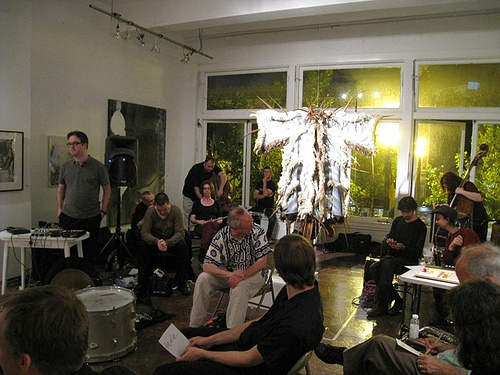
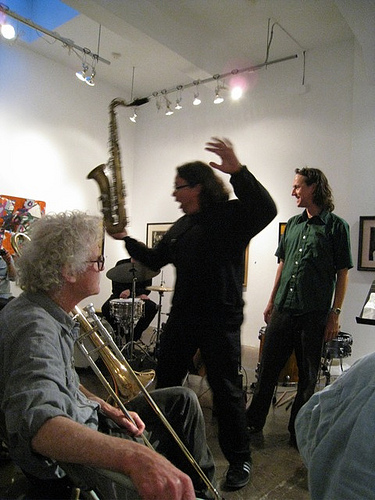
Last Thursday I attended and performed in the Tag Team Trio Shift at the Luggage Store Gallery. This event was part of the Eighth Annual Matthew Sperry Memorial Festival, a festival held every year in honor of local composer and bassist Matthew Sperry since his tragic death in 2003.

The event featured a large cast of characters from the Bay Area new music scene, improvising three at a time, with John Shiurba acting as referee.

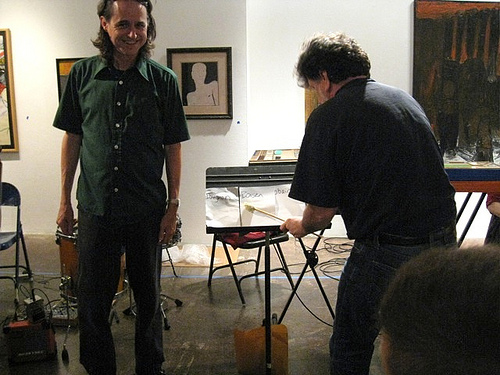
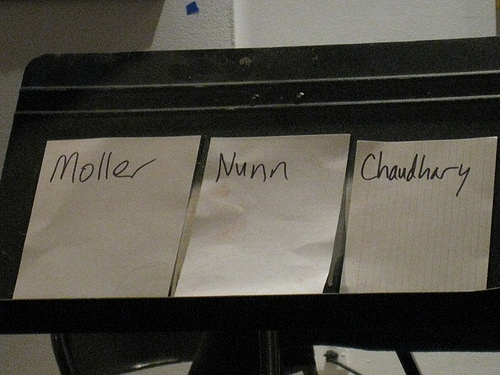
[John Shiurba as referee, with Gino Robair entering a trio.]Each of us was given a name card. At any given moment, three musicians would be performing. Anyone could hand in their card at any time and replace one of the three current musicians. Thus, there was an ever changing set of trios. For the most part, musicians entered and exited individually, but in the second half of the program we could submit three cards at once as a planned trio. The music ranged from trios of synthesizers and electronic noise, to purely vocal trios, to free-jazz improvisation (saxophones and bass), and all combinations in between.

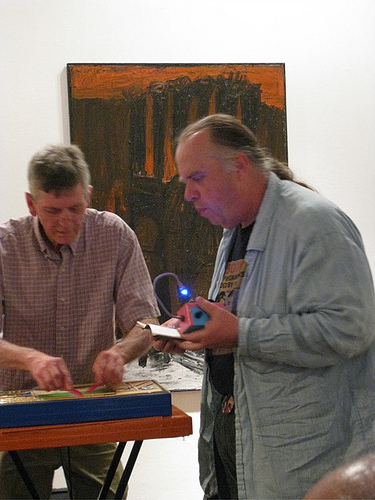
[Tom Nunn on skatch box and Tom Duff with Bleep Labs Thingamagoop.]
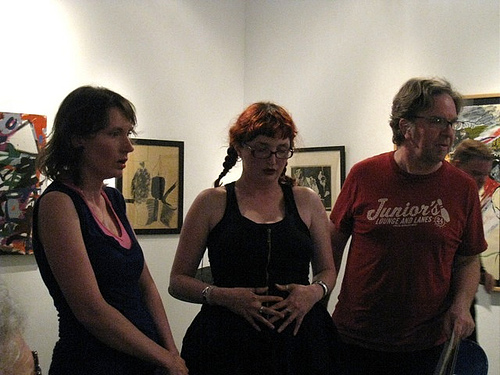
[Vocal trio of Agnes Szelag, Aurora Josephson, and Myles Boisen.]There were many strategies one could use for deciding when to hand in his or her card and replace someone. For me, I timed my card to coincide with others with whom I wanted to play, or moments where I thought my sounds would work well with the texture.

One could also be competitive and “cut” someone else’s improvisation (as one might do in a traditional jazz-improvisation setting). I can’t say that anyone did that, but there were certainly some playful back-and-forths with people replacing each other.
I brought the trusty Kaos Pad as well as my iPhone, with the BeBot app and a looping/playing app that I used for the Pmocatat ensemble. The latter (which featured variable-speed sounds of Luna and my Indian instruments) got some attention from the other musicians. Scott Looney, who was sitting next to me, and an interesting new instrument that used Reactable icons on a surface with a keyboard, to create a sort of “electronic prepared piano”:

[Scott Looney’s new control surface (photo by catsynth).]There were some fun moments. One of Philip Greenlief’s improvisations involved his attempting to balance his saxophone in the palm of his hand, constantly moving and shifting in order to keep it from falling. He was clearly hoping for someone to replace him quickly, but we actually let him keep going for quite a while.

[Philip Greenlief’s balancing act.]The sounds from busy Market Street outside contributed to the music at various times – indeed, the street should have gotten its own card.
Among the attendees were Matthew Sperry’s wife and daughter, who appropriately closed out the second set with the sound of shaking keys fading out.
The full roster of participating musicians included: Myles Boisen, Amar Chaudhary, Matt Davignon, Tom Duff, Tom Djll, Phil Gelb, Lance Grabmiller, Philip Greenlief, Ron Heglin, Jacob Felix Heule, Ma++ Ingalls, Travis Johns, Aurora Josephson, Scott Looney, Bob Marsh, Lisa Mezzacappa, David Michalak, Polly Moller, Kjell Nordeson, Tom Nunn, Dan Plonsey, Garth Powell, Jon Raskin, Gino Robair, Tom Scandura, Damon Smith, Moe! Staiano, Agnes Szelag.
[Unless otherwise indicated, all photographs in this article are from Michael Zelner. You can see a full set of photos from the performance at his flickr page.]
-
CatSynth video: In memory of Modesty the Cat
From monotonmusic on YouTube, via matrixsynth:
May 27, 2010 — “A little studio session just to get my mind of everything.
Nothing fancy, just some sweet Mono/Poly chords…Our cat got really worse these last days.
But she had a good life in the countryside among our other cats.
16 years old!
RIP 2010.05.27We send our thoughts to monotonemusic. It does sound like Modesty had a good life, 16 years in the countryside.
-
CatSynth pic: PAiA 4700s
Submitted by vlern via facebook:

That is one serious wall of synth!
It turns out this photo was from the PAiA 4700 Modular Synthesizer Project by Brett Maraldo (aka Plexus), referenced in the “Hall of Fame” on the PAiA website.
Here is another “catsynth pic” from the series:

We at CatSynth are always happy to get submissions of new pics from friends. If you discover or create any cat-and-music pictures, you can submit them via our handy submission form, or on facebook or twitter @catsynth.
-
Weekend Cat Blogging #261


We at CatSynth are happy to be hosting Weekend Cat Blogging #261. It’s a delightful weekend here, one to step outside and enjoy. And we hope we have a lot of cats come join us.
In order to participate, please leave a comment below, or contact us, and we’ll be happy to add you over the course of the weekend.
And without further ado, let us get started with the round-up:

First up, Nikita Cat provides definitive proof that cat lovers are not brainless. Thanks to MRI technology, see how Nikita performs a “cat scan” on his dad’s brain.

Next we have Parker caught in mid-yawn, or is that a roar? In any case, it sounds like Parker is looking forward to a nice weekend with some outside time on the deck (similar to Luna’s excursions on the patio).

Seeing double? No, this is “whiz-kitts” Daniel and Mikey, a pair a litter-mates in and old photo (as one can tell from the CRT monitor, anyone remember those?). They are part of the family at Kittens ‘n Things.

Samantha and Clementine are getting along better, but still have their differences, as can be seen in this Smilebox slide show they have put together to share this weekend, complete with captions of their antics and background music.


We are delighted to have Jules from Judi’s Mind Over Matter join us this weekend. “Jules and Luna have something special in common,” as can be seen in these pictures. Black cats and white blinds are also a good visual combination, as we have shown in some previous photos.

More of our fellow black cats are joining us this weekend, including Maruschka from Rosa’s Yummy Yums. Her eyes almost look orange in this photo, as does the rug on which she lies. They leave us with an apropos quote from the band Danzig: “Big black witch cat. Yes, you cast a real strong spell…”
Finally, Spot (aka “Harry Spotter”) and Fiona are happy to be reunited with their family after their mom and dad’s trip to China. And it looks like they have a new human member of the family!
That concludes the round-up for this weekend. Thanks to everyone who participated! (And if we did miss your entry, please let us know and we would be happy to add it retroactively.)
-
CatSynth videos: Cats react to iPhone Cat Piano
Today I specifically wanted to post some cat-and-iphone-music videos. While these don’t quite rise to the level of iggy investigating the iPad, they do make use of the popular “cat piano” app for iPhone.
From luke255 on YouTube:
“My cat Dennis has an interesting conversation with my iPhone!”And another, from amb0 on YouTube:
The black cat in this video looks a bit like Luna.
I do of course have this particular iPhone app, and have even used it in some shows. Luna has shown very little interest in it, however. She is clearly jaded from gadgets making strange sounds (even cat-like sounds)
-
Cat-and-keyboard pic: Beauregard
Submitted by Wayne via facebook:

Beauregard taking a break…
Not a synth per se, but it is still a keyboard 🙂
-
CatSynth pics: Mimi and Minimoog
From our friend Eric Pochesci of Polynominal, some more pictures of Mimi:

“2 pictures of Mimi with a minimoog D old school board.
A MIMIMOOG? ;)”
-
Carnival of the Cats / Carnaval de los Gatos #324
We at CatSynth are happy to host another (slightly tardy) edition of Carnival of the Cats


¿Por qué en español? Well, this weekend happened to also be the big Carnaval festival in San Francisco.


I spent most of yesterday at Carnaval with friends, enjoying the music, the rather vibrant and colorful costumes, and the overall energy. Considering that this actually has very little to do with cats, however, let is move on to our regularly scheduled “carnival”:
It’s been a sunny and warm weekend for us. And for others, too. K.T. Cat shows his jungle heritage while enjoying some sunshine outdoors in this great “nature photo” at K T’s Sratching Post.


Our friend Nikita Cat is also enjoying the outdoors in a unique way, as he goes for a stroll outdoors with his dad. Literally, a stroll in a stroller. In addition to being a great way to enjoy some fresh air, it’s helping his dad’s continued recovery and rejuvenation. And he certainly gets some attention from passers by. And this is a lead in to Nikita’s second contribution concerning how much non-felines obsess over cats.
Elisson visits his elder daughter’s new digs and meets some of the animal residents, including Miss Kitty, who has adjusted well to domestic life after being adopted from the streets (I wonder if she should meet Mister Kitty). There is also Minnie, appropriately described as “one tiny ass dawg.”

 At Elms in the Yard, Hadi is adjusting well and learning to trust humans after her past experiences (including the vet). As one can see from this image, she is learning not to trust but to quite appreciate belly rubs. Rahel also encountered a visitor in her home while preparing for bed. Fortunately, the stranger turned out to be a neighbors’ cat, and was soon back home safely.
At Dophin’s Dock, Dolphin says “goodbye” to Sigyn. But this story has a happy ending, as Sigyn is going to a new home where she should be able to enjoy a lot of love and attention.

Antics about at Life from a Cat’s Perspective, where Samantha and Clementine have a rough over a paper sack. They have a photo series with the action unfolding. Samantha does not look pleased.

That concludes our Carnival for this week. Thanks to everyone who participated.
(Note, if you had planned to participate but I missed your entry, please leave a comment or contact and I will be happy to add you.)