Category: Art

  • MoMA: Rene Magritte, Isa Genzken, John Cage, Dorothea Rockburne

    MoMA: Rene Magritte, Isa Genzken, John Cage, Dorothea Rockburne

    There is always a lot to see at the Museum of Modern Art (MoMA) whenever I return to New York. This includes major exhibitions as well as smaller surprises tucked away in the labyrinth of galleries on the lower floors.

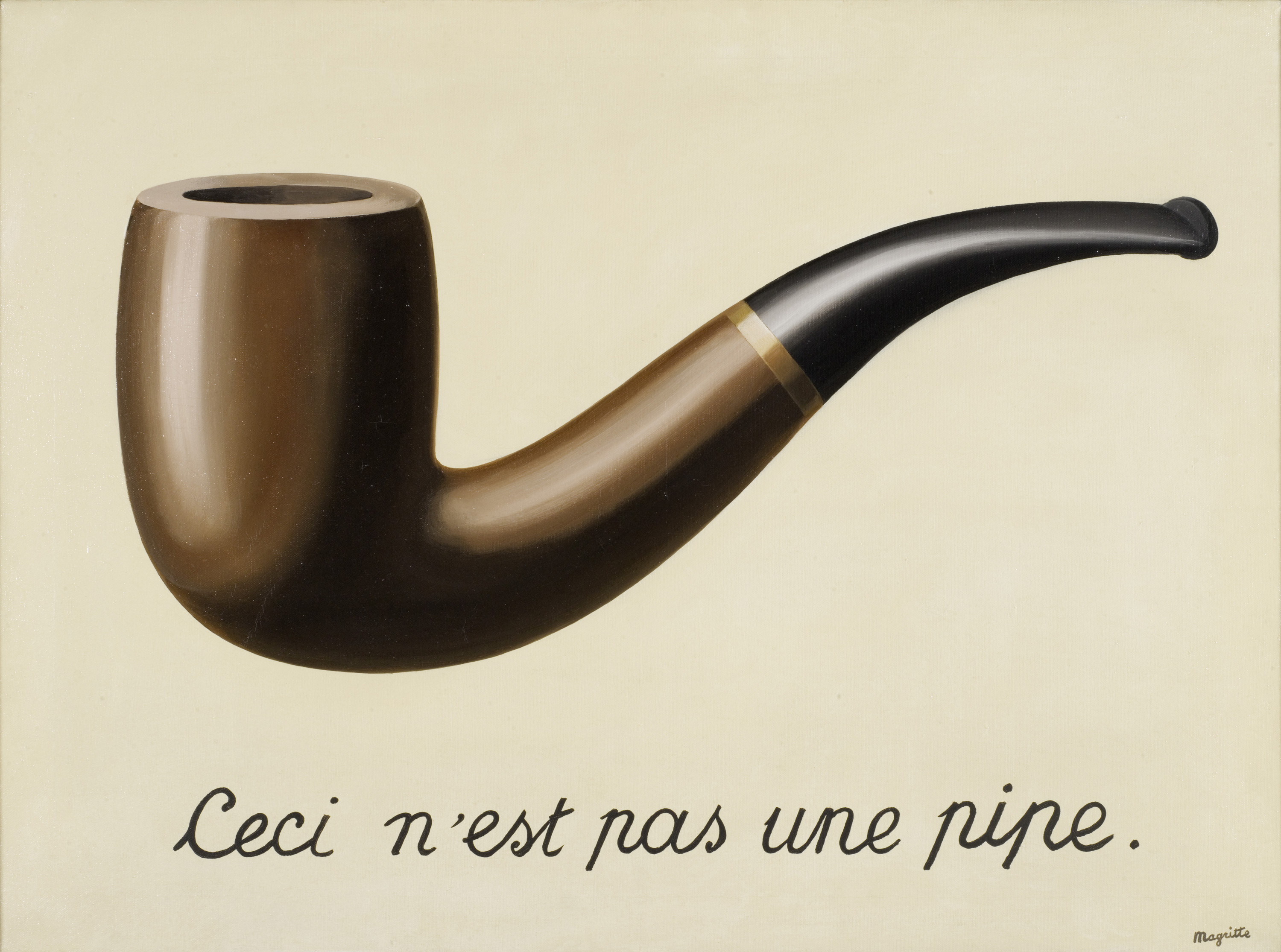
    Of course, the most featured (and crowded) show was Magritte: The Mystery of the Ordinary, 1926–1938. The exhibition is not a retrospective, but rather concentrated on a period of about ten years during which Rene Magritte developed his surrealist language and techniques. There are the deceptively simple scenes of everyday objects with unexpected or even disturbing details, as well as the early conceptual works that demonstrated his thinking about art, including This Is Not a Pipe.

    moma_magritte_treacheryofimages
    [René Magritte (Belgium, 1898-1967). La trahison des images (Ceci n’est pas une pipe) (The Treachery of Images [This is Not a Pipe]). 1929. Oil on canvas. 23 3/4 x 31 15/16 x 1 in. (60.33 x 81.12 x 2.54 cm). Los Angeles County Museum of Art, Los Angeles, California, U.S.A. © Charly Herscovici -– ADAGP – ARS, 2013. Photograph: Digital Image © 2013 Museum Associates/LACMA,Licensed by Art Resource, NY]

    Magritte, Rene
    [René Magritte (Belgium, 1898-1967). Le portrait (The Portrait). 1935. Oil on canvas. 28 7/8 x 19 7/8″ (73.3 x 50.2 cm). Museum of Modern Art. Gift of Kay Sage Tanguy. © Charly Herscovici -– ADAGP – ARS, 2013]

    While the exhibition doesn’t include some of his works with which I was most familiar (such as Les valeurs personelles), it was an opportunity to see early pieces I had never seen before. One can see in all of these the focus on out-of-cotext objects and repeated motifs such as bowler hats. The use of text and images disconnected from conventional meaning appears through many of the pieces as well. In addition to the paintings, which dominated the exhibition, were also collages and 3D objects from pre-existing elements, popular forms among Magritte’s contemporaries.

    Located across the hall from Magritte, Isa Genzken’s large retrospective exhibition was quite a contrast in terms of its scope and style. Rather than focused on a period of the artist’s career, it covered almost four decades from the 1970s to the present, during which Genzken’s practice changed significantly. Her earliest pieces indirectly incorporated elements of sound, with sculptures representing waveforms linearly or in polar projection (e.g., “ellipsoids”), and photographs of 1970s stereo system advertisements. From there, she moved to themes representing modernism and urban landscape, including in a series of large works made of concrete or other building materials, displayed together in a large room. While the largest suggested modern architecture, some of the concrete pieces suggested urban ruins.

    Isa Genzken: Retrospective
    [Installation view of the exhibition Isa Genzken: Retrospective. November 23, 2013–March 10, 2014. © 2013 The Museum of Modern Art, New York. Photograph: Jonathan Muzikar]

    From the very minimal and geometric, Genzken’s work seems to have taken a turn for the more playful, with a large variety of colorful mixed-media pieces. She also poked fun at artistic conventions with her Fuck the Bauhaus series of assemblages.

    060_IG
    [Isa Genzken. Fuck the Bauhaus #4, 2000. Plywood, Plexiglas, plastic slinky, clipboards, aluminum light shade, flower petals, tape, printed paper, shells, and model tree. 88 3/16 x 30 5/16 x 24″ (224 x 77 x 61 cm). Private Collection, Turin. Courtesy AC Project Room, New York. © Isa Genzken]

    There is a more serious tone, and one simultaneously hopeful and melancholy in her pieces made in response to the September 11, 2001 attacks in New York. The event affected her deeply, as it did many of us, and I found myself lingering with these last pieces to find the emotion along with the lines, shapes and colors.

    It seems like every visit to MoMA includes some show that directly or indirectly includes John Cage. This time, there was a small exhibition There Will Never Be Silence: Scoring John Cage’s 4’33″ built around the museum’s original score of the piece (in proportional notation). Works from the disparate schools such as Fluxus and minimalism and spanning a wide range of artists including Robert Rauchenberg, Josef Albers, Yoko Ono and Dick Higgens are included, and each some way explores the concepts of silence and space exemplified by 4’33”.

    1636.2012 2239.2008

    [John Cage. 4′33″ (In Proportional Notation). 1952/1953. Ink on paper, each page: 11 x 8 1/2″ (27.9 x 21.6 cm). The Museum of Modern Art, New York. Acquired through the generosity of Henry Kravis in honor of Marie-Josée Kravis, 2012. © 2013 John Cage Trust]
    [ Dick Higgins. Graphis No. 19 (Act One of Saint Joan at Beaurevoir). 1959. Felt-tip pen, ink, and pencil on paper, 14 x 16 7/8″ (35.6 x 42.8 cm). The Museum of Modern Art, New York. The Gilbert and Lila Silverman Fluxus Collection Gift, 2008. © 2013 Dick Higgins]

    The minimal and conceptual is also at the heart of Dorothea Rockburne: Drawing Which Makes Itself. The exhibition, which has the same name as one of the artist’s early exhibitions in 1973, focuses on the use of carbon paper and basic drawing processes to realize large-scale works on paper and on the walls and floor. Some, like Triangle, Rectangle, Small Square were self contained and made the simple shapes and curves life-size, while pieces covering entire walls and floors gave the concept of drawing a larger-than-life but nonetheless inviting quality.

    164.2004
    [Dorothea Rockburne. Triangle, Rectangle, Small Square. 1978. Colored pencil on transparentized paper on board. 33 x 43″ (83.8 x 109.2 cm). The Museum of Modern Art, New York. Gift of Sally and Wynn Kramarsky. © 2013 Dorothea Rockburne / Artists Rights Society (ARS), New York]

    There was much more to be seen at MoMA, some of which like the recent photography acquisitions can be difficult to summarize in an article like this. Like many of the places I visit in New York, I really should be going more than once a year.

  • Chris Burden, Extreme Measures, New Museum

    Chris Burden, Extreme Measures, New Museum

    Among my first stops during this year’s New York trip was the New Museum, which is currently featuring a museum-wide exhibition of works by Chris Burden.

    His work spans several decades and includes sculpture, performances and pieces that blur the boundary between the two. While the exhibition officially focuses on “weights and measures, boundaries and constraints”, the theme that seem to most unify all the pieces was “play”. Certainly, he has access to toys on larger scale than most of us could only dream of as kids who loved building sets. This was most apparent in his series of bridges, made from custom erector sets and other materials.

    20131123-IMG_9390

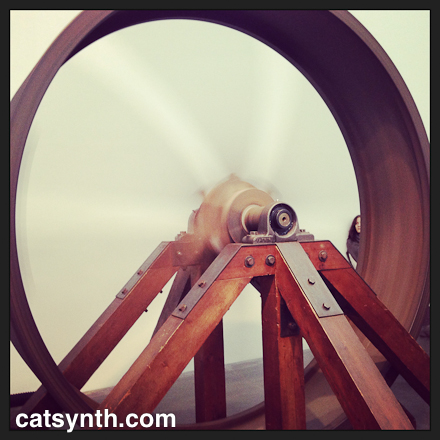
    Similar principles are at work in his large-scale sculptures, which use metal and found material and also included a sense of motion. The Big Wheel is indeed a huge wheel constructed from weathered metal.

    20131123-IMG_9382

    It is designed to spin freely, and visitors are treated to a twice-a-day “performance” of the piece where a motorcycle is used to start the wheel spinning. You can see a bit of this in the following video:

    A nearby sculpture address the absence of motion with a perfectly balanced Porsche and meteorite. I am curious as to how Burden obtained such a large meteorite to use in this piece.

    20131123-IMG_9375

    Motion is taken to another extreme in an outdoor piece (shown as video documentation in the exhibition) where large steel beams are dropped into a pool of wet cement. As the positions, angles, are unpredictable, the result is a rather chaotic jumble of vertical steel spires. The video itself is quite interesting with the motion of the cement in response to the the dropping beams.

    Perhaps the element of play is most apparent (and most poignant) in A Tale of Two Cities. Burden constructs a tableaux of two city-states at war using sand, plants and a large array of toys.

    20131123-IMG_9392

    Some of these toys (in particular, a few of the space-themed toys) were familiar from my own childhood. And certainly we sometimes created battles with them. But those fantasies never touched on the realities of war, and somehow Burden made that very apparent in this piece. Perhaps it was the presence of bullets among the toys that made it seem like something very, very bad could come of this.

    The exhibition also includes other conceptual pieces, as well as some examples of Burden’s early video work, which was interesting precisely because it seems dated.

    Chris Bürden: Extreme Measures will be on display at the New Museum through January 12, 2014.

  • APAture 2013 Opening Night

    After a four year hiatus, Kearny Street Workshop’s APAture festival is back. The previous APAture in 2009 was my first look into the Bay Area’s vibrant scene of emerging Asian Pacific American artists. This time around, I not only attended the festival and gallery exhibition opening, but participated as well as one of the featured musicians. I created a set that featured the dotara, a South Asian folk instrument, as well as a sketch box, DSI Evolver, and analog modular.

    20131005-IMG_9056

    The presence of blue and purple in the setup is not an accident, as the color blue was central to this performance. It was part of my costume and the lighting as well.

    IMG_0521

    [© 2013 Susa Cortez/Kearny Street Workshop.]

    The piece unfolded with the usual black-cat-blue-light opening, followed by a gradual swelling and fading of sounds from the modular. The dotata and sketch box were fed into the Make Noise echophon for effects reminiscent of old studio tape delays, alongside more modern noisy elements from the other modules. Overall, the performance was well received. For some, it was their first experience with electro-acoustic improvisation, and expressed to me their curiosity about it afterwards.

    The opening night also included an opportunity to see the work of the visual artists participating in APAture. There was quite a range of work, and several pieces were quite strong both technically and conceptually. Jessica Tang covered an entire wall with panels connected by strands of red string. A closer look revealed that the panels were successive runs of Google translator on a block of text. The view can observe the decay of meaning and language through her piece:

    20131005-IMG_9065

    Yuki Maruyama’s wooden blocks function as 3D versions of manga (comic) frames. The blocks can be assembled into new comic narratives, i.e., an “exquisite corpse”. Having three dimensions, however, allows for more combinations and interpretations of the assembled comic.

    20131005-IMG_9066

    More traditional artistic media were represented as well. Wenxin Zhang’s presented stark versions of portraiture and architectural photography.

    20131005-IMG_9064

    One of the more amusing pieces was an interactive conceptual work by Alison Ho, in which she invited visitors to stick gold stars with various Asian stereotypes on a blown up image of her face. Her piece was intended to challenge the notion of Asian American’s as a model minority. Clearly, many people were having fun with it.

    1375106_10152030406476802_187989994_n

    [© 2013 Susa Cortez/Kearny Street Workshop.]

    Other works that piqued my interest was Mido Lee’s starkly beautiful photographs of dead/forlorn trees, including some from desert landscapes; and a minimalist ring of light presented by featured artist Michael Namkung.

    APAture has continued throughout October with events focus on different media, including writing, performance, and comics/zines.   The next event will be music night on Friday, October 25, at SUB/Mission (2183 Mission Street, San Francisco). If you are in San Francisco, do check it out.

  • Wordless Wednesday: Ghost Pier

    20130704-IMG_8215

  • Desire Obtain Cherish, #sideffects, The McLoughlin Gallery

    Desire Obtain Cherish, #sideffects, The McLoughlin Gallery

    For us at CatSynth, the summer is usually a time of intense musical focus, and this one more so than most. While I keep up with the visual arts as best I can during these periods, it often takes something strong and unusual to get my attention for these pages. #sideffects, the solo exhibition by Desire Obtain Cherish (DOC) at The McLoughlin Gallery, is one such show.

    DOC - Blood Sugar High

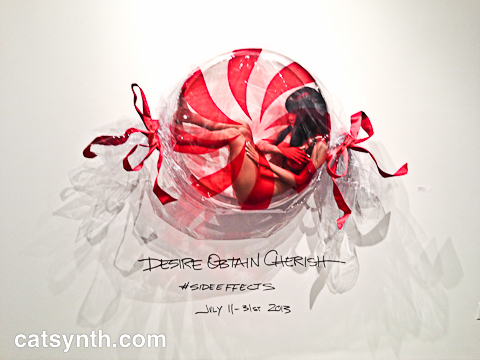
    The cover piece of the exhibition, shown above, along with the title itself, gives the viewer an immediate sense of what the show is about. The piece combines several banal and commercial elements, a store mannequin stuffed inside a replica of a familiar peppermint candy. These materials fit perfectly with DOC’s use of commonplace materials and tropes, but they are also provocative, pointing out the association of the female figure (particularly Asian female figures) with a commoditized “sweetness” and sense of possession. Clearly, we should expect to have our sensibilities tweaked a little bit as we progress through the exhibition. At the same time, the title with its hashtag and the written style tell us that along with the art, we will be subject to a bit of the artist’s written opinion, whether we want to or not. Indeed, the gallery layout for the show juxtaposes groups of similar art pieces with written thoughts from the artist, titled with a hashtag, an organization I found fun and creative.

    The entrance to the exhibition is dominated by a piece featuring a “red carpet”, which was particularly amusing for the opening.

    DOC #sideffects opening reception
    [Image courtesy of The McLoughlin Gallery.]

    The cartoon hands at the end of the carpet are sweeping something in some direction, but it’s not clear if it’s the carpet or the gold bricks that lie beyond it. The gold bricks, which were simultaneously part of the larger installation and individual works in their own right, bore DOC’s official designer monogram, if one imagined such a thing existed outside the confines of an art gallery.

    Desire Obtain Cherish gold bricks

    The resemblance to certain well-known designers’ monograms is clearly not a coincidence. Indeed, the monograms of actual well-known designers featured prominently in the series Designer Drugs:

    DOC Designer Drugs, single set
    [Image courtesy of The McLoughlin Gallery.]

    A sardonic and somewhat dark sense of humor permeates much of the work, with an emphasis on twisting commercial or pop-culture references. There was a series of crucifixes made from flavored chocolate bars emblazoned with the brand-name “Heresy”. (Unfortunately for me, but fortunately for the artworks, they were not made of real chocolate). The theme was most strongly present in the series of “pill portraits” featuring iconic images of celebrities who died from drug overdoses, assembled meticulously from thousands of individually wrapped pills. The subjects range from movie legends like Judy Garland as Dorothy to artists like Jean-Michel Basquiat.

    DOC - Judy's Purple Poppies
    [Image courtesy of The McLoughlin Gallery.]

    Despite his open ridicule of commercial and celebrity culture, Desire Obtain Cherish – whose real name is Jonathan Paul and was refreshingly down-to-earth when talking with visitors to the opening – is not without humility about his own role as an artistic provocateur and his history in Los Angeles street art. Indeed, one of the most fun parts of the opening was an installation in which visitors were invited to grab hold of a paintball gun and shoot a hanging figure directly mocking street art heroes including Banksy.

    DOC paintpall street art installation

    I did of course try my hand at the gun, which is quite an experience for those of us not immersed in so-called “gun culture.” It did splatter not only on the figure and the surroundings, but some bits rebounded back out into the main gallery dangerously close to myself as well as innocent bystanders.

    It should also be noted that Desire Obtain Cherish, who was trained at the Parson’s School of Design, still retains his knowledge of art history and practice even as he openly rebells against it. This was particularly noticeable in his riff on Dali’s famous “melting clock” piece. In a contemporary play on the original piece’s title, DOC’s is called “Short Term Memory.”

    DOC - Short Term Memory

    Overall, this was a strong show, and a coup for a gallery that I have been following since its inception about two and a half years ago.

    Desire Obtain Cherish, #sideeffects, will be on display at The McLoughlin Gallery through August 31. If you are in San Francisco this week, I strongly recommend checking it out.

  • Wordless Wednesday: Sundial Bridge

    Sundial Bridge

  • Wordless Wednesday: Southeast Industrial

    Industrial Southeast, Portland

  • Wordless Wednesday: Sonic Crossings

    Studio Cross Beams

  • Wordless Wednesday: Double Arch (Galena Creek Bridge)

    Galena Creek Bridge hipstamatic photo

  • Wordless Wednesday: Ascendance

    Ascendance - photo by Amar Chaudhary