Category: Music

  • Reconnaissance Fly at Studio 1510, Oakland

    A few photos and thoughts from last Friday’s Reconnaissance Fly performance at Studio 1510 in Oakland.

    I knew that Studio 1510 had a great acoustic piano, which I wanted to take advantage of particularly for our piece Emir Scamp Budge which features an extended jazz piano solo. But it turns that they also now have an actual Rhodes Stage Piano Mark II. I could pass up the opportunity to appropriate it for our set. Here is the Rhodes with the E-MU Proteus 2000 and Korg Kaos pad conveniently perched on top:

    Together with the acoustic piano and MIDI keyboard for a rather massive keyboard setup:
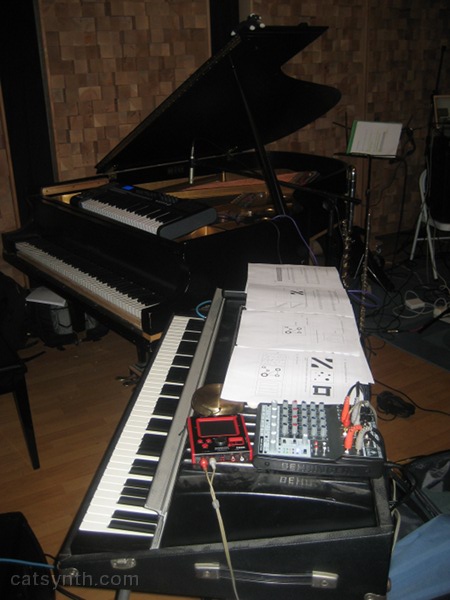
    Click the above picture to enlarge it and spot the cat!

    Here we are getting ready to play the first note of our opening piece “Small Chinese Gong”.


    [Photo by Tom Djll.]

    The set went well from that point. I have not yet heard the recording, but I thought the first piece, as well as “One Should Never” (which was about as tight as I have heard us play it), “Ode to Steengo” – with the interplay of the text, the Kaos Pad, odd drum beats and Tim’s live electronic processing – and “Emir Scamp Budge” went particularly well.

    Matt Davignon opened for us with a solo set featuring a live performance on drum machine and effects processors.

    This was nominally a performance marking the release of his new CD Living Things, although none of the pieces in the performance were actually from the CD. But that was OK. I particularly remember the last piece in the set for a variety of reasons, including but limited to the subtle effects in the music.

    Thanks to Scott Looney and Studio 1510 for hosting us!

  • Reconnaissance Fly at KUSF

    Here is the first photo of the current Reconnaissance Fly lineup, taken after our performance on KUSF today.


    [Photo by Bryan Chandler]

    Thanks to our host Bryan Chandler for the photo, and of course for the opportunity to play.

    Here is a photo I took at the start of the set.

    You can see the score for our opening piece “Small Chinese Gong” laid out behind the keyboard. This is one of the graphical scores that I have mentioned in a previous review. This is also the piece that fell victim to the “rebellious blue cord” that left the performance bass-less. Fortunately we were able to correct that and the rest of the set went quite smoothly.

    You can listen to an audio archive of the performance. I thought the later pieces, in particular “Canada”, “Ode to Steengo” and “An Empty Rectangle” came out quite well. We are definitely looking forward to our live performance tonight at Studio 1510.

    For those interested in the technological aspects: I was using my trusty Korg mini-Kaos Pad, E-MU Proteus 2000 (with Vintage Pro and Mo’Phatt), and a Voce Electric Piano module. Tim Walters was also performing live custom electronics programmed in Supercollider.

  • Reconnaissance Fly & Matt Davignon in Oakland, 2/5

    An announcement for upcoming performances with Reconnaissance Fly (consisting of myself, Polly Moller and Tim Walters), as initially reported on Polly’s Journal.

    We have six movements from Flower Futures all ready to share with you. We are all spoetry, all the time.

    First, we’ll be on the radio, performing live on KUSF starting at 11:00 a.m. (U.S. Pacific Standard Time) on Thursday, February 4th. KUSF streams live on the internet.

    Then we will be performing live at Studio 1510 the night of Friday, February 5th at 9ish PM. Studio 1510 can be found at 1510 8th Street, in Oakland, California. It’s conveniently near West Oakland BART.

    Here’s our set list:

    – Small Chinese Gong
    – One Should Never
    – The Animal Trade in Canada
    – Ode to Steengo
    – Emir Scamp Budge
    – Seemed to Be Divided in Twain
    – An Empty Rectangle

    You can actually read more about spoetry and some of our pieces in my review of our show last November.

    Our friend Matt Davignon will join us at 8ish PM for an opening set of extended drum machine soundscapes in support of his new album, Living Things.

  • LoveTech SF 1st Anniversary Epictacular

    We present a few photos and notes from the LoveTech SF 1st Anniversary “Epictacular”, which I attended on Saturday. LoveTech is a “Collaborative Music Technology Party & Interactive Multimedia Art Salon” here in San Francisco, and a group I definitely should try and be more involved in during its second year.

    Our friend Tim Thompson, together with Michael Broxton, performed live improvised music along with generative visuals (i.e., the graphics are generated live):

    Tim’s setup features a Launchpad/Mimo/Keyboard interface. This music featured tonal improvisations (lots of jazz chords and lines) with fast lines and rhythms, a structure that allowed one to shift focus between the music and visuals. The visual software was Broxton’s PhosphorEssence. You can see some clips from the performance on this video:

    In addition to live performances, there were also technical demonstrations. Here we see Moldover presenting the MOJO, a newly released music controller which features touch-sensitive strips, game-controller-style buttons and a rather sturdy looking case.

    There was also a “jam lounge”. Here we see a duo of *bernadette* (left) and Pamela Parker performing a delightfully noisy and inharmonic electronic improvisation with guitars and effects (including a Moogerfooger).

    They also had a theremin as part of their set. Note the porcelain cat figurine on the theremin.

    The video below features a demonstration by Komega of his custom sound and light instruments, including the Kromatron, Komegatone, and the Breadman.

    More on Komega’s instruments in a future article.

  • Muzundrum

    Muzundrum is a “game of musicians”. In the standard game, players take turns rolling 12-sided (dodecahedral) dice that contain one of the twelve tones in standard Western music and attempting to place the die on the board to form chords and scales from standard tonal music theory. For example, if a player rolls a G, he or she can place it next to a C and E on the board to form a C-major triad.

    There are of course many variations on the game. And the twelve sided dice can also be interesting tools for chance compositions or guided improvisation.

    We now have a pair of sample dice here at CatSynth HQ:

    The black die has the standard tones as described above, while the white has the solfege syllables do, re, mi, fa, so, etc.

  • Eigenlabs Eigenharp

    The Eigenharp Alpha from Eigenlabs:

    The instrument looks a bit like an “electronic bassoon”, but beyond the mouthpiece, long thin shape and wood finish, it is quite different. It has 128 discrete keys that are also sensitive to pressure and motion in two directions, several large heavier keys and continuous controller ribbons. As such, it has the potential to be a very expressive instrument.

    There is also a small version, the Eigenharp Pico:

    And a new intermediate version, the Tau:

    I particularly like the sleeker, modernist design on the Tau.

    I did hear some demonstrations, which showed the features of the instrument, but focused on very conventional sounds and performance techniques. There were standard software synthesizers with keyboard and wind control, percussion sounds and beats and patterns controlled by the keys. With so many degrees of freedom and the ability to map different axes of expression to different musical parameters, I would like to see such an instrument used to push musical expression in novel directions.  To this end, it is great to see that they are making their SDK open source.  The first extension I would recommend is an OSC (OpenSound Control) protocol interface.

  • Snyderphonics Manta

    Jeff Snyder of Snyderphonics poses with the new Snyderphonics Manta, a “a touch-sensitive interface for controlling music or video.”

    The Manta has a series of hexagonal sensors with LEDs that can be used as independent controls or together as a large X-Y control surface. I’m always interested in new control surfaces, and wouldn’t mind trying one of these out.

  • jamLink

    The jamLink from MusicianLink allows musicians to play together from different locations via high-speed internet. Below we see two performers onsite at NAMM jamming with a guitarist in Plano, Texas, which was 1438 miles (2312 km) away:

    (Can you spot the obligatory cat in this picture?)

    The performance was relatively tight, though one could hear a slight bit of delay or hesitation on the first beat of some measures.

    I have actually had a chance to glimpse the jamLink during its development, and would like to use it in the future. At the moment, however, it is doubtful that the network service at CatSynth HQ is up to the task.