Category: Music

  • Antibodies, Sk Orchestra, Do Make Say Think, The Happiness project

    On Saturday, I went a couple of very different performances in various neighborhoods of Brooklyn, ranging from poetry reading and performance art to experimental jazz and pop. At Central Booking in the DUMBO section of Brooklyn, I saw a performance by the Sk Orchestra, which uses Casio SK-1 sampling keyboards as their main instrument. The SK-1 is a very playable instrument for low-fi real-time sampling and lends itself well to live performance. On this evening, the orchestra was more of “chamber ensemble”, with two SK-1 performers plus a third performer playing an old-style hand-cranked telephone. The SK-1s were used for live sampling in a “call-and-response” style, with one player sampling a phrase in his own voice, and the other providing a sampled response. The back-and-forth of samples at different rates of attack and pitches got increasingly confrontational as the performance went on, even approaching “fake violence” as the players hid behind a screen from which screaming sounds could be heard.

    The performance was actually part of a release party for the book Antibodies, a collaboration of the interdisciplinary artist and musician Brandstifter and the word-and-sound artist Dirk huelsTrunk. The art book was based on found text and images from German medical textbooks. The authors performed a live reading from the book, reading lines once in German, once in English and the sung in both languages simultaneously. The performances featured a wide variety of musical and theatrical styles, from popular to more subdued to noisy/avant garde.


    At the Music Hall of Williamsburg, I saw a show featuring the Toronto-based band Do Make Say Think. Their music combined rock and pop with jazz and experimental elements, moving seamlessly from a driving rock rhythm to a rhythmless section of extended delay lines and analog-synthesizer drones to an acoustic chorale of trumpets and saxophone. They were able to blend the timbres of the core instruments (guitar, bass, drums, keyboard) with the large horn section and their rather impressive array of electronics – each performer appeared to have a large collection of dedicated pedals. The overall show had a lot of energy and seemed to move forwarded from one song to another without stopping (hence the joke towards the end of the set that they were “now going to play their second song), and resonated with the full but not claustrophobic audience.

    Beforehand, a subset of Do Make Say Think performed as Happiness Project, an intriguing set based on recordings made by bassist and lead Charles Spearin of his neighbors. He was intrigued by the prosody of the spoken words, with their wide variety of intonations, rhythms and phrases, and created several musical pieces that followed five of the neighbors’ recordings. We heard an old Jamaican woman’s voice followed by closely by saxophone’ Spearin’s daughter’s complaints interpreted by a violin against a minor-key jam; a very moving speech by a woman who was deaf until the age of 30, and her melodic description of what is was like to hear for the first time; a rather amusing repeated phrase from a six-year old girl as funky brass hits against a latin rhythm; and a duo of a bass and the words of a old Caribbean man. I have certainly seen musical performances before that attempt to capture the pitches and rhythms of speech closely, though this project worked quite well, and was certainly memorable. And it gives me something to think about for future pieces…

  • Performa 09: Composition for Cello and Brooklyn Queens Expressway

    Another piece from Performa: A Ballad of Accounting 2009: Composition for Cello and Brooklyn Queens Expressway, a composition by Alex Waterman with a 16-millimeter film by Elizabeth Wendelbo. I was quite interested to see this piece, given that it combines experimental music, art and highways, three of our interests here at CatSynth!

    Waterman lived near the Brooklyn Queens Expressway, or BQE, and was inspired by the sounds of the highway as well as its history. It was part of Robert Moses’ master design for the city’s highways, and winds its way through a narrow corridor in densely packed areas of eastern Brooklyn and Queens. (See this article for more info.) Waterman often walked under the highway, listening to sounds and in particular the harmonics. The piece includes live cello performances near and under the highway, with microphones in the resonant chamber of the cello, as a way of modifying and eradicating the noise of the highway, as if “the cello was eating the highway.”

    The video opens along the BQE, along the side, underneath, and riding on the surface, interspersed with images of Waterman carrying or playing his cello near the elevated structures. The music featured long notes set against filtered highway noises. There were lots of drones, often featuring noisy timbres or harmonics, but sometimes more familiar minor tonalities. The visuals included architectural close-ups of the elevated structures – hardly considered among the more picturesque in the city, but still quite interesting. I noticed exit signs for Metropolitan Avenue appearing a few times. One moment that particularly got my attention was a forlorn drainpipe. One could imagine the metallic resonances here, and indeed the sound became more electronic, reminding me a bit of early Xenakis. I also heard sounds that reminded me of more modern granular synthesis. There were also sharp departures from the drones, with very pointed “crackling sounds”, appropriate as the video began to feature rain and water dripping from the pipe.

    There is a permanent installation of the piece near Calistoga, CA. I am curious to see it sometime after I return home.

  • Ivy Room Experimental Improv Hootenany, November 16

    Last Monday, I performed again the experimental improv “Hootenanny” at the Ivy Room in Albany, CA. This is always a fun series to participate in or attend. It starts a little later at 9PM, and is set in a rather plush bar that makes a great setting for drinks and experimental music.

    Free Rein. Photo by Michael Zelner

    The evening opened with Free Rein, consisting of Andrew Joron (percussion, theremin), Joseph Noble (woodwinds) and Brian Lucas (guitar).  They began with Joron playing a bowed metal percussion instrument and Noble on flute.  The bowed instrument had discrete pitches and the music was quite tonal and repetitive, almost hypnotic. They were joined after a while by Lucas on guitar, and together weaved between pentatonic and chromic sounds that were sometimes quite lush, and other times sparse. Joron switched the theremin at some point during the set, and there was a particularly interesting duo of theremin and pennywhistle.

    Free Rein gave way to The Lords of Outland with CJ “Reaven” Borosque (electronics), Philip Everett (drums), Ray Scheaffer (bass), and Rent Romus (alto saxophone).  There sound was loud, fast, dramatic, with many of the standard idioms from free jazz, run of fast notes (particularly from Romus on sax), squeaks, and loud hits.  It was interesting to have the electronic noises set against the jazz sounds.

    Lords of Outland.  Photo by Michael Zelner.
    Lords of Outland. Photo by Michael Zelner.

    The set was very energetic and seemed to go by fast, and I had to keep track of time lest I miss the start for the set that I was curating.  On cue, as they faded out, we began to fade in.

    Photo by Michael Zelner
    Photo by Michael Zelner

    The set I curated included myself on electronics, Brandan Landis on prepared guitar, Beau Casey on violin and David Slusser on saxophone and the Slussomatic. As usual, I began by ringing one of my prayer bowls, which was answered by the metallic sounds of the prepared guitar and the violin, followed by the Kaos Pad and Evolver, and then the Slussomatic.  None of us have played together as a group before, but I was happy with the way we able to play off one another.  There were a couple of moments that particularly stood out for me, such as a rhythmic ostinato that emerged organically and I then reinforced; we went on with that pattern for a while, adding accents and syncopations; towards the end, the full ensemble played a series of loud and dramatic swells (anchored by a noise patch on the Evolver) that brought the set to a close…

    Elizabeth Torres with Cansafis Foote. Photo by CatSynth.

    …which segued to the next set featuring Elizabeth Torres on tenor sax, with Cansafis Foote on baritone sax and Mario Silva on trumpet.  The set began with Torres and Foote as a duo, moving between very synchronous playing in which the two saxophones acted as one instrument, and Torres’ improvising freely against a driving but ever-changing rhythm provided by Foote.    The duo was then joined by Silva, again moving back and forth between more free improvisation and rhythmic sections.

    Thanks again to Lucio Menegon for hosting the series and Suki O’kane for being “virtual Lucio” on this particular night.

  • Preparing for Saturday performance

    I am busy preparing for the first of three upcoming performances this week. That primarily involves hastily assembling a collection of gear and cables:

    For this show, I will be using the Evolver, the Korg Kaos Pad, looping and effects software the MacBook, and several of my Chinese and Indian instruments, including the prayer bowl at the center of the photo. A challenge for readers: how many cats do you see in the photo above?

    Meanwhile, Luna sits nearby. She seems to be accustomed enough to the odd sounds from my musical instruments to remain relaxed and even take a nap.


    Appropriately enough, Weekend Cat Blogging #232 is being hosted by our audio-gear-savvy friends LB and breadchick at The Sour Dough.

    The Carnival of the Cats will be up this Sunday at Artsy Catsy.

    And of course the Friday Ark is at the modulator.

  • Updated music website

    I have embarked on a long-overdue update of my professional music and art website, a sort of sibling to CatSynth.

    Besides the new look and feel which I quite like, I updated the available music for download, including some selections previously only available on the (now defunct) podcast, and the audio recording from my performance in Shanghai.

    Please do check it out. Feedback welcome.

  • Weekend Cat Blogging #231: at home in the studio

    A day when I was feeling mildly ill turned into an incredibly creative and productive day, including lots of time in the office/studio.

    Here we see Luna sitting on the ledge that borders the studio area. In the background one of our main workstations, with Pro Tools running on the computer, and the trusty E-MU Proteus 2000 module off to the side (it’s back in its rack after the recent Reconnaissance Fly performance). One of several photographs by our friend Luxe hangs in the back.

    The studio ledge is the highest point in CatSynth HQ, which makes it attractive to cats. There is also another workspace against the ledge where I often sit, so she likes to be nearby.

    Note that the duck is actually musical instrument that I have used in several live shows :).

    I do sometimes feel a little nervous when Luna gets up the ledge, given how high it is above the floor below. But I am putting my faith in her feline balance and dexterity. Eventually she comes done into the space itself to curl up for a nap, often on her favorite beanbag chair:


    Weekend Cat Blogging #231 is being hosted by Diamond and Tristan over at digicats. Do check out their cool graphic featuring another black cat with green eyes and a human “cat woman” companion.

    The Carnival of the Cats will be going to Nikita’s Place this Sunday.

    And of course the Friday Ark is at the modulator.

  • Reconnaissance Fly and Noertker’s Moxie at SIMM series

    Last Sunday (November 1), Reconnaissance Fly performed at the Outsound SIMM Series.

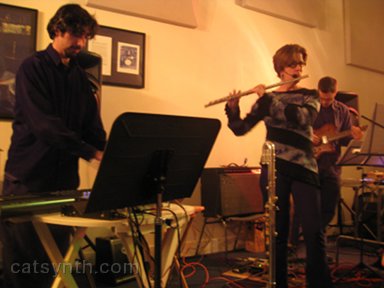
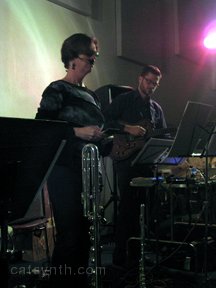
    This performance was as a trio, with Polly Moller (Scorpio, and flute and voice), Amar Chaudhary (Pisces, and electronics), and Bill Wolter (Saggitarius, and guitar).

    Photograph by Jennifer Chu. Click to enlarge.

    We performed four pieces from our “spong” cycle Flower Futures. What is a “spong cycle”? It is a series of pieces based on spoetry, “the deliciously powerful results of robot efforts to evade your spam filter” (as well as the enormous spam queue here at CatSynth). Most spam is banal or poorly written, but occasionally one stumbles upon a particularly beautiful piece of text. We performed four pieces from the eventual full cycle. The two I wrote entitled “Small Chinese Gong” and “Seemed to be Divided in Twain” are improvisational pieces based on graphical scores. You can see an example symbol to right. The interpretation of the graphics can be musical gestures “inspired” by shapes, or a more literal interpretation such as tracing them out on a Korg Kaos Pad – for this performance Bill and I had dueling Kaos Pads in some sections, which produced dense textures or “forests” of pointed sounds that reflected the underlying text.

    Photograph by Jennifer Chu.
    Photograph by Jennifer Chu.

    Bill Wolter’s “Spam-a-lot” is a combination of improvisational and traditionally written material. The highlight of the piece is the section in the middle concerning “the animal trade in Canada”, ending with a bluesy rock pattern set to “Ca-na-da-a!”, and is probably one of our favorite moments in every performance or rehearsal.

    Polly Moller’s “Emir Scamp Budge” is a more idiomatic piece, scored for a standard quartet of keyboard, bass, guitar and voice with a bit of a jazz feel. The text is set to a rolling melody set against a walking bass line and an odd chord progression. It is quite a contrast to the graphical score pieces, and a great excuse to dust off the jazz chops.

    It was a pretty solid performance, with all the practice and rehearsal time having paid off. Sadly, this was in all likelihood the last performance that Bill Wolter will be playing with us.

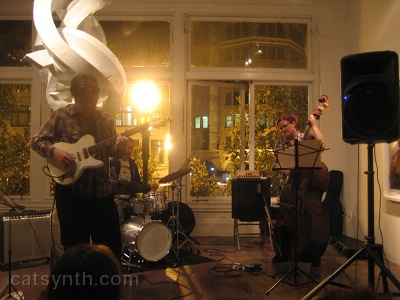
    We were followed by Noertker’s Moxie, featuring Bill Noertker on contrabass, Annelise Zamula on tenor sax and flute, Jim Peterson on alto sax and flute, Jenny Maybee on piano, and Dave Mihaly on drumset and percussion. They were marking the release of their new CD druidh lacunae.

    The piece, Kamilopárdali, started off very free-form, with lots of detached notes and percussive sounds, including a cloud of metallic-percussion sounds, and Maybee directly playing the strings inside the piano. Gradually, the music became more focused rhythmically and melodically, and then began to alternate between sections of standard modern jazz with rhythms and chromatic lines, and more free-form sections like the beginning. At one point the rhythm disappeared entirely with only sparse hits on the piano strings, drums and bodies of the bass and saxophones. After this, a section with a stronger and tighter jazz melody and rhythm emerged; I believe this was the segue into the piece Athenian Birds.

    This was followed by Virage, which Noertker described as having been composed in Hungary and Slovakia in 1995. However, the impression I had of the piece was more East Asian, with lots of pentatonic scales and harmonies set against a latin rhythm. Indeed, one flute melody performed by Zamula sounded exceptionally Chinese, not only because of the scale but also the ornamentation of the notes – there is a particular sound in Chinese music with grace notes or bends on accented notes.

    One other piece that particularly caught my interest was Desert Canto. It was described by Noertker as a “beautiful piece”, inspired by photos from Nevada Test Site (site of former atomic-bomb tests) that were “beautiful but also disturbing.” The piece was indeed beautiful, very atonal – but a traditional melodic atonality as opposed to percussive or non-pitched – and had a soft, more dreamlike quality, with frequent cymbal and drum rolls and freer rhythmic structure. You can hear a clip of Desert Canto on the Noertker’s Moxie website.

  • Metal Machine Manifesto – Music for 16 Intonarumori

    Last Friday, I attended Metal Machine Manifesto—Music for 16 Intonarumori at the Yerba Buenca Center for Arts here in San Francisco.   This concert, a joint performance of SFMOMA and Performa, was part of a celebration of the 100th anniversary of the launch of futurism, or more specifically the Italian Futurist movement launched in 1909. A century ago, the futurists were producing art, music, architecture and performance that still feels very modern, even more so than some of the more conservative post-modern art of recent decades.

    In the area of music, one of the most influential composers and writers was Luigi Russolo, who wrote the Art of Noises, and developerd the intonarumori or noise makers.  The work of Russolo and others in futurist music paved the way for experimental and technologically-focused music from George Antheil to the electronic experimental and noise music of today that we at CatSynth perform and celebrate.  Indeed, RoseLee Goldberg in her introductory remarks to the program refers to the music of the futurists as the “original DNA of noise music.”

    The intonarumori were hand-cranked instruments designed to produce “noises”.  Their sounds included whirrs and buzzes, clangs, scrapes, and also sirens and mechanically plucked strings.

    For this performance, Luciano Chessa, a “foremost Russolo scholar” oversaw the recreation of 16 intonarumori, which were used to perform both pieces by the original futurist composers, and contemporary pieces for these instruments.

    The recreated intonarumori looked much like the old pictures, with simple wooden boxes and large cones for sound projection.  You can see and hear some of the futurist noise makers in this video from Chessa and composer/performer Mike Patton:

    After the concert I a chance to see the intonarumori up close and even try a couple of them out.  This medium-sized instrument produced repeated plucked-string sounds.

    This one was purely mechanical, though another that I tried which produced automobile noises appeared to have an electric motor.

    The concert itself featured Luciano Chessa as conductor for most of the pieces, and members of the Magik*Magik Orchestra under the direction of Minna Choi.

    It opened with Paolo Buzzi’s 1916 piece Pioggia nel pineto antidannunziana.  This was a rather theatrical piece, with dramatic conducting by Chessa and various words in Italian shouted through a megaphone.  The noise intoners here were used to literally reflect the urban noises of the time such as sirens and the whirring of machinery.

    In the the more contemporary pieces, the noise intoners were used in other contexts rather than as simulation and expression of the modern noisy environment, but as instruments that could be played subtly and expressively. Such was the case with Theresa Wong’s Meet me at the Future Garden.  Hits and clangs and mechanically plucked strings were set against Wong’s percussive vocals and Dohee Lee’s more dramatic low voice with loud vowel intonations.  From Wong’s program notes: “2 a.m. sharp, in a primordial cooperation of pulsating forest, I will sing you a song tactitle tick tocking of residual harmonies, caution manifest launching the dominance of mutual respoect and hypersensitivitiy this message sent from my iphone [sp].”

    let us return to the old masters, a collaborative composition by members of sfSoundGroup, took its inspiration directly from a quote of Francesco Balilla Pratella ‘s Manifesto of Futurist Musicians to “destroy the produce for ‘well-made’ music”.  The piece itself was composed during the rehearsals for the concert.  The sfSoundGroup members have excelled at extended technique and performance of complex compositions with their traditional instruments, and brought that skill to the intonarumori.

    The first half of the concert ended with one of the most disinctive pieces of the evening, Donno Casina by Carla Kihlstedt and Matthias Bossi.  The performance featured two the larger “bass” intonarumori, along with Kihlstedt on vocals and violin, Bossi on accordian, and Moe! Staiano playing a large drum and collection of colorful metal objects.  The distinctly futurist sound of the intonarumori was blended with Kihlstedt’s more contemporary extended vocal and violin techniques, and Moe!’s intense and theatrical percussion performance.

    In addition to having the best title of any piece in the concert, James Fei’s New Acoustical Pleasures (A Furious Meow) was the most subtle.    It was made of “quiet noises” with lots of empty space between sounds and relatively little movement, and reminded me of some of John Cage’s more static pieces.  The short, soft tones from the intonarumori were quite a contrast to the loud blaring representations of modern life of the original futurist pieces.

    While listening to John Butcher’s penny wands and the native string, I came up with the word “scrapier” to describe the piece.   And I am pretty sure that is not a real word.  Nonetheless, the piece was “scrapier” than the others.  The performance, which featured Gino Robair, included lots of scrapes and grinding sounds building up to a crescendo and then coming to an abrupt stop.  After a brief silence, the scrapes and grinding sounds resumed.  This pattern repeated a couple of times, with variations in each repeitition.

    After Fei’s and Butcher’s pieces, the full ensemble returned for Mike Patton’s << KOSTNICE  >>.  All sixteen intonarumori were played together to produce a thick “orchestral” sound along with drums.

    Luciano Chessa’s L’acoustic ivresse (Les buits de la Paix) also featured the full ensemble plus bass vocalist Richard Mix.   There were similar thick clusters as in << KOSTNICE >>, but this time framing Mix’s vocals.  There were moments when the vocals and ensemble played off on another, with Mix’s strong bass voice and traditional singing style simultaneously blending and contrasting with intonarumori.  This performance received one of the longer and more spirited rounds of applause of the concert.

    Elliott Sharp’s Then Go, which featured Dohee Lee, received a similar reaction.  This was another full-ensemble piece, where the noise tones were very well synchronized to Lee’s dramatic singing.  She also tapped (or stomped) her feet in time with percussive sounds from the ensemble in a strong rhythmic pattern.  Through the rhythm, piece seemed to connect both the futurist sounds (as archetypically modern sounds) with something much more traditional, even primal.

    The concert concluded with a realization of a fragment from Luigi Russolo’s 1913 Risveglio di una città.  Like the other original futurist work in the program, this piece directly referenced “sounds of the modern world” like cars and sirens.  This very short fragment of a piece abruptly ended with Chessa dropping his baton.

  • Blood Moon Concert, Luggage Store Gallery

    Last Thursday, in addition the gallery and art walk, I also attended the Blood Moon Concert at the Luggage Store Gallery. This was latest in Polly Moller’s moon concert series and focused on the “Blood Moon”, a traditional name for the closest full moon to the autumnal equinox. It is associated with the fall harvest, and also with the hunting of game and the slaughtering of livestock ahead of the winter season. The two halves of the concert couldn’t have been more different, an experimental electronic/noise texture performance followed by “avant-gard blues”, but they both worked intimately with the evening’s theme of the “blood moon.”

    The concert opened with the duo of James Kaiser and Andy C. Way reimagining a piece that originally recorded on a blood moon several years ago. Both the original recorded version and this live performance featured “minimal electronics, voice, metals and much atmosphere”. The performance began with a noise swell, like a strong wave, embellished by ornamental sounds on a cymbal. Actually, the cymbal was part of a larger instrument, and mounted on top of a bicycle wheel. It was bowed to produce a variety of metallic resonances that blended with the electronics. Overall, the piece had a relatively constant texture. It was static, a dark tonescape, fitting for the theme. But there were also a variety of details that changed throughout. In addition to the bowed cymbal and bicycle wheel, there were breathing sounds, the use of voice to drive electronic effects, dark scratches and drones, noise glitches. Later on these were joined by loud bursts and “incidental pitches” from periodic noise. There was one sound that reminded me of the closing doors on a New York City subway train. The piece ended with a strong resonance and rumble, and then faded out.

    The second half of the concert featured the trio Past-Present-Future, with Myles Boisen on guitar, “Hollerin’ John Hanes” on drums, and Lisa Mazzacappa on bass.


    [Click to enlarge.]

    They premiered a Blood Moon Suite written for this concert. It began with a “free-improvisation” section characterized by harmonic and rhythmic swells. In particular, I noticed Boisen’s combination of chromaticism and harmonics admist the ensemble’s clusters of rhythm followed by more free-form sounds. Over time, the piece became more “bluesy” in terms of the scales and chords. There were still very linear chromatic jazz chords, but with a framework rich blues idioms on the guitar and bass. One memorable section featured a straight slow blues rhythm with guitar and drums (with a heavy swing feel), that moved immediately into a serious staccato notes and then to a slow expressive end. The next movement began with a strong six-eight rhythm with low guitar and chromatic thirds. It was definitely more steady rhythmically and harmonically than the previous movement, with occasional hits and stops, and overall more traditional harmonies, and a cool bass solo by Mazzcappa. Things got more free-form later in the piece, and morphed into something slower and darker. The final section was more minimalist, with an interplay between slide guitar and bass that sounded quite “southern”, with lots of slides, bends, octaves/unison and blues-scale lines. It ended more dramatic, and noisy elements on the guitar and bass.

    The Blood Moon Suite was followed by another piece, “Devil’s blues”. It featured a latin rhythm, with the bass and drums repeating a rather addictive pattern. The guitar was repetitive and subtle at first, with blue notes and tritones and inharmonic effects all within the rhythm.

    One interesting coincidence for this concert was running into Jeff Anderle at the taqueria below the Luggage Store. It was only an hour or so earlier that I had seen him perform at Steven Wolf Fine Arts at First Thursday. Yes, it was quite an evening of art and music.

  • First Thursday October 2009

    It’s been a while since we have a reviewed a First Thursday Art Walk here at CatSynth. It is partly because I have been away the first Thursday of several months, and on the ones that I have been here I felt largely uninspired. However, fall is usually the best season for these events, and several exhibits at 49 Geary did catch my interest this time.

    The highlight of the evening was actually the combination of visual art, musical performance and film at Steven Wolf Fine Arts. As I entered, bass clarinetist Jeff Anderle was performing a solo piece. We last saw Anderle at the 2008 Switchboard Music Festival. I then noticed the main visual exhibition Taking Pictures by Nicholas Knight. In these photos, Knight captures gallery viewers in the act of taking photographs of art, particularly with small digital cameras or iPhones. I of course needed to play along and take a photo of his photos of people taking photos of art:

    In front of Knight’s work, we see the part of the percussion setup for the next performance by the Magik*Magik Orchestra. The piece by composer David Lang (of Bang on a Can fame) featured flower pots purchased from a hardware and garden-supply store (visible on the lower right of the photograph). However, the pots were very well chosen for intonation and resonance, and the performance had a very harmonic and ethereal quality. The three percussionists also remained very in sync with one other through the long tones. The next piece, which was also by David Lang, was titled Little Eye and featured cello plus percussion. It was a contrast in complexity from the cello and simplicity from the percussionists. The cello melody was very classical or baroque, while the percussionists provided a very modern background texture that featured rubbing on rusted wheels. There were also individual notes on a xylophone and piano/keyboard that added a different texture.

    It turns out this performance of David Lang’s works was in support of the soon-to-be-released film (untitled), for which Lang provided the music. The comedy features a new music composer and Chelsea art galleries, and I am quite eager to see it when it comes out.

    At the Haines Gallery, I was particularly drawn to the exhibit by Julia Oschatz entitled Odd One Out. The room was painted in a geometric black-and-white pattern, which matched the quality of Oschatz’s largely geometric and abstract drawings on the wall.

    The drawings had a very stark quality to them in terms of the shapes and textures. Rather than just abstract geometry, the drawings depicted other worlds. Some seemed to be directly taken from science fiction, others more surreal. There were also several videos featuring a mouse-like character experience all sorts misadventures. On further inspection, I realized that a small version of this character was present in most of the drawings as well. One just had to know to look for it.

    Once again, the Elins Eagles-Smith Gallery featured large abstract paintings, this time by Gustavo Ramos Rivera. Rivera’s large canvases are brightly colored and feature large shapes that seem like signs or icons in an unknown language. One can see repeated shapes with different color palettes in each painting. The sculptures that dotted the gallery for the exhibition featured similar motifs and complemented the paintings well.

    Aaron Parazette’s paintings at Gregory Lind Gallery seemed reminiscent of Piet Mondrian’s famous neo-plastic works, but with a more varied color palette and some different shapes. The most stark pieces of the evening were Freddy Chandra’s retangular color fields of acrylic, resin and graphite at Brian Gross Fine Art .

    We conclude with a very different exhibit that again brings together visual art and music. Fifty Crows Gallery featured the solo exhibition Curse of the Black Gold by photographer Ed Kashi. Perhaps what got my attention more than the photographs themselves was the music of Femi Kuti, son of the legendary Nigerian musician Fela Kuti.