
Category: Music

  • 2009 San Francisco Electronic Music Festival

    This September was the 10th anniversary of the San Francisco Electronic Music Festival, and I had the opportunity to attend two of the performances. To mark the occasion, many of the original participants in the first festival ten years ago came back to perform.

    The festival began with a piece by Miya Masaoka (whom Pamela Z jokingly referred to as the “mother of SFEMF” in her introduction). The LED Kimono project not surprisingly featured a kimono with LEDs, worn by dancer Mariko Masaoka-Drew. The dress itself was very pretty and simple, with a large LED array on the right-hand sleeve. Throughout the performance, different patterns were featured on the LEDa, sometimes very subtle with only a few active, and at other times large oscillating rectangular patterns.

    The music began with a very traditional koto performance. There some delay, sampling and pitch-shift effects in the background. The koto was mostly struck or plucked, and occasionally bowed. During the section of the performance, there was almost no dance movement. Over time, more electronics came in, initially low, dronaning, and with overtones that sounded vaguely FM or inharmonic, almost like electrical noise.

    As more electronic sounds came in, the dancer began to move, very slowly and subtly. Indeed, most of the movement throughout the piece was very subtle and slow, and did not clearly map to the musical material. On the other hand, the LEDs on the dress did match the rhythms and timbral changes. The first came on during and electronic arpeggio that sounded like classic FM synthesis. There were some dramatic swells with the higher FM-like sounds. The music primarily moved between the elements described, with the long drones and then the fast arpeggiation. But the physical movement of the dancer remained slow. As a result, I found myself mostly focused on the LEDs and the dress.

    And the end, I stayed to watch the process of Masaoka-Drew being “unplugged” from the dress, and to fully observe the amount of electronics (and wiring) that were required for it to function.

    The second set featured Lukas Ligeti performing his own compositions on the marimba lumina. He began slowly, with very low tones, one so low that the amplitude modulation itself became and audible rhythm. He then layered other sounds over these tones, including some vocal samples that sounded like chatters or whispers. Overall , I would describe his music as a cross between classic minimalism, world music, and electronic music. He described what we was doing as using the marimba lumina to play “samples and funny synths” on his laptop, with a focus on samples were collected from his world travels. One could definitely hear some of the instruments and voices from various places around the world, particularly Africa, in his performance.

    The final performance of the evening was by Amy X Neuberg. Her performance was a combination of her “electronic cabaret”, which we have heard several times before and reviewed here at CatSynth; and a new work entitled “The Dude Trilogy”, a series of abstract poems for voice and the Blippo Box. The Blippo Box employs chaotic oscillators and modulation, and can be very difficult to control in a predictable way. However, Neuberg manages to perform it in a very poetic way, and more remarkably is able to match her voice to the sounds of the synthesizer. Rapidly changing vowel sounds matched a fast chaotic filter modulation, the rhythms of spoken word material matching the sequences. At other times her high sung tones followed the unstable high electronic pitches. During the piece, a video camera recorded and projected close-ups of her hands manipulating the instrument, including its theremin-like antenna.

    Several of her electronic cabaret pieces were familiar from previous programs. They always are very tight and solid, combining voice, electronics and theatre. She did close with one song I had not heard before. It began with her striking the electronic drum pad repeatedly to produce a “banging piano-chord” pattern, which was matched by her vocals. It ended with a solo and fade-out on the Blippo Box, which almost seemed like a spontaneous moment.


    The location of the festival, the restored Brava Theater in the Mission District of San Francisco, was itself an attraction. Besides the large theater space and lobby, the deliberately weathered foyer housed the installation The Exchange by Dukoro, the duo of Agnes Szelag and The Normal Conquest. This installation with subtly placed speakers and sounds generated interactively by visitors, complemented the architecture.
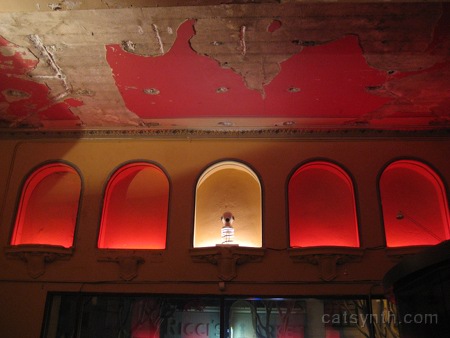

    [click to enlarge.]


    The Saturday performance opened with [ruidobello], aka Jorge Bachmann performing his piece Coleoptera_0909 for electronics and video. The piece centered around beetles, or scarabs, who are members of the biological order Coleoptera. Videos of scarabs were projected onto the screen. Some were crawling on skin, some were in dishes, a couple were on a corrugated cadrboard surface that resembled a Q-bert board. Initially the beetles were solitary, but then they started to appear in groups. One particular scene involved one poor scarab being madly chased and grabbed at by another (one can only speculate what was going on here). The sounds were based on recordings of natural sounds from scarabs. In the early part of the piece, the relation to the insect noises was quite transparent (i.e., it “sounded like insects”). Later on, the connection between the performed sounds and the original material became more abstract, and sounded like thick pads with delays, time-stretching and pitch-shifting effects. The piece ended with a scarab taking off in flight, and the sound following suit with an ascending glissando.

    [ruidobello] was followed by an electronic performance of Gino Robair’s opera I ,Norton. It is an improvisational piece based on the writings of Norton I, “Emperor of the United States and Protector of Mexico”, and a famous character from San Francisco history. In 1859, Joshua Abraham Norton declared himself Emperor Norton I of the United States, and began to issue a series of decrees, including the dissolution of the United States Congress. The opera is based on the text from these decrees, but in an “open-ended structure [that] allows it to be assembled differently for each performance.”

    In this version, Tom Duff played Norton I and read from his various edicts, while the spoken words are processed by three electronic performers Chris Brown, Kristin Miltner and Wobbly. Indeed. all the electronic sounds were based on Tom Duff’s voice. At first, the electronic manipulations kept the words intact through various delay, pitch and time effects; but over time the electronics became more complex, with delay lines or samples short enough for the snippets from the original voice to form completely different timbres, and as such became more detached from the stage performance. I found myself focusing heavily on the video work of Tim Thompson along with the theatrical performance, and the electronic sounds became part of the background. One particularly strong visual moment was when Tom Duff/Norton I built a small “city” out of colored translucent cubes and shining flashlights through them. This illuminated construction was then picked up by the video and projected onto the screen. There was a middle section in which our protagonist appeared to go to sleep (perhaps dreaming) and the electronic music became the focus, with the video playing against the sounds (which were still entirely based on previously sampled vocal material). There was an overall calm pace to the entire opera performance, punctuated by the dramatic proclamations and occasional abrupt shifts in timbre or visuals; and one simply became immersed in the whole experience.

    Pamela Z concluded the festival with what she described as an “old-new sandwich” with several short pieces. The first “older” pieces included looped rhythms layered with rich vocal textures and harmonies, with one featuring a dramatic simulation of a manual typewriter complete with carriage return. There was a performance of a piece I had originally seen her perform at room: PIPES back in May. The next piece was the “new” part, a work in progress entitled Baggage Allowance. It opened with a video of a baggage carousel, with various people reciting the contents of their luggage (clothing, toiletries, books, etc.). The contents became a little more unusual over time, as people described confiscated items and even an attempt to hide a knife at LAX. A simulated x-ray of a bag included strange objects like a frog and a gun (actually, I suppose I gun isn’t all that strange). This was set against live electronic processing of vocals as well as other sounds such as the popping of bubble wrap. The final piece was another older work involving delays and dramatic harmonic vocals (it was originally done years ago with hardware effects boxes before being ported to modern laptop computers); as a representation of classic electronic music being redone with modern technology, it was a fitting conclusion to the festival.

  • CatSynth video: MPC Cat

    From officialanticon on YouTube, via matrixsynth:

    “Doseone’s cat Purple takes inspiration from the keyboard cat.”

  • Expanded Strangelet at oakuff

    Last night I performed with Expanded Strangelet at the Oakland Underground Film Festival. The Expanded Strangelet was described as “Lucio Menagon’s peripatetic ensemble with Suki O’kane, Michael Zellner, Jonathan Segel, John Hanes, Amar Chaudhary, and Allen Whitman.”

    This was a combined “music jam” and “projectionist jam”, with several improvised video and film projections on the screen, a free-form piece that followed the more formal screenings earlier in the evening. The screen was filled with several changing images projected from different angles:

    It was particularly interesting in the context of the theatre itself. This was one of those classic cavernous movie theaters with stylized art-deco details, but with very contemporary abstract lighting in deep blues, reds and violets, as can be seen on the right side of the image above.

    It was in this context that we set up on the floor of the theater and made music. Basically, the performance was a collection of bleeps and bloops, noises, glitches, loops, crashes and snippets of melody and harmony here and there. Nonetheless, it was all musically done with phrasing and dynamics, loosely “conducted” with ongoing whispered directions from Suki O’kane.

    In order to keep things light, I bright a very small setup, consisting of red Korg Kaos Pad, an iPhone now loaded with multiple software synthesizers, a circuit-bend instrument with photovoltaic modulation, along with a small mixer and amplifier.

    As expected, it was difficult to pay attention to the screen during the performance, while attempting to manage the instruments and listen to the other performers. Fortunately, I did get to see the first half of the projectionist jam with another group providing the music: POD BLOTZ (Suzy Poling) and lazyboy (Bruce Anderson, Dale Sophiea and Gregory Hagan). The combination of images, sounds and environment combining old and new elements, noises and images, was quite captivating.

    I would also be remiss if I didn’t mention the beer from Linden Street Brewery. I particularly liked the stout.

  • APAture Festival: Music Night

    The APAture Festival (Asian Pacific American artists) is currently underway here in San Francisco. It began last Thursday (September 18) and continues until next Saturday (September 26). The APAture festival showcases the work of Asian American artists and is produced by the Kearny Street Workshop, who also co-produced the Present Tense Biennial exhibit.

    We actually begin with the second night of the festival: “Music Night” at the Poleng Lounge. The music was relatively mainstream, focusing on hip hop and rock artists who all happened to be of Asian or South Asian heritage.

    Nomadik Messengers opened the evening with Bay Area hip-hop by way of the Philippines. Hip hop is generally about the words, but I find myself focusing on the beats, samples and instrumental sounds in the background, and I liked their use of classic funk and R&B from the 1970s (for which I have a soft spot). In his set, Mandeep Sethi (originally from the Los Angeles hip-hop scene but now residing in San Francisco) did call out the mighty MPC 2500 while creating words about social consciousness and cultural issues. Compared to the other hip-hop artists, Hopie $spitshard’s sounds were less old school and more infused with electronics, sirens, and synth noises reminiscent of contemporary dance clubs. Her words and stage presents was also fun, including her line “I’m glad you guys are here because it makes it more funner…and less creepy.” Her high energy vocals seemed to melt from one line into the next, and were full of electronic effects.

    Lumaya’s music was a stark contrast to the hip-hop sets, and quite reminiscent of 1990s indie rock from my college years. As one would expect from an indie-rock power trio, it was loud and hard, with both blues and chromatic elements. Lead singer Olga Salamanca’s vocals and presence were the central element and her ethereal but forceful voice seemed to blend musically into the rock vibe, but it was somewhat hard to hear what she was saying due to sound issues in the room.

    Johnny Hi-Fi’s style of pop rock seemed to be from a different era than Lumaya, either a decade earlier (1980s) or later (2000s). I think this as much due to lead singer/guitarist/keyboardist Eric Hsu’s visual style as well as the style of the music. The keyboards gave the group more of a singer-songwriter sensibility as well. Sometimes it seemed a little over-emoted, at other times a bit light, like a small-club rock show where people dance and hop around. I did like the last songs, including their soundtrack to a documentary on domestic violence (a topic in sharp contrast to the otherwise light and fun nature of their music); and especially the encore song which was sung in Hsu in Chinese. I thought this was a fitting way to conclude the event.

  • Dieb13, Djll, Greenlief, Robair, and Ueno at CNMAT

    Last Thursday, I found myself back at my old “stomping ground”, the Center for New Music and Audio Technologies (CNMAT) to hear an evening of improvised music.

    Dieb13 (aka Dieter Kovacic) opened with a solo set for multiple turntables. It started with a single turntable producing noise/static sounds, and gradually incorporated electrical hums and synthesizer sounds, along with complex repeated rhythms. The rhythmic patterns were sometimes metric, sometimes more stuttering. With three turntables going at once, Kovacic’s performance seemed more “synthesizer” and less “DJ.”

    Dieb31 was then joined by Tom Djll (trumpet and electronics), Philip Greenlief (saxophone), Gino Robair (percussion and electronics) and Kenn Ueno (extended vocal techniques). The set began with “scraping sounds”, Robair blowing a small horn against a drum and Greenlief scraping a mouthpiece cover along his tenor sax. Indeed, the acoustic instruments as noise sources dominated the first section of this extended improvisation, before the Blippo Box, the other electronic instruments and Dieb31’s turntables entered. It was interesting to hear how the sounds from the turntables an Ueno’s vocal techniques matched the acoustic instruments, and it was a challenge at times to tell which sounds were acoustic and which sounds were electronic.

    Another notable confluence was Ueno’s throat singing set against low-frequency sounds from the turntable and the Blippo Box. There were also contrasting sections with percussive short notes on all the instruments (trumpet, electronics, sax, voice, turntable, percussion) in rapid succession. There was a very soft section with saxophone multiphonics (we have commented on Greenlief’s expertise with multiphonics in the past), vocal whispers, low-level electrical sounds, and a resonant tube; and very loud moments, screeching, high-pitched. One very rhythmic section featured Gino running fan against cymbals and Tom Dill running a similar fan against his trumpet. Greenlief joined in running keys against his sax. The piece ended with loud notes that came to a sudden stop.

    This was followed by a much shorter “encore” improvisation, whose memorable moments were the variety of sounds from the turntable, which included an excerpt from a bebop recording and a toilet flushing.

  • Weekend Cat Blogging and Photo Hunt: Electric

    This weekend we at CatSynth sing the body electric (with apologies to Walt Whitman) and present another combined Weekend Cat Blogging and Photo Hunt.

    Electricity and electronics are a central part of our existence:

    Luna poses with an electric guitar, cables and our Mr. Echo delay pedal. Below we see Luna posing with another of our electronic devices, a Korg Kaos Pad:

    Electricity permeates not only our music but art as well. Here we see a piece entitled Reflective by artist Roy Forest. It contains a red neon light running the length of bamboo tube.

    For WCB, note the Suzhou cat and maneki neko on the shelf about the sculpture.

    It’s interesting how there is a black and red theme throughout the images in this post. I only noticed that after completing it. It has a suggestion of fire to it, and fire and electricity have a strong connection.

    More electricity. This morning, we were awakened by a large electrical storm with loud thunder and flashes of lightening. It’s a remarkable coincidence, as thunderstorms are quite rare in San Francisco. They lasted most of the morning, and some neighborhoods lost electricity. Our area was not affected by the outages, and in the end things just got a little damp.


    Weekend Cat Blogging is hosted by our friends LB and Breadchick at The Sour Dough. We know they will appreciate the audio and music gear featured in this article.

    Photo Hunt #178 at tnchick features the theme of electric, with the prototype image being an electric guitar.

    Kashim, Othello and Salome are hosting the Carnival of the Cats this Sunday.

    And of course the Friday Ark is at the modulator.

  • Moe!kestra! “End of an Error” at Cellspace

    Last night I attended the latest performance of the Moe!kestra! at Cellspace.

    “Imagine a man playing an orchestra as though it were a percussion instrument, and you might get some idea of the Moe!Kestra!”. Indeed the performance was in many ways a percussion piece even though the ensemble was almost entirely string instruments: violins, violas, electric guitars, and upright basses. All led by Moe! Staiano.

    A Moe!kestra! often includes many familiar musicians. Frequent collaborators Bill Wolter and Clyde Niesen played guitar and upright bass, respectively. Suki O’kane (percussion) and Moe! were both participants in the July Flip Quartet performance. Marielle Jakobsen was part of the Blessing Moon concert that we reviewed here at CatSynth.

    The piece being performed was “End of an Error”, inspired by the date January 20, 2009, a date that many of us were highly anticipating, both for its beginning and for the great national embarrassment that it (at least in a formal sense) ended.

    The music started out with series of percussive notes on the basses. Soon the violin and viola sections joined in, not on their regular instruments, but instead playing “switches”, i.e., cut sticks that they shook vigorously. An “out of phase” rhythm emerged between the basses and switches, may two notes from the former followed by a splattering of air sounds from the other.

    Eventually the other instruments, the guitars, the percussionists and the actual violins/violas entered with more of the percussive notes, and the music became louder and denser. At some point, with all the instruments playing, the texture changed dramatically to something more akin to a “rock orchestra” or a film soundtrack. The pitched material was tonal with lots of familiar chords, but what I call “tense tonality” that one hears in films, and behind it the rhythm of a conventional drum kit from the percussionists. I can’t pin point exactly when the texture and style changed, but it was a sharp contrast.

    There were several such changes throughout the performance. Things grew to a crescendo, then “crashed”, with everyone playing long extended tones, forming an atonal drone. After a subsequent swell, there was another “film-like” element with string glissandi. Other moments of note included the tossing of an empty water cooler by Moe! over the heads of the violists. No one was hurt, and it landed a perfect hit in between the other instrumental rhythms.

    There was a really thick drone of all seven guitarists playing slides out of sync. The guitarists also closed the performance with a series of repeating flange/chorus tones that gradually came to a stop.


    The Moe!kestra performance actually did not begin until 9:30 (despite the announcements suggesting 8PM as the start). We were treated a Sun Ra tribute, featuring videos set to music from The Arkestra. The video included clips of Sun Ra and animations with pseudo-Hebrew lettering and odd vaguely extraterrestial elements, presumably from some of his films. But there were also many other unrelated elements including numerous anime scenes – there was one anime in which all the characters seemed to be playing keytars while doing battle with mechs; martial-arts comedies, a James Bond film (probably Diamonds Are Forever); and a transgendered singer walking down the street and then being transported to another dimension with a Sumo wrestler and bizarre Asian puppet characters. Four of us started playing iPhone Scrabble instead. It has a multi-player mode where one can pass the phone around in a circle and each player takes turns with their own tile set. Highly recommended as a way to pass the time.

  • CatSynth video: LOLdelay

    Submitted by Elijah B Torn:

    LOLdelay from Elijah B Torn on Vimeo.

    “Just a video of me making a tune with my Empress SuperDelay on Caturday. lmao! Hope you enjoys! This video is obviously influenced by icanhascheezburger.com. They took mai bucket!”

  • Containment Scenario: FUEL, Luggage Store Gallery

    This performance, entitled FUEL, was part of the Containment Scenario performance series “which explores the current environmental situation through the lens of improvisational music-dance-theater.” This was the third part of a five-part series adopted from the book Containment Scenario: DisloInter MedTextId entCation: Horse Medicine by M. Mara-Ann, who also directed this performance.

    This was a multimedia piece with voice, text, instruments, dance and reactive video (Luke Selden). It began with the vocal leads (M. Mara Ann and Sarah Elena Palmer) sitting down in the front of the stage with computer printouts, loudly ruffling and connecting them up with packing tape. As video of bucolic grass scenes and a close-up of a human are projected on the walls behind them (and onto their reflective white dresses), we hear their voices come in, speaking words disjointed and percussively. The voices gradually become more melodic, but all the while the “paperwork” continues. The other performs move slowly onto the stage, all wearing white shirts. As they take their positions, first the guitar (Noah Phillips), then the electronics (Travis Johns), then violin (Emily Packard) and percussion (Anantha R. Krishnan) all came in.

    Musically the texture remained very gradual, interspersed with vocals, though the words became clearer and louder over time. This was aided by the fact that the text (presumably from the Containment Scenario source) became synchronously part of the music and the projected media. Text scrolling by on the right video projection was recited in various musical styles, harmonic, percussive, expressive, while the vocalists took turns typing their words into a laptop that would project onto the other screen, sometimes mixed with other videos. During this section, the instrumental music was much more sparse, often silent as the written and spoken words became the focus.

    Later textual recitations returned from the video to the computer printouts. At times the words came out as whispers, sometimes more melodically, with the instrumentals returning into the mix. As the performers moved around the stage, there were dramatic visual moments where they became part of the video projection, their white shirts and dresses becoming screens on which the video was reflected and distorted and combined with the flat background.

    The dancers (Julie Binkley and Rebecca Wilson) eventually took the printouts used for the back screen and began to wrap each of the musicians in a cocoon of paper. First Travis Johns on electronics was encased, then the each of the others in succession, eventually binding the two vocal leads into a bundle of their own printouts. The piece concluded with the dancers bringing out large number signs (I’m not sure what these were about), and handing them to the vocalists, after which the sounds and words gradually stopped.


    The performance of Containment Scenario: FUEL was preceded by two fun sets of improvisational music.

    The first set was by Drew Ceccato, playing an electronic valve instrument (EVI) by Steiner and an analog synth by Crumar – a beautiful and intriguing instrument. The set began with a low rumbling, which joined with “watery” sounds and pitch modulation expressively controlled by the EVI to create a subtle rhythm. Over time, this become louder, with wider pitch modulations, beating, percussive sounds before returning to the low rumbling. The music then changed completely for more traditional “analog sounds” with traditional pitched notes, like a conventional wind instrument, though with extremely high pitches at times. It was a very brief, and very intense set, without a moment wasted.

    Ceccato was followed by a duo of Gino Robair and Christopher Riggs who was playing “guitar and a box of cool looking stuff”. Of course, Gino Robair had his collection of cool stuff as well, analog synthesizers along with metallic resonant objects and various means of exciting them. It started with a metallic roar, which I believe was created by Riggs’ rubbing the guitar strings. This was combined with the chaotic sound of the Blippo Box and other synths. The two performers appeared to come to an equilibrium of sorts, with sounds repeated and played off one another. Indeed, it was sometimes hard to tell who was playing what sound – and this is a good thing. Robair moved on from the synths to cymbals, with loud dramatic resonances set against the guitar rhythms. I heard a plaintive brass synth set against a more “chattery” guitar; a styrofoam instrument that was “insect-like” in both its appearance and sound; a funny voice vaguely like throat singing made with a tube and a coffee can; and more metal objects excited by motorized fans crawling along the floor. After a climx with angry resonances and a metal on metal thud, lots of motion, convulsing and fast scraping, the sounds faded out.


    The turnout for this particular evening was quite impressive, it seemed that all the seats were filled, even the extra “kiddie seats” that the folks at the Luggage Store often put out.

  • Cat Synths on a Whole New Level…

    No, this is not Luna. It’s a video from YouTube by cyriak, as seen on matrixsynth:

    Sorry… meow mix
    “my cat wrote the song, I just played the music and shot the video”