January 1, 2010, was a calm, and truly monochromatic day, which set the initial tone for the year and the first photo I posted reflected the tone. It was turning away from the excitement and adventures in 2009 towards a more inward and local focus on creativity and relationships…and finding a new job. And at the end of the year, much of that remains true: more creative output, both musically and visually than ever, new friends (and deepening ties with old friends), and I did get that new job. But the pace and energy are anything but calm. Life has been hurtling forward at a faster and faster pace, with an ever higher density of activity and experience, and that can’t keep going forever. There are limits. Limits in time, in resources, and in my body. Slowing down is not easy, and may not even be necessary, but this coming year is going to be about doing the best I can within those limits. In terms of this site, there is always the tension between experiences and writing about those experiences, and lately I have been erring on the side of experience versus writing about it. It’s a continuous process to learn how to balance that.
Things don’t always look particularly bright when you’re in the middle of them. This year (like most) was riddled with mistakes and failures, missed opportunities, and more. But if, say, “2008 me” got to look ahead and see “2010 me”, he would probably be amazed at how much has changed…mostly for the better. I saw another interesting perspective yesterday when a friend, in saying good riddance to 2010, pointed around the table and said (and I paraphrase) “your 2010 sucked”, “your 2010 sucked” and then when she pointed to me said “yours was actually pretty good”.
Today we look back the Omega Sound Fix Festival, which took place at the Alfa Art Gallery in New Brunswick, New Jersey. The festival spanned two days, Saturday, November 20 and Sunday, November 21, and I was myself scheduled to perform on the second night. (You can read an earlier article about my preparations for the event here.)
As with other events this year, I was live tweeting during the performance @catsynth, using the tag #omegasoundfix. Additionally, PAS has posted videos from the first night of the event, several of which are included below.
After a brief trip to lower Manhattan on Saturday, I headed across the river via the Lincoln Tunnel (which the iPhone assured me had the least traffic of any crossing) and south on the New Jersey Turnpike towards New Brunswick. It was comforting to finally arrive at Alfa Art Gallery after the long trip and come in out of the cold air to the abstract electronic sounds. I arrived in time to hear the second half of Richard Lainhart’s set (I wish I had arrived in time to hear the whole thing). You can see part of Lainhart’s performance below:
I had not arrived in time to hear Lainhart’s introduction in which he explained that piece was by the renowned 20th Century composer Oliver Messaien – a 1937 piece Oraison that was was one of the early pieces written purely for electronic instruments. It was later adapted for acoustic instruments as part of Messaien’s “Quartet for the End of Time”, composed while he was in a German prisoner-of-war camp in 1941. Lainhart’s arrangement of the piece uses the Haken Continuum with a Buchla synthesizer. The music starts out very quiet and melancholy, like a mournful piece of acoustic chamber music. But one can hear the timbral details, suble pitch changes and effects that make it unmistakably electronic. Every so often, there is strong feedback in the sound, but it remains very expressive within the context of the piece. The harmonies move between minor and very anxious augmented. It feels very much like piece of music for a dramatic film, set in forlorn ruins or a desert approaching dusk.
Lainhart then joined Philippe Petit for the next set. I would characterize Petit’s performance as “virtuosic experimental turntable”, as that was the primary instrument he was using (along with a laptop) to generate his sounds that were at once very natural and very constructed. The set began with Lainhart playing long bowed tones on the vibraphone set again Petit’s liquidy granular sounds, scratches, low rumbles and anxious harmonies. There was a strong contrast between the more ethereal and natural timbres, and the lower-frequency and louder machine noises. Petit’s sounds moved from more natural and machine towards snippets from other recordings with bits of distorted harmony, and urban city-like environments. It then changes over to turntable effects, pops and skips and speed changes, and gets noiser and more agressive. Lainhart’s bowed vibraphone provides a constant dreamlike quality against Petit’s changing textures.
At some point during the set, the duo were joined by a guitarist to form a trio. [Note if anyone can provide me the guitarist’s name, please let me know!] The trio with guitar began scratch and percussive, but became more tonal over time. There is a section which I referred to as the “thud march”, which electrical pops forming a march-like rhythm with other turntable effects filling in the space in between. The rhythm breaks apart after while, with the electronic pops continuing in a more chaotic pattern, and scratching and percussive effects on the guitar providing a counterpoint. Quiet inharmonic synthesizer pads can be heard in the background. The set drew to a large close, starting with a quiet turntable solo and then into a big finish, with loud howling wind-like sounds, and dark harmonies.
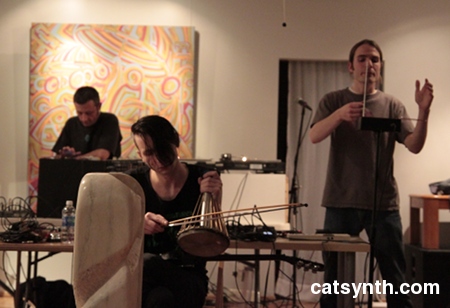
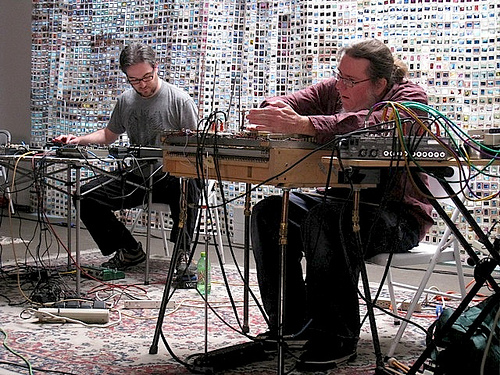
They were followed by PAS (Post Abortion Stress). Petit remained on stage and joined regular group members Michael Durek, Robert L Pepper and John “Vomit” Worthley and guest saxophonist Dave Tamura.
[Click image to enlarge.]
The set began with a very simple pentatonic sequence. On top of this, Worthley played a bowed waterphone waterphone, and Durek soon joined on thermin with a melodic line. Tamura’s saxophone provided a strong counterpoint to the other elements, alternating between very expressive jazz-like lines and a “skronking”. There were moments where the saxophone and thermin seemed to respond to each other, melodically and harmonically. At some point, the original pentatonic pattern cut out, and the music centered around saxophone, theremin and electronic violin. This was followed by a purely electronic section with dark analog sounds and driving electronic drums. Pepper repeatedly slammed his electronic violin against the table, while Tamura played fast runs on the saxophone. Another interesting moment was Pepper using a standard fishing rod as an instrument (perhaps the first time I have seen that), set against synthesizers, guitar and saxophone. Gradually the music gets louder and more insistent, with driving percussive guitar, loud saxophone, and synthesizer sweeps, howls and sound effects in the background. Below is a video of PAS’ entire performance.
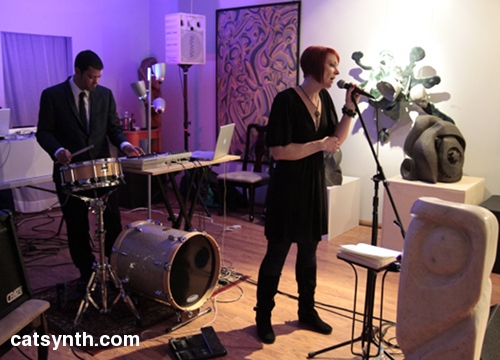
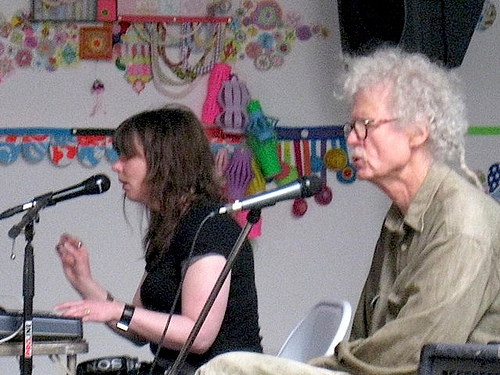
The Sunday program began with blithe (doll). The performance combined acoustic drums as a foundation with live electronics and voice. I particularly liked the combination of loungy Latin rhythm and harmony in one piece with eerie electronic sounds and Phrygian vocal melodies that permeated much of the set. There were sections that were more “spacelike” with analog square waves and loud hits. Overall, the slow rhythms and melodies were reminiscent of goth or darker electronic club music.
[Click image to enlarge.]
This was a fun set to watch and listen too, and the band drew a relatively large crowd. I guess that should be surprising given that the band is local, and husband-and-wife duo of James and Lisa Woodley were well known from the previous band.
Blithe (doll) was followed by Borne (aka Scott Vizioli). He created a large dramatic and very visual soundscapes. Although his sounds included ambient, environmental and noise-based material, there was also a somewhat unsettling minor harmony that seemed to be just under the surface. Nonetheless the overall sound it was quite meditative, and easy to get lost in the soundspace. Over time, a beat emerged, very sparse and minimalist with metallic sounds. It gradually became stronger and more drum-like, with ethereal bell sounds in the background. I also recalled a single sample of a dishwasher (or something that sounded like a dishwasher) towards the end.
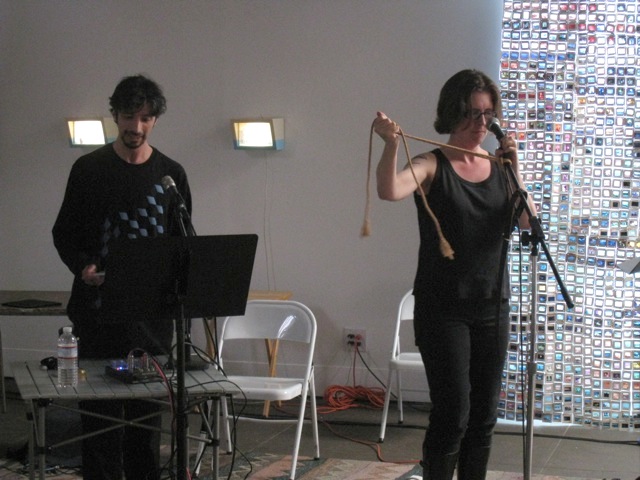
Next up was Octant, which could be described as a band consisting of one human and several robots. The electromechanical robots play acoustic instruments (drums, etc.) while the human member of the band, Matthew Steinke performs on lead vocals.
This was a unique set to watch. My focus was definitely on the robotic performance, but I was also listening to the music itself, which reminded of 1960s British rock with lots of chromatic chord changes. (@catsynth It’s not every day I see retro rock music performed by robots #omegasoundfix ). In order to get a rock rhythm feel, the timing among the robots needs to be well controlled – too much jitter or drift between machines and the musical quality is lost. Octant seems to have that down from a musical and technological perspective. Among the individual songs were “Bowl of Blood”, and another that was introduced by Steinke as being a “song about my cat.”
[Click image to enlarge.]
Octant was followed by Ezekiel Honig. As stated in the program notes, “He concentrates on his idiosyncratic brand of emotively warm electronic-acoustic music.” The set began with sounds that evoked water as well as machinery. I was able to hear that we was making extensive use of looping, although as he states he is “using the loop as more of a tool than a rule” and elements come and go freely outside the context of strict looping. A strong heartbeat sound emerged, and then later other elements joined to form a calm rolling pattern. At one point a strong major 7th harmony emerged. The beating changed sublty over time, as did the implied harmonies, which became more minor. Towards the end, the sounds seemed to focus on voices in the distance and other evidence of everyday human activity.
I had to begin setting up for my set after this, but I was able to part of Trinitron, the musical project of local artist Mark Weinberg. More so than Honig’s set, Trinitron’s performance was very focused on looping of processed electric guitar. Weinberg sat with his guitar in the middle of a circle of candles, and began to layer different lines and effects on top of one another. The resulting sounds from were alternately harmonic and gritty or noisy. Overall, his performance had an ambient dream-like quality to it.
Then it was time for me to play. I started the set with one of the “Big Band Remotes”, old radio broadcasts of big band shows made in the 1930s and 1940s. In particular, I used a recording of Count Basie and the Blue Note in Chicago, under the control of the monome so that I could start, stop and jump to different sections at will. I immediately segued from the final note to the Chinese prayer bowl and a similar metallic resonance on the Evolver synthesizer. After a while, I attempted to add the Smule Ocarina to the mix, though attempting to induce feedback from the speakers was a little more unstable than I had hoped. The second piece involved live sampling and looping of several of my Indian and Chinese folk instruments, including the newly acquired dotara, the gopichand, and Chinese temple blocks. Once again, this was under control of the monome. The piece transitioned to more electronic sounds, otherworldly crashing waves and loud resonances, and into a meditative solo using a guzheng app on the iPad. You can see a video of the first two pieces below:
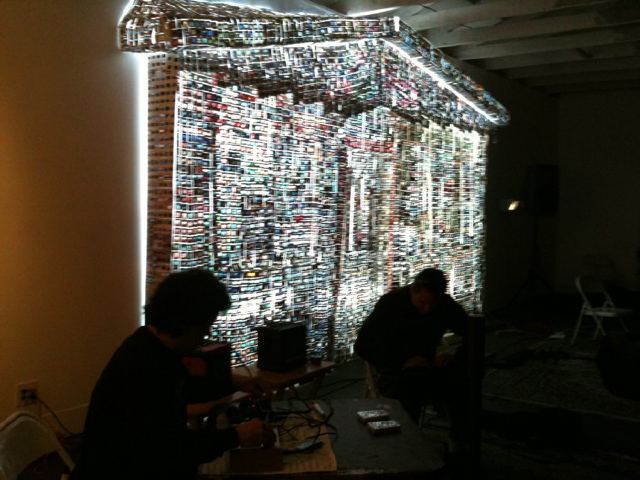
I then performed 月伸1, the video piece featuring Luna that I did at the Quickening Moon concert in February. In this instance, I did not have the Octave CAT synthesizer, but instead used the Smule Magic Fiddle and Korg iMS-20 on the iPad as the main electronic instruments, along with the Bebot app, a simple synthesizer on the laptop controlled by the monome, and the Evolver. I liked the new iPad apps for improvising against the video, it gave it a different musical quality from the premiere performance, though not as different as one might suspect. The video projection was a challenge – it covered the entire back wall, and I found myself standing “inside” the images, sometimes next to a gigantic projection of Luna. The effect of the projection against the artwork was also quite interesting visually. You can see this performance in the video below:
My performance was the last of the evening, and of the festival. Overall, I thought it was a great experience, both as a performer and audience-member. Thanks to Michael Durek and Mark Weinberg for organizing this event, and to the Alfa Art Gallery for hosting.
December 25 (Christmas) is a completely free day us.
After a season (and indeed, a year) that has been exceptionally hectic even by my own standards, such emptiness can be a bit jarring. One could catch up on the myriad creative projects and practical items that have been languishing, or just relax. Luna on the other hand has no problem with this whatsoever.
This is yet another lesson we should learn from our animal friends.
I would go for a walk downtown or along the highway structures, but with the blustery wind and stormy skies outside, it seems best to stay inside this morning with a warm cup of of coffee and a cat. It also seems like a good morning for some 1950s/1960s minor-key jazz (actually, a lot of mornings are good for that). Just imagine The Dave Brubeck Quartet’s Take Five or John Coltrane’s Equinox in the background with the pictures of Luna and you can glimpse Christmas morning at CatSynth HQ.
Weekend Cat Blogging #290, Holiday Edition is hosted by Jules and Vincent at Judi’s Mind Over Matter.
The Carnival of the Cats will be hosted tomorrow by Nikita Cat.
Wednesday 12/15 9PM-midnight Ivy Room hootelatkenanny
kingman’s ivy room, 860 san pablo avenue Albany, CA
Hanukkah may be over, but the Hoot still has its big barrel of boiling oil, thanks to
The Atchleys [kattt and Kenneth]
voice and electronics and latkes
Dean Santomieri [with special guests]
voice and reeds and percussion and jonathan frazen and latkes
Amar Chaudhary
with Dave Coen (djembe), JP (drums), Bill Wolter (guitar) and… applesauce, we need to balance this out
I am excited about this set. It combines experimental work based on iPad instruments (including Curtis and the Korg iMS-20 app) with my recent work in jazz and jam-session performance. It should be one big rhythmic continuum that elides into the Atchleys performance. Or maybe something else. The Ivy Room shows are always a bit unpredictable 🙂
And then on Thursday…
Thursday 12/16 8PM-10PM
Long Night’s Moon Concert: Droneshift
Luggage Store Gallery, 1007 Market Street, San Francisco, CA
Droneshift is a collaborative concert of improvised drone music. Between 15 and 25 musicians will gather to contribute to a continuous 2 hour drone, each adding their acoustic or electronic instruments here and there, and weaving their sounds together to create gradually shifting tapestries of music. The performance will most likely shift back and forth from completely acoustic music to electric ambiance and post-industrial noise.
Tom Bickley – wind controller
CJ Borosque – trumpet
Bob Boster – processed voice
Amar Chaudhary – iThings
Matt Davignon – wine glasses/vessels
Tony Dryer – bass
Adam Fong – bass
Phillip Greenlief – sax/clarinet
Ron Heglin – trombone/trumpet
Jeff Hobbs – bass, clarinet or violin
Travis Johns – electronics
Andrew Joron – theremin
Aurora Josephson – voice
Sebastian Krawczuk – bass
David Leikam – Moog rogue synthesizer
Cheryl Leonard – viola
Brian Lucas – electric bass / tapes
Melissa Margolis – accordion
Bob Marsh – voice
Marianne McDonald – didgeridoo
Chad McKinney – supercollider/guitar
Joe McMahon – didgeridoo
David Michalak – Omnichord
Kristin Miltner – laptop
Ann O’Rourke – bowed cymbal
Ferrara Brain Pan – sopranino saxophone
Rent Romus – sax/tapes
Ellery Royston – harp w/effects
Lx Rudis – electronics
Mark Soden – trumpet
Moe! Staiano – guitar
Errol Stewart – guitar
Lena Strayhorn – tsaaj plaim / wind wand
Zachary Watkins – electronics
Rachel Wood-Rome – french horn
Michael Zelner – analog monophonic synthesizer, iPod Touch
This is an impressive list of musicians participating in this version of the Droneshift! I will contribute my small part with “iThings” (iPad and iPhone) and using several apps, including the drone-friendly Smule Magic Fiddle.
Today marks Luna’s official birthday. She turns six years old either today or sometime near today.
I arrived back in San Francisco last night, just in time to celebrate with her, although not at home. There is (once again) construction at CatSynth HQ, so Luna is staying at her boarding facility until it’s over. I know she will not only be safe there, but she will be doted on and receive lots of love and attention. When I went to visit her today, she came over to greet me, but then immediately settled down to nap. But I was able to get some “relaxed” birthday photos.
Please join me in wishing Luna a happy birthday! And thanks to everyone who has already left her comments.
The Omega Sound Fix gets underway tonight at the Alfa Art Gallery in New Brunswick, New Jersey. I am planning to be present tonight as well as tomorrow and as with other larger music and events I will be probably be live tweeting @catsynth.
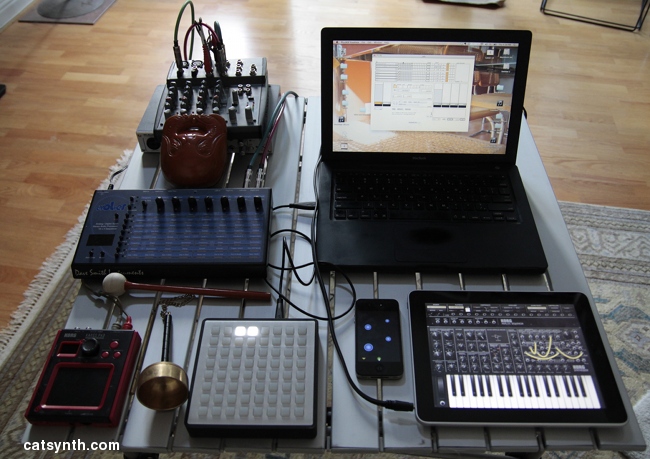
I have been busily preparing for the performance (along with everything else one does for a long-distance trip). The basic setup features the iPhone, iPad, MacBook, monome, DSI Evolver and Korg Kaoss Pad.
[Click to enlarge.]
The iPhone will primarily be running Smule Ocarina, while the iPad will be used for the new Smule Magic Fiddle, the Korg iMS-20 (pictured) above, the Bebot, and sundry other instruments.
One thing I have noticed is that although the main musical items have shrunk in size, the entire rig remains large, primarily because of the ancillary elements such as cables, stands, etc., so it ends up still being quite cumbersome and heavy, especially when loading it into airline-friendly suitcases. I ran into similar challenges with previous performances in New York as well as the one in Shanghai last year.
Musically, I will be doing three pieces. I will reprise the music-plus-video piece featuring Luna that I did at the Quickening Moon concert in February, but using the iPad with Magic Fiddle and the iMS-20 to replace the Octave CAT (which I will not take on the road). I will also perform a couple of the other current standard solo pieces, such as the prayer bowl with Evolver plus Smule Ocarina, and the live-sampling piece featuring the monome and a variety of Indian and Chinese folk instruments. I have two new Indian instruments to use tomorrow:
The first is a dotara. Although the name implies two strings, this instrument actually has five. I have not played it before, so we will see what happens. The second is a new gophichand. My other gopichands are fine, but it’s nice to have a few (if only as spares, as they are quite delicate). I will be freely mixing them with Chinese percussion instruments as well as my iPad-based model of a Chinese guzheng that I first used at the Luggage Store Gallery in September. I like the idea of mixing elements from different traditions together into something new.
For those interested in attending for following, here is the full info on the Omega Sound Fix festval:
Sonic Architecture Unveiled by Electronic Composers and Human-Robot Band at Underground Music Venue Electronic Music Festival resonates in New Brunswick art gallery
Over twenty innovative international and local musicians will perform at the bleeding edge of sound on Nov. 20 & 21 at Omega Sound Fix. Headlining performers have performed with the likes of John Cage, David Tudor, Steve Reich, Lydia Lunch, Faust, and Throbbing Gristle and are exploring new territory this fall.
Richard Lainhart is an award-winning composer, author, and filmmaker renowned for his individual work and collaborations with John Cage, David Tudor, and Steve Reich. His compositions have been performed worldwide with his earliest sonic forays predating Brian Eno’s ventures into ambience.
Philippe Petit of Marseilles, France is an innovative composer, who considers himself a “musical travel agent,” and assembles “sound-images” with turn tables and digital wizardry. He has performed across Europe and the Americas with Lydia Lunch, Faust, and Throbbing Gristle.
Octant, a one-man and multi-robot band, will plumb the depths of cybernetic accompaniment on Sunday, Nov. 21. Mathew Steinke serves as the band’s Gepetto and sole human member. “I would go out of my way to see an Octant show…” writes CMJ magazine.
Tickets are $6 for one day, $10 for a two-day pass. Doors open at 6 p.m. on Saturday and 4 p.m. on Sunday.
About Omega Sound Fix:
Local musicians, Mike Durek and Mark Weinberg, spawned the idea of an innovative and eclectic music festival during a mini-golf match last summer. Durek and Weinberg expressed frustration with the lack of a new music scene in New Brunswick and sought to fill the void with innovative sounds and talented performers. Click here for more info.
UPDATED List of Performers:
Day 1: Saturday 11.20.10 @ 6:30pm
Brendan Byrne
Zilmrah
Richard Lainhart
Philippe Petit
PAS
Pots and Powercells
As summer drew to a close, much of the Bay Area new music community gathered at 21 Grand for our annual ritual of live musical performance, socializing and tasty barbecued treats known as the Annual Transbay Skronkathon. The Skronkathon is also a benefit for the Transbay Creative Music Calendar, a free print publication that serves the creative music community here with event listings and articles (including several from this site).
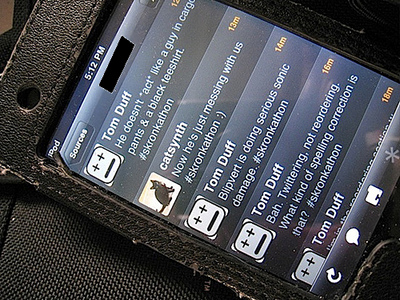
I had been planning my own part in this ritual since, well, last year’s Skronkathon when Polly Moller discovered that my CatSynth review had been reposted in “spammogrified form” by another website. That became the basis for this years performance, which featured a reading of the spammogrified text and the inexplicable repeated phrase as a dominate. Another thing that was different this year was our “live tweeting team” of myself, Polly Moller and Tom Duff. It sort of happened spontaneously. It seems a bit difficult to search for the past #skonkathon posts via Twitter, but I have collected them all and will sprinkle a few throughout this article. (Look for the @ signs.)
[Live tweeting. Photo by Suki O’kane. (Click to enlarge.)]
In fact, one of Tom’s live tweets described the duo of Ann O’Rourke and Carlos Jennings as “a disco remix of Berio’s Visage”. I am sorry I did not arrive earlier – it’s hard to pass up something with a description like that.
Rachel Wood-Rome. Photo by Michael Zelner.
I did arrive in time to see Rachel Wood-Rome’s performance for solo horn. Her melodic performance seemed like a snippet from a 19th or early 20th century concerto, minus the orchestra. However, in listening I started to fill in an orchestral part myself. She then presented a sing-along of a piece with lyrics by Max Gutmann. It included this refrain song with a minor melody in 5/8 time:
Our librarian is Miss Marion
she is scary an’ very old
pause and pity us
’cause she’s hideous
very hairy an’ likes to scold
Wood-Rome was followed by Respectable Citizen. Usually the duo of Bruce Bennet and Michael Zbyszynski, they were actually a trio on this occasion with the guest appearance of Jeff Ridenour on violone. For those not familiar with the violone, it is a large bowed stringed instrument with frets, closer to the viols used in Renaissance and baroque music than to the modern orchestral string family. The set started off softly with flute, picking on the violone, and stringy ethereal sounds.
[Respectable Citizen. Photo by Michael Zelner. (Click to enlarge.)]
The next piece featured more noise and distortion, with scratching sounds on the violone and a particularly interesting moment with the keyboard resonated together with squeaking sounds from the saxophone. There was also a section of “loungy free jazz” – which is certainly fun for me – mixed with some FM-like sounds.
as a dominate
Respectable Citizen was followed T.T.F.W.’z. If I had to describe their performance, it would be “punk skronking”, with loud, fast, driving rhythms and noisy squawks, squeaks and long strings of notes. And they had their own fan section doing 1990s-style jumping-up-and-down dancing. Given the loudness, I opted to enjoy their set from the alley, and even relive a bit of my youth by briefly demonstrating this form of dance to some of my musical colleagues.
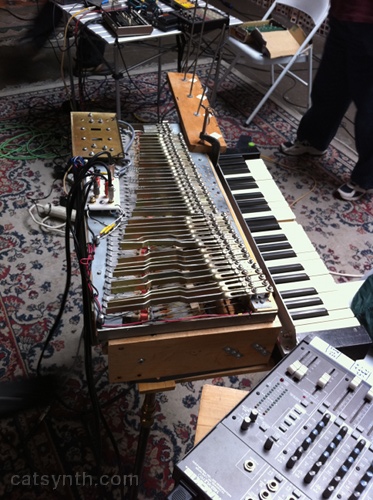
The next set was one I was quite looking forward to: a duo of Matt Davignon with “a table full of junk” (as Tom Duff delicately described it) and Eric Glick Rieman on prepared electric piano. I am quite fond of electric piano (e.g., Fender Rhodes) and interested in prepared acoustic piano, but this was first time I had seen and heard the two concepts together.
[The prepared electric piano. (Click to enlarge.)]
The sounds of the Rieman’s instrument and Matt’s drum machines and effects ranged from high and tinny, to scratchy, glitchy, or sometimes more bell-like. The piano certainly made some unique sounds: boings. bell-like scratching and other effects that made the purely electronic sounds seem tame by comparison On occasion, the instrument’s piano-like quality would stand out, and one could hear the tines that are characteristic of electric pianos. At other times it was more aggressive and percussive. Rieman’s playing style brought out this quality, and I found myself watching the mechanics of the instrument as I was listening to the music. There was moment that seemed like film music, with long piano notes set against “squishy sounds” from Matt Davignon’s electronic effects. And then a sound that reminded me of marbles. There were anxious harmonies, and rhythms on top of rhythms in samples.
[Matt Davignon and Eric Glick Reiman. Photo by Michael Zelner. (Click to enlarge.)]
Next up was blipvert (aka Will Northlich-Redmond). Standing behind a table with an Alesis Air and a Pioneer DJ controller, he launched into an intense and frenetic blast of music and choreography (@TomDuff He doesn’t *act* like a guy in cargo pants & a black teeshirt). The electronics were all controlled by his voice or other live sounds and gestures, so when he shouted or snapped or spun around or fell and the floor only to spring back up moments later, it would trigger a new sound or change in the sonic process. The hits and squeaks and thuds and sample loops and retro-1980s synthesizer sounds were perfectly timed to his over-the-top theatrics and choreography. It is clear that he spent a lot of time practicing and perfecting this. And it was definitely a fun performance to watch! Just when it seemed he was running out of energy and about to collapse from exhaustion, he got back up with a shout and launched into the next one. It is difficult to describe in words, but you can get a flavor from his videos from other performances. And the videos do not give the full sense of the energy.
[Blipvert. Shared by @TomDuff on twitter. (Click to see original post.)]
Blipvert was followed by Blowout Preventer (@TomDuff fresh from their gig at Deepwater Horizon), a clarinet quartet featuring Philip Greenlief, Dan Plonsey, Ceylan Yagmur and Michael Zelner. I am always intrigued by clarinet ensembles, having played the instrument in the past and written a piece for clarinet quartet. This performance began with whaling sounds that sounded like sirens, and then suddenly became quiet and harmonic and even contrapuntal. An intricate rhythm emerged in the sum of the four parts – even though each part seemed relatively simple, the interaction was complex. There was also a section with long growling tones, followed by more harmonic sounds; scraping of mouthpieces set against multiphonics; and a waltz that was interrupted.
Next up was Kattt and Ron, a duo of Kattt Atchley on Ron Heglin on vocals with electronics. Their set began with long electronic drones with beating patterns. Heglin began his vocal incantations in this backdrop, with his words soft and purposefully hard to discern. The drone, which was slowly but continually changing, had a generally minor harmony, but with inharmonic tones and continued beating patterns. The overall effect was very meditative. There were some odd facial expressions as the vocals became more noisy. By this time, both Atchley and Heglin were performing with voice, gradually becoming more harmonic and moving between unisons and perfect intervals. I was able to hear the voices both as a single unit and as individuals, the male and female contrast. The sounds gradually faded to a single beating tone at the end with a sprinkle of more percussive vocalizations.
[Kattt Atchley and Ron Heglin. Photo by Michael Zelner.]
As always happens at Skronkathon, I miss the set right before my own as I set up and prepare. In this, the set featured Bob Marsh on classical guitar, CJ Borosque on pedals an turntable, and Sandra Yolles on electronic percussion.
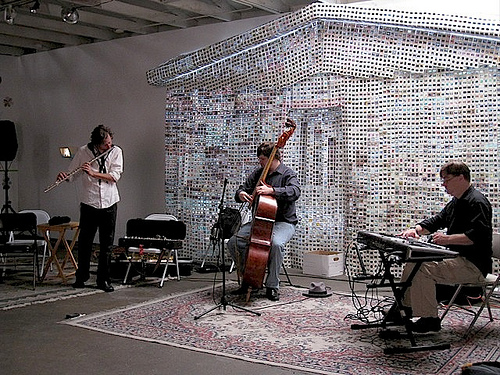
This is as good a time to mention the work of art that served as a backdrop for the performances, perhaps the most beautiful that I have seen at 21 Grand. The piece is by Dina Rubiolo and is titled 13th Ave. It features 8500 35mm slides arranged into the shape of a building facade and backlit. (@pollymoller Stage area has a striking backdrop: a proscenium arch made of backlit photographic slides.)
It was then time for our performance. I recited the entirety of the spammogrified text (you can see a copy here), while Polly performed the refrain “as a dominate” as it appeared within the text, complete with props and choreography. It was interesting to both read (and hear) how my text was affected by the various translators and other processes that may have been used. Certain phrases kept popping out, such as “plum sonorous” and “plum decorous” – I think “plum” was the retranslated equivalent of “rather” or “quite”, which I often use in my writing. Soft instruments or musical passes were re-worded as “sissified”, and several people seemed to enjoy the phrase “sissified trombone” – and some people also had fun hearing their own names of those of their friends and colleagues appear in the middle of the barely comprehensible narrative.
[Amar and Polly. Photo by Michael Zelner. (Click to enlarge.)]
In terms of technology and instrumental accompaniment, I kept things rather sparse. I opted to only use the iPad, running the Smule Magic Piano and the a granular synthesis app called Curtis. As source material, I used some pre-recorded passes of myself reciting the text.
(@TomDuff Decourous as a notwithstanding. #skronkathon(Amar and Polly.). As a dominate)
We were followed by RTD3, with Doug Carrol on cello, Tom Nunn on his invented instruments, Ron Heglin on trombone and voice. They are always a fun group to watch. (@catsynth Scraping sounds percussive cello trombone and vocal blah blah. Some particularly interesting moments included all three instruments making percussive scraping sounds, Carrol performing the cello like a guitar and also upside-down, and a moment whether the tone of bowed cello and the skatch box and the two blended together. There were some very soft moments, such as soft staccato trombone tones, and a low drone-like rumble from the ensemble. There was also a series of sounds that conjured up the image of a scampering mouse.
Next was a trio of Matt Ingalls on clarinet, Tom Scandura on percussion, and Thomas Dimuzio on Moog guitar. This was the first time I had heard a Moog guitar in a live performance setting. Knowing the musicians involved, I knew in advance this was going to be a loud set (@catsynth Scandura, Ingalls and Dimuzio trio will definitely not be sissified). The music started off with a dramatic film-like drone, with the clarinet coming though on top. The drums gradually got louder and started to match. From this point, there was mixture of fast runs and loud notes, some sections that sounded like 1960s free jazz and others that seemed to follow a more Middle Eastern scale. At some point, both the clarinet and the electronic guitar become more inharmonic and the drums got wilder and louder. Then suddenly a beat entered into the music, a bit of a slow rock shuffle or rock ballad overlaid with dark ambient guitar sounds. Matt Ingalls switched the violin at one point during the set. As the music started to feel more relaxed, it suddenly get loud again with FM-like sounds and acoustic drum, and then it got “super loud”. Even within the loudness, one could hear interesting details, such as a latin beat and a phrygian scale, and a really loud high-pitched squeak.
The contrast to the next set, a duo of Philip Greenlief and David Boyce, was rather dramatic. Although it was full of fast virtuosic runs, it was relatively quiet and spacious. There were moments where the seemed to go into unison, or where the rhythm seemed to stand still, before returning to the fast and complex runs. There were also a variety of interesting breathing sounds, mouthpiece effects, and other extended techniques. At one point, it sounded like a bird or a creature that was “laughing”.
[Greenlief and Boyce in front of Dina Rubiolo’s artowrk. (Click to visit original post.)]
The combination of the relative calm of the set and the time of the evening made this one that truly took advantage of the backdrop provided by Rubiolo’s artwork. I featured this image of Greenlief and Boyce in front of it in a previous Wordless Wednesday.
They were followed by another duo, Gino Robair and John Shiurba under the name G / J. Robair was billed as playing “voltage made painful”, and incorporated a Blippo Box, as well as a drum machine, effects boxes and a device for pre-recorded samples into the mix. Shiurba played guitar with a variety of extended techniques, including using a superball to excite the strings. The were lots of fast cuts and cartoonish moments, with boinks and slaps and machine noises. The Blippo Box had a liquidy organic sound that contrasted with finger-picking on the guitar. At one point in the performance, Robair set in motion a rather funky rhythm loop that sounded for a bit, then came in and out and decayed into grains of sound (@catsynth I want Gino to keep that funky rhythm background going longer. As a dominate.). There were moments that were a bit more aggressive, with loud piercing sounds, but then others that were…well, “plum sonorous” and featured minor harmonies.
[G / J in front of the wall of beauty. Photo shared on twitter by @TomDuff. (Click to visit original post.)]
Next up was Wormses, a trio of Jacob Felix Heule (percussion), Tony Dryer (bass) and Bobby Adams (electronics). The set started with a low rumble and hum, with the bass soon coming on top of scratchy electronic sounds and Heule playing a cymbal against a bass drum. The music became more anxious and busy over time, with some electronic insect-like sounds coming in above the other parts. Then all of a sudden things got very soft. A rhythm emerged in the background, but barely audible behind the bass and cymbal. As the set continued, a walking bass line came out of nowhere, then lots of swells and glissandi. Gradually, the music built back up to a rather loud level, a couple sounds that were like clipping and feedback, and ultimately ending with the sounding of the bass drum.
I think that was where I walked out to the alley for another break. There was lasagna!
The final set featured Ghost in the House, with Karen Stackpole (percussion), Tom Nunn (invented musical instruments), David Michalak (lap-steel guitar) and Andrew Voigt (who was sitting in for Kyle Bruckman on winds). I had heard them previously at the Wind Moon Concert back in April, and their sound is quite ethereal and airy, even for the percussion and lap-steel guitar. As with the previous performance, they began with a procession, of elemental instruments. The room was dark, except for the light from the 35mm slides in front. The performers then took their places for the remainder of the performance. The sounds were quite subtle at times, slightly minor, and sometimes like old film or radio soundtracks with eerie wind sounds mixed in. The metal instruments (primarily Stackpole’s gongs on Nunn’s instruments) served as a foundation, with the sounds of the wind instruments floating above. In addition to the long atonal sounds, there were moments with high squeaks and east-Asian harmonies and timbres. In the final piece, Stackpole played on an interesting metal-tube instrument and also used a vinyl record as percussion. Michalak’s lap-steel guitar featured prominently in this piece as well. The overall effect sounded electronic, even though the ensemble was purely acoustic instruments. The night concluded with the ensembles recessional from the room, still appropriately dark.
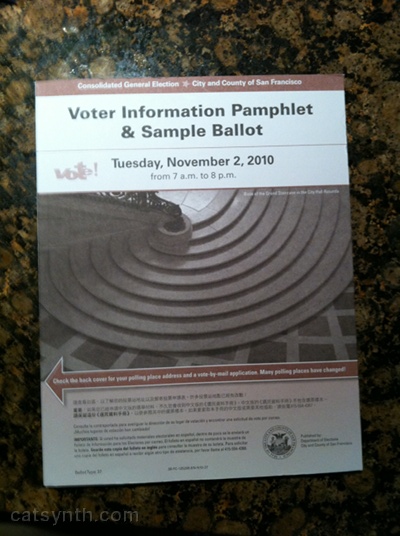
Well, it is Election Day in the U.S., the closest thing we have to a national civic ritual. And in California, that means another of our exceptionally long ballots. Here is this November’s sample ballot plus voter guide:
[Click to enlarge.]
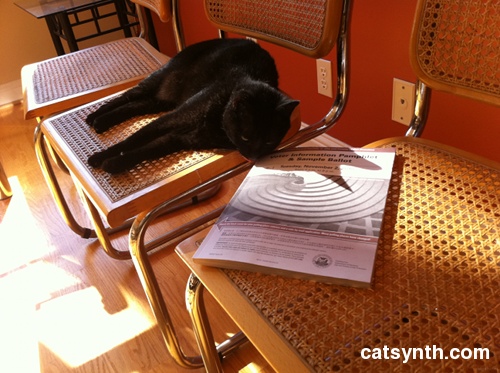
I have to admit, as voter guides go, this one has a pretty cool cover with a detail of the spiral staircase at San Francisco City Hall. And although it’s not the largest we have had, but still pretty substantial.
[Click to enlarge.]
Indeed, elections here can be a bit unwieldy. I find myself voting on all sorts of things, like arcane budget issues or judges that I feel completely unqualified to make a decision on. Of course, there are fun things like having our Proposition 19 (legalization of marijuana for sale in the state) and serious things like Proposition 23, an attempt to suspend our leading climate and energy law – a law that is actually a point of pride for many of us as we watch the much of the country (and our national leaders) fail on the issue. One sign I particularly liked was a dual “Go Giants!” and “No on 23” banner hanging from a building on 3rd Street, with the subtitle “Beat Texas (Oil)”. As often happens, baseball and elections collide. Our celebrations yesterday may end up being short lived depending on how things go today.
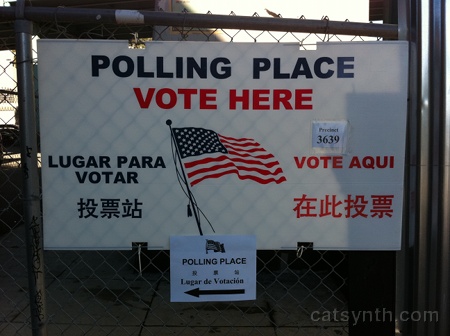
In addition to a sense of civic duty, you get a cool sticker:
I quite like having English, Spanish and Chinese all represented – there is something that feels right about it, a sense of people from different backgrounds coming together for a collective purpose. Of course it is not all the languages spoken by residents of the city, but it is still a decent cross section. It also made me think about a statement I had heard yesterday, thinking more optimistically about the future, that demographics is currently on the side of those with a more cosmopolitan and progressive view of the world as the older generations with their traditional notions of racial, linguistic, religious, national and sexual boundaries fade away. But that’s a story for another time.
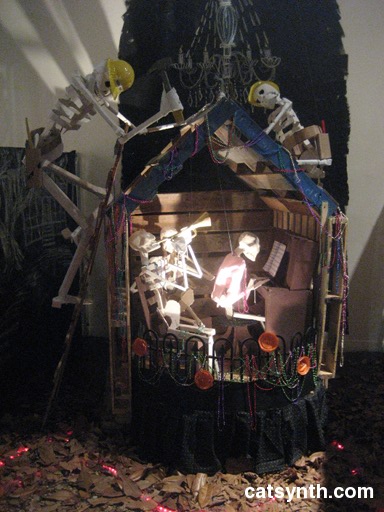
My current polling place is at SOMArts Cultural Center, so going to vote also means taking in the current exhibition, the annual El Día de los Muertos (Day of the Dead) exhibition. This years theme was “Honoring Revolution with Visions of Healing” and featured “altars and installations that will honor the dead and provide offerings to the living.” It was certainly interesting to have an exhibition with the theme of “revolution” adjacent to the place where I was voting. And while the theme may be connected to the 100th anniversary of the Mexican Revolution, many of the pieces were more general in nature, honoring loved ones who have passed away, or tied to current events, such as disasters and war. For example, I was drawn to this piece because it featured musicians:
[Judy Johnson-Williams and Judy Shintani. Honoring Construction Workers, Rebuilding of the New Orleans, Revolution with Visions of Healing. (Click image to enlarge.)]
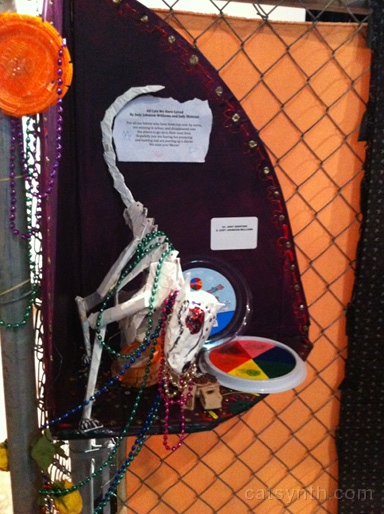
At first I was not quite sure what the construction workers were about. But once I understood that it honored the workers who were helping to rebuild New Orleans, the combination of music and construction made sense. It has a double resonance, looking back on Hurricane Katrina, but there are also echoes of the disastrous oil spill in the Gulf of Mexico this summer. The piece was a collaboration by Judy Johnson-Williams and Judy Shintani. The also had another piece nearby, “All Cats We Have Loved”:
[Judy Johnson-Williams and Judy Shintani. All the Cats We Have Loved. (Click to enlarge.)]
Their accompanying statement was very touching:
For all our kitties who have been run over by autos, are missing in action, and disappeared into the ethery to go onto their next lives. Hopefully you are having fun pouncing and are purring up a storm! We miss you! Meow!
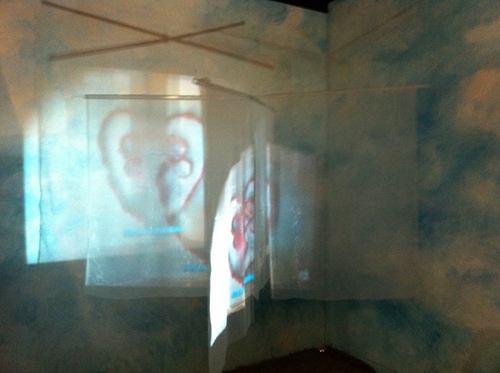
The passing of a loved was also the subject of one of the featured pieces, an alter by artist Adrian Arias to his mother who passed away this year. The large installation was almost entirely white, but with bits of color in the arranged objects. Please visit his blog for images of this piece, including a performance by the artist. Individual remembrances were also part of Susana Aragon’s “Life is a Revolution.” This piece featured tribute images on transparencies arranged on the wall, a series of moving screens onto which images were projected, and a mirror in which ones own reflection was project (as the artist suggests, it was a bit of a challenge to make the reflection work). The piece has a very moody but also clean quality to it that kept my attention:
[Susana Aragon. Life is a Revolution. (Click image to enlarge.)]
In their piece “Trapped”, Ytaelena and Bruce Lopez present a narrow and dark cave-like space which viewers can enter. It seems inviting enough, with a warm earthy aroma. But inside there is the faint sound of a person calling for help, and a detached hand in the middle of some vegetation. The piece is inspired by the Gulf of Mexico oil spill and the earthquake in Chile.
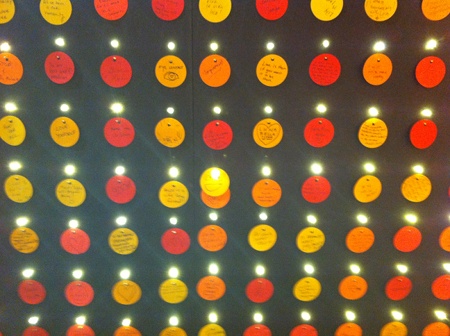
Finally, on a more positive note, Lanell Dike invites viewers to write messages of love and gratitude, and place them on an array of lights in her interactive piece “Make a Love Offering.”
[Lanell Dike. Make a Love Offering (close-up view)]
I did decide to participate and left a message, not far away from where I cast my ballot only a little earlier.
The collection contains 97 individual tracks, each exactly 23 seconds in length, with the total assemblage running for 37 minutes and 14 seconds. You can find my 23-second contribution, entitled “Four ideas in 23 seconds”, at track 80!
Volume One will be released in a limited edition of 123 hand numbered CD Copies.
This CD is planned for release on November 23,2010. Until November 23, you can download or stream the entire collection for free as a single MP3. In either format, I encourage everyone to check it out!
It is interesting to hear the pieces as a single unit, with such short durations they become phrases in a larger whole piece, sometimes with very sharp transitions.
Today we look back at my solo performance at the Luggage Store Gallery in San Francisco two weeks ago. This was part of the regular Outsound music series every Thursday, and on this night featured two very contrasting sets: my solo electronic work, and then an acoustic horn trio.
We being with a view of the setup:
My solo rig has slowly turned into a table from an Apple store, with an iPhone, iPad, and MacBook all in use. At the same time, I continue to blend old and new technology with the presence of the traditional Indian instruments, such as the ektar and gopichand, and Chinese instruments. I set up the monomer to mostly face the audience and provide interesting displays on the grid, unless I specifically needed to interact with it.
[Click image to enlarge]
From my perspective, as well as a couple of people I talked to in the audience, the most successful piece was the new string-centric piece that combined the guzheng model on the iPad with live sampling of the ektar and gopichand. This piece mixed traditional instruments of two cultures with advanced technology. In addition to the iPad, this piece used the mlr application with the monome for sample playback and looping. Most importantly, however, was how it came together musically with the harmonies and timbres of the instruments standing on their own to create a meditative soundscape.
The other piece that worked well was my update of the meditation with prayer bowl and DSI evolver, which also incorporated the Smule Ocarina on the iPhone. I used the feedback technique again where the iPhone is placed in front of a speaker and starts to play itself. Here is a video excerpt:
Overall, it was a good performance and provided an opportunity to try out new things. It was nowhere near as tight and polished as my set at the Quickening Moon Concert back in February, though (or as well attended).
I was followed on the program by the horn trio of Darren Johnston, Matt Nelson, and Cory Wright. Their improvised music moved back and forth freely between rhythmic avant-garde jazz, long drones and all-out skronking.
Although it was a completely different instrumentation and format, there were a few similarities between the trio and my set, particularly towards the beginning. The opened with a series of complex rhythms with pauses and odd time relations that reminded me a bit of the piece I did with the monome+mlr. Every so often, the rhythms came together into a uniform pattern and then into long notes that formed perfect intervals or occasional consonances with thirds. Then the drone broke apart. On the opposite end, there were noise elements, especially on the trumpet and more atonal harmonies. At one point, the sound was reduced to very soft breath noises, followed by a swell with staccato notes and warbles, getting ever busier and louder.
The next segment began with solo muted trumpet. While listening, I was thinking how muted trumpet always sounds “jazzy” no matter the style of music being played. The jazz feel was sustained as the other performers came in, building a texture that was both elaborate and nostalgic. The jazz feel gave way to more percussive sounds, such as rubbing the headjoint of the soxophone on the body of the instruments. The mutes themselves became percussion instruments, as did a beer bottle. The percussion sounds were loud and resonant, set against clarinet and saxophone headjoint.
The final piece opened with a nice strong baritone saxophone solo. At the same time, the other performers began dropping and throwing objects on the ground. Then everyone came in again on horns with fast and loud notes. The saxophone in particular kept the percussive quality going.
It was a short set, but overall quite good and kept my attention throughout.