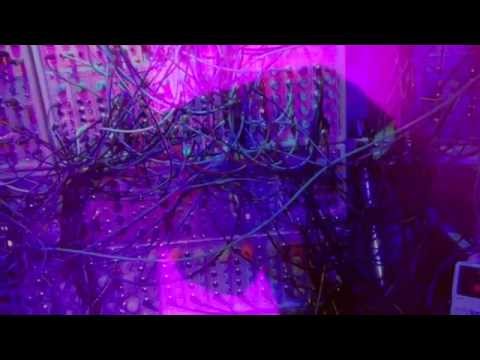
From arpodyssey on Instagram.
In addition to the case for the Moog Prodigy, can you name all the synths that appear in this picture? 🙂

From arpodyssey on Instagram.
In addition to the case for the Moog Prodigy, can you name all the synths that appear in this picture? 🙂

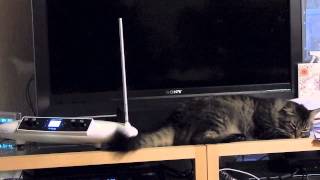
By timbolature on YouTube, via matrixsynth.
“A Moog Theremini comes to visit, and finds a fan in the form of Tom the Cat. Recorded by Offspring #2.”
Tom is playing the Theremini in way that only a cat can play 🙂

Submitted by AnalogKeys via Twitter.
“Vincent the cat keeping me company in the studio #cats #StudioLife”

Via matrixsynth. (PS: thanks for the shoutout for the app 🙂 ).
This one in via L.T.
“After my beloved orange four legged companion ‘Charlotte the Cat’ passed on and ascended high into SynthCat heaven, I have realized that Charlotte was always annoyed with my collection of electronic keyboards and audio gadgets, (see the old Charlotte the cat photos at Matrixsynth)
I have since adopted a wonderful. large 4 yr old, 4 legged orange companion – Miles the Cool SynthCat.
See attached photo of Miles the cool SynthCat, chillin’ and relaxin’ with the Moog EatherWave Plus Theremin… looks like Miles has a much better attitude when it comes to sharing his space with Electronic Music Keyboards ,Gadgets and Gizmos.

What do you think…. anyone have a caption for these SynthCat photos?”
The theremin is painted with green marine enamel for boats.
The late Charlotte has appeared on CatSynth many times. You can see one of her photos here.
Moog Music seems to have a bigger presence and NAMM every year. This time they had a large enclosed space complete with retro neon signs.

But that merely prepared the way for what was inside. The centerpiece and main attraction was the reintroduced Moog Modular.

There was quite a bit of excitement with the news about the modular. Besides being huge and impressive, it also boasts simple and easy to control modules with distinctively Moog sound.

While some sounds that one could get out of the demo system reminded me of the Minimoog, it was a different instrument. It is a modular, so the combinations can go quite distant from the classic Minimoog subtractive sound. Since the modules are fairly basic in terms of function compared to the recent Eurorack modular releases, it does take quite a few to make a patch. The larger size of the modules and knobs does make it easy to handle and play. But it is probably more of a studio instrument than a live instruments (especially with the high price tag).
More down-to-earth but perhaps odder was the Moog Werkstatt, a tiny patchable synth with Moog sound that interoperates nicely with Eurorack systems.

This one is indeed something for live use. I’d love to see how it works together with the Theremini. It does make some weird crunchy sounds, and would make a great first stage of a modular in between the Theremini as controller and various Eurorack modules as post processing.
In between, Moog does continue to provide its “Phatty” line, including the Moog Sub 37. These are quite practical to get a Moog sound for live-stage situations.

Of course there was quite a crowd to see the Modular. We at CatSynth certainly wish them well with the new instruments and exposure.

New year, new pictures and posts! From the Facebook group of Cats on Synthesizers in Space. There are at least four levels of awesome in this image 🙂
Once again, it’s time for our traditional end-of-the-year image at CatSynth. 2014 was a year like no other for us: transition, turbulence, complexity, controversy, beauty. Luna turned 10, and is enjoying the life of a mature but very spoiled house cat. And for me, the year began with a profound change that is still reverberating. Some things stayed remarkably constant, as one can see from themes in the words and images here. But others changed in ways I was not prepared for. Changes in my music, my personality and identity, my friendships and relationships, and my professional life. But in the end I learned the importance of speaking one’s truth. It comes with tremendous risks, but with potential great rewards. So what this means is that even more big changes are likely in store for 2015, especially in music, work, and the pages of this website.
The blog did suffer a bit amidst all the tumult of this past year, but we are reinvigorating it for 2015. There is the new look and feel – one of our truths – and more posts and channels coming. Thank you for being part of this year with us, and looking forward to the next!
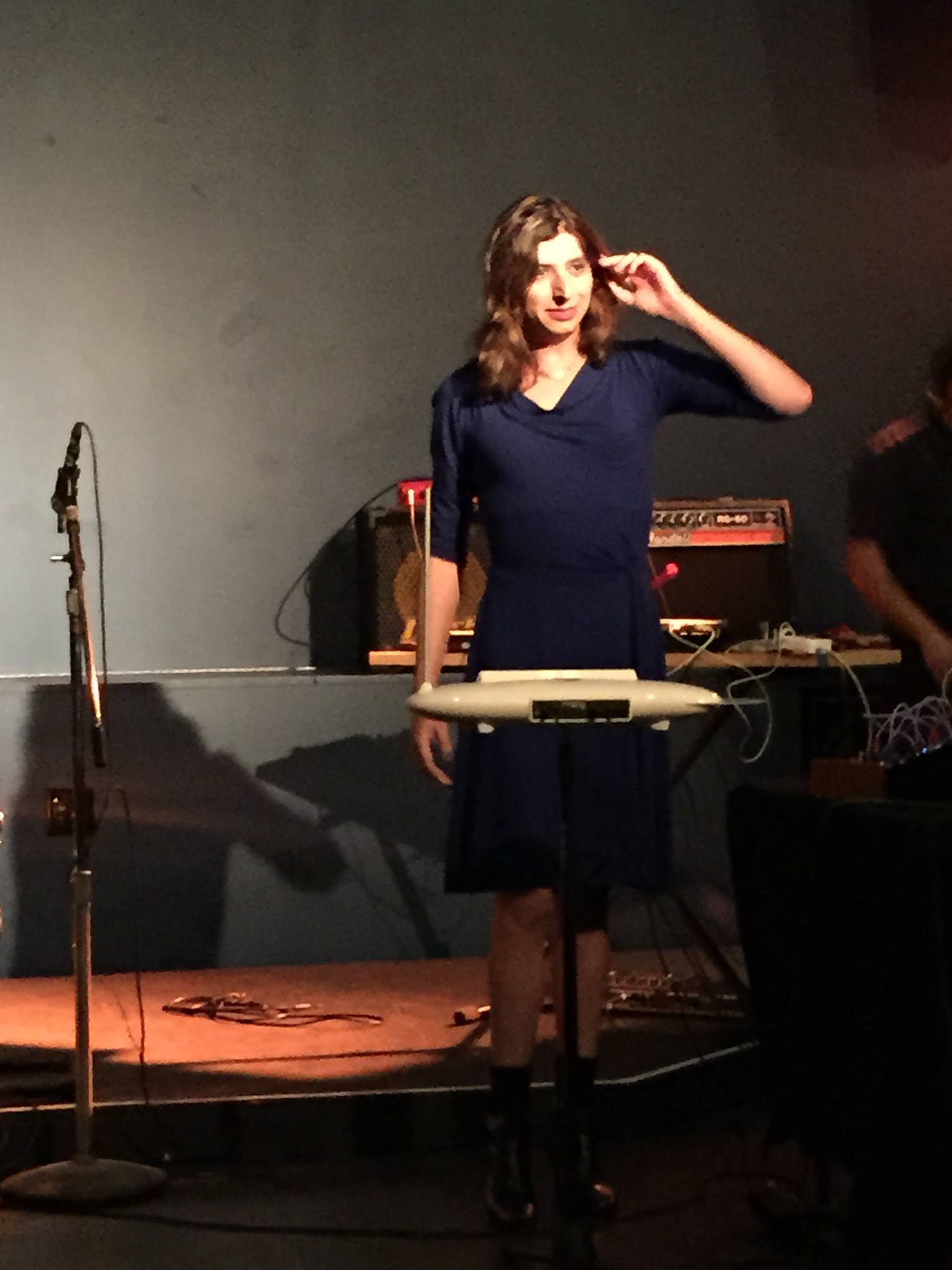
This past week Polly Moller and I brought our duo Ode to Steengo to Spectrum in New York, part of a rich night of experimental acoustic and electronic music in the Ambient-Chaos series.
The evening began with an acoustic brass duo featuring Torben Snekkestad on trumpet with David Whitwell on trombone.

The two engaged in a very musical exploration of the extended timbres of these instruments. Indeed, I was quite captivated by the sounds of Whitwell’s drones and multiphonics, which sounded more like my Minimoog than a concert brass instrument. His use of a single-reed mouthpiece within the trombone’s mouthpiece was likely part of how he achieved these sounds. The pair also included sections with percussive pops and very quiet tones.
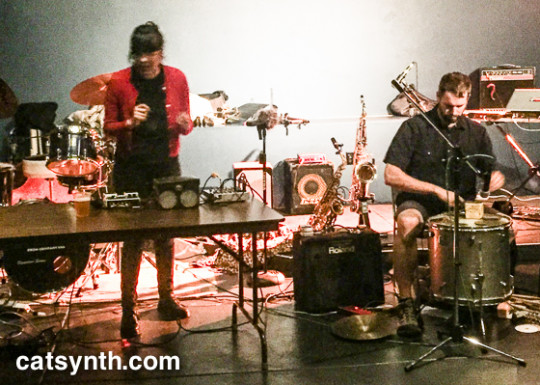
The duo was followed by the Jazzfakers, featuring Robbert Pepper on violin and electronics, David Tamura on saxophone and electronics, Raphael Zwyer on bass and Steve Orbach on drums.

Before they start playing, they look like they could be a conventional jazz quartet, but once they start one realizes they are anything but that. Their energetic performance flowed between free improvisation, electronic noise, and more familiar rhythmic and harmonic hooks. What started as a thick noise drone quickly moved to frenetic fast-moving notes from all four performers, and then hit textures in between. They are also a lot of fun to watch.
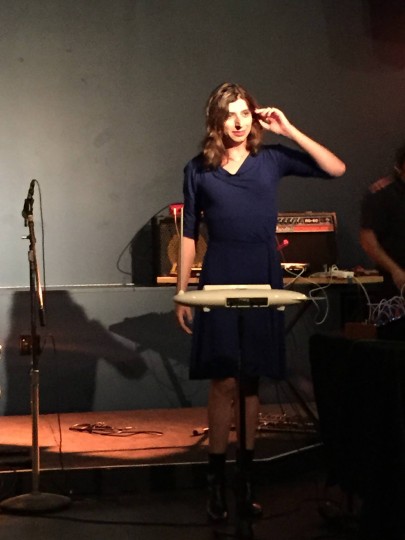
And then it was time for us to take the stage. Ode to Steengo is a piece based on spoetry (spam poetry) derived from Harry Harrison’s “Stainless Steel Rat” series. Polly Moller and I performed it several times as an electro-acoustic duo in 2008 and 2009, and then later in our band Reconnaissance Fly. We have since reprised the piece as a duo a few times. We jokingly called this version “Steengo takes Manhattan.”

[Photo by BC]
This performance was quite sparse, both in comparison to previous instances and to the Jazzfakers’ set that preceded us. But we were able to get quite a few interesting textures, some liquidy sounds from the analog modular controlled by the Moog Theremini, Polly’s flute and chanter, and a bit of live processing with a rather temperamental analog filter. As always, we try to bring a bit of wit and irreverence to our experimental music. You can here our full performance on this video.
Amanda Polly duo at Spetrum, 11-24-2014 from CatSynth on Vimeo.
Overall, it went well. We had a great time performing and we received a warm response from our New York audience.
We were followed by alphamale, a solo electronic-and-viola project.

Her set started off as a thick drone of electronics. After a time, she began to incorporate the viola as well. Overall the texture remained one of long tones and ambient sounds. It was once again a contrast to our set and the others that preceded us, and quite pretty to listen to. At times it had a dark sound – it is hard to discern if the melancholy was truly in the sound or part of a built-in set of expectations around the viola. Nonetheless, it was nice to see someone using this instrument in a solo electronic setting.
The final set of the evening featured Rawmean, another solo set, this time with guitar and electronics.

Very quickly, it was clear that this was more of a beat-and-grove set, with thick layers of guitar. The guitar work was interesting in that he was doing quick staccato motions but producing thick droning chord pads via the connected effects. The grooves and rhythmic patterns were fun, veering between straight 4/4 rhythms and the occasional odd times. Overall, the texture did remain quite constant, with a steady stream of beats that periodically changed. As I sometimes have suggested in these reviews, some sets that contain otherwise engaging material are better when shorter, and I think this was one of those instances.
Five sets in an evening is a lot, but overall we kept things moving. We had a good turnout for the first three sets, with a bit tapering off for the last two. But it was a diverse and rewarding evening of new music, and we were grateful to be a part of it. Thanks to my friends Robert Pepper (PAS) and Mike Durek (The Use) for putting this show together, and as always to Glenn Cornett of Spectrum for providing this venue for new and visiting avant-garde musicians.