Today we look at the last show I attended in 2011. On December 29, Outsound Presents featured a pair of duos at the Luggage Store Gallery: Hare and Arrow, and Charm and Strange.

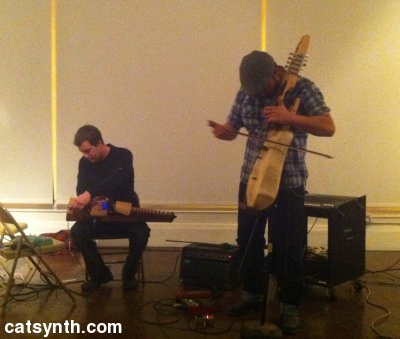
Hare and Arrow was a duo of musical-instrument maker Sung Kim and David Dupuis. I had the opportunity to hear Kim perform on his instruments several times during 2011, but I found this performance to the the most musical. The instruments were of course quite interesting sonically as well as visually, but the music held its own with having to be conscious of this. The set started with a combination of scratchy noise and feedback, but then moved to more traditional bowed sounds and glissandi. The combination of harmonies and relatively gentle noise had a plaintive quality. Over time, the music grew noisier and darker, and more animated. You can hear a short clip of the set in this video:
There were some interesting moments as the piece continued, including a clarinet-like timbre from one of the string instruments and a jazzy bass line. The second piece was more percussive, with plucked strings and striking of the instruments. As a result, it had a more sparse texture. Towards the end, Kim set aside the instrument to manually control the effects pedals for an electronic conclusion to the set.
It was then time to transition to Charm and Strange, an electronic-music duo of Julia Mazawa and Sharkiface. During the intermission, I found myself quite curious about this bright red device. It definitely had the look of a Ciat Lonbarde instrument (i.e., like the kitten-nettik that I have somewhere at CatSynth HQ).

It turns out it is a combination of oscillators and loop processors, although in this performance it was mostly used for the latter. Plus, the red color matched Sharkiface’s shawl. And they both contrasted nicely with the leopard-print table cover.

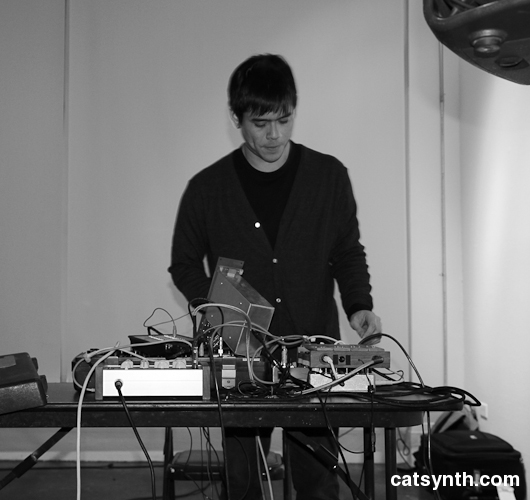
The set opened with a looping sound and a texture that was industrial, ambient and machine-like. Mazawa, who was performing on an iPhone, appeared to be controlling the loops and applying turntable-like effects. Over time, different looped sounds came in. It was only after the performance that I found out that the sampled sound sources were actually from Hare and Arrow’s set. Simultaneously, Sharkiface played the red instrument, both using the raw contacts and applying jumper cables at various points. A syncopated rhythm emerged, with environmental sounds set against machinery. It then turned to a more turntable-like pattern with metric scratching. There were repeated string phrases (i.e, from Hare and Arrow), hissing sounds, and loud machine noises. The loops seemed to have similar lengths, but set at different phases to create rhythmical effects. Other pieces featured chaotic noise that reminded me of circuit-bent instruments (though I think the sounds were coming from the iPhone), a steady pulse set against more random wobbling sounds, and a section where Sharkiface played the red instrument more expressively, almost melodically.
You can hear a tiny bit of their set in this video:
The video clip is rather short (only a few seconds). I’m not sure why that is all I have of the video, but it is what it is. And I hope to hear more performances from them in the future.






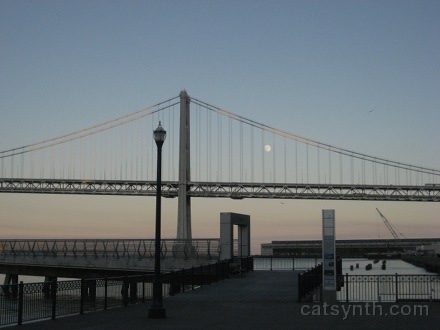


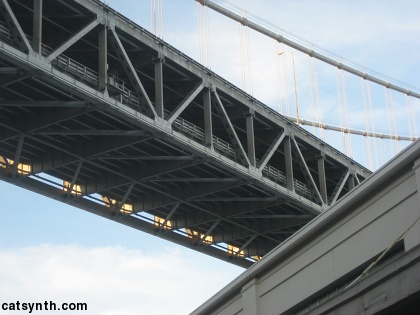
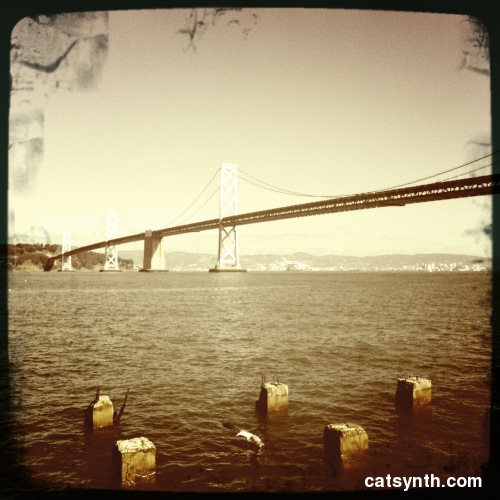


 When bridge first opened, it carried US Highways 40 and 50 as well as the trains from the Key System in the East Bay. The upper deck had longer ramps leading to Harrison and Bryant Streets at 5th, roughly the same as the rather long ramps at those streets today. On the Oakland side, the bridge had viaducts from Cypress Street (Highway 17) as well as San Pablo Avenue and the Eastshore Highway (US 40). The bridge now carries Interstate 80 across the bay. The railway is long gone. Gone also are the connections to the old Transbay Terminal and Embarcadero Freeway, both of which have been demolished. The area under the bridge on the San Francisco side, once a gritty industrial waterfront, is now a picturesque boulevard that is great for walking. Through all of the changes, the bridge itself has not changed very much at all…