
Tag: San Francisco
-
Rubber ()) Cement, bran(…)pos, Hora Flora at Luggage Store Gallery
Today we look back at a recent show featuring noise and theater at the Luggage Store Gallery, part of Outsound Presents’ regular Thursday-night experimental-music series.
The first set featured Hora Flora, a project of Raub Roy. Most often, we associate noise music with electronic affects, but this set focused on acoustic noise opportunities. It opened to the sound of electric toothbrushes on drums. It turns out this sound can be quite rich, and also quite loud at times. Over the course of the performance, he used other acoustic generators for excite the drums, most notably large colorful balloons.

The set continued in this way, with the balloons and toothbrushes on the drums creating ever changing acoustic noise drones, with other elements such as didgeridoo and portable cassette players layered on top. The cassette players were very deliberately placed at even intervals on the beam that spanned the length of the gallery in front of the audience. I was right near one of them, but the sounds were still quite subtle when combined with the overall drone texture.

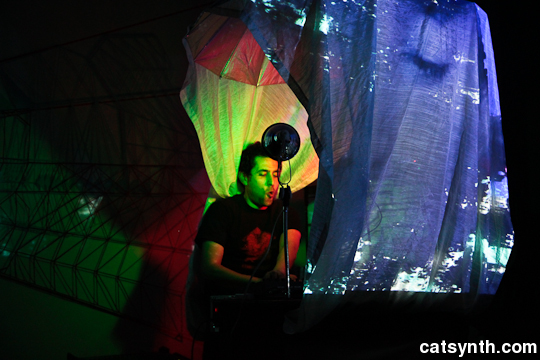
Horoflora was followed by bran(…)pos. I had last seen him perform at the 2011 Outsound Music Summit. Once again, he was performing from within a curtained space with video projections on the outside, but the setting was far more intimate setting. From my vantage point, I was able to see both his live performance “behind the curtain” as well as the enveloping video projection.

In his performance physical use of his face both generated and shaped the sound, which in turn controlled the video. The performance opened with expressive percussive sounds, which become more resonant through electronic processing and gradually formed a rhythmic pattern. It continued with a series of slurps, crunches and other forms of face percussion mixed with breath, voiced sounds and synthetic sounds. In addition to electronics for direct vocal processing, there were synthesizers as well, including an Access Virus:

Overall, the performance had the phrasings and overall structure of storytelling, but in a language whose words I cannot understand. It did come to a strong finish with growls and roars against a frantic thudding pulse.
The final performance featured Rubber (() Cement (pronounced “Rubber oh Cement”). The set was quite the spectacle, with a large costumed figure, a space creature of sorts, next to a towering old-school computer system made from cardboard. The visuals and sounds reminded me a bit of Caroliner Rainbow, but on a smaller scale, and on top of the audience instead of separated by a formal stage.

[Photo by Michael Zelner.]Somewhere inside that lumbering lurching figure was a large custom string instrument. The plucking and striking of the strings formed the sonic base of the performance, which were both processed electronically and countered by other synthesizer sounds emanating from the “computer”. I suspected that the things would get quite loud, and indeed they did, with lots of loud shrieky pedal noises processing the strings and reprocessing themselves in complex ways. Of course the focal point remained the physical and visual aspects of the performance. In fact, that is a bit of an understatement, as part of the audience experience including being “attacked”. I got swiped at least once by one of the extending parts appendages, which are actually quite heavy – I was nearly knocked over. Things got a little crazier as the creature moved out into the audience. But it was all in good fun, and I don’t think anyone was hurt. Definitely an unusual experience for this series.
Overall, it was a great show attend, with different sites and sounds than usual. The audience was different as well, with the artists bringing their own followings. I hope to see more of them at other venues in the near future.
-
#iSnapSF, Hipstamatic portraiture in San Francisco
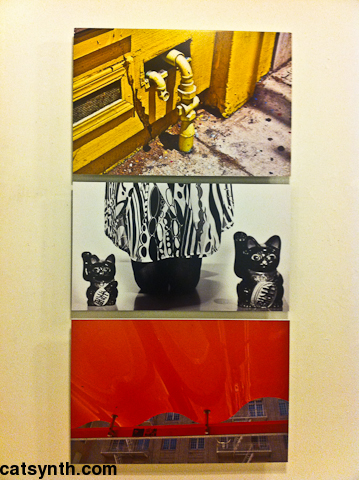
Those who have followed the photography on this site over the past year or so know that I have become quite enamored with the Hipstamatic photo app on my iPhone. It certainly has nottaken over all my photography or replaced by DSLR, but it has become one my tools for certain types for images and for the challenge of working with limited degrees of freedom. Synthetic, the makers Hipstamatic are actually based here in San Francisco in a renovated factory building not far from CatSynth HQ. And I recently visited them for the opening the photography exhibition #iSnapSF.
Most of the images in the show and the accompanying book are portraits. I have to admit I have not used Hipstamtic for portraits (except portraits of my cat). But the photographers this show have managed to capture quite a bit of detail and expression in their human subjects.


[Images from #iSnapSF from facebook page and reproduced courtesy of Synthetic.]In both cases, the subjects are integrally part of the urban environment around them, either by design or by coincidence. In the second instance, the subject is more integrated into the architecture of the environment in terms of her pose and dress – this was one of favorite images in the exhibition. If we are to follow a trajectory of portraiture to architecture, there was also this image of a downtown SF building with the distinctive bay-window architecture characteristic of the city.

This one (another favorite of mine) is particularly impressive in that it includes several layers of reflections, subjects and scenery. And of course it includes a cat.

[Images from #iSnapSF from facebook page and reproduced courtesy of Synthetic.]The lens and film effects bring out certain details while obscuring others. This particular combination has a grainy quality but still emphasizes outlines, such as those of the subjects’ figures and the buildings. It also amplifies the rough texture of the concrete.
The prints were relatively large (between 12 inches and 18 inches square), and they came out consistent with one would expect. They are relatively low-fidelity in terms of pixel resolution and the nature of the lens and film effects, but the images are still quite detailed.


I am not sure what the goal was in having some of the images framed and mounted, while others were hung from clothespins.
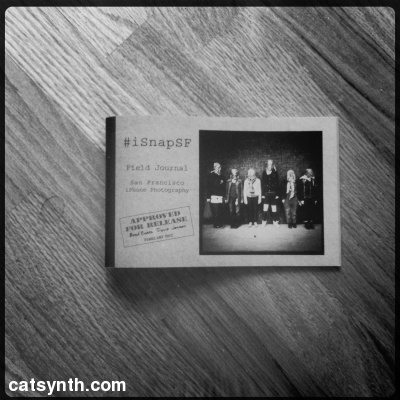
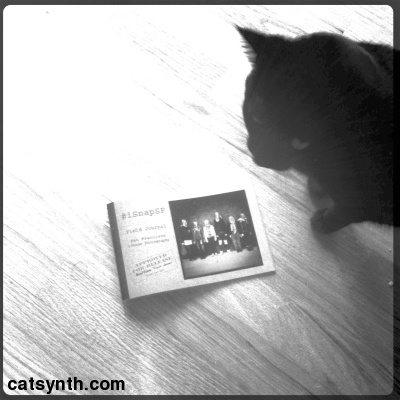
The proceeds from the show and the accompanying #iSnap Field Journal support Larkin Street Youth Services, a “San Francisco-based non-profit organization that provides various support services such as emergency shelter, medical services, meals, counseling, and job training for at-risk youth ages 12-24 living on the street.” Indeed, most of the photographs in this series were taken in the downtown neighborhoods around mid-Market Street and the Tenderloin that they serve. I did get a copy of the field journal:


[click images to enlarge]In addition to the prints themselves, each page also has notes about the images. For the picture of the young woman shown above, the notes confirmed that it was a chance shot on Market Street with the photographer curious about the subject. Surprisingly, the seemingly posed image of the man in the cowboy hat is also described as a chance encounter. I remain a bit skeptical of that. The cat photo that I quite liked started out as a cat photo but pulled in the other layers as chance operations to produce the image, and had a working title “Tenderloin Magic”. I think that is a good alternate title for many of the images in the exhibition.
It’s also worth noting that all of my own photos to support this article (with the catsynth.com watermark) were done with the Hipstamatic.
-
SIMM Series: Hay/Honda/Kuehne trio and Forward Energy
Today we look at a recent show in Outsound Presents’ SIMM Series that featured two different but energetic ensemble performances. Jim Ryan’s Forward Energy was back for a CD release performance. And they were preceded by a trio of Emily Hay on flute+vocals, Motoko Honda on piano, and New-York-based Valerie Keuhne on cello.

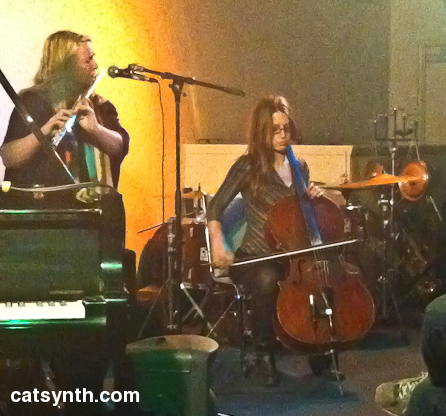
[Emily Hay and Valerie Kuenhe]Before the show, I went up to the piano to take a closer look at the array of gear arranged on top, including a Korg Kaoss Pad and 4ms Noise Swash. These were used by Motoko Honda during the set, though she mostly used it to control audio from the other performers.

The set opened with cabaret-style piano (no electronic effects yet), joined by flute trills and melodies. Keuhne’s cello complemented Hay’s flute, but then grew more intense and frantic, eventually reaching high-energy “bow-wrecking” levels. Hay switched from flute to vocals that nonetheless retained a flute-like quality. The rhythm of the voice and piano were set strongly against the cello.
Keuhne started the second piece, again with fast bowing, harmonics and percussive effects. Her performance was forceful and featured rich tones. The piano and flute came in more subtly, with processing by the Kaoss Pad. It was easier to hear the electronics with the flutter technique on the flute and percussive vocal effects, with a variety delays, pitch bends and harmonizations. While controlling the effects, Honda continued her vigorous piano performance, using the inside of the instrument in addition to the keys.
Hay opened the next piece with flute mouthpiece and electronic effects. Here I think the 4ms pedal was being used, particularly on the buzzing effect of the low drone from the cello. The overall texture became quite noisy, but the vocals and scraping effects from the cello came through. The final section featured the full ensemble, and particularly forceful piano performance by Honda that included shaking the instrument. The ending was a little quieter from all, but nonetheless still vigorous.
After a short break between sets, Forward Energy took the stage in a performance celebrating the release of their new CD The Awakening. The group featured Jim Ryan on voice and saxophone, Rent Romus on saxophones, CJ Borosque on trumpet, Scott Looney on piano, Eric Marshall on bass, and Timothy Orr on drums.
The set started off immediately with a burst of energy. After this opening fanfare, the music relaxed into a fast jazz rhythm with repeating atonal patterns. The horns (Ryan, Borosque, Romus) took turns with solos separated by ensemble improvisation sections. There were passages where the three horns played together as a single instrument; and Rent Romus’ solo had a more soulful and deep quality compared to the overall frantic and anxious quality of the piece. Scott Looney’s piano solo switched back and forth between rhythmic chords and fast runs that I couldn’t possibly play myself. The bass solo by Marshall was accompanied by scraping metallic percussion and prepared piano, including drumsticks and metal percussion on the strings.
The rhythm section opened the next piece, with resonances in the piano and slow percussion tones. This eerie mixture was set against slow trumpet. Then all at once the ensemble started playing loud and fast. Then a sudden silence followed by prepared piano. It kept going back and forth this way, soft versus angry. I found myself particularly noticing the various gongs that Looney was using inside the piano to both visual and aural effect
The final piece was where the reeds pulled out their virtuosic techniques. Rent Romus played double saxophone (similar to a few nights earlier at the Music of Invention concert), and Jim Ryan launched into his poetry (one friend on Twitter referred to this as “Jim going bore poet”) with lines ranging from “Naked on the plane of full being” to “Did you ever see an elf die?” I can with all honesty that I have never actually seen an elf die. It was delightfully weird, and I think some of the lines took the other musicians by surprise. The prepared piano accompaniment was noisier and scratchier than in the previous piece, which gave the overall background a more staccato and pointed texture.
Overall, the performance did live up to the name of ensemble, and it was clear that everyone, especially Jim Ryan, had a great time with it.
-
Music of Invention: A Concert Celebrating Tom Nunn’s Invention
Today we review the Music of Invention: A Concert Celebrating Tom Nunn’s Inventions which recently took place the Community Music Center in San Francisco. This retrospective concert brought together not only many of Tom Nunn’s musical inventions from the past decades, but many of his closest musical collaborators as well. The evening was divided into several miniature sets, some with established ensembles as well as individual collaborations. Most of the names on the program were quite familiar, and I recalled from my interview with Nunn his describing the “master players” he has been fortunate to work with over the years.

[Bart Hopkin and Tom Nunn. Photo: PeterBKaars.com.]The concert opened with a “inventors’ duo” as Tom Nunn performed alongside music-instrument maker Bart Hopkin. The first sounds were scratchy and metallic, primarily from Nunn’s instrument, the crab. Hopkin’s instrumental performance started out quite percussive as well but soon settled into a more tonal marimba-like state, albeit a tonality with an odd scale. The crab seemed to have two types of sound and texture that reflected the different types of rods, one louder and more metallic, and another more quick and watery. They settled into a pattern with quick rhythmic textures from the watery sounds and bass notes, with a steady rhythm forming and then breaking apart and then forming again. Hopkin switched to one of his other instruments, the ‘Moe, a clarinet-like instrument with a continuous pitch control. Although the sound was unmistakably that of a clarinet, the rapid pitch bends sometimes made it sound more like an analog synthesizer (with a square wave, of course). Against this, Nunn generated a musical “waterfall” from the crab that concluded with a harp-like arpeggio.

[Bart Hopikin on ‘Moe. Photo: PeterBKaars.com.]This was followed by a performance of Allan Crossman‘s piece Plasticity. This was one of the only fully composed pieces on the program (the other being Skatchbox Blues). Originally for Sonoglyph and orchestra, on this occasion it was reduced to Sonoglyph performed by Nunn and piano performed by Crossman. The music began with metallic watery sounds from the Sonoglyph and anxious harmonies on the piano. The overall effect was quite dreamlike, and I had the impression throughout the piece of being a well-crafted children’s movie with a richly detailed imaginary world. The instrumental sounds ranged from resonant and chime-like to more scratchy and noisy. There were sections with traditional contrapuntal textures, humorous phrases, and even something that brought to mind a march or procession.
The next set featured the Octatonic T-Rodimba, a pitched instrument tuned to three separate octatonic scales. Nunn was joined for this set by guitarists Gary Knowlton and Michael Knowlton. From the start, it was a clash of timbres between the guitars and the T-Rodimba, with slow chords against fast runs. Over time, the guitars became more melodic and all three performers settled into a jazz-like feel. The rhythms were all separate at first, with scratchy guitar sounds providing percussion, but coalesced into a single unit with repeated phrases. Certainly, the octatonic scales were part of the music, but not a distinct part to be heard separately. With the rhythms aligned, the tonalities of the different instruments blended together. The music became louder and more percussive before concluding with a guitar drone and effects from the green Line 6 pedal many of us know and love.


[Tom Nunn on Lukie Tubes and Paul Winstanley on prepared bass. Photos: PeterBKaars.com.]The following set introduced the Lukie Tubes, an instrument with a resonant metal plate suspended on balloons that excited using a series of cardboard tubes. Nunn was joined by Paul Winstanley performing on “prepared electric bass”. He performed by bowing on the bass, which had several rods inserted between the strings and the neck for a variety of sounds that were enhanced by additional electronic effects. The bass blended will with the Lukie Tubes as the set began with a long metallic drone on both instruments with different resonances coming in and out of focus. The overall effect was a lush but eerie landscape, punctuated with bits of static and shorter tones. The were moments that brought to mind whales and others reminiscent of Central Asian throat singing. In addition to the acoustic strength of Lukie Tubes, Winstanley used another Line 6 pedal to build up energy. The loud sounds gave way to softer higher tones and then a quiet but more percussive conclusion.

[RTD3. Photo: PeterBKaars.com.]The final set of the first half featured RTD3, a trio of Ron Heglin, Tom Nunn and Doug Caroll. I have heard RTD3 on several occasions in the past. For this performance, Caroll was on cello as usual, Heglin was performing only on voice (i.e., no trombone), and Tom Nunn was on Skatchbox. In particular, this was the debut of one of the “perfect” Skatchboxes that I had seen during the interview. Musically, things start of softly with voice a percussive cello. Heglin’s vocals featured a wide variety of effects, groans, gurgles and rumbles, along with incantations on unknown (and perhaps unknowable) words. The vocals filled the space in between the cello and the distinctive comb noises of the Skatchbox. Nunn switched to Lukie tubes during the performance, and then to another instrument called the Techphonic plate. During this time Caroll’s cello performance moved from traditional practice (pitched bowed tones) to more plucking and percussive techniques, and finally to extended techniques such as using a cork on the strings and scratching on the back of the instrument. All three performs came together for a final drone that ended with a minor modal harmony.
The second half opened with a live performance of “Skatchbox Blues”, which was released as a single in conjunction with the concert. It was a lighthearted departure from the other sets with a traditional “country blues” feel provided by Gary Knowlton and Michael Knowlton on guitars, and Aurora Josephson on voice. The Skatchbox itself as played by David Michalak was a purely percussion instrument in the context of this piece, with the grinding and buzzing sounds working together with the guitar to provide the familiar traditional rhythm. The lyrics were a humorous send-off of the experience of building and playing a Skatchbox, with the repeated cadence “treasures in the trash.”

[Skatchbox Blues. Photo: PeterBKaars.com.]
The next set featured Ed Herrmann on the Octatonic T-Rodimba with Nun on the Crab. Here, the tonality and timbre of the T-Rodimba was used to full effect, with Hermann performing rhythmic phrases and switching among different types of mallets. Between the two metal instruments and rhythmic texture, this set was particularly “gamelan-like”, with call-and-response between the two performers and moments of synchronicity. There were moments of slower movement and empty space as well. During the set, I heard something from hall which I dubbed at the time “unexplained bass”, a series disembodied low bowed tones. It turns out the Doug Caroll was had quietly slipped into the audience with his cello and joined into the mix. The acoustics of the hall helped to give his addition a more surprising and disorienting quality. But overall, it did add a supporting quality to the music and a contrast to the more metallic sounds. The overall effect reminded me quite a bit of the music of Harry Parch.

[Rent Romus and Tom Nunn. Photo: PeterBKaars.com.]TD Skatchit, the Skatchbox duo of Tom Nunn and David Michalak, made its official appearance with a pair of mini-sets, each with a guest soloist. The first featured Rent Romus on saxophones. The result was a delightfully noisy set the requisite squeaks, squaws and other effects, punctuated by more jazz-like tonal phrases. Nunn and Michalak provided a rhythm trading notes on the Skatchboxes. The tones were more of the continuous scratches and rumbles, but after a grand pause, Nunn produced a more rhythmic sound from one element of his Skatchbox with a repeated beat that reminded me a bit of rumble strips. The music gradually grew louder, with more complex and intricate jazz runs. Ultimately, Romus pulled out both an alto and soprano sax to play simultaneously in a loud and intense final run.

[Aurora Josephson with TD Skatchit. Photo: PeterBKaars.com.]Aurora Josephson returned to perform in the second set with TD Skatchit. It was clear from the start that this was going to be different from her traditional blues vocals only a few minutes earlier, as she took a large swig of water from a bottle and began to vocalize with subtle squeaks and wiggles as well as louder gurgles. Her percussive sounds blended well with the Skatchboxes, which responded with squeakier timbres. The performance was visually and aurally quite humorous and small bursts of laughter could be heard from the audience – to me, this seemed perfectly appropriate and acceptable for such a performance. At times, she seemed to be a third percussion instrument as she traded short notes with Nunn and Michalak. There were a few messy (i.e., wet) moments, but Josephson reminded us, “It’s just water.”

[Ghost in the House. Photo: PeterBKaars.com.]The final performance featured Ghost in the House, with Nunn and Michalak joined by regular group members Karen Stackpole on metal percussion and John Ingle on saxophone, and guest Bart Hopkin. Like RTD3, I have seen Ghost in the House a few times before. This time they did not do their usual ritualistic procession into the hall, probably because of the logistics involved, but they appeared on stage bathed in eerie blue light punctuated by candles. The opening sounds were quite resonant and featured rich harmonics. Nunn’s instrument, the Crustacean, blends quite well with Karen Stackpole’s gongs, and a rhythm emerged in the beating patterns between the instrument. Layered in between was Michalak’s lap-steel guitar, which always seems to have a melancholy sound. Bart Hopkin’s instrument, called the Disorderly Tumbling, provided a cascade of high bell sounds that lingered above the other timbres. In a performance like this I find myself listening for the details such as these. Others that caught my attention in this section of the performance were Stackpole’s row of keys, Ingle’s swelling saxophone town, and intense sound of the bowed Crustacean. Over time, the texture became more sparse and glitchy, including mouthpiece noises on the saxophone, striking of metal bowls, and short notes on the Techphonic plate. The music then moved into an eerie phase with lap steel drones, toy-like sounds and the Lukie tubes that reminded me of an old radio or classic science fiction soundtrack. The tones became richer and darker, with long tones and wiggling metal sheets, saxophone multiphonics and glissandi; and finally more rhythmic, with bouncing high tones and the cascading bells, matched by saxophone and gong.


[Karen Stackpole and Tom Nunn. Photos: PeterBKaars.com.]
The concert was well received, and there was quite a long moment of mutual appreciation between Tom Nunn and the audience. This was clearly a special occasion for him, for the musicians and those in attendance. There was also a warm recognition of David Michalak, who was primarily responsible for proposing this concert and making it happen as well as it did. It was quite a logistical feat to have so many sets with large and unusual instruments.
We conclude with what I believe is the smallest invention of the evening. Nunn had made several limited-edition mini-Skatchboxes to commemorate the evening. One of them went home with me and waits to be used in a future musical project inspired by what I heard at this concert.

-
Gino Robair and Andrea Centazzo, with Trevor Dunn and Travis Laplante, Luggage Store Gallery
The first Thursday of this month featured an impressive performance by Andrea Centazzo together with Gino Robair at the Luggage Store Gallery in San Francisco. I had missed an earlier performance of theirs at another Bay Area venue earlier the week, but glad I was able to make this one.
The evening opened with solo sets by Trevor Dunn on upright bass and Travis Laplante on saxophone. Dunn’s set unfolded as a single piece, which had just started when I arrived. It was a combination of long bowed notes that are part of traditional bass practice along with timbral effects and more percussive extended techniques. The low tones filled the room nicely and provided a more meditative start to the evening.

Laplante’s solo saxophone set was quite a contrast in terms of energy and dynamics. It was nearly all extended technique with fast runs of notes. And it was quite loud. Given the acoustically active nature of the Luggage Store Gallery, this made for some interesting effects. I think the combination of the two sets worked well. Dunn and Laplante were touring the west coast of the United States and Canada together, so I suspect their contrasting styles played into their other performances as well.
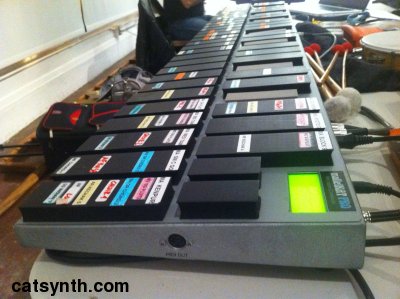
Afterwards, the audience shifted 90 degrees towards the front of the gallery, where two tables festooned with a variety of percussion and electronic gear awaited the start of the second set. Andrea Centazzo’s table was dominated by the MalletKAT, a marimba-like electronic controller.

He also had a variety of small acoustic percussion, as well as this toy that he said was from a previous visit to San Francisco in the 1980s.

Gino Robair had his usual assortment of percussion, noisemakers and electronics, including the Blippo Box and his signature broken cymbals.
The set began in either a dramatic fashion, nor in an especially subtle way. It was well timed and well balanced and drew one quickly into the music. As I have said on previous occasions, a masterly improvisation performance will balance rhythm, dynamics and timbres into a cohesive whole, and this performance was no exception. Even with the “noisy” source instrumentation, I felt like the interaction of the performers created a harmonic structure of sorts to go along with the rhythms. And the electronic and acoustic elements blended well in this context. You can hear a short excerpt in this video:
Overall, this was a great performance, and I sat quietly and intently in full absorption of the music, foregoing the note-taking I sometimes do during experimental-music concerts. And it was a perfect conclusion to what had been a long day of not only experimental music but art-gallery openings. But that is another story.
-
Todd Hido: Excerpts from Silver Meadows, Stephen Wirtz Gallery
One exhibition I have come back to a few times over the past month is Todd Hido’s solo photography show, Excerpts from Silver Meadows at Stephen Wirtz Gallery.

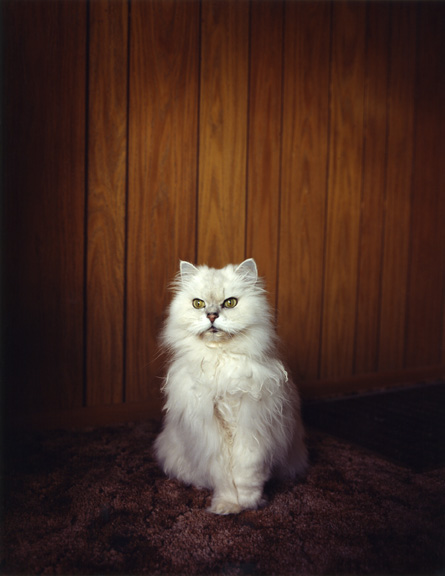
[Todd Hido, Untitled #10121-A,2011. Courtesy of Stephen Wirtz Gallery]The show features large images that were taken near Kent, Ohio, where Hido grew up. We see wintry scenes of modest houses and fields in a flat landscape with a few trees. The effects of snow, wind and the windshield of a car give the images a somewhat blurry quality. Interspersed among these pieces are a contrasting set of clear, high-contrast images featuring female models in vintage dress or poses. All the pieces bear very dry titles that are presumably based on serial numbers of some sort, a detail which I find interesting for what are emotionally strong images.

[Todd Hido, Untitled #10106,2011. Courtesy of Stephen Wirtz Gallery]
[Todd Hido, Untitled #10473-B,2011. Courtesy of Stephen Wirtz Gallery]At first glance it may seem to like two shows mashed together into one, a stark wintry landscape in a small community, and stylized portraits of female subjects. The often blurry effects of weather and glass in the exterior images also contrast with the hyper-clarity of the indoor portraits. But taken together they do form a narrative whole that is very film-like. Indeed, I had the impression of stepping into a David Lynch film. The wintry exterior is a small town somewhere in the Midwest that seems perfectly normal. It’s a not a picture postcard of a the archetypical “small town” adorned with a layer of snow, but rather a place that is maybe a little more bleak, a little more tired, a little more isolated. But afterd entering a few of the snow covered houses, a more eerie and eccentric reality emerges within, populated with unnerving but seductive characters. The effect is accentuated by the fact that several of the portraits feature the same model in very different roles and appearances (something I would not have recognized if it were not pointed out to me), but by the dreamlike effect of the inclement weather and dark skies in the outdoor photographs.

[Todd Hido, Untitled #9221,2010. Courtesy of Stephen Wirtz Gallery]My impressions seem in line with Hido’s mission in this collection, “the artist’s metaphorical reckoning with his own past, while providing a majestic summation of the suburban childhood experience in general…homes built similarly to convey stability actually conceal lives seething with sexual and psychological instability.” I also like how he uses road trips as his part of his execution of this vision (indeed, the feeling of looking out a car window in stormy weather permeates much of Hido’s outdoor imagery). It suggests a dark corner of one of my “Fun with Highways” posts.


[Todd Hido, Untitled #1843,1996. Courtesy of Stephen Wirtz Gallery]
[Todd Hido, Untitled #10502-42,2011. Courtesy of Stephen Wirtz Gallery]The cat portrait is a bit random, but it is quite humorous and does fit into the overall structure. I thought it worked especially well paired with the classic head portrait reminiscent of the late 1950s or early 1960s.
The show will continue at Stephen Wirtz Gallery in San Francisco through February 25.
-
Wordless Wednesday: Mission Bay Instagram

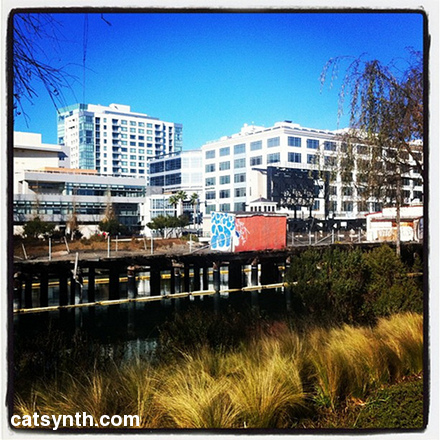
As usual, the description is in the comments. But while you’re here, please checkout yesterday’s South Carolina post.
NOTE: CatSynth will go black 8AM to 8PM US Pacific Time in protest of SOPA/PIPA. More information at http://www.fightforthefuture.org/pipa and http://sopastrike.com/.