
Tag: San Francisco
-

#OccupySF October 26
On Wednesday, I returned home to San Francisco around 9PM and was greeted by the sounds of helicopters overhead. I went outside to the patio and saw a helicopter flying closer to CatSynth HQ and lower to the ground than I had ever seen. We had all seen what had happened across the bay in Oakland the day before, with tragic results. Twitter was alight with concerns and rumors that a raid of #OccupySF was possible, and the official protest feed exhorted followers to “come join us”. So I did.

There was a fairly large crowd when I arrived at Justin Herman Plaza, and a rather festive atmosphere. In the center of the plaza, north of the camp, there was a large circular procession like a picket line. A small brass and drum band was playing a funky riff. Indeed with the bass line, pentatonic scale and four-on-the-floor rhythm it had a bit of an old disco feel! You can hear a bit in this video:
The sound from the iPhone recording was not that great, so the lower brass instruments are a bit soft. But there was a bass line, and the bass line is key to the disco/funk feel (something I suspect most Tea Party rallies lack).
However, underneath the party-like veneer it was a bit tense. The nearby BART station was shutdown (as were the stations in downtown Oakland), and reports were flying over Twitter of various groups of police massing, most notably in the Potrero Hill area where they were seen to be boarding MUNI busses. This led to all sorts of jokes about the fact that if they were riding MUNI they would probably never make it here. But jokes aside, organizers and participants took the threat of a raid quite seriously. We had frequent drills for those who were going to hold the camp (and thus risk arrest), and those who were going to form a more diffuse perimeter. There were advisories on what to do in the event of tear gas being used. It involved vinegar. It did not sound pleasant at all.
Hours went by, alternating between the festive party-like scene, the drills, and an open mic. No sign of any police activity – a fire truck with horns blaring did pull up near the camp, but that was it. Still, conflicting reports and rumors continued to circulate. There was even talk that people from #OccupyOakland who wanted to come across the bay to support us would attempt to cross the Bay Bridge, which is a busy freeway even at night and has no pedestrian sidewalks of any sort. (It was amusing to follow that from the point of view an anthropomorphized @SFBayBridge). This of course did not actually happen, though a small number of people from Oakland were able to come across by using alternate BART stations or other means and did speak to the assembled crowd, including accounts of what had happened on Tuesday and what people in Oakland were doing that evening, and a moving account of what happened to Scott Olsen.
Several political figures from the city were on hand as well, including several members of the Board of Supervisors (our city council equivalent) and a few mayoral candidates. Current Mayer Ed Lee was not present. However, my own Supervisor, Jane Kim, whose district covers my neighborhood as well as the plaza itself was present – I had actually run into her and (almost literally) earlier in the evening but not recognized her at first. At first, the officials started speaking so a small crowd of media people around 2AM, but after a back and forth with protest representatives, they came to speak to us, using the official “mic check” and call-and-response system:
[video by josborn25 on YouTube.]There was one really annoying heckler, even though he seemed to be echoing the immediate and long-term concerns of many in the Occupy Wall Street movement, he was not respecting the mic system, the speakers or the audience, and its not clear to me if we was really an agitator rather than an overly enthusiastic supporter. For example, he was demanding portable bathrooms, even though the city had already provided several that were present and available at the time.
In some ways it was a lonely experience. I did not really have any close friends there. But I did feel connected to a community online on Twitter, with people I know across the bay in Oakland who sent and solicited updates, and with readers beyond who let me know they supported my being there.
I ended up departing around 3AM. It felt like a raid was not likely. And I was happy to see the next morning that it did not happen. It’s not clear if there was a raid in the works that was called off or if it was never really planned. It will also be interesting to see how the movement and the events this week and next week play into local politics (we do have a mayoral election coming up in less than two weeks).
-
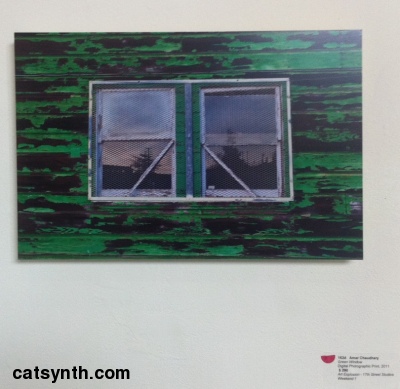
San Francisco Open Studios at Art Explosion
San Francisco Open Studios has been going on all of October. I have live tweeting from my various studio visits each weekend using the hashtag #SFOS. But as both the month and Open Studios draws to a close, we look back and my own experience on the first weekend, showing my photography at Art Explosion and in the showcase at SOMArts.
The works were mostly drawn from the same set that I featured in the solo show at The Parts Room in Oakland in early September, include the “triptych” of the large red, blue and yellow pieces.

The show in Oakland was a great experience, the best visual arts show to date. And I learned a lot about hanging which I put to use for Open Studios. This was most true for the showcase at SOMArts, where I showed up fully equipped to have my piece perfectly centered and mounted in the allotted space. The tools and meticulous measuring and drilling of holes seemed to impress the staff at ArtSpan.

And the work paid off with the end result (though the camera distorts the leveling a bit).

During the preview party, I received numerous positive responses from visitors and various people in the arts community.
The response at the studio itself was also positive. There weren’t always a lot of people visiting, it came in waves throughout the weekend, but those who did come were quite engaged.

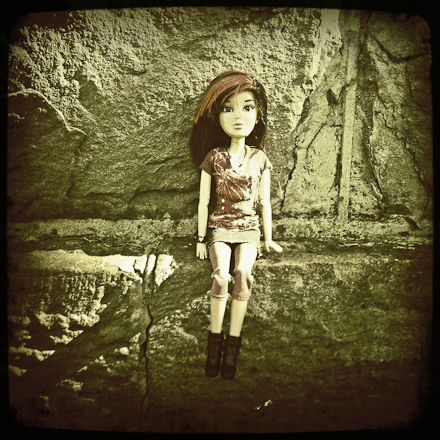
[Photo from Art Explosion Studios Facebook page.]I received both positive and constructive feedback over the weekend. One thing that is clear is the strongest works are those, like the “triptych” that focus on details of the urban landscape, a particular shape or pattern or color. Those are also among the most rewarding to work on, so I will likely focus more on this in the future. I will probably continue to have humorous pieces as well. People of course loved the big orange cat. The doll was a lot more polarizing (see the most recent Wordless Wednesday for an example), with some people really liking it and others hating it.
In balance it was a good experience – it was also great to share it with the other artists in the studio. It was also nice to get it out of the way during the first week, and spend the rest of the month as a viewer rather than presenter. But I am left with a sense of “OK, what next?” in terms my visual-art work…
-
Art Practical Year 3 Launch, with Music and Super-8 film
 Today we look back at the launch party for Year 3 of Art Practical, an online magazine that documents and discusses Bay Area visual arts through reviews and analysis. The event took place at Fivepoints Arthouse. Upon entry, we were offered the opportunity to purchase a logo shot glass (which I did). During the evening, it was filled a few “Shotgun Shots” (Shutgun! being the title of their first issue for the year).
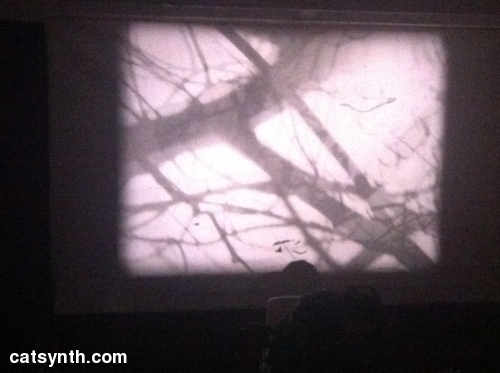
However, the highlight of the evening was in basement of Fivepoints, where artists/musicians Joshua Churchill and John Davis presented live experimental music set against a hand-solarized Super 8 film. It’s pretty rare these days to see actual Super 8 films, but it definitely added something to the piece. They images were purposefully grainy, and even more distorted as a result of the solarization and other treatments of the film – it reminded me of some of the effects on the Hipstamatic (see examples here and here), but on a much larger scale and with a richer depth of intensity and contrast.

Joshua Churchill sat in front of the screen and performed the live with electric guitar and an array of electronic effects. There were echoes, distortions, some elements that sounded like looping, and synthetic sounds from the combination of effects. There was a noisiness and graininess to the music that seemed to reflect the quality of the film. The overall effect was quite beautiful and evocative, and mesmerizing.

Through small slots in the ceiling, light poured in from the main floor gallery, creating a series of light streaks that worked both in concert and contrast with the images from the film and heightened the overall presentation. Even though the space was quite crowded, I found myself completely immersed in the visuals and sounds of the piece.
The piece would have been a great event to see on its own even without the party, but I am happy it was there otherwise I might have missed it. All in all, a great evening. And now Art Practical is already on its third issue of Year 3.
-
#OccupySF
#OccupySF, our local incarnation of the increasingly global Occupy Wall Street movement, has had its ups and downs. I first visited the camp, located in front of the San Francisco Federal Reserve Building at 101 Market Street, a little over a week ago, a few days after a major confrontation with SFPD on October 6.
At that particular moment, the camp and protests were quite small, mostly situated on the sidewalk in front of 101 Market. The Federal Reserve Building itself was blocked off with large fences, and eerily quiet.

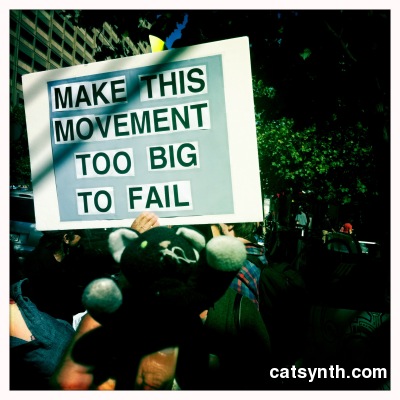
There was a large police presence at the front of the gate, but things were quite peaceful and orderly, and seemingly cordial. Inside the camp itself, a relatively relaxed but serious atmosphere also prevailed. But there was a friendly and welcoming atmosphere, and certainly a lot of humor in the protest signs that participants were creating and holding up towards Market Street. This one was by far my favorite:

But I did also like this one with its Sci-Fi mixed metaphors:

I did take a turn at standing in protest with the other participants, holding up a couple of different signs, and enjoying the support from the MUNI operators of streetcars and busses that came by and honked/chimed in support. I also got a chance to participate in the now well-known technique of call-and-response that was used for conveying information and having discussions. Basically, each phrase of a speaker is echoed by the others assembled. It is efficient to amplify words and meaning without using megaphones or electrical equipment, but it also gives the communication a musical quality.
There was also the juxtaposition of the Blue Angels flying around the buildings of the city during Fleet Week. I always find the presence of loud airplanes among downtown buildings extremely disconcerting, but set against the protests it became rather surreal.
Since my visit, the encampment has grown and moved to nearby Justin Herman Plaza (home of the Vaillancourt Fountain of which I am quite fond). There was a large march through the Financial District (which I wished I had been able to attend), and a larger rally this weekend ended at Civic Center Plaza. However, in addition to these positive developments, there was also a raid on the camp late this past Sunday night. I was not there myself, but you can see a bit of what happened in this video by Josh Wolf:
Since then, my own city representative has visited the camp in support. And a march and rally at City Hall occurred today in support of #OccupySF’s right to assemble and protest. This is one of the days my work takes me out of the city, and I don’t yet know how things turned out…
-
San Francisco Electronic Music Festival (SFEMF), Part 2
Last week, I presented the opening night show of the San Francisco Electronic Music Festival at SFMOMA. Today we look back at the September 10 installment of SFEMF, which took place at the Brava Theater.
It was a busy Saturday evening of art and music, but after a trip through three neighborhoods on our illustrious public transportation system and chatting with several friends on the way in, I was still able to get a perfect seat in the center of the theater for the full immersive experience. As I often do these days, I was live-tweeting between sets with hashtag #SFEMF to share with a wider community both in the theater and beyond.
The concert opened with a tribute to Max Mathews presented by Marielle Jakobsons. Mathews is considered to be the “father of computer music” and his career spanned over five decades and continued up until the last days before he passed away earlier this year. The tribute brought together the technologies that Mathews pioneered and his love of classical music. It began with a recording of his 1971 piece Improvisations for Olympiad, set against images of Mathews’ long career and time with family and friends. In the piece, one can hear how far computer-music technology had advanced since the 1950s, in large part do to his own work (though it still hard to fathom that the piece was done using punch cards). The photos demonstrated how much he was loved by the community around him – many featured familiar faces from CCRMA at Stanford, where he had most recently worked.

[Diane Douglass and Marielle Jakobsons. Photo: PeterBKaars.com.]Jakobsons then presented a personal tribute in the form of a new piece, Theme and Variations on Beethoven’s String Quartet No. 4 For Violin and Phaser Filters. Jakobsons had worked with Mathews on his Phaser Filters, a technology for live performance based on tuned resonances. With Diane Douglass on computer, Jakobsons performed on violin, with the familiar classical sounds blending seamlessly with the rich sounds from the filter technology.
Next up was Area C, a project of Erik J. Carlson. Carlson’s performance featured live looping of electric guitar and a variety of analog and digital effects, which were output via two guitar amps.

[Area C. Photo: PeterBKaars.com.]Although the piece unfolded as a series of loops of small melodic and rhythmic figures on the guitar that were processed and re-looped, the overall texture of the music gave the impression of an ever evolving drone, not unlike something we might do at the Droneshift but with less strict rules and more opportunity for bits of texture to emerge.
After an intermission, the concert resumed with 0th, a “collective of four female artists, Jacqueline Gordon, Amanda Warner, Canner Mefe, and Caryl Kientz” presenting a live-performance piece Deep Blue Space: Factories and Forests. The performers were scattered at the edges of the stage, with a large lit hemisphere in the center, and an array of base drums in front. Behind them, a large video was projected. Additional unnamed performers beyond the quartet contributed to the dance elements. Costuming was also an important part of the piece, with interesting outfits and one performer sporting a pyramid-shaped hat.

[Setting up for 0th. Big bubble in the middle stage. And bass drums in front. #sfemf ]Their performance was based on a fictional story that followed the exploits of the chess-playing supercomputer Deep Blue on a satellite that leaves Earth orbit and heads to the asteroid belt. The performance unfolded with a series of very punctuated sounds set against very deliberate motions with frequent pauses. The overall effect was mechanized and robotic, enhanced by the industrial imagery in the video. This was of course appropriate given the theme of machines in the underlying story.

[0th. Photo: PeterBKaars.com.]Towards the end of the piece, several of the performers moved into place at the front of the stage, each behind one of the base drums and they began to strike the pedals in unison, a loud stream of slow rhythmic thumps against the electronic sounds spread in the background.
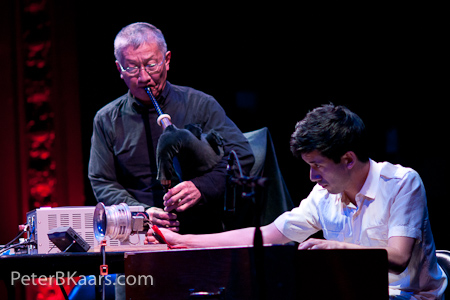
The final performance featured a collaboration by Yoshi Wada and Tashi Wada on a piece entitled Frequency Responses: 2011. The piece explored the interactions of the timbres of a variety of instruments and devices that can sustain long tones, such as a bagpipe, sirens, and old analog oscillators. It begin with jarring sound of an alarm bell but quickly settled into a steady state with an ever changing combination of sounds and instruments. Yoshi Wada, a veteran of Fluxus, frequently played the bagpipe during the piece. Tashi Wada remained behind the main table focused on a variety of electronic elements.

[Yoshi Wada and Tashi Wada. Photo: PeterBKaars.com.]The equipment and overall texture of the piece evoked the early experiments in electronic music, and brought the concert full circle from its starting point with the tribute to Max Mathews. Although the interaction of the timbres could sometimes be rather intense, the focus on this element and listening for beating patterns on other details was quite meditative.
I think my live tweet “An exploration of very long tones ends in a major harmony #sfemf” is a fitting end for this review. Overall another strong concert.
-
San Francisco Electronic Music Festival, Part 1
Today we look back at the San Francisco Electronic Music Festival that took place earlier this month. Specifically, we review the opening concert which took place for the first time at SFMOMA. Appropriately for a collaboration with an institution focused on the visual arts, many of the pieces combined electronic music with graphics, video, or dance.
SFEMF is often a coming-together of people from the Bay Area electronic-music and new-music communities, and the audience was filled with familiar faces. Some even joined me in live tweeting with hashtag #sfemf during the concerts.
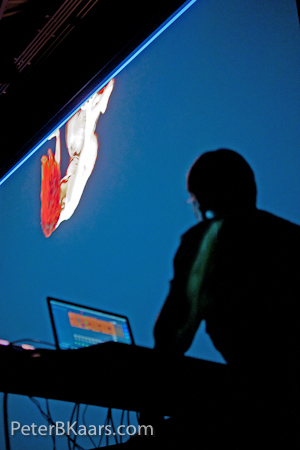
The concert opened with a solo performance by Sarah Howe entitled Peephole live electronic music and video.

[Sarah Howe. Photo: PeterBKaars.com.]Howe describes her video work as “beautifully messy textures of low fidelity source material”. The result was quite mesmerizing, with ever-changing pixelated patterns on the large screen that pulsated and radiated, sometimes converging on seemingly recognizable images, sometimes completely abstract. The music featured highly processed electronic sounds taken from acoustic sources.
Next was Interminacy, a performance by Tom Djll and Tim Perkis based on “lost” John Cage stories, as “rescued from a Bay Area public-radio vault” (they did not say which public radio station). We hear Cage’s distinctive voice and speaking style, as recognized from his recorded interviews – see our post on John Cage’s 99th birthday for an example – with Djll and Perkis providing music in between the words supposedly derived from I-Ching. The music did cover a variety of synthesized electronic sounds, recording samples, and other elements, leaving plenty of silence as well.

[Tom Djll and Tim Perkis channel John Cage. Photo: PeterBKaars.com.]It started out straightforward enough, but the narrations took a bit of a darker turn, which audience members may or may not have reacted to in amusement or horror. I personally fell into the former category, and considered this one of the more brilliant and well-crafted tributes I have heard in a long time. You can hear an excerpt from an earlier performance below (or here).
<a href=”http://djll.bandcamp.com/track/interminacy-excerpt” _mce_href=”http://djll.bandcamp.com/track/interminacy-excerpt”>Interminacy (excerpt) by Tom Djll/Tim Perkis</a>
The following performance featured Kadet Kuhne performing live with a video by Barcelona-based artist Alba G. Corral in a piece entitled STORA BJÖRN. Corral created visuals using the programming environment Processing that generated complex graphical patterns based on the constellation The Great Bear.
Kuenhe’s music weaved in and out with the visuals in undulating but ever changing textures and timbres. The result of the combined music and visuals was quite meditative – at the same time, the visuals retained a certain analytical quality perhaps because of all elements based on connected lines. Glitchy elements in the music fed back into the lines and spaces.
Plane, a collaboration Les Stuck and Sonsherée Giles featured dance, visuals together with music. Stuck’s musical performance began against a video of Giles’ dancing that was created using a special camera technique and a limited palette of colors and effects to produce a low-resolution image with no sense of perspective. It did look a bit like a heat image of a moving body.

[Les Stuck. Photo: PeterBKaars.com.]At some point during the performance, Giles herself appeared on the stage and the performance transitioned to live dance. Her movement was slow and organic, and she often stayed close to the ground, as if to make herself two-dimension like the images on the screen. Stuck’s music combined with the dance had a greater intensity than the previous music-and-visual performances on the concert, particularly in contrast to the far more delicate STORA BJÖRN that preceded it.
The concert concluded with a performance of Milton Babbit’s Philomel, performed by Dina Emerson. We lost both Milton Babbit and Max Mathews this year, and both were recognized with tribute performances during the festival. Philomel is perhaps the best known of Babbit’s famously complex compositions. You can hear an early recording of the piece in a tribute post here at CatSynth, as sung by soprano Bethany Beardslee. Emerson certainly had her work cut out for her in taking on this piece, but she came through with a beautiful and energetic performance.

[Dina Emerson performs Milton Babbit’s Philomel. Photo: PeterBKaars.com.]The piece combines electronic sounds, live voice and processed recorded vocals weaved together in a fast-moving texture that preserves a narrative structure. One can alternately listen to the words as disjoint musical events or as part of the larger story. At some point, even while focused directly on Emerson’s presence, the live and recorded sounds began to merge together. The electronics often seem to match the timbre and pitch register of the voice, which aided in the illusion of a single musical source.
Overall, I thought it was a strong concert with a particularly strong finish. It also was somewhat shorter and faster paced, with no intermission or long pauses between sets, which I thought was quite effective.
I also attended the Saturday concert and will review that in an upcoming article.