Reconnaissance Fly at KUSF

Here is the first photo of the current Reconnaissance Fly lineup, taken after our performance on KUSF today.


[Photo by Bryan Chandler]

Thanks to our host Bryan Chandler for the photo, and of course for the opportunity to play.

Here is a photo I took at the start of the set.

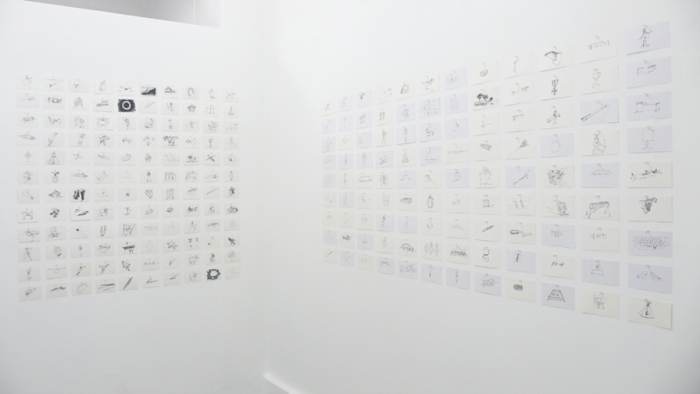
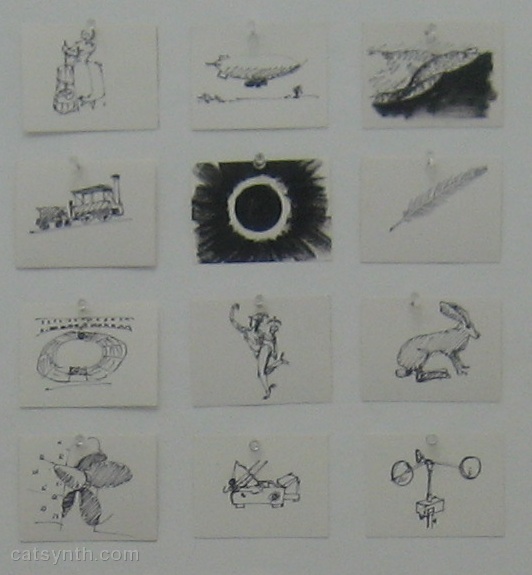
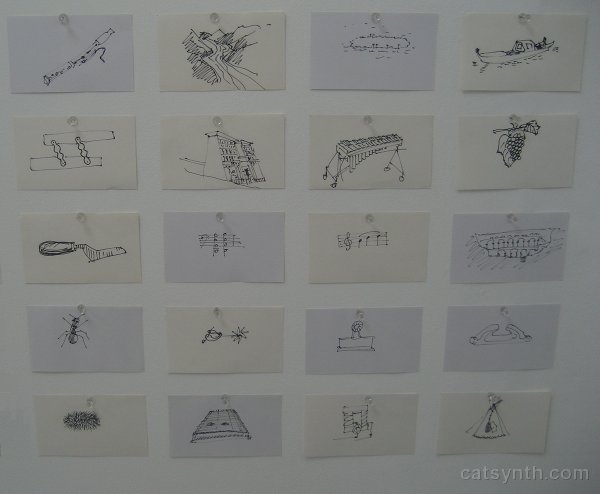
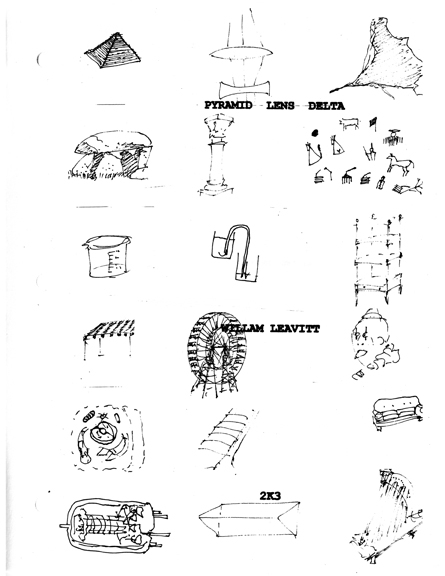
You can see the score for our opening piece “Small Chinese Gong” laid out behind the keyboard. This is one of the graphical scores that I have mentioned in a previous review. This is also the piece that fell victim to the “rebellious blue cord” that left the performance bass-less. Fortunately we were able to correct that and the rest of the set went quite smoothly.

You can listen to an audio archive of the performance. I thought the later pieces, in particular “Canada”, “Ode to Steengo” and “An Empty Rectangle” came out quite well. We are definitely looking forward to our live performance tonight at Studio 1510.

For those interested in the technological aspects: I was using my trusty Korg mini-Kaos Pad, E-MU Proteus 2000 (with Vintage Pro and Mo’Phatt), and a Voce Electric Piano module. Tim Walters was also performing live custom electronics programmed in Supercollider.

LoveTech SF 1st Anniversary Epictacular

We present a few photos and notes from the LoveTech SF 1st Anniversary “Epictacular”, which I attended on Saturday. LoveTech is a “Collaborative Music Technology Party & Interactive Multimedia Art Salon” here in San Francisco, and a group I definitely should try and be more involved in during its second year.

Our friend Tim Thompson, together with Michael Broxton, performed live improvised music along with generative visuals (i.e., the graphics are generated live):

Tim’s setup features a Launchpad/Mimo/Keyboard interface. This music featured tonal improvisations (lots of jazz chords and lines) with fast lines and rhythms, a structure that allowed one to shift focus between the music and visuals. The visual software was Broxton’s PhosphorEssence. You can see some clips from the performance on this video:

In addition to live performances, there were also technical demonstrations. Here we see Moldover presenting the MOJO, a newly released music controller which features touch-sensitive strips, game-controller-style buttons and a rather sturdy looking case.

There was also a “jam lounge”. Here we see a duo of *bernadette* (left) and Pamela Parker performing a delightfully noisy and inharmonic electronic improvisation with guitars and effects (including a Moogerfooger).

They also had a theremin as part of their set. Note the porcelain cat figurine on the theremin.

The video below features a demonstration by Komega of his custom sound and light instruments, including the Kromatron, Komegatone, and the Breadman.

More on Komega’s instruments in a future article.

SF Recology Artists in Residence

Last Friday, I attended an exhibition for the Artist in Residence program at Recology San Francisco (formerly known as, SF Recycling & Disposal, Inc.). Yes, this was an art opening at the SF dump. The program has been around for almost twenty years, and provides space and support for artists who work with materials from the city’s waste stream, including recycled wood, paint and metal. Pretty much anything the artists can scavenge. This exhibition marked the end of the residency for artists Erik Otto and Christina Mazza.

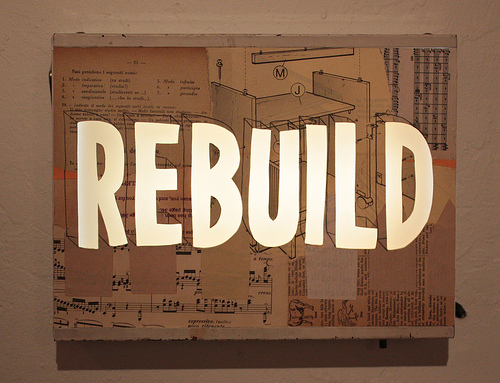
We first enter the gallery through an anteroom, with some smaller works including Erik Otto’s Rebuild, featuring the title word cut into scrap paper (including a musical score and furniture assembly instructions) and illuminated by a recycled light box.

Erik Otto. Rebuild, 2010. (Click to enlarge.)

The title and the materials of this piece set the tone for the show. In addition to my standing interest in text as a visual element, I liked the inclusion of music as part of its texture.

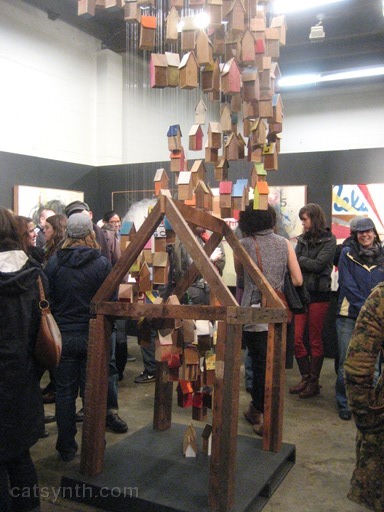
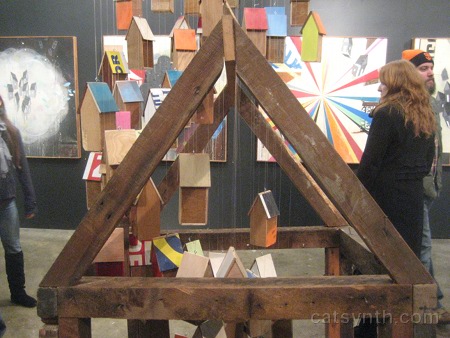
Moving into the main room, one immediately sees Otto’s Road of Prosperity (The Start of a New Beginning), with over one hundred small wooden houses suspended from the ceiling on fishing line, forming a chaotic spiral that descends towards the ground.

[Erik Otto.  Road of Prosperity (The Start of a New Beginning), 2010.  (Click each image to enlarge.)]

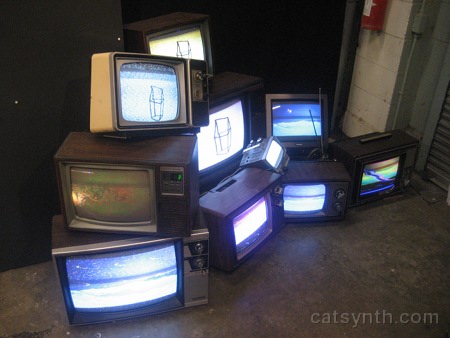
The houses, made of recycled wood, all have a similar iconic shape. Stepping back, one can see the the wooden frame at the base is itself another house. Indeed, the houses reappear throughout Otto’s work, either as central or peripheral elements, in his paintings and mixed media pieces and even in a video installation featuring recycled television sets:

Erik Otto. In the Abundance of Water, We Are Still Thirsty. (Click to enlarge.)

I am drawn to recurring icons in a series of work. So what is the significance of the houses? Certainly, they are a symbol of our current economic crisis, and a very visible part of natural and human-made disasters. Otto’s own words are informative:

My work is a narrative told by the recurring characters/elements I use often in my artwork. The house is a physical embodiment of our spiritual being. Inspired by the notion that being home is “knowing” – knowing your mind, knowing your heart – that if we know ourselves, we are always “home”, anywhere. It is often depicted in chaotic landscapes and is found seeking safety from a storm and/or rising water levels, which refer to our current social and economic climate.

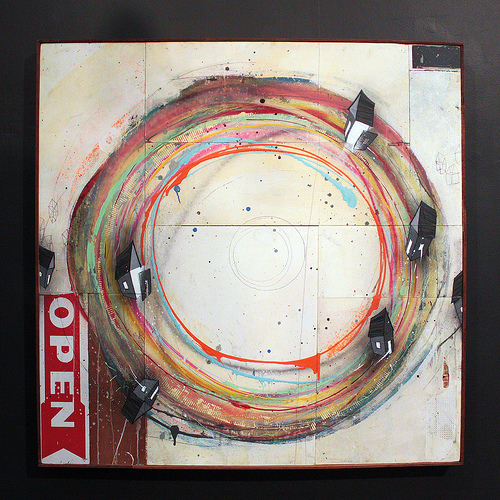
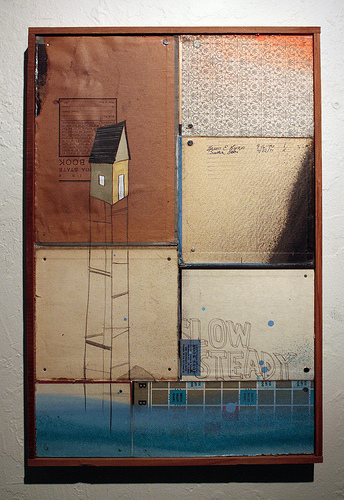
His paintings, which also prominently feature the houses, include other elements such as found text, such as the “OPEN” sign in the large painting Moment of Reflection. Devotion 5 features a house (perched on stilts above a body of water) painted over book covers and a Scrabble board – certainly a powerful symbol of out-of-context text.

Erik Otto. Moment of Reflection. (Click to enlarge.)

Erik Otto. Devotion 5. (Click to enlarge.)

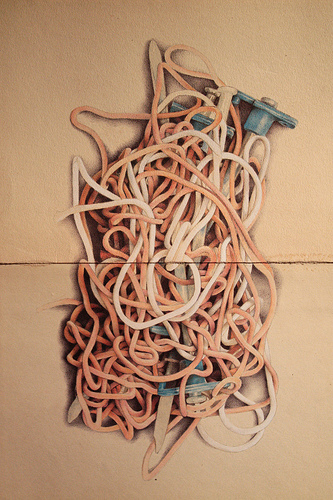
While Erik Otto’s work seemed to focus on discrete elements, icons and text, Christina Mazza’s pieces were about more continuous textures. Many of her finely detailed drawings feature entanglements of string or rubber bands or rope.

Christina Mazza. Construction. (Click to enlarge.)

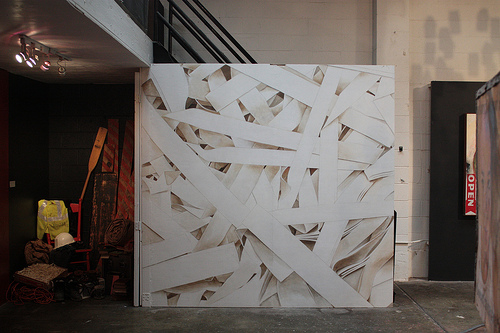
She takes this theme of complex tangles to a larger scale with this wall piece made of shredded packing paper.

Christina Mazza. (Click to enlarge)

Mazza presents a very different texture with Redemption: SF Dump, which features a video inset in a wall made of brightly colored wood panels. Up close, one can see the imperfections, nails and slightly off angles of the the recycled wood. From a distance, it can seem a texture of precisely generated color rectangles with a moving image at the center.

Christina Mazza. Redemption:SF Dump. (Click to enlarge)

Mazza found inspiration in the discoveries she made at the dump, and documents her adventures on her blog. Looking through the images, I can see piles of discarded items that served as “subjects” for her drawings. One image which I found interesting but was not reflected in the pieces at the show was a discarded Chinese paper frame .

Christina Mazza. Chinese paper frame.

I find this image a fitting conclusion as I turn my attention to other recently visited exhibits and my own upcoming projects.

Thanks to Recology SF for providing many of the photos for this article. You can see more pieces from this exhibition and previous artists in residence at their flickr site.

First Thursday, January 2010

We at CatSynth present a few notes from our gallery visits here in San Francisco on the first Thursday of the year.

Peter Focault, courtesy of Micaela Gallery

First up, we visit Micaela Gallery for an exhibition of work by Peter Focault and “friends”. Focault’s large ink-on-paper works build up complex structures from simple lines and strokes. The textures can be come very intricate and dense, such as in this detail from Four Square Squared Series #2. Several pieces also have a very architectural quality, while others such as the Evolution Series #1 have a more organic feel.

In addition to the wall presentation, there was a live performance and creation of a new drawing. This was a collaboration of Focault, musician Jake Coolidge, and Jonathan Grover. Coolidge performed live processed bass guitar with loops and other samples. The audio was then interpreted by a robot that moved with a pen on a surface in response to changes in the sound. The long curving strokes with back-and-forth motions gradually produced an image that was similar in style to completed works. You can see a brief sample in the video below from Jake Coolidge’s blog, along with a more detailed description of the process:

Shannon Ebner’s Signal Hill at Altman Siegel depicted every day objects, some with text, some with symbols like stick figures, some bits of manufactured material, that all convey information or “signals” in contemporary society. I identified with the simple and geometric elements and incorporation of text in her large photographs as well as her sculpture, as well as the sparse presentation by the gallery.

Shannon Ebner, courtesy of Altman Siegel Gallery

The photographs also had a very three dimensional texture, such as one photograph of an international graphic symbol (included in the photograph above) that one often sees on a very smooth surface.

Holly Andres, courtesy Robert Koch Gallery (click to enlarge)

At Robert Koch Gallery, I saw Holly Andres’ Sparrow Lane series. The photographs this series feature a group of adolescent women. The photographs seem to be narrative, as if the girls are exploring and investigating, but they are also disjoint without any real story line. As she explains in this interview, Andres spends a lot of time carefully crafting the images, including the clothing worn by the models and the walls and furnishings of the spaces. The clothing was very well done. Most seemed vintage mid-century and featured skirts and dresses with straight lines and solid colors that gave the characters a modernist “early 1960s” feel. On the other hand, the props and settings seemed more baroque and and did not really hold my interest. The one exception was the The Missing Bird (presented here), which places the characters in a grittier basement covered in media images with a cat in the background.  I did find myself contrasting this series with the Dystopia exhibition I saw at this same gallery a year ago – it would be intriguing to see them side by side. (The exhibition will remain on display at the gallery through the end of the month.)

While exploring the photographs at the Koch Gallery, the air from the doorway carried the heavy tones of electric blues. I followed the sounds next door to the Haines Gallery, where a blues band was playing. It turns out the band was led by Mike Henderson, whose paintings were featured in the current exhibition.

I tend to be drawn to minor keys and modes, so minor blues holds a special place in my musical vocabulary. His paintings have geometric shapes with complex textures, overlaid with various line drawings and lettering. Some have a very bright texture akin to a wood surface, while others are dark black with small light shapes and figures.  It is interesting to consider the connection between the music and the visual art.  Unlike the collaboration described above where the connection was direct, the connection here is more emotional or evocative.

Stephen Wirtz gallery presented Catherine Wagner presented large highly-detailed prints of specimens from the California Acadamy of Sciences. They were arranged by biological taxonomy, but also visually. From a distance, one can focus on the overall texture, while up close one notices the details of each specimen. Hits by Rick Arnitz featured large canvases, each of which seemed to take on a different geometric theme: brightly colored circles, a texture of red a black vertical lines, stars on a light blue field, etc. I often like discovering pieces from the permanent collection on display in the back room – I recall Ulrike Palmbach’s soft sculptures of cats from a previous visit – this time it was Marc Katono’s Half Light, a large light canvas with very delicate curves and lines. The piece was reminiscent of organic fibers and would have seemed at home among Wagner’s prints.

Randy Hussong, Courtesy of Gallery Paule Anglim

Across the street at Gallery Paule Anglim, I saw Randy Hussong’s Sculpture and Lithography exhibit. All the images were based a large steel box held up on one side by a stick with a chain, essentially a “trap” of sorts. The box itself was shown in the center of the room as a piece entitled Prey and Weight.  Along the walls were combination photographs/lithographs based on images of the box in outdoor setting, based on photographs at different times of day. The box is clearly artificial, but it’s coloring and worn texture allow it to merge with the natural environment. Additionally, there was one pure black-and-white lithograph entitled Trap.

At A440 Gallery, Dominic Alleluia’s large mixed media works had a very contemporary feel. They combined large abstract elements, color textures and shapes with energetic dark swirls and waves reminiscent of graffiti. A third dimension in some works included objects and materials such as wooden dowels and metal. I found this video of the “artist at work”, and I thought the music expressed the energy of his pieces the exceptionally small gallery space.

Finally, I would like to mention seeing the exhibition Diane Arbus‘ photographs at Fraenkel Gallery.  The exhibition, titled Christ in a lobby and Other Unknown or Almost Known Works by Diane Arbus, were selected by sculpture Robert Gober from a collection of little-known photographs.  The photographs, which were relatively small in size, did fit into the context of Arbus’ better known images in that they depicted a wide selection of people, some very everyday and some a bit more challenging.

Farewell to 2009

So this is the time when we choose to look back on the year that has just ended.  Or in some cases, not look back.  It seems that this past year was a difficult one for a lot of people, an annus horribilis or a “year to forget.” For me, that particular title could be better applied to another year that was far more tragic and difficult.

So I feel a little at odds looking back at 2009 and seeing a really rich year, one filled with visual and personal experiences.  I actually learned a lot, about other people around the world, about myself, about what is important to me, and I think that is actually reflected on these pages in a strange way.

I expect this coming year to be more of a transitional one, though I am not exactly sure yet where that will lead.  But in the meantime, we at CatSynth will continue to do what we do…

Rain and Resurface

I usually try not to be intimidated by the rain here. But it was coming down pretty hard as I wondered the familiar streets of SOMA and South Beach looking for a particular gallery not far from the former Fremont Street overpass that I photographed on a sunnier day. I was trying to catch an exhibit before it closed on Sunday, only to find the gallery itself was closed for the extended holiday weekend.

So now I had not only the pouring rain around me, but also a large caption reading “FAIL”. Not a big deal per se, but we did need to get out of the rain. We headed down 2nd Street, looking for someplace that would be at least dry and somewhat comforting, a cafe or a bar that had not opted to close for the holidays. I was surprised to find that 111 Minna was open, and in fact quite well populated. They were having some sort of fundraising event with work from several artists. However, I found myself more interested in the permanent exhibit, Resurface, a solo exhibit by local artist Micah LeBrun. LeBrun had taken a hiatus from his work, which primarily focused on painting, for a year in late 2008 and early 2009 to travel through Central America, Asia, Australia, Africa and Europe. During this time, he focused on photography, and only returned to painting after returning home. The exhibit included examples of his photographs (partially obscured by the art being displayed for the fundraiser). I was more drawn to the stark landscape images, which reminded me of my own adventures in the desert and sparsely populated areas, than to the portraits. Among the paintings, I was also drawn to the non-portrait pieces, such as the large red canvas with the words “the New Yorker”, and another piece featuring an algebraic equation (the solution to which was of course 0.5). Both pieces are visible in this promotional image, featuring the artist in his studio:

[Click to enlarge.]

Afterwards, I did visit LeBrun’s website, and found myself more interested in some of his earlier work, such as the combination of figurative and abstract paintings from 2005 and 2006. There were several works that focused on black and shades of pink. It was interesting to view one of his figurative pieces, such as “high maintenance” next to an abstract work like “take it easy”, as if one is a distillation of the other (small versions of both works are displayed to the right). You can see other works from this series at his online gallery.

Weekend Cat Blogging: Holiday Windows

This weekend, we present some of the cats featured in the Macy’s SF/SPCA Holiday Windows. Every year during the holidays, San Francisco SPCA teams up with Macy’s in San Francisco to feature adoptable pets in the holiday window displays at their main store in Union Square.

Here are couple of kittens in one window:

and this handsome black cat:

Many passers-by in this busy shopping district were surprised and delighted by the live animals in the displays.   We at CatSynth certainly hope that some of these animals, including the cats featured above, find new homes as a result of this program.

To find out more about the program, including when to see the animals and how you can contribute, please visit the official Macy’s SF/SPCA Holiday Windows site.


Weekend Cat Blogging #238 will be hosted by our friends at the House of the (Mostly) Black Cats.

Carnival of the Cats will be going up this Sunday at When Cats Attack!.

And of course the Friday Ark is at the modulator.

Happy Holidays!