
Tag: San Francisco
-
Moldover, Celeste Lear and Nonagon at Control Freq
Last Wednesday I attended Control Freq at the Hotel Utah here in San Francisco. Of course, that is a fantastic name for a show, being a play on words for electronic music controllers, audio signal processing, and the tendency of many of us to be in fact “control freaks.” The overall theme among the three groups who performed was use of Ableton Live! with various controllers.
The evening opened with Celeste Lear (guitar, vocals, electronics) and her band, including Adam Willis (drums) and Ian Montgomery (bass).

Lear has quite a pedigree in music and audio, and her music and band is quite technologically sophisticated (I did see the iPhone as a controller on the bassist’s strap). Nonetheless, they manage to combine technology with popular music idioms. I heard various funk, house, and reggae influences in her music – I had a soft spot for the final song which sounded like a classic house/disco track in a minor key. Though most of the music was very rhythmic, there were some free-form moments as well with guitar effects, etc. For much of the set, they were joined by trumpeter John Gibbons.
Celeste Lear was followed by Nonagon [along with guests]. The group had an impressive array of gear, arranged as multiple stations with laptops and controllers, including offerings from Akai and Albeton+Novation and of course a Monome. There were also two glowing globes in between the performers that emitted an ever changing color of light. Musically, the set began with complex ambient sounds, quite different of the Celeste Lear Band. Gradually, beats and recognizable chords emerged, with the beats eventually becoming quite strong and pronounced. Over the course of the set, they seamlessly moved through various beat-based soundscapes, with various resonances, vocal pads, pianos and other sounds filling in.
Moldover concluded the evening with a very impressive, high-paced and virtuosic performance with his Mojo controller, guitar and voice. We had last seem Moldover at LoveTech.

His performance on the controller was strong and rhythmically tight and fun to watch. He played the various buttons and sliders as if he was playing guitar or drums. Even though the Mojo was being used to bring in out various loops, recordings and processed sounds, the end result were new rhythms, chords and even melodies. This can be best seen in a video clip rather than in words:
-
SoundSpeak, Luggage Store Gallery
Last Thursday’s performances at the Luggage Store Gallery were all about poetry and spoken word.
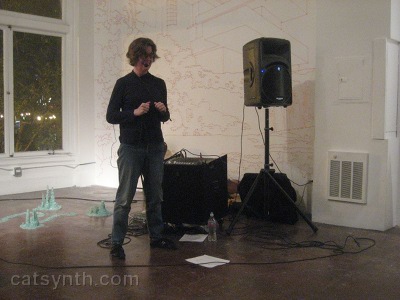
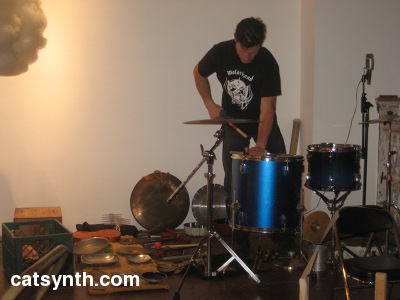
The first performance was a duo Polly Moller (vocals) and Moe! Staiano (percussion) interpreting a recent form of spoetry. Spoetry is spam that in its effort to evade filters rises to the level of high art. Our current set of songs in Reconnaissance Fly is based on spoetry, but the performance this evening featured a new and different form where words were grouped into disjoint sequences of two or three words, and in one case the words were themselves decomposed into individual sounds and reordered.


[Click on images to enlarge.]
The performance began with coarse drums and cymbals set against dramatic recitation of the first spoem. Although I wasn’t fully aware of the structure of the spoem at the time, one could definitely sense that the words were quite disjoint from one another. There were multiple languages, which allowed Polly the opportunity to play with different accents, pitches and timbres within the text. The drums at times were “prepared” with various objects on the heads. At one point, the drums got very soft, then gave way to scraping sounds on the cymbals set against longer drawn-out words, and then both the voice and percussion suddenly became very staccato and active.
The third piece focused more on Moe!’s percussive gadgets, including a back massager that was used to set a steady pulse for the piece, and set of old intercoms that were used to remotely set of loud squeaks from the edges of the room. This was the most rhythmic of the pieces, with a steady pulse that one could even sway to a bit. Moe! expertly threw and struck various objects in a way that kept the beat going, complete with accents.
In the final piece, the sounds of the words were decomposed into even smaller units that further blurred any sense of meaning. I did recall the phrases “Isis kitsch”, however. The main percussion instruments in this piece were a set of rubber balls attached to sticks that created a powerful sound when rubbed along the walls or on the heads of the drums.
The second set featured poet Robert Anbian with Rent Romus on saxophones and Bob Marsh on cello. This was more of a “traditional” poetry performance, with Anbian reciting long-form poetry against improvised music, and quite a contrast to Polly and Moe!’s more experimental set.
The first piece began with long cello harmonics that were matched by tones on the saxophone. The poem had memorable phrases such as “square root of suffering” and “posey for your supper.”
The second piece started with an animated run of fast saxophone notes and pizzicato on the cello. Then the poetry entered, with imagery and words related to fire and memorable phrases such as “The post war blues you are feeling is perfectly normal.” The music became noisier and sparser, then moved towards more of a jazz idiom (i.e., with the cello sounding a bit like a bass) then back to more noise and free improvisation. This was quite a long poem, and towards the end I think we in the audience began applauding before it was actually done. Anbian took this in stride and simply said “the audience has spoken.”
The last piece, My Country Loves Peace Remix began with cello and electronics (delays, etc.) set against a moaning saxophone. After a while the music moved to bowed cello and sax harmonics, then back to more electronically processed cello. The poem was about the perpetual state of war we seem to find ourselves in, despite leaders proclaiming their desire for piece. War was used broadly and included not only guns and bombs, but the taking of resources and cultural assets from others, sometimes by force, yet still proclaiming peace. “When will the war end?” A section of the music featured harmonics on the cello matching long tones on the sax with tremolo on both instruments. At one point, the pitches stablized on a major third before “falling apart” as a series of glissandi. The poem ended with the question repeated “When will the war end…Barack?”
-
Storm Moon Concert
A little over a week ago, I attend the lastest in the Full Moon Concert series, the Storm Moon, at the Luggage Store Gallery. The Storm Moon concert was all about electric guitars, and featured two very different guitarists with their own interpretations of “gathering and releasing the storm.”
The first set featured guitarist Joshua Churchill in collaboration with filmmaker Paul Clipson. The music began with recorded samples, with changes in pitch and speed. The music in these samples formed a drone of minor chords, against which Churchill sprinkled metallic tones from the edge of the guitar. The overall effect was quite ethereal. With this sound as a backdrop, Clipson’s film began. The film was actually a Super 8mm film (i.e., not a video), which brings with it a certain image quality and style of editing that was does not often see in contemporary live music+visual performances. It started with simple geometric patters of light and shapes, notably rectangles and parallelograms that suggested office windows or overhead lighting. Against these emerging patterns, the music moved to guitar loops and longer tones set against the earlier metallic sounds. This gradually gave way to full chords and drones. Both the movie and the music become more intense, but the building blocks of guitar tones and shapes and light remained.

At one point, the film became entirely patterns of red and green, as the music continued to grow in intensity and fullness. There were sounds reminiscent of wave motion and some trills, but there remained overall a droning quality and a minor tonality. This gave way to beating patterns and a “loud wall of sound.” As the film progressed, I began to notice more familiar objects and patterns, such as looking through a chain-link fence. As distinct images of urban lights and street scenes emerged, the music became louder, faster and nosier. I was then able to recognize familiar images from New York, the Chrysler Building and some of the bridges. At this point the music came to a loud and noisy climax after which the softer harmonies re-emerged and both the music and movie gradually came to a close.
This interplay of sound, light and image was followed by a solo performance by Peter Kolovos. We had heard his very dextrous and energetic style of performance during his set at last year’s Outsound Music Summit; he brought the same energy and technique to channel the peak of the storm moon’s energies on this particular evening. He began with short blips, scrapes and squeaks. The overall effect was staccato and percussive – quite the opposite of the previous set – and it was quite loud. Even as the notes grew longer, they remained percussive. Kolovos not only moved fast on the guitar itself, but also with his effects, quickly switching between effects such as heavy delays and distortions even within single notes. Gradually, the texture began to include sounds with longer duration, such as feedback and overdriven delay patterns. There were even some harmonic chords in there, though I quite liked his inharmonic sounds on the guitar, with or without effects. As the tones grew longer, the music felt even louder, feeling it more in my entire body than as sound. Then all of sudden, it became software, with percussion and a tone that reminded me more of analog synthesizers. Gradually things became louder again – in one section I heard what seemed like a standard rock chord progression – and then drew to a quick and decisive close.
-
Sonja Navin and Mike Kimball
I recently visited two openings for artists I met at Open Studios last fall and whose work reflects my interests in highways, architectural images and the urban landscape. The artists take very different approaches, and the shows were in very different parts of the city – but having both openings on the same night was a great opportunity to see them together and simultaneously reflect upon the city itself.
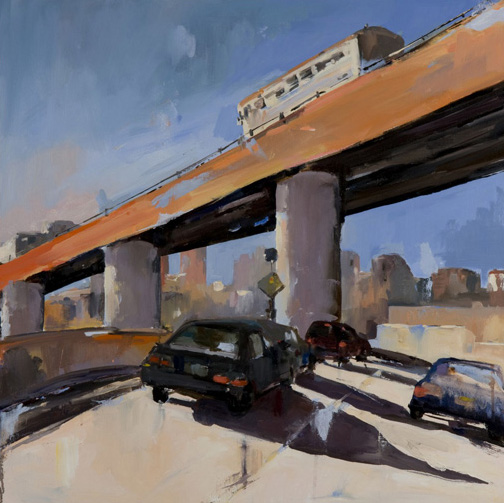
First, I stopped in the relatively quiet West Portal neighborhood for a show at the Greenhouse Cafe featuring Sonja Navin. Navin draws on her architectural background to capture familiar images of the city in her paintings. Perhaps the most “familiar” image was the King Street off-ramp from I-280 in her large painting entitled 280.

[Sonja Navin. 280. Photo courtesy of the artist. (click to enlarge)]
Navin experienced this interchange the way many of us do, i.e., being stuck in traffic, and thus had the opportunity to visualize it in detail. She also had a painting East on N which featured a familiar view along the N-Judah metro line in the Sunset district.
Although her subject matter is often architectural in nature, her painting style features large brush strokes and irregular areas of color rather than the straight lines and precision of architectural drawings. She also had several figurative paintings, and some such as In The Haight combine both character and street elements.
Navin’s exhibition, which also features artist Kacie Erin Smith, will be on display at The Greenhouse Cafe, 329 West Portal Avenue in San Francisco through April 30.
After brief ride over Twin Peaks, I found myself descending into the Mission district for an opening at City Art Gallery, where I was particularly interested to see new works by Mike Kimball.
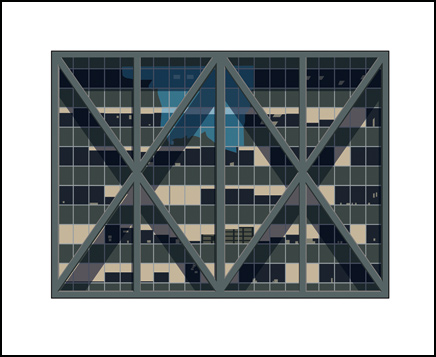
Like Navin, Kimball’s interpretation of the urban landscape distills it down to basic elements, but his prints and paintings feature very clean lines and simple geometric shapes. One example is his Maritime Plaza, which I immediately recognized (it is a favorite out lunch spot of mine).

[Mike Kimball. Maritime Plaza. Image courtesy of the artist. (click to enlarge.)]
Like the building it represents, the image is framed by the triangules and X-shapes of the seismic bracing. This was one of the first buildings to use this technique, which is now a familiar site on buildings in the Bay Area.
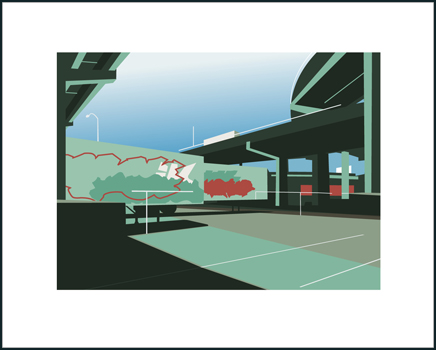
In Division Street, Kimball represents another familiar sight from daily life, the interchange of I-80 and US 101 that sits above Division Street in SOMA. The image is composed of very simple curves and lines and solid colors, from which one can distinguish the elevated structures of the highway and the shadows they cast, as well as details such as the markings (and probably graffiti) on the sides of the trailers.

[Mike Kimball. Division Street. Image courtesy of the artist. (click to enlarge.)]
Trucks and trailers also feature prominently in Kimball’s work. His “Truckograph” series features a similar graphic quality to Division Street. His larger work Meditations on a port looks at the stacks of trailers at the port as an abstract collection of boxes. Kimball bridges the industrial and abstract in this work – close up, one can see the writing and metal texture, but from a distance one simply sees the colored squares.
Kimball’s current exhibition will be on display at City Art Gallery, 828 Valencia Street, through March 28.
-
On Kawara, MAR. 16, 1993
Today, we consider a work from the Today series by conceptual artist On Kawara. Since 1966, he has created many paintings in this long series, each consisting of the date the painting was created in simple white lettering set against a black background.
By coincidence, the San Francisco Museum of Modern Art (SFMOMA) has in their collection MAR. 16, 1993 from On Kawara’s series:

[On Kawara, MAR. 16, 1993 from the Today series. San Francisco Museum of Modern Art, http://www.sfmoma.org.]I have seen it several times in the past, but when I wandered though the museum’s 75th anniversary exhibition a couple of weekends ago, there it was again. And there is no way I would pass up mentioning it today.
-
Truong Tran: the lost & found
Another review of art from the month that has past. In mid-February, I attended an artist talk with Truong Tran, part of a month-long exhibition of his work at Mina Dresden Gallery. The exhibition was presented by our friends at Kearny Street Workshop.
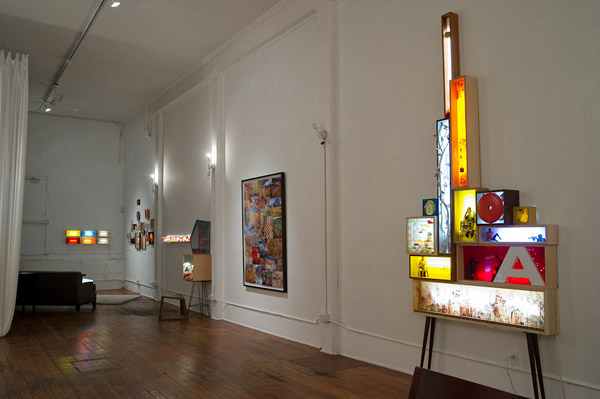
The gallery itself is a narrow and starkly white space. Upon entry, one is drawn first to the illuminated shapes and color fields that dot the walls. Moving closer to a particular artwork, one begins to see the meticulous detail and the variety of elements from which it is composed.

[Truong Tran. Installation view. Photo courtesy of the artist. (Click to enlarge.)]
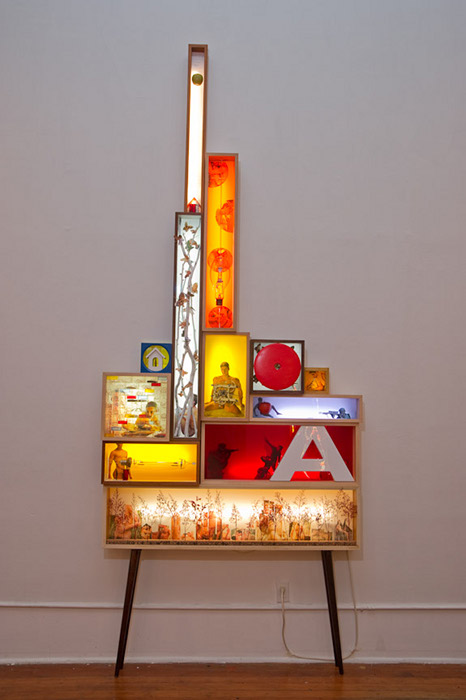
As suggested by the title of exhibition the lost & found, the pieces are created primarily from found objects and materials. Tran is a self-described collector, indeed he admit, “I was a collector long before I was an artist.” This brought to mind the artist in residence program at the SF dump that I reviewed back in January. Far from a simple presentation of found objects, he constructs large-scale works from these constituent parts, placing them into boxes and the combining these boxes into larger structures. This process of found objects, containment and construction is perhaps most apparent in tower, the largest piece in the show:

[Truong Tran, tower. Photo courtesy of the artist. (Click to enlarge.)]
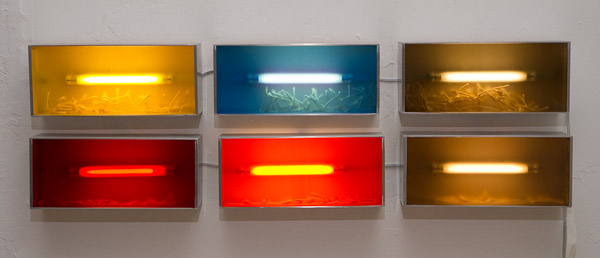
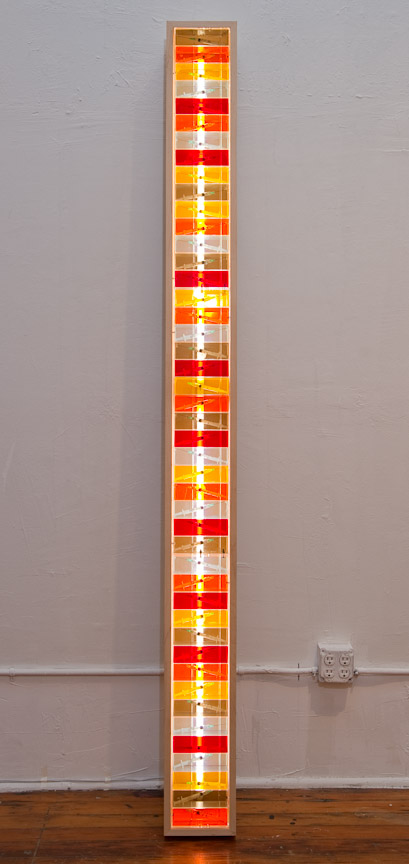
Tran cites Joseph Cornell and Donald Judd as influences, and one can see the combination of “things contained in boxes” and large minimal geometric elements reappearing in many of the works. There is also a certain polished quality to many of pieces, particularly the illuminated works that most caught my attention. For example, the piece broken and whole, shown below looks to be a very minimalist installation with lights, rectangles and solid colors. On closer inspection, one can see that each box contains bones, presumably part of a “collection.”

[Truong Tran, broken and whole. Photo courtesy of the artist. (click to enlarge)]

Truong Tran, a ladder to. Photo courtesy of the artist. (click to enlarge) The use of found materials within a larger minimal pattern of boxes and solid colors appears in many of the works. The contained materials at times are provocative, such as the syringes that are placed in each box of a ladder to.
Tran is as established writer and author of several collections of poetry and a children’s book. With this exhibition, he is moving into a new medium of visual art and sculpture. However, his poetry is also very visual, as in his book within the margin where a single line of lower-case text is presented on each page. His other books published at Apogee Press have a similar visual quality to them. You can see some excerpts from a couple of the books here. Similarly, text enters into many of the visual pieces in the exhibition, such as the large letter “A” in tower. In both his written and visual works, there is a strong sense of things being “constructed”, and indeed he emphasized the concept of construction during his talk at the gallery.
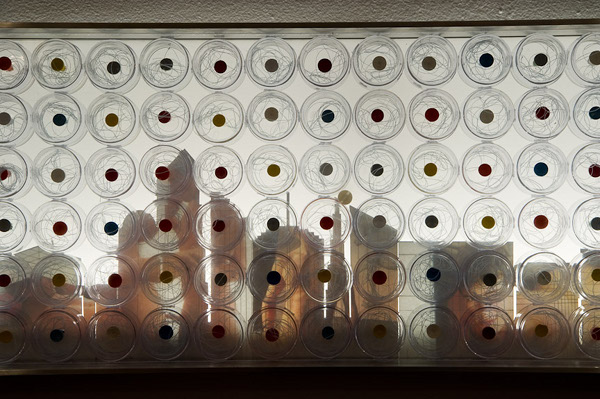
One work that did not get mentioned during the talk but which drew my attention the invisible city. Once again, found materials (in this case, multicolored golf tees and thread) were arranged into a repeated rectangular pattern, but this time set against an image of a city skyline. While many of the pieces have an architectural quality to them (i.e., as “constructions”), this was only one where the image contained within was itself architectural.

[Truong Tran, invisible city. Photo courtesy of the artist. (click to enlarge)]
However, there is another level of containment, as each of the buildings contains a pornographic image – I believe they are all images of men. This is another recurring theme in many of the pieces, perhaps best exemplified via boy with butterflies which at a distance appears to be a flock of hundreds of colored butterflies frozen in mid motion. Upon closer inspection, one sees that the butterflies are cut from pornographic magazines, and it is the sections of the male bodies in these images that give the butterflies their colors and patterns.
You can see some more photos of other works from the exhibition at The Lost and Found, a visual blog created by Tran. You can also see photos from the well-attended opening at KSW’s blog.