
[Click to enlarge.]

Another piece from Performa: A Ballad of Accounting 2009: Composition for Cello and Brooklyn Queens Expressway, a composition by Alex Waterman with a 16-millimeter film by Elizabeth Wendelbo. I was quite interested to see this piece, given that it combines experimental music, art and highways, three of our interests here at CatSynth!
 Waterman lived near the Brooklyn Queens Expressway, or BQE, and was inspired by the sounds of the highway as well as its history. It was part of Robert Moses’ master design for the city’s highways, and winds its way through a narrow corridor in densely packed areas of eastern Brooklyn and Queens. (See this article for more info.) Waterman often walked under the highway, listening to sounds and in particular the harmonics. The piece includes live cello performances near and under the highway, with microphones in the resonant chamber of the cello, as a way of modifying and eradicating the noise of the highway, as if “the cello was eating the highway.”

The video opens along the BQE, along the side, underneath, and riding on the surface, interspersed with images of Waterman carrying or playing his cello near the elevated structures. The music featured long notes set against filtered highway noises. There were lots of drones, often featuring noisy timbres or harmonics, but sometimes more familiar minor tonalities. The visuals included architectural close-ups of the elevated structures – hardly considered among the more picturesque in the city, but still quite interesting. I noticed exit signs for Metropolitan Avenue appearing a few times. One moment that particularly got my attention was a forlorn drainpipe. One could imagine the metallic resonances here, and indeed the sound became more electronic, reminding me a bit of early Xenakis. I also heard sounds that reminded me of more modern granular synthesis. There were also sharp departures from the drones, with very pointed “crackling sounds”, appropriate as the video began to feature rain and water dripping from the pipe.
There is a permanent installation of the piece near Calistoga, CA. I am curious to see it sometime after I return home.
This past weekend, I attended several exhibits and performances from the Performa 09 biennial.
On Saturday evening, I saw the New York premier of In Order of Appearance by Youri Dirkx and Aurélien Froment. The piece began with a spare, white on white stage, which was gradually populated by Dirkx with various geometric objects.

I was quite taken with the silence, which in its way became musical (I have long had a musical appreciation of silence in art). It also allowed me to concentrate on the objects themselves, their shapes, colors and perspectives, and the dramatic gestures Dirkx used to manipulate them. The main objects were a cube, rectangular prism, ball (sphere) and cylinder, all in white to match the walls. Sometimes they were stacked, at other moments placed side by side. There were also miniature versions of these same objects, in a dark gray shade. Beyond these were a variety of shapes, clothing and architectural elements, some in bright primary colors, which gave the impression of a modernist/minimalist gallery in a museum.
I really liked seeing this work, with its minimal take on motion and geometry. The spare stage and the silence made it quite arresting to watch. And like a museum, I could switch my attention from one simple object to another on my own terms.
The piece ended with full complement of objects on stage:

I came to this performance without any context, so I pretty much experienced it as described above. It was only afterwards that I reviewed the notes, and found this excerpt quite matched my own perceptions:
“In Order of Appearance” questions ways of presenting an artwork. The presentation takes place amidst architecture made of paper, modelled on the white cube of the museum. This draft version of the gallery space is used here as an operating table, an abstract playground where objects and artworks are transformed in one way and then another, exploring their identity and functions. The piece explores the different viewpoints that one has of objects according to their context of exposition.
 Many of the stations on the New York subway system have been upgraded over the years, cleaned up and adorned with artwork and location-specific decor. The Bleecker Street Station on the Lexington Avenue line is not one of them. It’s still quite spare and run-down, the supporting columns a bit rusty. As I waited for an uptown #6 train, I took this photograph looking along the tracks and platform:

Just afterwards, I looked across to the opposite platform and saw a young woman making a similar photograph, also looking uptown. Almost as quickly, a downtown #6 pulled into the station, and as the train pulled away, she was of course gone. A typical movie cliche, but our main purpose in this little station was to catch our trains to wherever it was were going next.
While I am away in New York this week, Luna is back at her deluxe boarding facility. She seemed to adjust relatively quickly after reacquainting herself with the place:

Of course, she quickly found her little alcove where she can peer out.

It’s always a little bittersweet to drop her off, but I know she will be well cared for. And I have a sense this trip to New York will be good. I expect to post some art and music reviews as time permits.
Meanwhile Weekend Cat Blogging #233 is being hosted by Samantha at Life from a Cat’s perspective. We still hope that Mr. Tigger comes home.
The Carnival of the Cats returns this Sunday to Pet’s Garden Blog.
And of course Friday Ark is at the modulator.
Last Monday, I performed again the experimental improv “Hootenanny” at the Ivy Room in Albany, CA. This is always a fun series to participate in or attend. It starts a little later at 9PM, and is set in a rather plush bar that makes a great setting for drinks and experimental music.

The evening opened with Free Rein, consisting of Andrew Joron (percussion, theremin), Joseph Noble (woodwinds) and Brian Lucas (guitar). They began with Joron playing a bowed metal percussion instrument and Noble on flute. The bowed instrument had discrete pitches and the music was quite tonal and repetitive, almost hypnotic. They were joined after a while by Lucas on guitar, and together weaved between pentatonic and chromic sounds that were sometimes quite lush, and other times sparse. Joron switched the theremin at some point during the set, and there was a particularly interesting duo of theremin and pennywhistle.
Free Rein gave way to The Lords of Outland with CJ “Reaven” Borosque (electronics), Philip Everett (drums), Ray Scheaffer (bass), and Rent Romus (alto saxophone). There sound was loud, fast, dramatic, with many of the standard idioms from free jazz, run of fast notes (particularly from Romus on sax), squeaks, and loud hits. It was interesting to have the electronic noises set against the jazz sounds.

The set was very energetic and seemed to go by fast, and I had to keep track of time lest I miss the start for the set that I was curating. On cue, as they faded out, we began to fade in.

The set I curated included myself on electronics, Brandan Landis on prepared guitar, Beau Casey on violin and David Slusser on saxophone and the Slussomatic. As usual, I began by ringing one of my prayer bowls, which was answered by the metallic sounds of the prepared guitar and the violin, followed by the Kaos Pad and Evolver, and then the Slussomatic. None of us have played together as a group before, but I was happy with the way we able to play off one another. There were a couple of moments that particularly stood out for me, such as a rhythmic ostinato that emerged organically and I then reinforced; we went on with that pattern for a while, adding accents and syncopations; towards the end, the full ensemble played a series of loud and dramatic swells (anchored by a noise patch on the Evolver) that brought the set to a close…

…which segued to the next set featuring Elizabeth Torres on tenor sax, with Cansafis Foote on baritone sax and Mario Silva on trumpet. The set began with Torres and Foote as a duo, moving between very synchronous playing in which the two saxophones acted as one instrument, and Torres’ improvising freely against a driving but ever-changing rhythm provided by Foote. The duo was then joined by Silva, again moving back and forth between more free improvisation and rhythmic sections.
Thanks again to Lucio Menegon for hosting the series and Suki O’kane for being “virtual Lucio” on this particular night.
Another from pulsewidthmod:

In a previous post we met Plato, who apparently is quite fond of the theremin.
From twitter.com/adileen”>, via matrixsynth:

“custom sequencer cat circuit bent casio mt240 jomox t resonator”
Last Friday, I attended the opening exhibition of the Marina Abramović Institute here in San Francisco. The exhibition, entitled Degeneration / Regeneration, featured several live performance pieces and videos, and included an introductory talk eponymous founder, Marina Abramović.
Abramović was a pioneering performance artist in the 1970s; I first encountered her work when briefly studying artistic collaboration in conceptual art of the 1960s and 1970s. (This was the same time that I discovered Gilbert and George.) In her introduction, she was particularly concerned with how contemporary audiences experience “long-duration performance art”, preferably with concentration and without distractions such as conversation or “Blackberries.” As a demonstration, she instructed us on how to walk into the first exhibition space, a very slow and deliberate sequence of “lift, stretch, land and move” repeated the entire way of the lecture area up the stairs to the first exhibition hall. For someone who tends to walk rather fast, this can be difficult.
In terms of the pieces themselves, a few stood out in particular. Jennifer Locke was busy in a glass-enclosed space, painting it entirely black. She was herself covered entirely in a black suit as well.
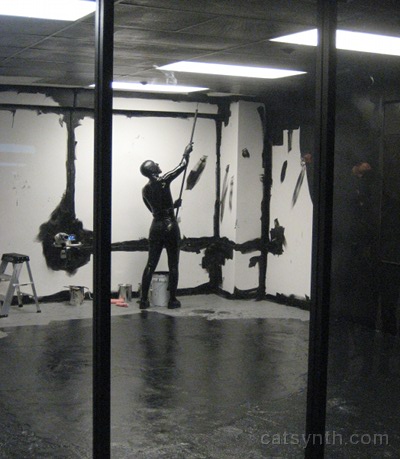
With her were cans of paint, standard commercial painting equipment, and several large containers of Elmer’s glue. It was not exactly clear what the glue was for. We came back a few times to see her “progress” and eventually she had the room completely painted black. At this time, she proceeded to remove her suit and pick up one of the containers of glue. It was then we all realized what the glue was for, as she poured one container after another over her body. I did not stick around to see how this situation resolved itself (no pun intended).
 I did like Mattias Ericsson’s pair of pieces. Maybe everything is grey after all covered a kitchen area of the building with black-and-white photographic prints, some of which were displayed openly, and others (particularly tiny 1×1 inch prints) neatly placed in closed boxes or behind cupboards. One could open these spaces and peruse the images, which appeared to chronicle very personal and intimate moments. Readers can get a sense of the images via interactive version. One starts to feel a bit voyeuristic going through them. Ericsson also present a video entitled 1630 photographs, in which he described his photographic process and his vision for his work.
Another featured live performance by Michael Ryan Noble invited audience members to participate by placing clay on his body, an act that is both sculptural and symbolic of burial. Many audience members did participate, and a participants sculpted elaborate clay objects to place on him, such as a dorsal fin.
Overall, it is an exhibition that does push one comfort’s zone (especially the glue). I am often left wondering whether performance art is closer to the visual arts than it is to music and theater, or something entirely different. I find myself wanting to treat it more like visual art, which seems to go against what Abramović stated at the start of the evening.
