
Category: San Francisco
-
Containment Scenario: FUEL, Luggage Store Gallery
This performance, entitled FUEL, was part of the Containment Scenario performance series “which explores the current environmental situation through the lens of improvisational music-dance-theater.” This was the third part of a five-part series adopted from the book Containment Scenario: DisloInter MedTextId entCation: Horse Medicine by M. Mara-Ann, who also directed this performance.
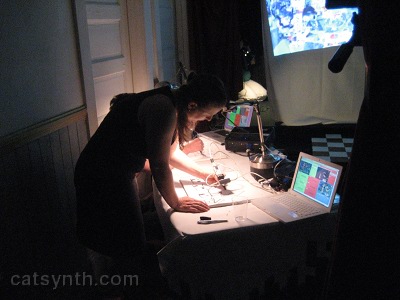
This was a multimedia piece with voice, text, instruments, dance and reactive video (Luke Selden). It began with the vocal leads (M. Mara Ann and Sarah Elena Palmer) sitting down in the front of the stage with computer printouts, loudly ruffling and connecting them up with packing tape. As video of bucolic grass scenes and a close-up of a human are projected on the walls behind them (and onto their reflective white dresses), we hear their voices come in, speaking words disjointed and percussively. The voices gradually become more melodic, but all the while the “paperwork” continues. The other performs move slowly onto the stage, all wearing white shirts. As they take their positions, first the guitar (Noah Phillips), then the electronics (Travis Johns), then violin (Emily Packard) and percussion (Anantha R. Krishnan) all came in.

Musically the texture remained very gradual, interspersed with vocals, though the words became clearer and louder over time. This was aided by the fact that the text (presumably from the Containment Scenario source) became synchronously part of the music and the projected media. Text scrolling by on the right video projection was recited in various musical styles, harmonic, percussive, expressive, while the vocalists took turns typing their words into a laptop that would project onto the other screen, sometimes mixed with other videos. During this section, the instrumental music was much more sparse, often silent as the written and spoken words became the focus.
Later textual recitations returned from the video to the computer printouts. At times the words came out as whispers, sometimes more melodically, with the instrumentals returning into the mix. As the performers moved around the stage, there were dramatic visual moments where they became part of the video projection, their white shirts and dresses becoming screens on which the video was reflected and distorted and combined with the flat background.

The dancers (Julie Binkley and Rebecca Wilson) eventually took the printouts used for the back screen and began to wrap each of the musicians in a cocoon of paper. First Travis Johns on electronics was encased, then the each of the others in succession, eventually binding the two vocal leads into a bundle of their own printouts. The piece concluded with the dancers bringing out large number signs (I’m not sure what these were about), and handing them to the vocalists, after which the sounds and words gradually stopped.
The performance of Containment Scenario: FUEL was preceded by two fun sets of improvisational music.
The first set was by Drew Ceccato, playing an electronic valve instrument (EVI) by Steiner and an analog synth by Crumar – a beautiful and intriguing instrument. The set began with a low rumbling, which joined with “watery” sounds and pitch modulation expressively controlled by the EVI to create a subtle rhythm. Over time, this become louder, with wider pitch modulations, beating, percussive sounds before returning to the low rumbling. The music then changed completely for more traditional “analog sounds” with traditional pitched notes, like a conventional wind instrument, though with extremely high pitches at times. It was a very brief, and very intense set, without a moment wasted.
Ceccato was followed by a duo of Gino Robair and Christopher Riggs who was playing “guitar and a box of cool looking stuff”. Of course, Gino Robair had his collection of cool stuff as well, analog synthesizers along with metallic resonant objects and various means of exciting them. It started with a metallic roar, which I believe was created by Riggs’ rubbing the guitar strings. This was combined with the chaotic sound of the Blippo Box and other synths. The two performers appeared to come to an equilibrium of sorts, with sounds repeated and played off one another. Indeed, it was sometimes hard to tell who was playing what sound – and this is a good thing. Robair moved on from the synths to cymbals, with loud dramatic resonances set against the guitar rhythms. I heard a plaintive brass synth set against a more “chattery” guitar; a styrofoam instrument that was “insect-like” in both its appearance and sound; a funny voice vaguely like throat singing made with a tube and a coffee can; and more metal objects excited by motorized fans crawling along the floor. After a climx with angry resonances and a metal on metal thud, lots of motion, convulsing and fast scraping, the sounds faded out.
The turnout for this particular evening was quite impressive, it seemed that all the seats were filled, even the extra “kiddie seats” that the folks at the Luggage Store often put out.
-
Outsound Music Summit: Part 2
This is the second part of my report on the Outsound Music Summit, focusing on the first two concerts. For those who missed it, the first part described the Touch the Gear Expo on the Sunday before the formal concerts began.
The first concert, which was titled “Free Improvisation | Free Composition” began the way I often begin my own performances these days: with the ringing of a prayer bowl. This signified the start of Sacred Unit, the duo of Alicia Mangan on saxophones and the percussionist Spirit. Overall, this set consisted of free improvisation that blended avant-gard and more idiomatic jazz techniques with other folk and world traditions. I did find myself paying most attention to Spirit’s drumming and use of other elements for percussion, including his body and voice.

[click to enlarge]The Rova Saxophone Quartet performed a new, set-length performance piece created especially for the Summit titled The Contours of the Glass Head. This is one of those pieces where it is difficult to tell where composition ends and improvisation begins. The group describes it as “the intersection of improvisation and composition, using improvisational games and strategies.” The members of the quartet demonstrated their powerful technical and musical skills as an ensemble and as four very strong players working together. At times one could focus on an individual solo or line from one performer, while at others the timbres and harmonies of the four saxophones seemed to act as one. As with some of the electronic performances the following night, there were sections of long drawn-out notes, and some very quiet subtle moments, which were interrupted by flurries of fast notes and punctuated phrases. Even if it was largely improvised, one could follow an imaged narrative to go along with the music.
Throughout the evening, I couldn’t help but notice the rather large wind instruments on the right side of the stage:

[click to enlarge]In this photo, we see a bass saxophone, a tubax, and a contrabass flute. These were all instruments used by Vinny Golia in the final set of the evening. Golia performed solo and group Compositions for Woodwinds together with Thollem Mcdonas (piano), Damon Smith (bass), Rent Romus (saxophone, electronics), Garth Powell (percussion), and Noah Philips (guitar).

[click to enlarge]The lively and energetic performances centered on free jazz , with free improvisation and interaction among the performers, but showcasing the unique aspects of each musician and instrument. In addition to Golia’s virtuosic performance wind instruments large and small, I also noticed prepared piano sounds from Mcdonas, and hard driving guitar and percussion from Philips and Powel, respectively, and Smith’s ever present and versatile bass.
The second program, “Industrial Soundscapes”, opened with Ferrara Brain Pan’s Form of Things Unknown. Long droning oscillators served as the foundation, on top of which he layered various shakers, bowls and other sounds, processed electronically. Ferrara Brain Pan is also an accomplished wind player, and incorporated bass clarinet into the set, which complemented the low-frequency oscillators. Sometimes they matched precisely, while other moments were as a counterpoint. Perhaps more than any of the other sets, this one matched my own current style of electronic music performance.

[click to enlarge]Guitarist Peter Kolovos was introduced as having “surgical precision”. And it was an apt description. The staccato articulation of the guitar as well as the frequent changes of effects were very precise. There was never a moment where the sound was not changing, and changing quickly. At times it was quite loud and the effects quite heavy, but his dextrous performance was great to watch.
Conure focused on analog and digital noise, with lots of distortion, feedback, delays and lo-fi effects. There were sections of steady-state noise, but what most stood out were the moments with interesting transitions and glitches. I realized that Conure and I had crossed paths at an Outsound event last year.
Hans Fjellestad presented Slimspor Cosmonau, a short video with improvised electronic sound accompaniment. I actually wasn’t sure whether or not the music was scored out precisely to match the film, but I was assured by the artist that was entirely improvised, which is possible if one is intimately familiar with the visual material. The film appears as a computer screen, with controls around a central video area depicting lunar and astronomical images as well as biological and anatomical scenes.

[click to enlarge]Late in the piece, I recognized a distinctive squeak that I thought might be a Metasonix effects box, and inspecting his setup after the performance confirmed that he did have one of these infamous boxes. Indeed, Fjellestad’s performance featured an eclectic mix of analog instruments – fitting for creator of the 2004 documentary MOOG.
Thomas Dimuzio concluded the program with his complex electronics and timbrally rich and evolving soundscape. Dimuzio uses a variety of technologies, including live sampling and looping, feedback and modulated effects. The piece started quite simply with a relatively harmonic chord, and the overall effect was very calm but also metallic. Then a swell, and metal resonances. The overall motion of the set was very slow, a strong contrast to Kolovos’ set earlier in the evening. This is not to say that there weren’t discrete textures and details within the music, but it was more like the details one would focus on while examining a natural scene, or perhaps the industrial urban landscapes where I enjoy walking. With it’s gradual place and close, this was an apt conclusion to the “industrial soundscapes” evening.
-
Outsound New Music Summit: Touch the Gear
This is the first of two articles about the Outsound New Music Summit, which took place last week here in San Francisco.
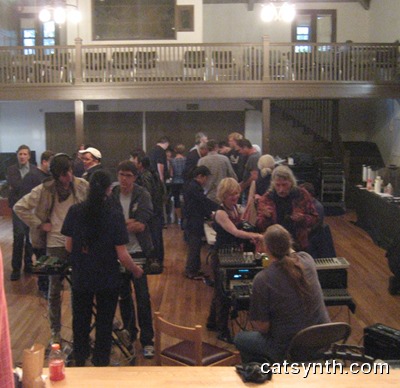
The first night was the Touch the Gear Expo in which the public is invited to try out the musical instruments and equipment of a number of artists from the festival as well as other Outsound events. It was a respectably sized turnout, with a large number of visitors.

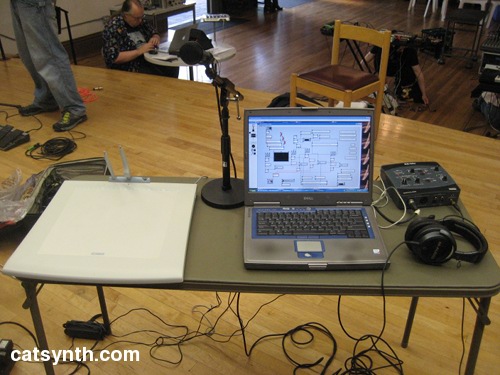
[Click to enlarge]I brought the venerable Wacom Graphics Tablet and PC laptop running Open Sound World for people to play.

[click to enlarge]It often gets attention during performances, and did so at this hands-on event as well. Because it uses familiar gestures in a visually intuitive way, many people were able to start right away experimenting with it making music with phrasing and articulation. I provided a simple example using FM synthesis as well as chance for people to play a phrase from my piece Charmer:Firmament (which uses additive synthesis).
Tom Duff also demonstrated his own custom software in combination with a controller, in this case an M-Audio drum-pad array. One thing we observed in his demo was how much computing power is available on a contemporary machine, like a Macbook Pro, and that for many live electronic-music applications there is more than enough. But somehow, many applications seem to grow to fit the available space, especially in our domain.
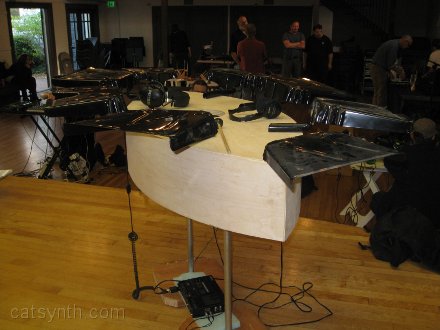
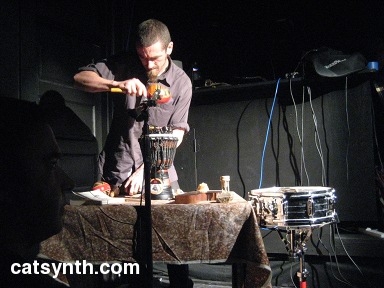
There were several demonstrations that were decidedly more low-tech, involving minimal or in some cases no electronics. Steven Baker presented a collection of resonant dustbins with contact microphones.

[Photograph by Jennifer Chu. Click to enlarge.]The dustbins were arranged in such a way as to allow two performers to face each other for interactive performance.
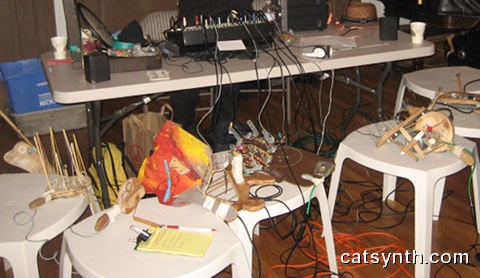
I enjoyed getting to try out the hand-cranked instruments of the Crank Ensemble:

[Click to enlarge]Basically, one turns the crank which creates a mechanical loop of sounds based on the particular instrument’s materials. I have seen the Crank Ensemble perform on a few occasions, but never got to play one of the instruments myself.
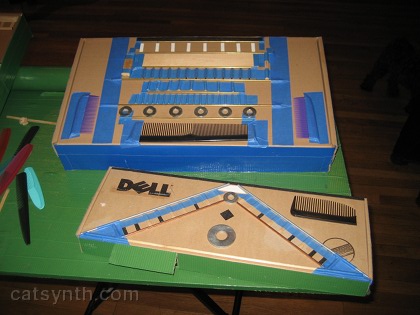
I also finally got to try out Tom Nunn’s skatch boxes, which I had seen at the Skronkathon as well as “Tuesdays at Toms”.

[Click to enlarge]The body of the instrument is a cardboard box, and one plays it by running a comb over the various metal and plastic elements attached to the box. I spent a few minutes exploring the sounds and textures running different combs over the elements, including other combs. It was very playable and expressive, I could definitely make use of one of these!
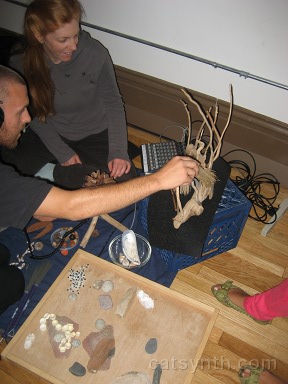
Another variation on the theme of amplified acoustic objects was Cheryl Leonard’s demonstration in which one could play sand, water, wood, and other natural elements:

Returning now to electronics, and a different kind of “elemental music.” CJ Borosque presented her use of analog effects boxes with no formal input. Analog circuits do have some low-level noise, which is what she is using as a source for feedback, resonance, distortion and other effects. Ferrara Brain Pan demonstrated an analog oscillator than can handle very low frequencies (i.e., less than 1Hz!).
There are also several other live-performance electronics demonstrations. Bob Marsh presented the Alesis Air Synth (no longer in production). Performers pass their hand over the domed surface to manipulate sounds. Similar to the tablet, this is a very intuitive and rich interface. Rick Walker demonstrated a new powerful instrument for recording and controlling multiple live loops, with the ability to manipulate rhythm and meter. I look forward to hearing him use it in a full performance soon. Thomas Dimuzio showed a full rig for live electronics performance, that I believe he used at the electronics-oriented concert the following week.
-
Blessing Moon – July 9, 2009
The past Thursday was the latest in the Full Moon Concert Series at the Luggage Store Gallery, curated by Polly Moller. This month’s theme was Blessing Moon.
The first set was by a new all-improv trio Free Rein. The group focuses on “Earth music for space people” and includes reeds/flutes, Danelectro 6 string bass, percussion,voice, cymbal, keyboard and theremin.

[Photograph by Jennifer Chu. Click to enlarge.]Musically, the set began with microtones and synchronicity among the flute, theremin and another wind instrument. Melodic elements were sometimes present, performed on one of the flutes or the theremin. Other elements that stood out included the bowed cymbal, which blended with the other instruments in drones, a bird-like slide whistle against a saxophone, and undulating tones and the formation of harmonies between the percussion and low-frequency modulation. This fit with their statement of “spontaneously collaborating with the Moon, sculpting a sound that reflects back to Earth, playing tones that wax and wane through vibration, harmonic bodies phase shifting.”
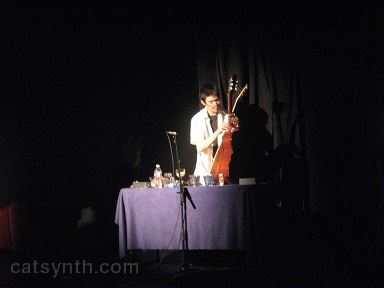
The second set was performed by Valka, featuring Agnes Szelag and Marielle Jakobson (who have also collaborated as myrmyr) with guest Noah Phillips on guitar. Szelag was performing with an electric cello, Jakobson on violin, and all three performers together had an impressive array of pedals arranged centrally between the string instruments:

[click to enlarge]From the program notes, “Valka’s Blessing Moon rituals are inspired by ripe dreams and the balance between dark and light.” This includes drones, effects, lots of long tones and big masses of sound, with a mixture of harmonicity and noise. I did focus on slow bends and other gradual changes of tone through the performance. The first piece did end on a dramatic note, with a rather loud insect-like sound that seemed to have taken the musicians by surprise.
-
Hypnagogia, Climate Theater
Hypnagogia defines the state between sleeping and waking: the state in which our dreams can seem more real to us than the waking world, and which, depending upon the nature of our dreams, our limbo-selves seek to flee, or to sustain.
My primarily mission in attending Hypnagogia at the Climate Theater was to see the performance of The Flip Quartet by Polly Moller, as I will be part of upcoming performance of the piece in July. The performance featured Karl Evangelista, Jason Hoopes, Thomas Scandura and Bill Wolter. The Flip Quartet is a composition for four improvisers who move between four stations representing the cardinal directions (north, east, south, west) and the four medieval elements: earth, air, fire, water. Each station had a variety of instruments and sound-making objects to represent elements.

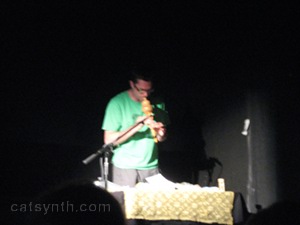

[click to enlarge]“Earth” had drums, stones, and blocks. “Air” included various wind instruments and shakers. “Fire” featured metal instruments and electric instruments (keyboard, electric guitar, etc.). And “Water” included water-filled containers, but also acoustic string instruments – this was the only association I had a difficult time figuring out, with my own interpretation being “standing waves.” Each section of the piece starts with the performers “flipping” a timer. When the time runs out, they stop and move on to the next station.
The audience sat in the middle of the theatre, with half the seats facing one pair of elements and half facing the others. Since there were two performances, I got a chance to see and hear the piece from “both sides.” Musically, the piece unfolded as ever changing harmonies of the different objects, often very discrete and percussive, along with many theatrical moments such as attempting to balance on the “earth” elements on the head of a drum. My favorite moment musically was the combination of the Asian pipe (shown one of the photos above), lute, shakers and thunder tube.
The other musical performance was Philip Greenlief performing a solo work The Fourth World. The piece is based on Hopi conception of time and the Fourth World from Hopi mythology, and is a solo performance featuring Greenlief’s expressive and virtuosic saxophone playing. I am always impressed with his multiphonics, which he manages to make seem as easy to play as standard tones. Spatially, this performance was the opposite of The Flip Quartet, with the audience seated in a circle facing inward and creating a more intimate space.
In addition to the featured live musical performances, there were visual art pieces, installations, and media and performance art. Sean Clute, Jessica Gomula and Gina Clark presented a “video action painting and performance” entitled Slippery Dreams 2009.

Live video of the drawings being created were projected onto the screens, and I believe also used to control the sound that was generated.
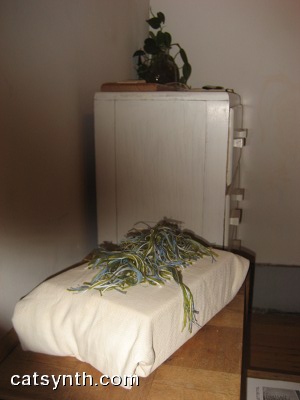
Louis Rawlins presented the installation Sleep Patterns, set up as a bedroom or sitting room where one could relax and touch the ball of yarn on the table.

[click to enlarge]
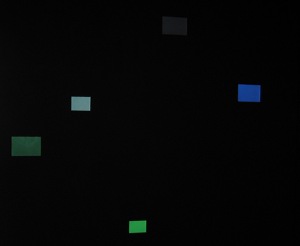
The string (which included conductive thread) was used to generate sounds in response to the viewers interactions. Presumably, one could interact with this piece while asleep.The were several video pieces of varying subject and quality. I did like Vanessa Woods’ What the Water Saw, a short film that originally was shot on 16mm/35mm film and transferred to video. It was meant to mimic ocean with the distortion of images through water, as represented by the intense layering and deep colors of the film. After looking at Woods’ website, I think I might have been more interested in some of her black-and-white films. Rebekah May’s Celestial Cadence for video on five iPod Touches was an interesting visual in itself, with its arrangement of abstract color and shape patterns:
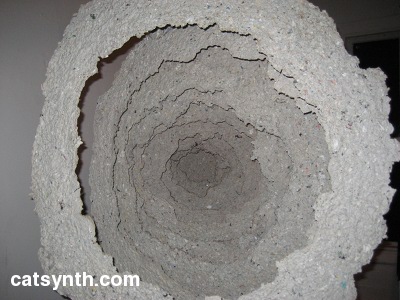
Among the purely visual works that caught my attention was the undulating Circulation III by Julia Anne Goodman, a mobile work that was created from junk mail (and there is certainly plenty of that around); also Klea McKenna’s Taxonomy of My Brother’s Garden from Center of Gravity:

[click to enlarge]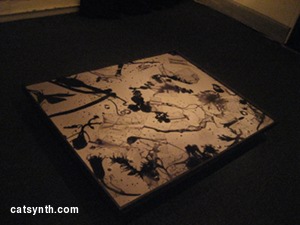
Finally, as it was quite stuffy inside the theatre and gallery on this rather warm night, there was the welcome retreat to the rooftop, where VoxMaids performed rhythmic and traditional-sounding music for drums, accordion and voices against projections of astronomical objects. Alternatively, one could look at a real astronomical object, the moon, on this rather clear night.